
Executive Summary
Accounts receivable automation is software that uses rules and AI to run the full invoice-to-cash cycle: credit scoring, invoice delivery, dunning, payment matching, disputes, and reporting. It cuts cost per invoice from $15-40 to $1-3 and reduces DSO 20-40%.
Key Takeaways from This Guide
- AR automation covers seven invoice-to-cash stages: credit, deliver, dun, match, portal, dispute, report.
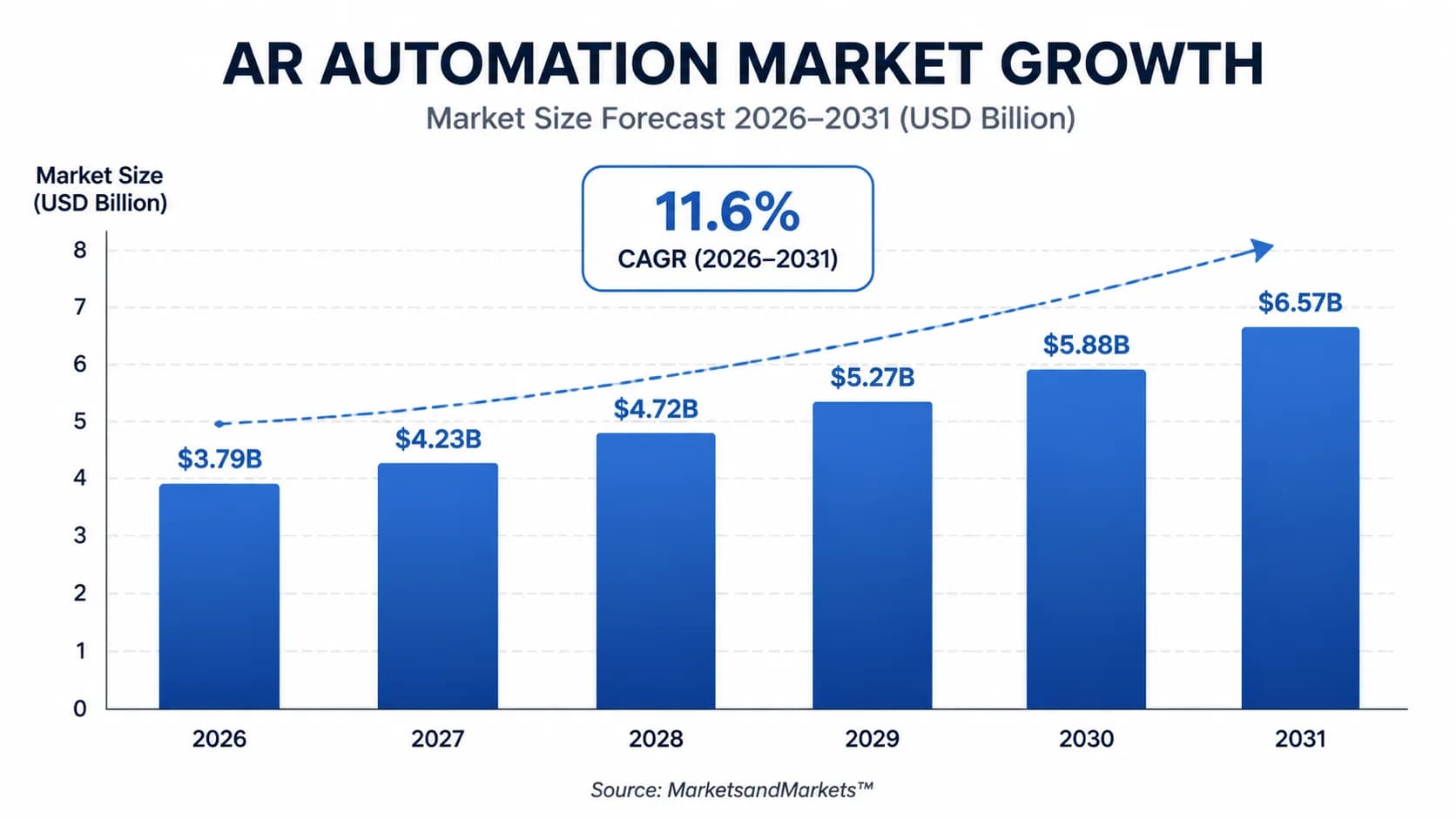
- The 2026 market is $3.79B and growing to $6.57B by 2031 (Mordor); 93% of mid-market AR teams plan more automation (PYMNTS).
- Cost per invoice drops from $15-40 manual to $1-3 automated; top performers see 40% faster collections and 55% less bad debt (Ardent).
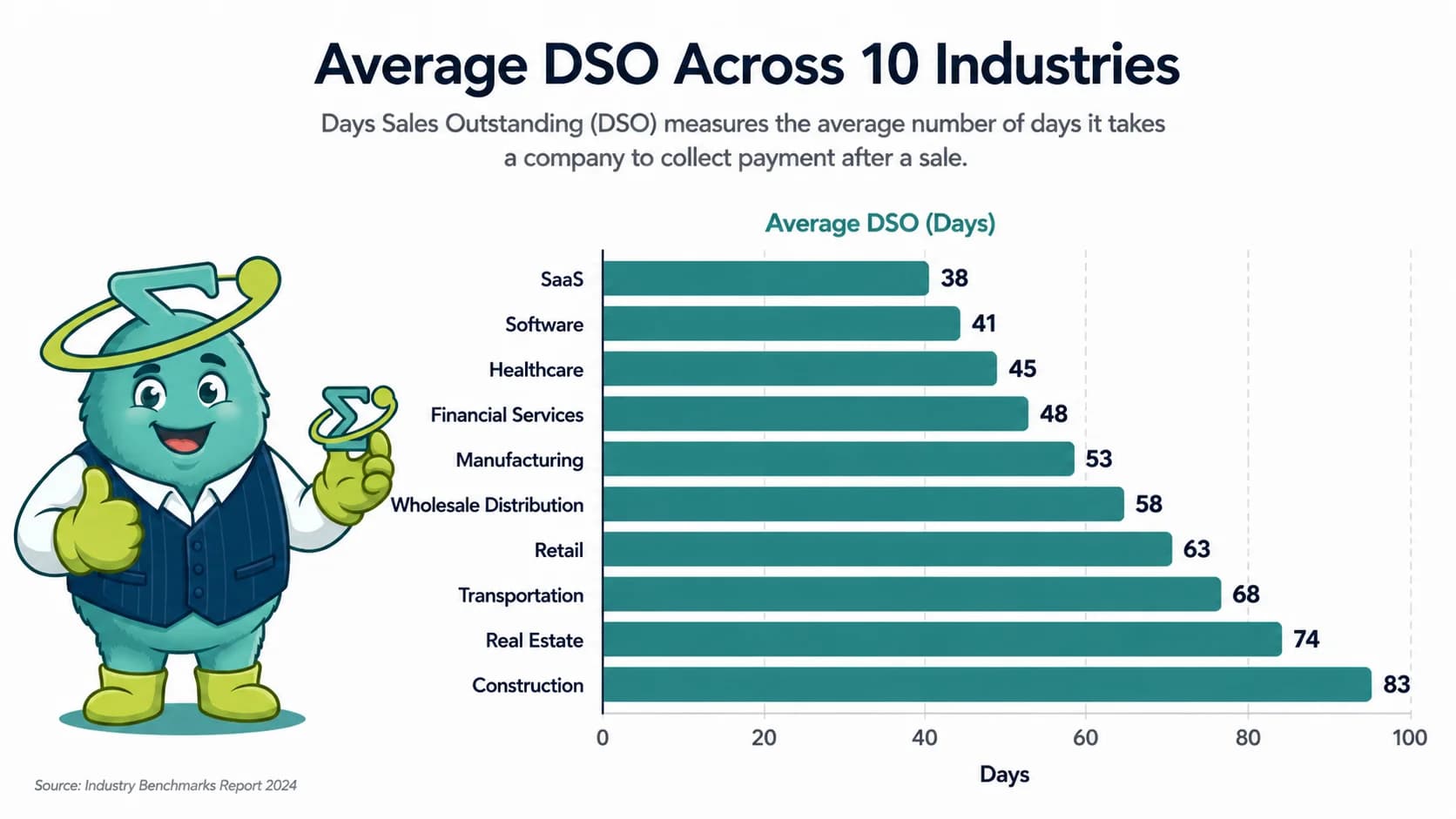
- Industry DSO ranges from 38 days (SaaS) to 83 days (construction), so fit-to-industry beats fit-to-feature-list.
- ROI comes from four streams: cost reduction, working capital release, bad debt savings, and capacity reallocation. Mid-market payback is typically 4-9 months.
- Score vendors on six dimensions: pricing transparency, ERP depth, AI maturity, implementation timeline, support, and security.
- A realistic rollout is 30/60/90 days: connect, configure, optimize. First ROI measurable by day 90.
- Agentic AI is the 2027 inflection. Autonomous collector agents and conversational AR assistants will redefine what AR automation means.
Introduction
It is 9:47 PM on the last business day of the quarter, and your AR manager is still pasting remittance lines from a bank file into a spreadsheet. Forty-three invoices remain unmatched, three customers are disputing line items via email, and tomorrow the CEO will ask why DSO climbed four days. This scene is the reason 93% of mid-market AR executives told PYMNTS in 2025 they plan to invest in more accounts receivable automation over the next 24 months.
What is accounts receivable automation, exactly? In plain language, it is software that uses workflow rules and AI to handle the entire invoice-to-cash process: scoring credit, sending invoices, dunning customers, matching payments, working disputes, and forecasting cash. Modern platforms cut the cost of processing one invoice from $15 to $40 manually down to $1 to $3, according to the same PYMNTS report, and trim DSO by 20% to 40% within the first year.
This guide is the most fact-dense primer we could write for the finance leader who is one search query away from a dozen vendor demos. We will define AR automation precisely, walk through the seven invoice-to-cash stages a real platform covers, run conservative ROI math on a $50M revenue example, and hand you a vendor scorecard you can use without us in the room. No hype, no marketing claims dressed as analysis.
If you are a CFO, controller, or VP of finance trying to decide whether your company is ready for its first dedicated AR platform (or whether your current billing tool is quietly masquerading as one), you are in the right place. By the end you will be able to write the business case yourself, score three vendors against six dimensions, and tell your team what 30, 60, and 90 days of rollout actually look like.
What is accounts receivable automation? (the plain-language definition)
The cleanest one-sentence definition: AR automation is the software layer that sits between your ERP and your customers and replaces manual decisions across the invoice-to-cash cycle with rules, machine learning, and (increasingly) agentic AI. Where a billing module asks a human "who should get a reminder today?", an AR automation platform answers that question itself based on aging, payment history, customer segment, dispute status, and dozens of other signals it tracks in near real time.
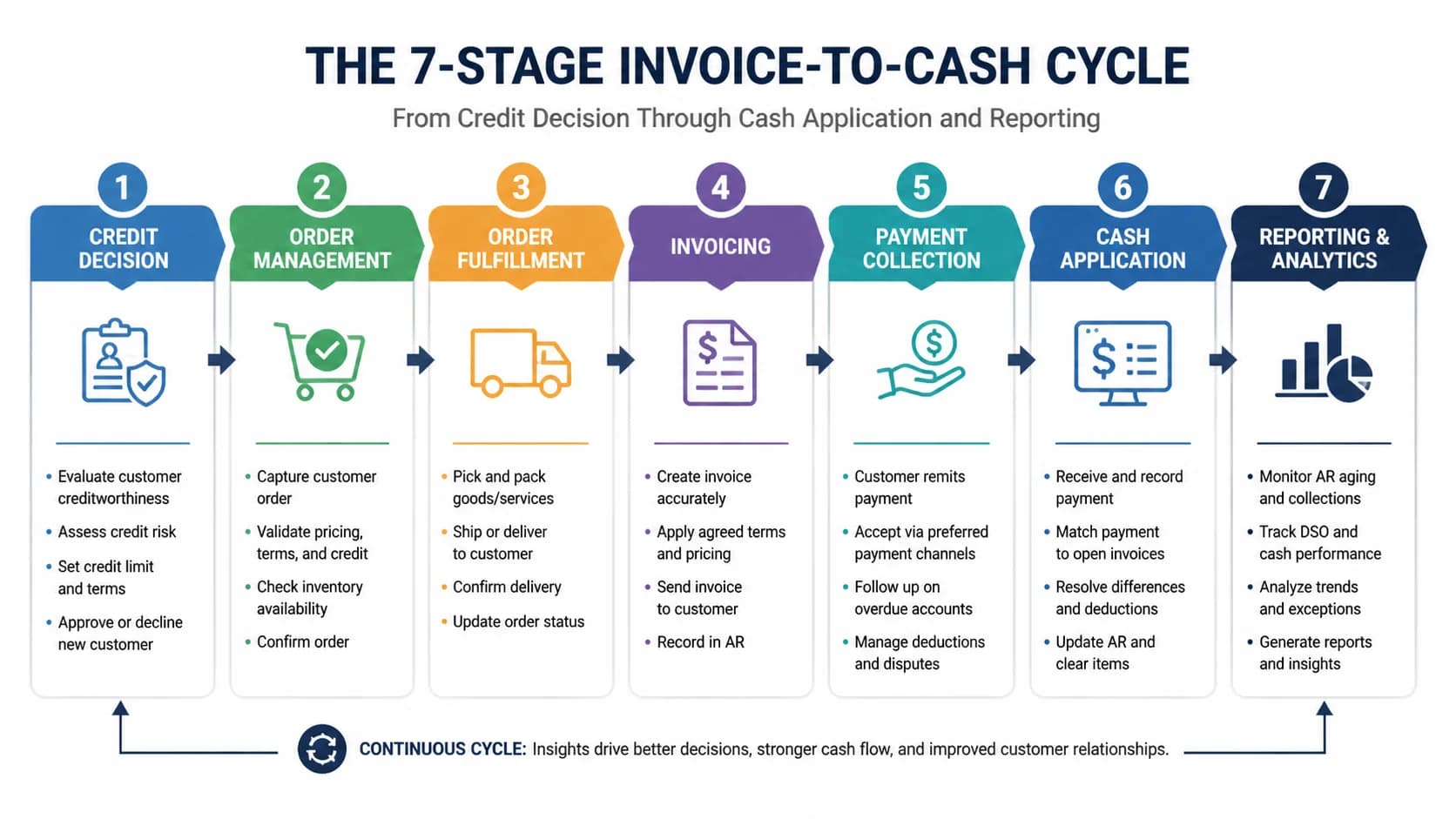
It helps to be precise about what it is not. Billing software sends invoices. An ERP records receivables and matches cash when a human tells it where the payment goes. RPA bots can mimic clicks but rarely understand why a customer paid short. AR automation is different because it owns end-to-end decisioning across seven distinct stages: credit decisioning, invoice delivery, customer onboarding into a payment portal, dunning, cash application, dispute and deduction workflow, plus forecasting and reporting. If a tool covers fewer than four of those stages, it is not really AR automation.
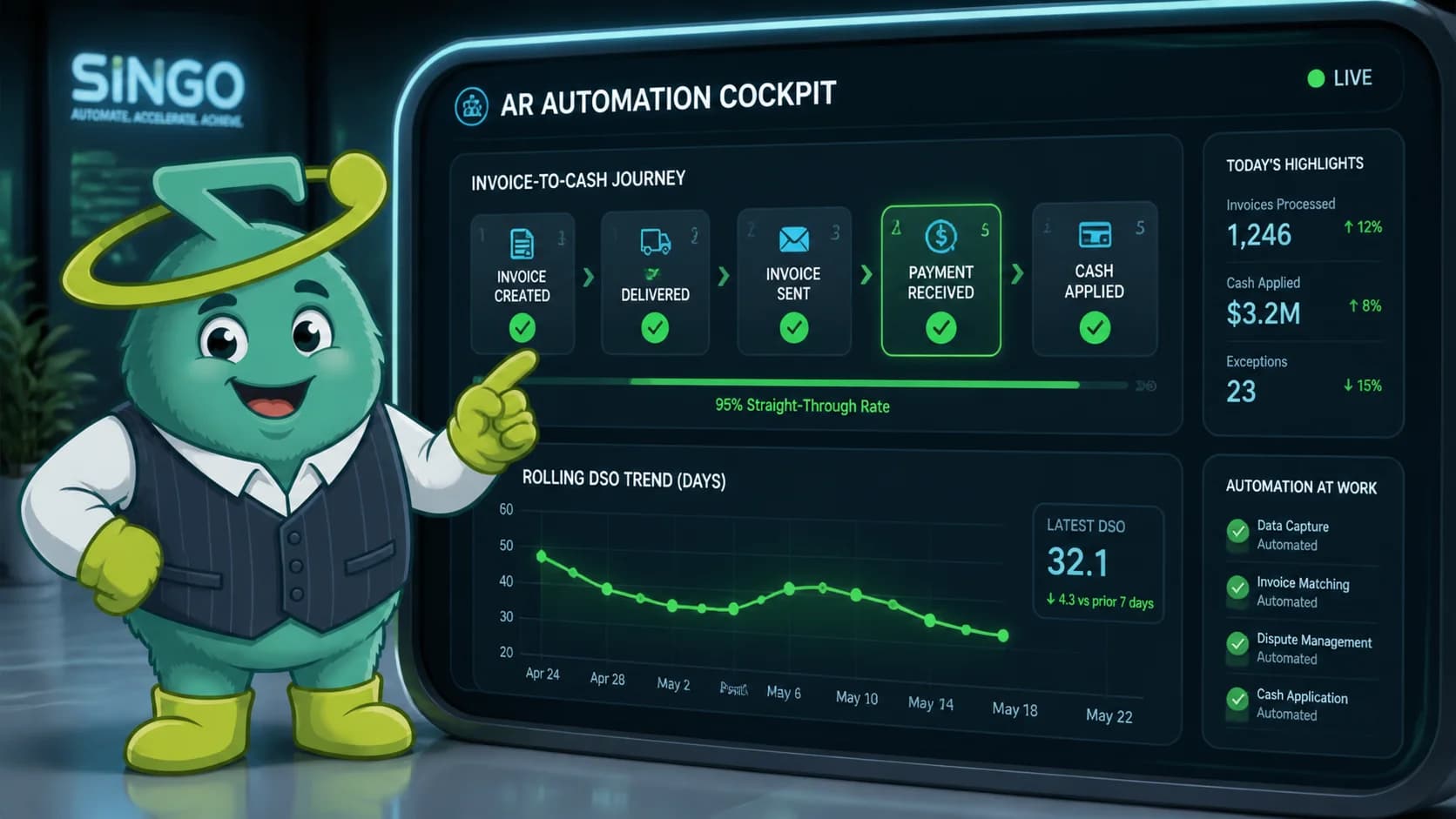
Think about the seven stages as a relay race rather than a checklist. Credit decisioning sets the terms. Delivery makes sure the invoice arrives in the format the customer pays from. The portal captures intent and self-service payments. Dunning nudges before due dates and escalates after. Matching closes the loop when cash hits the bank. Dispute workflow catches the friction that would otherwise stall payment. Reporting feeds the cash forecast and the next credit decision. A real platform sees these as one connected system, and you can explore [core SINGOA features](/features) mapped to each stage if you want to see this concretely.
The shift that matters in 2026 is from rule-based to AI-driven decisioning across all seven stages. Older platforms automated the easy parts (sending an invoice, posting a payment if remittance was clean) but left collectors and cash appliers to chase exceptions. Modern platforms apply ML to predict who pays late, behavioral models to time and tone dunning messages, and increasingly autonomous agents that draft replies, surface disputes, and propose payment plans for human approval. That is the difference between automating tasks and automating outcomes.
Pro Tip
If a tool only sends invoices and accepts payments, it is billing software, not AR automation. True automation requires decisioning logic across at least four of the seven invoice-to-cash stages, plus a platform that learns from every collector action and customer signal.
Why now: the 2026 inflection point for AR teams
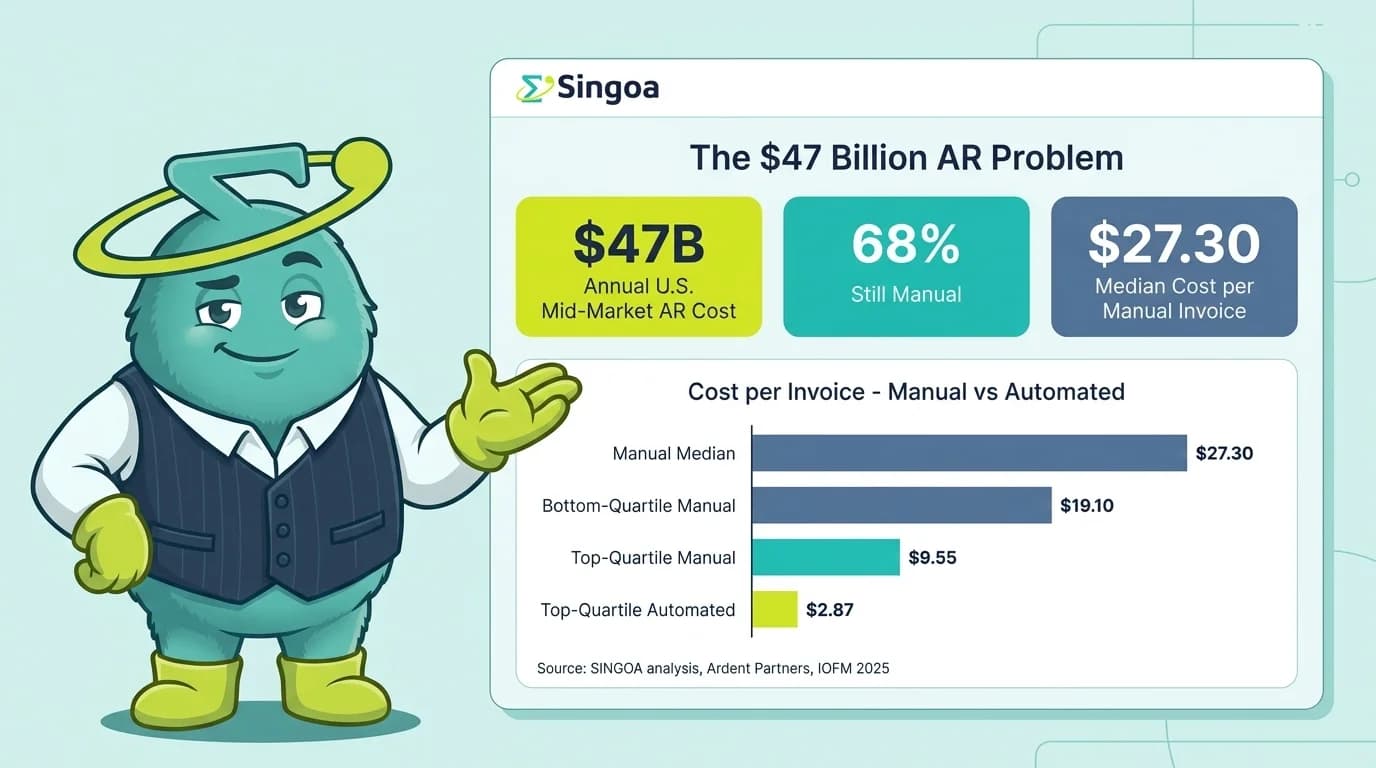
Three forces converged in 2026 to push AR automation past the tipping point. First, the cost gap. Manual invoice processing still runs $15 to $40 per invoice once you load fully burdened FTE time, paper, and rework, while automated processing lands between $1 and $3 according to PYMNTS. For a 50,000 invoice company that gap is roughly $1.2M a year sitting on the floor.
Second, the cash flow squeeze. Mid-market DSO has crept up across most industries since 2021, and 75% of AR executives told PYMNTS automation directly improved their cash flow. The math is brutal: each day of DSO ties up roughly 0.27% of annual revenue, so a $50M company carrying 8 extra days is sitting on more than $1M of avoidable working capital. The deeper picture, including the [$47B manual AR problem](/blog/47-billion-ar-problem-manual-invoice-processing) across the US mid-market, is what is forcing CFO desks to act now rather than next budget cycle.
Third, the AI inflection. Forrester's 2026 trends report flagged agentic AR as a fundamental shift: collector agents that run their own outreach loop, conversational assistants that answer customer questions, and predictive credit engines that re-score accounts in real time. Vendors that were rules-only in 2023 are now shipping agentic features in 2026. The competitive risk of waiting is no longer just operational; it is strategic, because your peers are already collecting cash 40% faster.
Put together, the timing question answers itself. The market is consolidating, the AI capabilities are real (not roadmap slides), and the per-invoice economics now favor automation at almost any volume above 100 invoices a month. Here is where it gets interesting: the gap between top-quartile and bottom-quartile AR teams is widening, not narrowing, which means the cost of waiting compounds.
Calculate your AR automation ROI
Plug in your invoice volume and DSO to see the four-stream savings model run on your numbers.
The 7 core capabilities of AR automation software
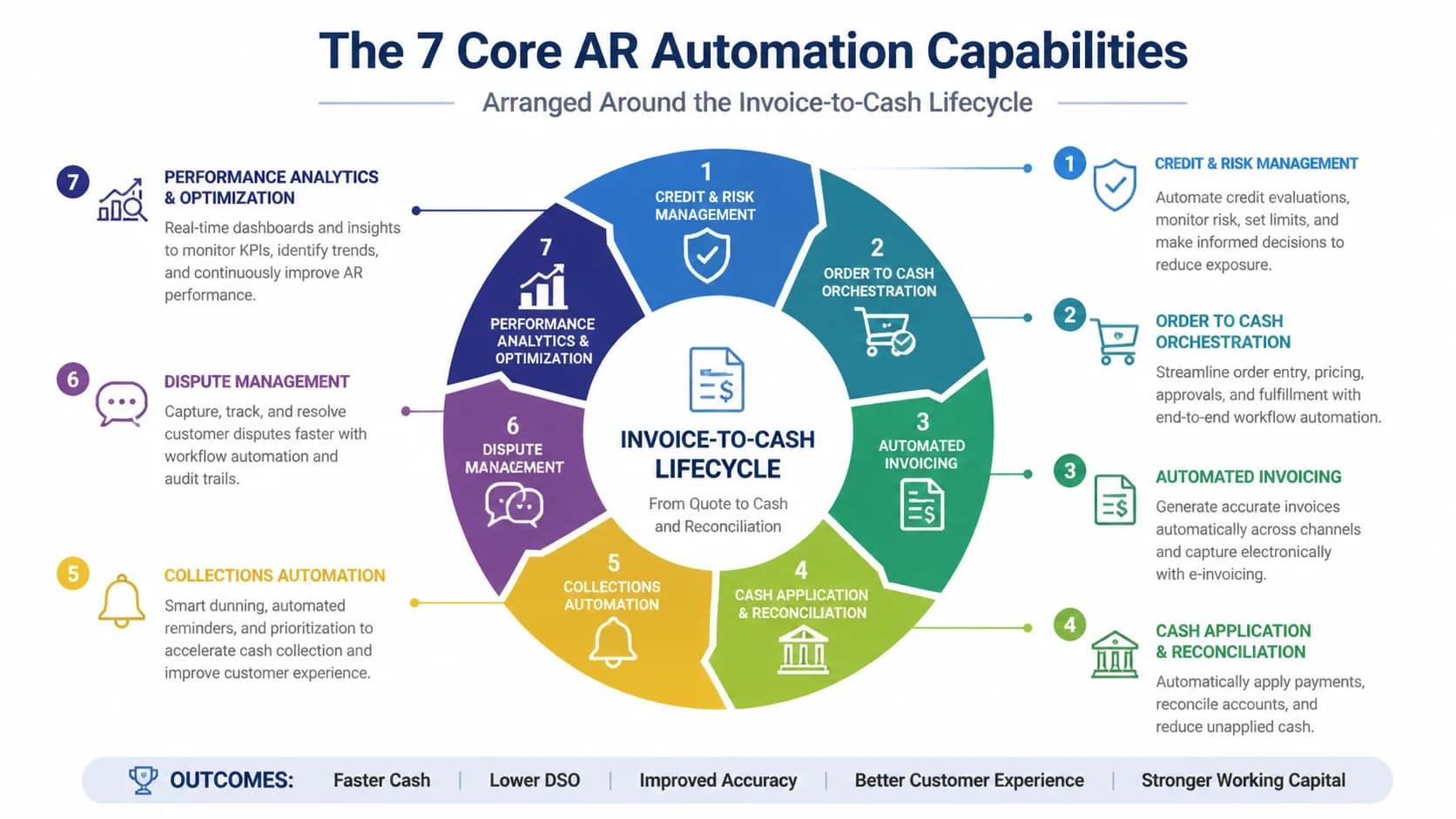
The first capability is credit scoring and risk monitoring. Instead of a static credit memo updated once a year, modern platforms re-score accounts continuously using payment history, public filings, and macro signals. That feeds limits, terms, and dunning posture in real time, which is what the SINGOA Risk Oracle does for a typical mid-market portfolio of 500 to 5,000 accounts.
The second capability is multi-channel invoice delivery. Some buyers want a portal upload, some want EDI, some still want PDF email, and a stubborn 8% want paper. A real AR platform handles all four without you maintaining a delivery matrix in someone's head, and it tracks open and view events so dunning can fire only when the buyer has actually seen the bill.
The third capability is behavioral or AI-driven dunning. Static reminder schedules are out; tone-aware, persona-aware outreach is in. The platform learns which accounts respond to a polite nudge versus a pre-call escalation and adjusts the cadence per customer. Done well this lifts collector productivity 2 to 3x without alienating long-tenured customers.
The fourth capability is AI payment matching and cash application. This is the heart of the product. Manual matching runs 70% to 85% accuracy on a noisy day; modern AI hits 99%+ on the same remittance set, including unstructured email cash and short-pays. We covered the technique in detail in [how AI payment matching reaches 99% accuracy](/blog/ai-payment-matching-accuracy), and it remains the single biggest swing factor in AR automation ROI.
The fifth and sixth capabilities are the customer-facing layers. A branded payment portal lets buyers self-serve invoices, payments, and dispute filings, which removes the email back-and-forth that absorbs collector hours. A dispute and deduction workflow then routes the resulting cases to the right owner with SLA timers, attachment capture, and resolution analytics, which is where most generic tools fall over because deductions live in operations, not finance.
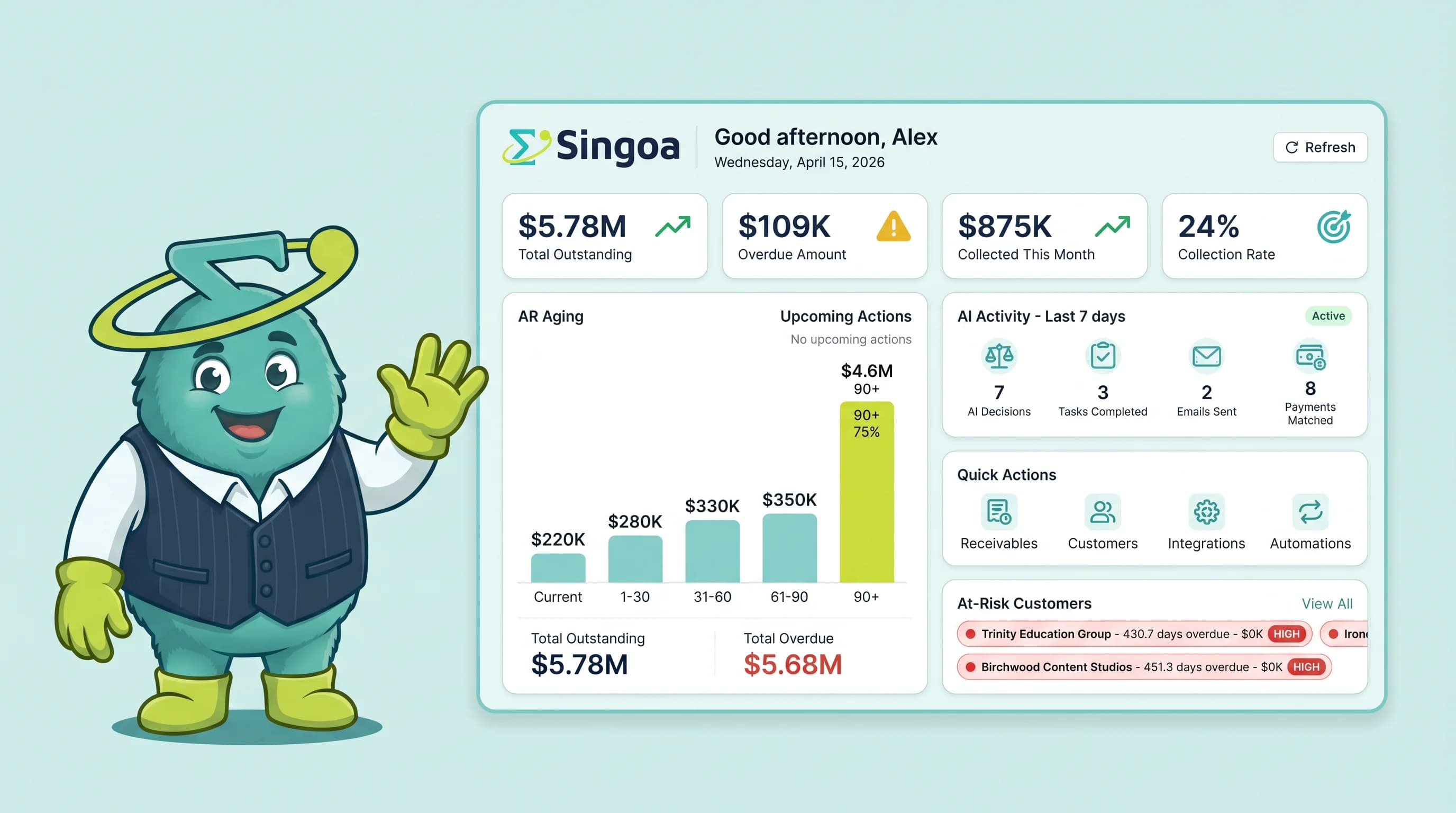
The seventh capability is real-time AR analytics and forecasting. A daily cash forecast that ties to the GL, an aging that updates as payments hit, and a DSO trend that breaks down by segment, region, and industry. The seven capabilities together are what NetSuite's research summarized in its [NetSuite Top 11 AR Automation Benefits](https://www.netsuite.com/portal/resource/articles/accounting/accounts-receivable-automation-benefits.shtml) writeup, and they are also what separates a platform from a point tool. The real question for a buyer is which of the seven your team needs depth in this year, and where you can accept thinner coverage.
Pro Tip
Score vendors against all seven capabilities individually. Most legacy tools cover three to four well and stitch the rest together with thin integrations or services hours.
How AR automation actually works: from invoice to cash, end to end
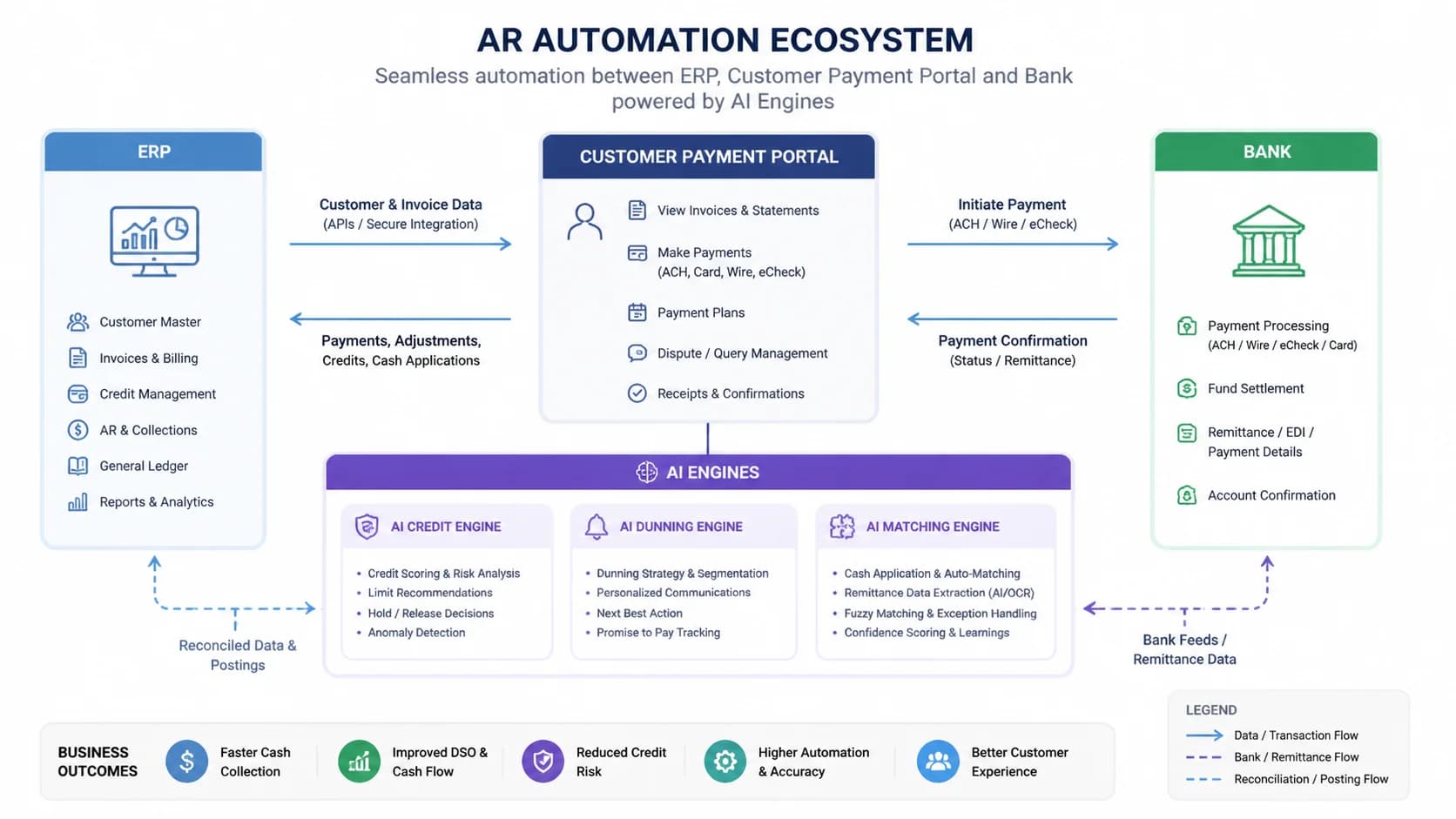
The pipeline starts at your system of record. The platform pulls orders, invoices, customer master, and credit memos from the ERP through pre-built connectors, with [50+ ERP integrations](/integrations) covering NetSuite, Sage Intacct, Microsoft Dynamics, SAP, Acumatica, QuickBooks Online, and the long tail of vertical systems. Bi-directional sync is the part that matters, because most legacy tools only read; a real platform writes cash receipts, adjustments, and dispute resolutions back without an export step.
From there an AI rules engine fires at each stage. Credit checks run on order intake using both internal payment history and external bureau data. Invoice delivery picks the right channel and confirms receipt. The dunning engine schedules outreach based on payment risk, account tenure, and prior responsiveness rather than on calendar days alone. The payment matching engine reconciles incoming ACH, wire, check, and card payments against open invoices, including short-pays and merged remittances that historically required human eyes.
The customer portal is where most of the data capture happens. When a buyer logs in to pay or to file a dispute, the platform captures the why behind the action: the disputed line item, the requested PO match, the credit memo reference. That data flows back into the rules engine and into the GL, which is how a modern AR platform builds the audit trail that finance and external auditors actually trust.
The continuous learning loop is the part most buyers overlook. Every collector action (escalation, write-off, payment plan, promise-to-pay) and every customer signal (open rate, portal login, partial payment) feeds back into the model. After 90 days of operating data the dunning timing, the credit thresholds, and the matching confidence cuts all retune themselves. That is why a year-two AR platform meaningfully outperforms a year-one deployment without you doing additional configuration work.
AR automation vs the manual process: what really changes day-to-day
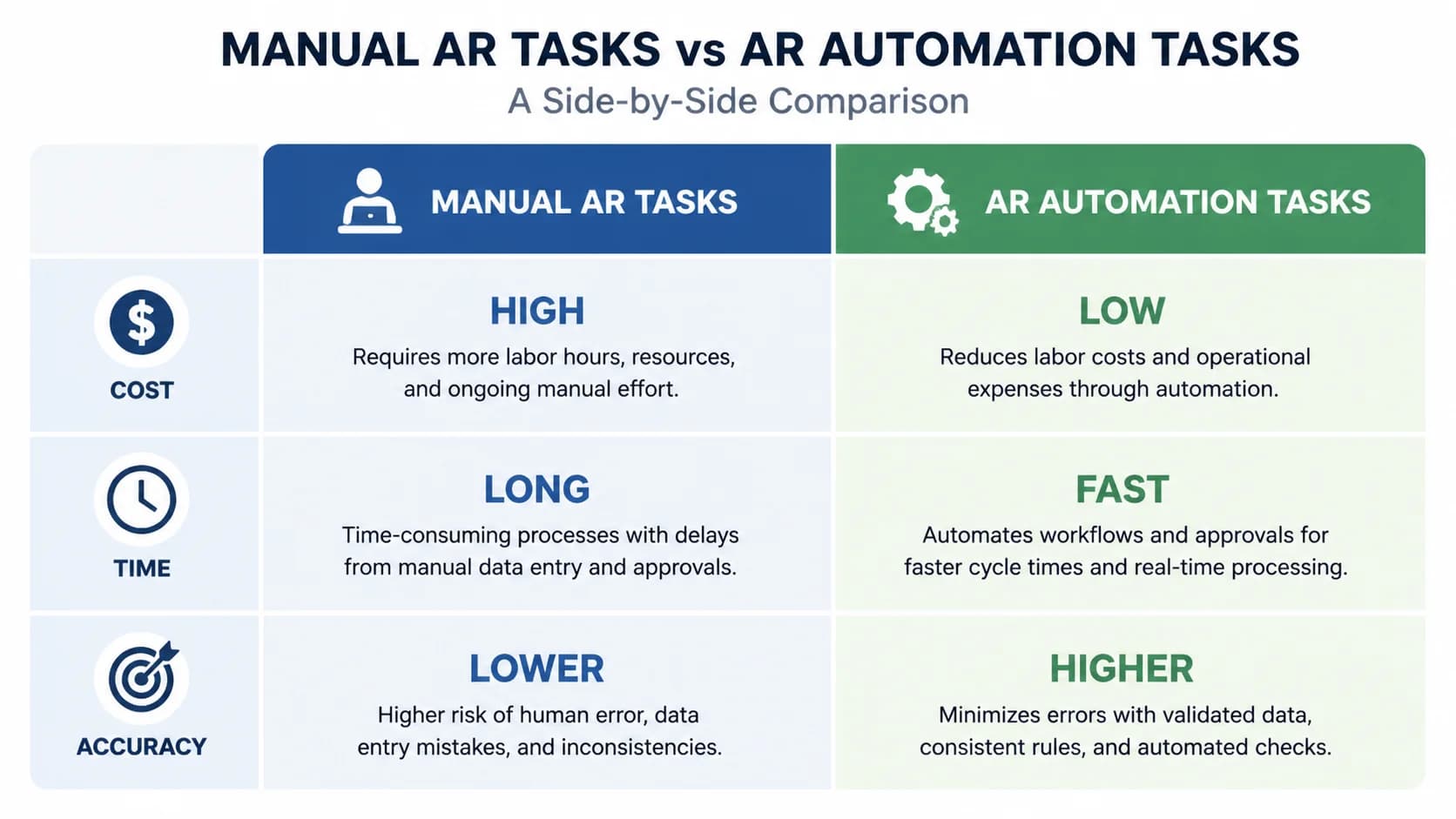
Walk through a normal Tuesday under each model. In a manual shop, a collector starts by pulling a fresh aging report, sorting it by days past due, and emailing 40 customers from a Word template. Cash application takes the AR clerk three hours to match a $400K bank deposit against 180 invoices, with eight short-pays kicked back as exceptions. Disputes live in Outlook folders. By 5 PM, half the work is done and tomorrow's queue is already heavier.
In an automated shop, the platform sent 600 dunning messages overnight, tuned by account behavior. The bank file landed at 7 AM and 178 of 180 lines auto-matched at 99%+ confidence. Two exceptions sit in a queue with the suggested invoice already attached. The collector spends the day on five accounts that need actual judgment, not on triage. The Ardent Partners 2024 benchmark report shows top-quartile teams reach exactly this state and collect 40% faster than the median, with 55% less bad debt write-off.
The economic delta is the headline. Cost per invoice drops from $15-40 manual to $1-3 automated per PYMNTS, which on 50,000 invoices a year is a $1.1M+ annual swing. DSO falls 20% on average and up to 40% for best-in-class implementations, releasing roughly $1M of working capital per $50M of revenue per 8 days of DSO reduction. Collector productivity rises 2-3x because the work shifts from data entry to judgment-heavy account management. You can read more about how teams [scale AR without adding headcount](/blog/scale-ar-operations-without-adding-headcount) when the tooling carries the volume.
The qualitative changes matter too. Audit trails become continuous rather than reconstructed at quarter end. Period close shrinks because reconciliation is already done. Customer satisfaction lifts because dunning is less robotic and disputes resolve in days, not weeks. Here is the catch most buyers miss: these gains compound only if you let the AI tune itself for 90 days before you start tweaking thresholds. Teams that micromanage the rules in week two never reach the year-two productivity ceiling.
Get the 2026 AR Problem Research Report
100+ pages of mid-market AR benchmarks, vendor scoring criteria, and the full ROI model.
Industry variation: why one-size-fits-all AR automation fails
The 38-to-83-day DSO spread is the single most overlooked fact in vendor evaluations. SaaS companies bill mostly via card or ACH on automated subscriptions, which is why average DSO sits around 38 days. Professional services firms invoice on milestones with net-30 terms and run closer to 45 days. Manufacturing and distribution average 51 days because of order-to-cash complexity. Healthcare hits 49 days dominated by payer mix and claim denials. Construction lands at 83 days because retainage holds 5% to 10% of every invoice for months.
Each of those numbers points at different feature priorities. A SaaS finance team needs subscription-aware dunning, mid-cycle proration handling, and dispute workflows tuned to product value perception (where a $50 short-pay can mean a churn signal). A professional services firm needs deep timesheet integration and partial-payment intelligence. A manufacturing AR platform needs to handle deduction codes, chargebacks, and trade-promotion accruals that no SaaS vendor has ever modeled.
Construction is the canonical example of why generic platforms fail. Retainage means an invoice cannot be fully paid until project closeout, so dunning logic has to know not to chase the held portion. Pay applications follow AIA G702/G703 formats. Lien waivers gate disbursement. Joint check agreements complicate cash application. None of those concepts exist in a generic SaaS-built AR tool, which is why construction CFOs end up implementing [AR automation for construction](/industries/construction) on a platform that ships those rules out of the box rather than retrofitting a horizontal product.
Healthcare adds another layer. Provider AR runs on 835 ERA matching against 837 claims, with denial codes that need to route to the correct work queue (eligibility, coding, authorization). Payer mix shifts the dunning equation because you cannot dun Medicare the way you dun a commercial PPO. A platform that only models invoices misses 60% of the workflow. Done right, healthcare AR automation can shrink the days-in-AR for self-pay balances by 25% within two quarters, but only if the tool understands ERA splits, contractual adjustments, and patient responsibility flows.
The practical takeaway is that fit-to-industry beats fit-to-feature-list once you cross a threshold of complexity. A 30-checkbox feature comparison sheet looks impressive but tells you nothing about whether a vendor can release retainage on project completion or auto-route a CO-45 denial. The vendors that win in the verticals are the ones who built domain logic into the core data model, not the ones who layered industry vocabulary on a generic engine. So when you evaluate a platform, the right test is not "does it cover the seven capabilities" but "does it cover the seven capabilities in the language my industry uses".
Pro Tip
Ask vendors to walk through a billing scenario unique to your industry: a retainage release, a denied 835, a mid-cycle subscription change. Generic demos will not surface their real fit, and a 20-minute scenario walkthrough exposes shortcomings no feature checklist will.
The ROI of AR automation: four value streams and the math behind them
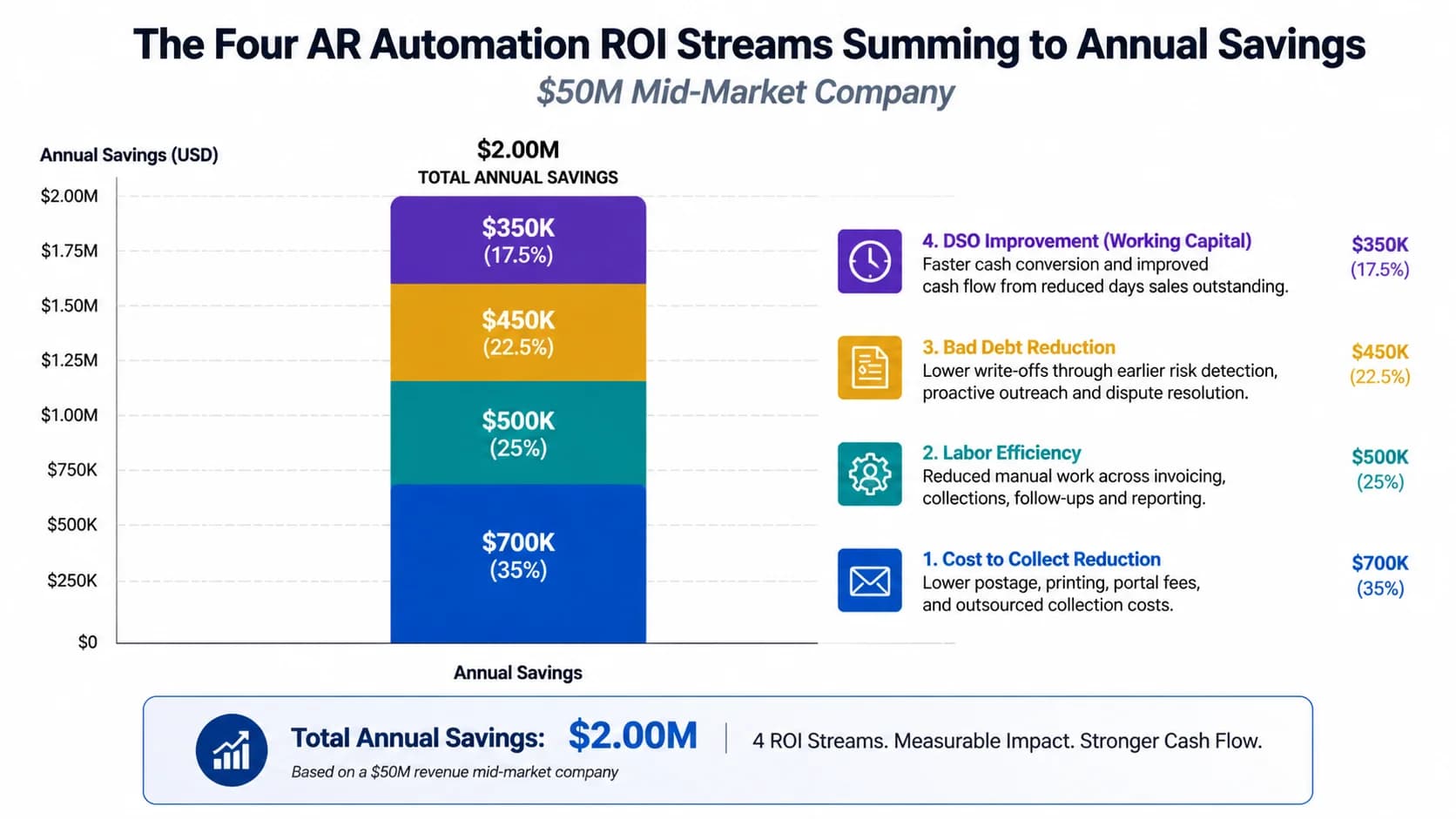
Stream one is direct invoice processing cost. PYMNTS pegs manual invoice handling at $15-40 fully loaded; automated processing runs $1-3. Take a midpoint of $25 manual versus $2 automated, multiply by 50,000 invoices a year, and the math is $1.15M of annual cost reduction. Even a conservative case (using the low end of the manual range and the high end of the automated range) still yields more than $600K. This is the stream every CFO can model on a napkin.
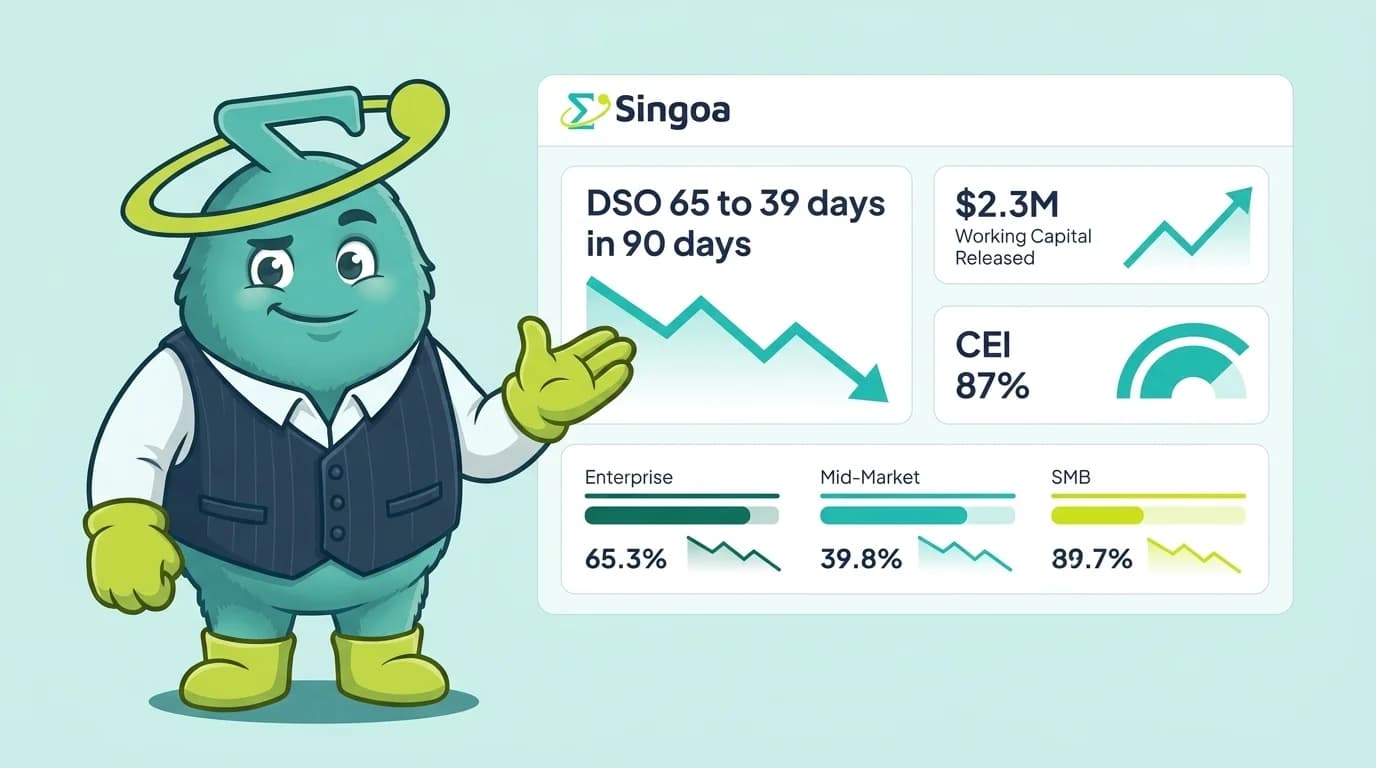
Stream two is working capital release through DSO reduction. The shorthand is that each day of DSO equals about 0.27% of annual revenue tied up. For a $50M company, eight days of DSO equals roughly $1.1M of working capital. AR automation typically delivers 20% DSO reduction in year one (Ardent Partners), so a company starting at 55 days of DSO and reaching 44 days frees about $1.5M of cash. That is one-time release, but it funds inventory, hiring, or debt paydown without touching the credit line.
Stream three is bad debt avoidance. The Ardent Partners 2024 AR Performance Report found top-quartile performers carry 55% less bad debt than the median because their collectors get to risky accounts earlier and their dispute workflow resolves the issues that cause write-offs. For a company writing off 0.6% of revenue today, a top-quartile result means dropping closer to 0.27%, which is roughly $165K saved on $50M of revenue per year. You can model your own version using the [$1-3 per invoice pricing](/pricing) as the cost denominator.
Stream four is capacity reallocation, which is the stream finance teams under-claim. When collectors stop doing spreadsheet triage and cash appliers stop hand-matching remittance, two things happen. Either you redeploy that capacity into proactive collections on the 20% of accounts that drive 80% of overdue balances, or you reallocate FTEs to higher-value work like FP&A and audit support. A 2-3x portfolio-per-collector lift means a five-person AR team can handle the workload of 10 to 15 without backfilling.
Worked example: $50M revenue company, 50,000 invoices a year, current DSO of 52 days, current bad debt at 0.5% of revenue. Year one savings: $1.15M cost reduction, $1.4M one-time working capital release, $115K bad debt reduction, plus two FTEs of capacity reallocation worth roughly $200K. Total year-one return is $2.86M against a $300K to $600K annual platform cost, putting payback at 4-9 months. The catch is that the working capital release is one-time, so years two and beyond run on the recurring streams alone, which is still a 5-10x annual return on platform cost.
Vendor evaluation framework: a vendor-neutral scorecard
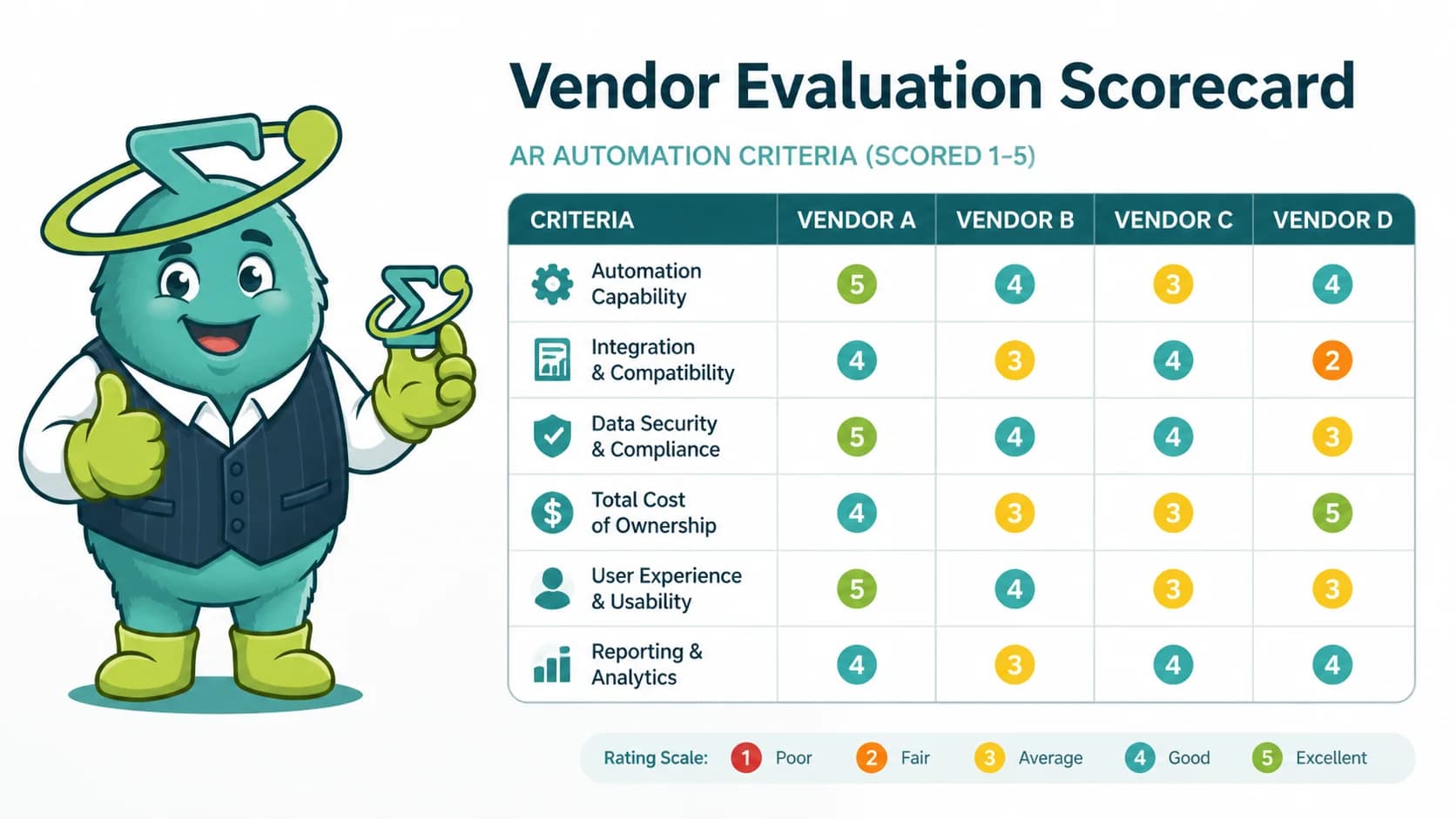
Pricing transparency is dimension one because it predicts your three-year total cost of ownership. % of AR pricing penalizes growth and obscures the real per-invoice number. Per-invoice or per-transaction pricing is honest but has to be checked for floor minimums and overage clauses. Flat-tier pricing is simplest but typically over-pays smaller volumes. Ask any vendor for a unit-economics breakdown at 25K, 50K, and 100K invoices a year. A vendor that cannot give you that is hiding something.
ERP integration depth is dimension two and the most common point of post-purchase regret. Connector breadth alone is not enough; bi-directional sync is what matters because read-only integrations leave you exporting cash receipts manually. Ask whether the connector writes adjustments, credit memos, dispute resolutions, and cash receipts back, and ask for a customer reference on your specific ERP. AI maturity is dimension three: rules-only platforms are fine for stable industries, but anything with high exception volume needs ML payment matching and behavioral dunning at minimum.
Implementation timeline is dimension four. A serious mid-market platform should hit go-live within 90 days for a single-ERP, single-entity implementation. Vendors quoting six months are either over-customizing or under-staffed; vendors quoting 30 days are usually skipping configuration depth. Customer support is dimension five: ask for the CSM ratio, the support SLA, and how many hours of services come included in year one. Security is dimension six. SOC 2 Type II is table stakes, ISO 27001 is increasingly expected, and data residency matters if you process EU or Canadian payments. Walk through [SINGOA security and compliance posture](/compliance) for a reference template.
The Forrester 2026 AR Automation Trends report confirmed the dimensions that actually predict ROI: AI maturity, integration depth, and implementation success. The other three (pricing, support, security) are filters; the first three are differentiators. Score each vendor 1-5 across the six and you will land on a defensible shortlist of two to three rather than the eight names your team is currently debating in Slack. The real question is which dimensions your industry weights heaviest, which is why a 200-row RFP rarely beats a six-dimension scorecard you can defend to your board.
Pro Tip
AI maturity is the dimension most prone to vendor inflation. Ask for the model card, the training data source, and a live, untriggered demo on your own remittance file. If a vendor will not run their matcher live on a sample of your data, score them a 2 at most.
Implementation roadmap: a realistic 30/60/90-day rollout
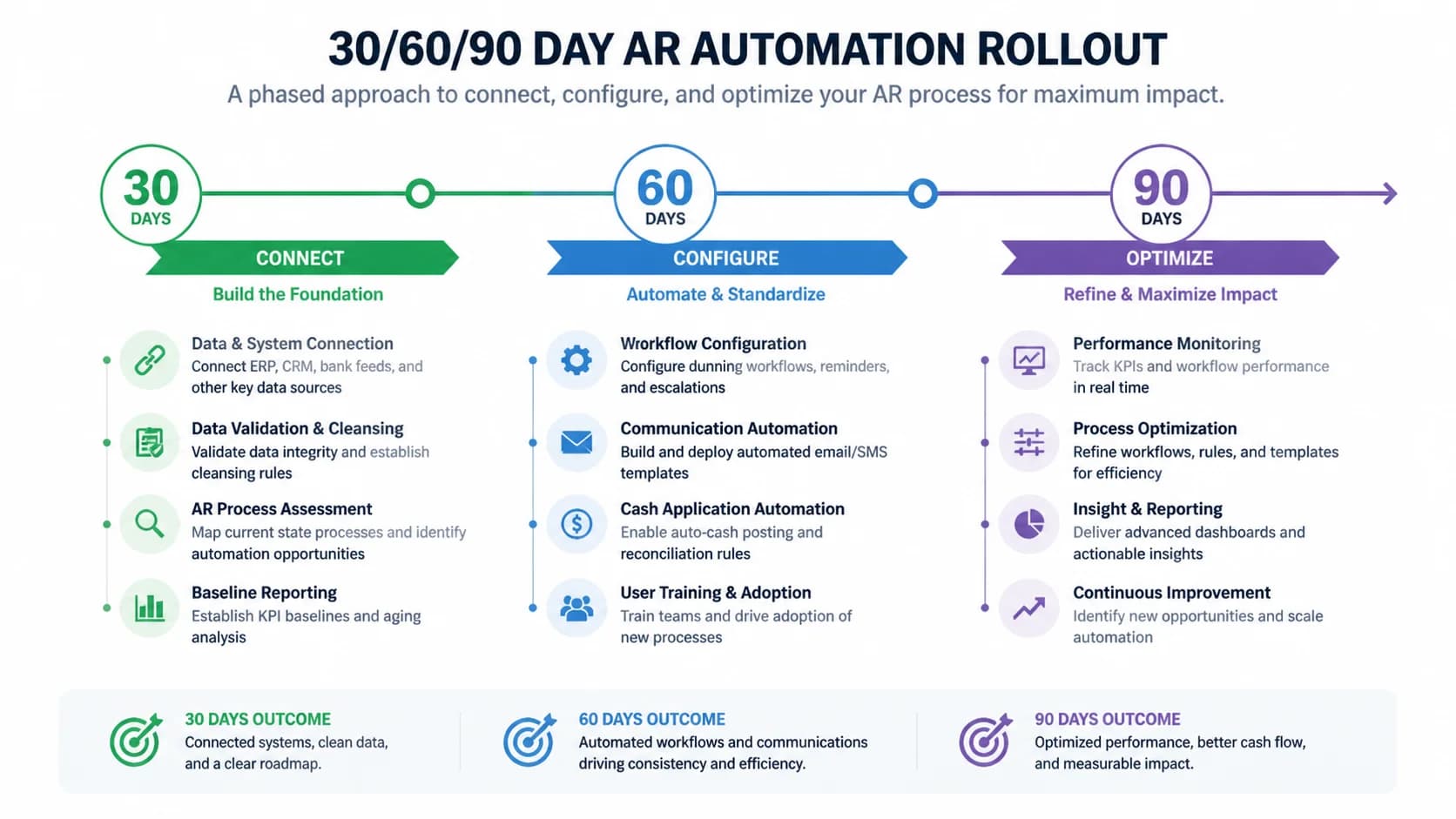
Days 0 to 30 is connect. The work is unglamorous but decisive: stand up the ERP connector, validate that customer master, invoices, and credit memos flow correctly, connect bank feeds for ACH, wire, and lockbox, and provision the customer payment portal. Most projects that stumble do so here because nobody pre-cleaned the customer master. Run a duplicate-merge pass and a tax-ID validation in week one and the rest of the month gets easier. By day 30 you should have live data flowing in and a small pilot group of 10 to 20 accounts.
Days 31 to 60 is configure. Set up credit decisioning thresholds against your existing policy, define three to five dunning ladders by account segment, configure payment matching rules including known short-pay tolerances, and load deduction codes into the dispute workflow. Train the AR team on the queue model rather than the spreadsheet model. By day 60 the system should be running outbound dunning for the pilot group with humans reviewing every decision. Resist the urge to expand scope; depth on a small population beats breadth on the full book.
Days 61 to 90 is optimize and expand. Now you turn the human-in-the-loop dial down. Auto-send dunning for tier-three accounts, raise the auto-match confidence threshold from 95% to 97% as accuracy proves out, and roll the configuration to the full customer book. Track three metrics weekly: cash application auto-match rate, average dunning response time, and DSO trend. By day 90 you should see a measurable DSO improvement (typically 3-5 days), a 90%+ auto-match rate, and the team operating from queues rather than spreadsheets. For deeper tactical advice, the [DSO reduction strategies](/blog/reduce-dso-proven-strategies-2026) playbook complements this rollout view.
Common failure modes to plan around: dirty customer master data (fix in week one), under-resourced project owner (assign 30% of a controller's time minimum), late ERP IT engagement (loop them in before kickoff), and over-customization in month one (resist; let the AI tune itself first). Teams that follow this 30/60/90 cadence consistently hit first ROI by day 90 and full ROI by month nine. The teams that miss the timeline almost always failed at one of those four checkpoints.
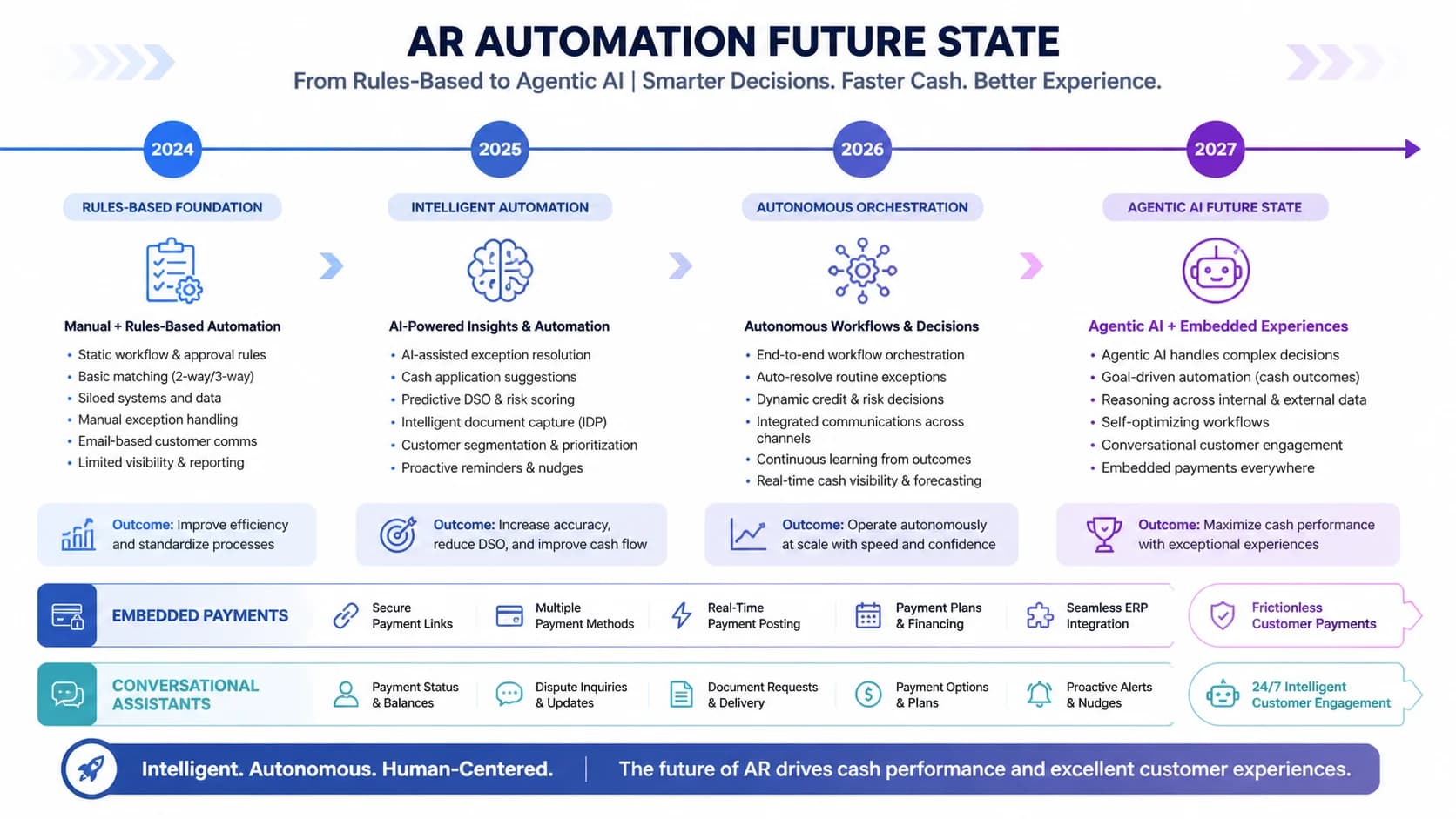
What's next: agentic AR, embedded payments, and the post-2026 horizon
Agentic AR is the most visible shift. A collector agent reads the aging, decides which 12 accounts to touch today, drafts the outreach message in the right tone for each one, sends it, monitors the reply, and proposes a payment plan if the customer signals constraint. The human collector reviews and approves rather than authoring. This is not science fiction in 2026; the early production deployments are already running on platforms like SINGOA and a small number of competitors. By 2027 it will be the default expectation, not a differentiator.
Embedded payments and conversational AR are the two adjacent shifts. ERPs are starting to host payment acceptance and AR workflows directly, which means the line between AR platform and ERP module will blur within 24 months. Conversational assistants let an AR manager ask "which accounts contributed most to the DSO uptick last quarter" and get a sourced answer with the underlying records in two seconds. CFOs evaluating vendors today should ask explicitly about the agentic roadmap, the conversational interface, and the embedded-payments stance, because those three answers predict whether the platform you buy in 2026 will still be competitive in 2028. For tracking the metrics that signal whether your AR function is keeping pace, the [AR KPIs every CFO should track](/blog/accounts-receivable-kpis-cfo-track) list is a good companion.
The case for AR automation in 2026 is no longer a debate about whether the technology works. It is a debate about how fast you can capture the four ROI streams: $23 saved per invoice on processing, roughly $1M of working capital per 8 days of DSO reduction at $50M of revenue, 55% lower bad debt for top-quartile performers, and 2-3x capacity per collector. The companies still on spreadsheets in 2027 will not be saving money. They will be losing share to peers who priced more aggressively and reinvested AR cost savings into product and sales.
The most actionable next step is the smallest one. Pull your last 12 months of invoice volume, your current DSO, and your bad debt rate, and run the four-stream math on a single page. Compare that number to a $300K-$600K annual platform cost. If your payback math comes back over 12 months, your data probably needs a closer look (most $50M companies underestimate manual cost and overestimate current DSO performance). If it comes back under nine months, you have a defensible business case to take to the CEO without a single vendor in the room.
The next 18 months will reshape what AR automation means. Agentic AI, embedded payments, and conversational interfaces are arriving fast, and the platforms you evaluate today will look meaningfully different in 2027. Buy the capability you need now, but choose a vendor whose roadmap matches where the category is going, not where it sat in 2023. Your AR team should be doing judgment work, not data entry. The tooling to make that real exists today.
30/60/90-day implementation roadmap
Connect
Days 0-30Stand up integrations for ERP, bank, customer master, and payment portal. Pre-clean data before going live.
- Stand up the ERP connector and validate customer master flow
- Connect bank feeds for ACH, wire, and lockbox
- Provision the branded customer payment portal
- Run duplicate-merge pass and tax-ID validation in week one
- Onboard a 10-20 account pilot group by day 30
Configure
Days 31-60Set up credit policy, dunning ladders, payment matching rules, and dispute workflow. Train the AR team on a queue-driven model.
- Configure credit decisioning thresholds matching policy
- Define three to five dunning ladders by account segment
- Configure payment matching rules and short-pay tolerances
- Load deduction codes into the dispute workflow
- Train AR team on the queue model with humans reviewing every decision
Optimize
Days 61-90Turn the human-in-the-loop dial down, expand to the full customer book, and capture first measurable ROI.
- Auto-send dunning for tier-three accounts
- Raise auto-match confidence threshold from 95% to 97%
- Roll configuration to the full customer book
- Track auto-match rate, dunning response time, and DSO trend weekly
- Confirm 3-5 day DSO improvement and 90%+ auto-match rate by day 90
Get the 2026 AR Problem Research Report
100+ pages of mid-market AR benchmarks, vendor scoring criteria, and the full ROI model.
Get your free AR benchmark report