
Quick Answer
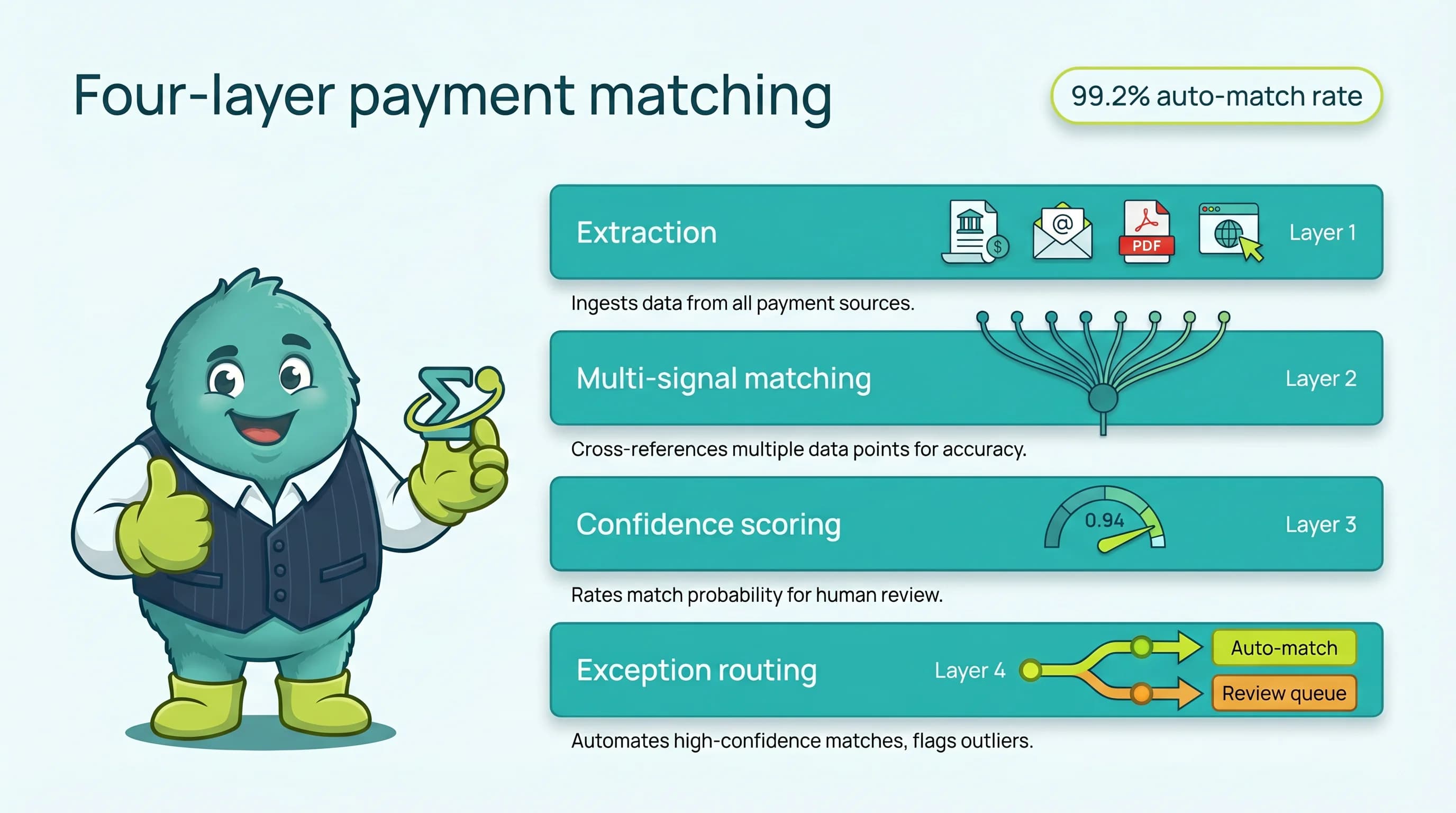
AI payment matching achieves 99.2% accuracy through four layers: multi-format data extraction, multi-signal matching algorithms, ML confidence scoring with dynamic thresholds, and AI-assisted exception handling that resolves the remaining 0.8% seventy percent faster than manual research.
Key Takeaways
- Manual cash application costs AR teams 2-4 hours daily and achieves only 92-95% accuracy. Downstream reconciliation errors compound across the month-end close cycle.
- Rule-based matching systems top out at 80-85% auto-match rates. They fail on partial payments, missing references, and combined invoice scenarios that require contextual analysis.
- AI matching reads remittance from 4 formats simultaneously (bank files, email, PDF, payment portals). Cross-source enrichment resolves cases manual processes handle one format at a time.
- ML confidence scoring applies dynamic thresholds by customer tier and payment size. That prevents the false-positive auto-matches that undermine trust in automation.
- The 0.8% exception rate matters as much as the 99.2%. AI-assisted exceptions resolve 70% faster because the system provides candidate invoices, confidence scores, and recommended actions.
- Accuracy improves from 97-98% in week one to 99%+ within 60 days. The model learns customer-specific payment patterns, discount behaviors, and reference formats.
Watch AI Match 50 Payments Live
See the four-layer matching engine resolve partial pays, combined invoice payments, and missing remittances in a 15-minute live walkthrough with your questions answered.
Why Manual Payment Matching Breaks Down at Mid-Market Scale
AI payment matching matters because manual cash application creates a capacity ceiling that mid-market companies hit long before they outgrow their ERP. Your AR specialist opens the morning bank file, sees 25 incoming payments, and starts the matching ritual. Open the lockbox report. Identify each payment's customer. Search for candidate invoices by amount and reference number. Confirm the match. Post the cash receipt to the ERP. Handle the five payments with missing remittance by emailing customers or checking their portal.
For 25 payments, this routine consumes 90 to 150 minutes. That time is gone before any collections work, dispute management, or reporting begins. Modern [AR automation platforms](/features) address this bottleneck at every layer. According to Emagia's 2025 analysis of 500+ global enterprises, AI-driven cash application reduced processing cycle times by 42% compared to manual workflows.
The accuracy problem amplifies the time problem in ways most finance leaders underestimate. Manual matching achieves 92-95% accuracy under ideal conditions, when remittances are complete and reference numbers are clear. In practice, those ideal conditions are rare. According to PYMNTS research, a significant percentage of B2B payments arrive without adequate remittance information. Customers pay multiple invoices with a single round-dollar transfer, reference purchase order numbers instead of invoice numbers, take undocumented early-pay discounts, or send wire transfers with minimal identifying data. Each of these cases demands 10-30 minutes of research per payment. The Hackett Group found that top-performing organizations process cash application at 3-4 times the throughput of average performers, a gap driven almost entirely by automation maturity.
Rule-based matching systems, the first generation of cash application automation, improved on manual processing but plateau around 80-85% auto-match rates, according to IOFM 2025 benchmarks. These systems apply fixed logic: match if the amount equals the invoice total within a tolerance, match if the reference contains the invoice number. That logic works for clean, simple payments. But a rule saying 'match within $1 tolerance' fails when a customer pays $9,800 against a $10,000 invoice as a round-number payment with an undocumented 2% discount. The rule flags an exception. A human AR specialist, or an AI model trained on that customer's history, recognizes the pattern instantly.
42%
Processing cycle time reduction with AI-driven cash application
2-4 hours
Daily hours spent on manual cash application for 400+ payments per month
80-85%
Auto-match rate ceiling for rule-based cash application systems
$9.40 manual vs. $2.88 fully automated
Average cost per invoice for manual AP/AR processing versus automated
The 4-Layer AI Payment Matching Architecture
Every incoming payment passes through four sequential layers. Each layer increases matching confidence and narrows the exception population. By the time a payment reaches the exception queue, the AI has already completed 90% of the resolution work, the human confirms rather than researches.
Layer 1: Multi-Format Remittance Data Extraction
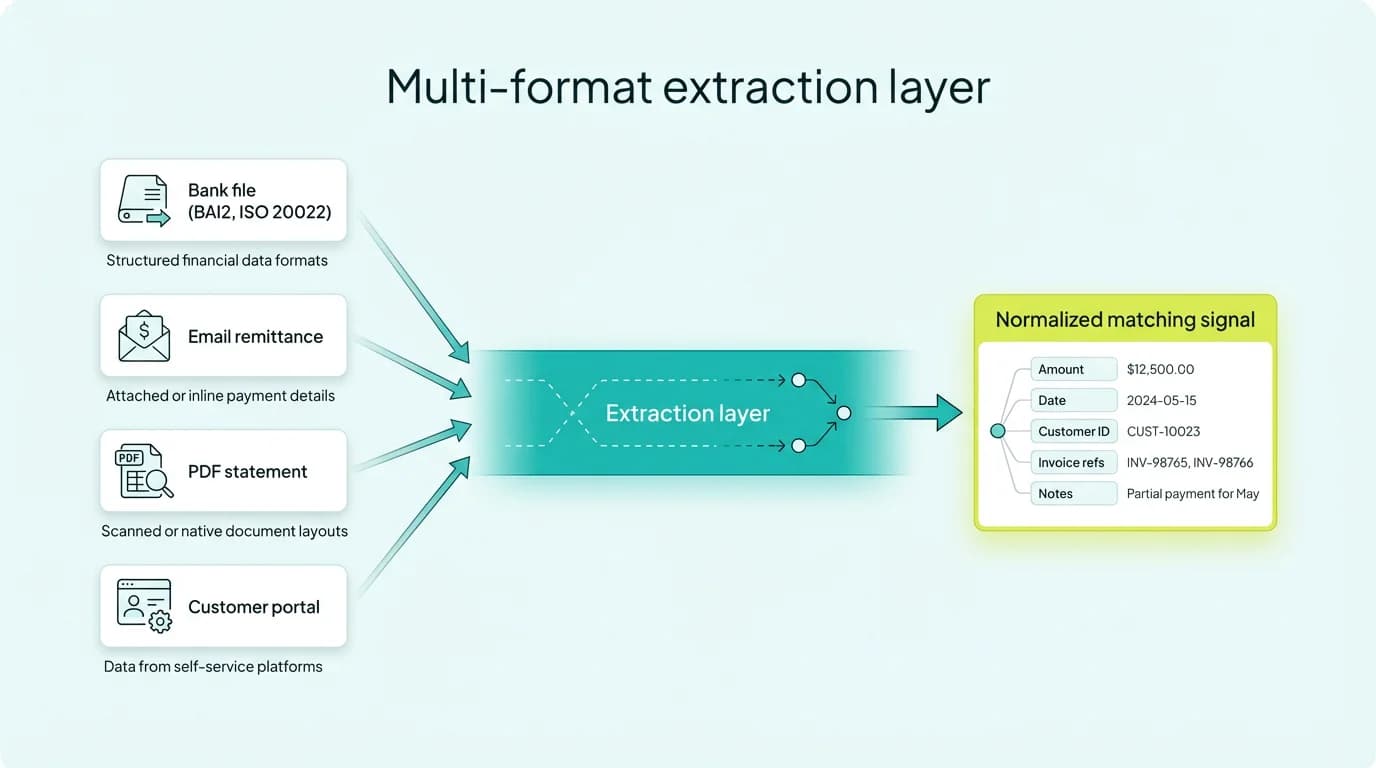
The first challenge in payment matching is not matching, it is extraction. Customers transmit remittance information across a proliferation of formats: BAI2 bank files from ACH originators, MT940 SWIFT messages for international wires, PDF remittance advice attached to or embedded in emails, inline remittance typed into email body text, and structured data submitted through payment portals. A system that reads only bank files misses 40-60% of available remittance context that would improve match accuracy. According to the Hackett Group's 2025 research on top cash application vendors, AI-powered extraction across multiple sources is now a baseline requirement for achieving above-90% auto-match rates.
The extraction layer uses a combination of EDI parsing, natural language processing, and optical character recognition to read remittance data from all four formats simultaneously. Consider a single payment that arrives as an ACH deposit with a cryptic reference code plus a separate email from the customer's AP team containing a PDF remittance advice listing three invoice numbers. The extraction layer combines both sources into one enriched matching context, giving the matching algorithms significantly more signal than either source provides alone. This cross-source enrichment is the single largest accuracy differentiator between first-generation rule-based systems and modern AI matching.
The layer also handles data normalization that humans perform unconsciously but rule-based systems stumble on: converting date formats across US and international conventions, stripping currency formatting from amounts, standardizing invoice reference variations (INV-1234, Invoice #1234, and 1234 are recognized as identical references), and mapping customer identifiers across naming differences between the ERP customer master and the bank file originator name. This normalization prevents the false negatives that rule-based systems produce when a reference number match exists but formatting differences hide it.
- BAI2 and MT940 bank file parsing with field-level data extraction
- Email body and subject line NLP for inline remittance parsing
- PDF remittance OCR with table structure recognition for multi-line statements
- Payment portal structured data ingestion with full line-item detail
- Cross-source enrichment combining bank file and email remittance into unified context
- Reference normalization across 50+ common invoice number formatting conventions
Layer 2: Multi-Signal Matching Algorithms
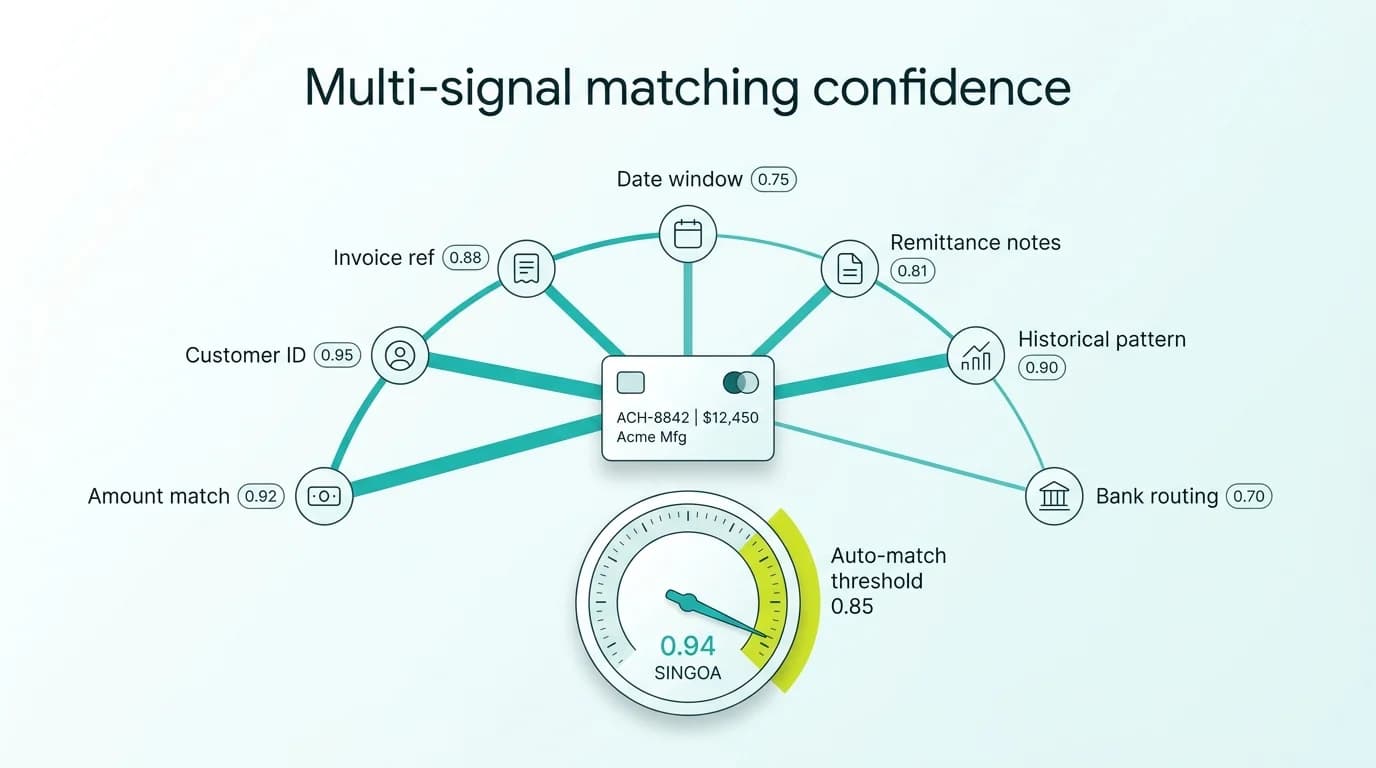
With normalized remittance data extracted, the matching engine evaluates seven signals simultaneously, a fundamental departure from rule-based systems that apply one or two rules in sequence. Each signal receives a dynamic weight based on data availability and historical reliability for the specific customer. This is where AI matching achieves the accuracy gains that single-signal rules cannot reach. A payment that shares an exact amount with two different open invoices (both $5,000) stumps a rule-based amount-match. The AI model disambiguates using timing signals, customer history, and bank account identification working in concert.
The seven matching signals are: exact invoice reference match, amount proximity within configurable tolerance, customer historical payment patterns (typical payment day, usual payment method, frequency of combined payments), timing alignment with invoice age and payment terms, combined invoice matching (does the payment equal a sum of open invoices?), partial payment and discount pattern recognition, and source bank account or payment method identification. For each payment-invoice pair, the engine produces a composite signal score that reflects real-world match probability rather than binary rule-pass outcomes.
Multi-signal matching shows its power most clearly on the hardest 15-20% of payments that rule-based systems cannot resolve. A $47,850 ACH with the memo 'October invoices' and no invoice references is unsolvable for amount-match rules. Multi-signal matching identifies it as a combined payment (no single invoice matches). It runs a combinatorial search across open invoices, finds three invoices summing to $47,850, and validates with timing and history signals that the customer pays monthly combined batches. Each signal alone is insufficient. Combined, they produce high-confidence resolution in seconds.
- Exact and fuzzy invoice reference matching with character-level similarity scoring
- Amount proximity matching with configurable tolerance by customer tier
- Combined invoice matching that identifies invoice combinations summing to payment amount
- Payment timing analysis against historical customer payment-day patterns
- Short-pay and early-pay discount pattern recognition by customer
- Bank account and payment method cross-referencing against customer master data
- Partial payment resolution weighted by customer-specific short-pay history
Layer 3: ML Confidence Scoring and Dynamic Thresholds
Multi-signal matching produces a candidate match and a raw composite score. Layer 3 applies a machine learning model to translate that raw score into an actionable classification: auto-post (high confidence, match and post without human review), review-recommended (medium confidence, AI suggests a match for one-click human approval), or exception (low confidence, escalate with research context). The critical distinction: these classification thresholds are not static. They adjust dynamically based on payment amount, customer tier, and the model's historical accuracy for that specific customer.
The ML model is pre-trained on millions of B2B payment transactions, providing strong baseline accuracy from day one, typically 97-98% auto-match rates during the first week of deployment. Over the next 60 days, the model fine-tunes on each customer's specific data. It learns that Customer A always references PO numbers on wire transfers rather than invoice numbers, so it routes Customer A's wires to amount-based matching rather than reference-based. It learns that Customer B takes a 2% early-pay discount on invoices paid within 10 days. This per-customer calibration drives accuracy from the initial 97-98% to 99%+ within two months.
Dynamic thresholds solve the false positive problem that erodes trust in rule-based automation. A rule that auto-posts all amount matches within a $1 tolerance will incorrectly post a $10,000 payment to the wrong invoice when two $10,000 invoices exist for the same customer. The ML model recognizes the ambiguity, calculates that the confidence score falls below the auto-post threshold for this payment amount, and routes to the review queue. The model is calibrated to minimize false positives, incorrect auto-matches, even at the cost of producing slightly more review-queue items. This design choice preserves AR team trust in the automation, which is essential for sustained adoption.
- ML model with 40+ input features evaluated per payment-invoice candidate pair
- Dynamic auto-post thresholds adjusted by payment size and customer risk tier
- Per-customer model calibration using historical exception resolution data
- False positive prevention: ambiguous matches downgraded to review queue automatically
- Confidence score transparency allowing AR teams to see why each match was classified
- Continuous learning from human exception resolutions improving future accuracy
Layer 4: AI-Assisted Exception Handling
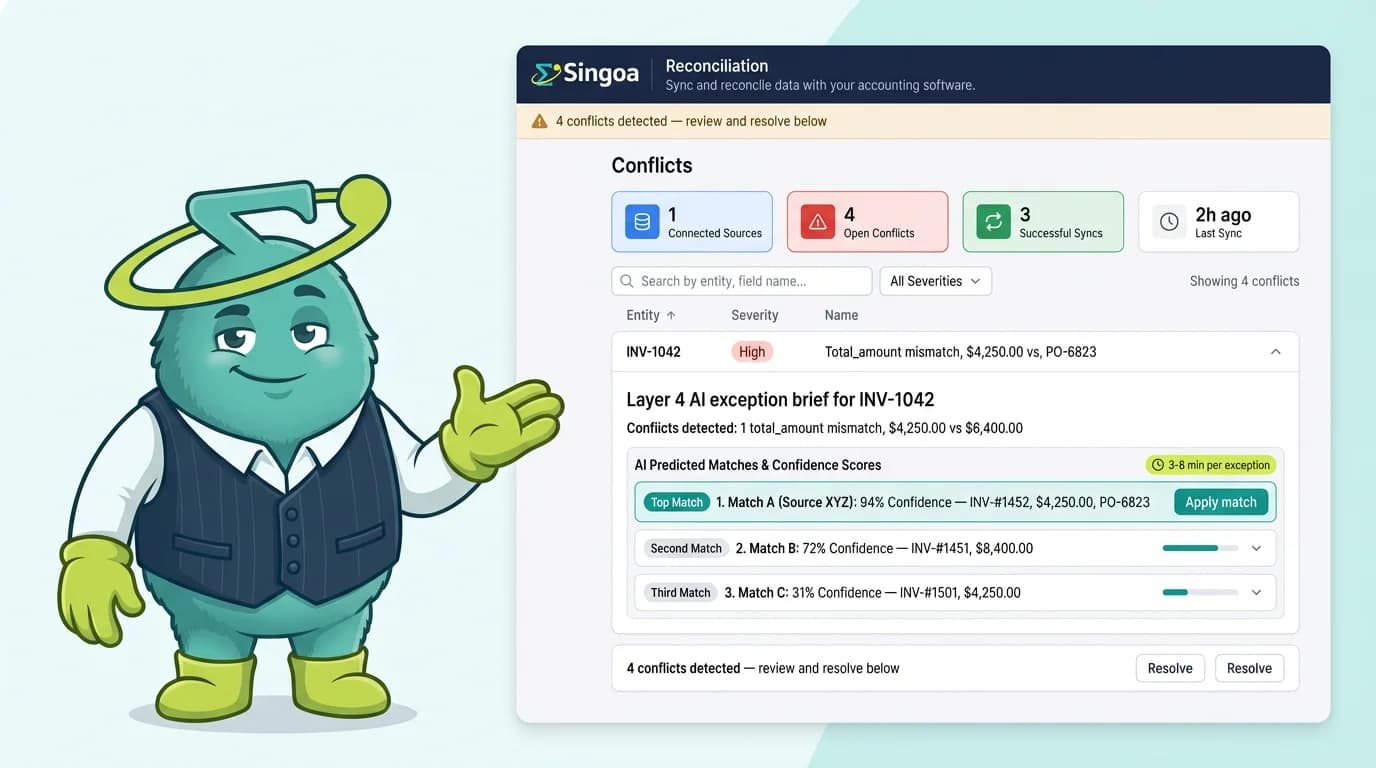
The 0.8% of payments that do not auto-match are not abandoned to manual research. They enter an AI-assisted exception queue that transforms the resolution experience from open-ended research to structured confirmation. For each exception, the system prepares a resolution brief containing: the payment details and source data, the top three candidate invoices ranked by confidence score with reasoning explanations, the customer's recent payment history including past exception patterns, and a recommended resolution action with supporting rationale. AR staff, aided by [conversational AI assistants](/features), see the probable answer and supporting evidence, not a blank research problem.
This exception handling efficiency is where AI payment matching delivers its second major value driver. Traditional exception queues require AR specialists to open the ERP, search for the customer, manually review open invoices, call or email the customer for remittance details, and reconcile, a process averaging 15-30 minutes per exception. AI-assisted exceptions resolve in 3-8 minutes because the research phase is already complete. For a team processing 500 payments monthly with 4 exceptions at 0.8%, this saves 30-90 minutes per month on exception handling alone. But the compounding benefit matters more: faster exception resolution means faster cash posting, which means more accurate daily AR aging and better cash flow forecasting.
The system also creates a feedback loop that continuously improves accuracy. When an AR specialist resolves an exception, applying a $9,800 payment to a $10,000 invoice and noting a recurring 2% early-pay discount for Customer B, that resolution trains the model. The next time Customer B sends a similar payment, the model recognizes the discount pattern and auto-posts at high confidence rather than generating an exception. Over time, the exception rate decreases as the model absorbs more customer-specific resolution patterns. Platforms like SINGOA use this feedback architecture to push accuracy higher with every resolved exception, turning the exception queue into a training mechanism rather than a cost center.
- AI-generated resolution brief for each exception with candidate invoices and confidence reasoning
- Conversational AI integration for follow-up questions about exception context
- One-click exception resolution from AI recommendation with full audit trail
- Exception pattern learning: resolved exceptions train the model for future payments
- Escalation workflow routing complex exceptions to senior AR staff or customer contacts
- Exception aging alerts flagging items approaching delinquency thresholds
Calculate Your Cash Application Time Savings
Enter your monthly payment volume to model the hours reclaimed at 99.2% auto-match. Most mid-market teams recover 35-38 hours per 400 payments monthly.
What 99.2% Accuracy Delivers to Your Business
Time Recovery: Reclaiming 8-15 Hours Per Week
The most immediate impact of AI payment matching is time recovery for AR teams stuck in the cash application cycle. Consider the math for a company processing 400 payments monthly. At 6 minutes per payment, an optimistic estimate for manual matching, cash application alone consumes 40 hours per month, equivalent to one full-time employee working exclusively on payment posting. At 99.2% auto-match, 397 of those payments post automatically in seconds. The 3 remaining exceptions consume approximately 15-24 minutes total with AI assistance. The net time recovered: 35-38 hours monthly that your AR team can redirect to proactive collections, dispute resolution, and strategic account management.
That reallocation matters more than the raw hours suggest. AR specialists who shift from reactive cash posting to proactive collections directly impact DSO. Every hour moved from matching to follow-up calls accelerates payment velocity. According to the Association for Financial Professionals (AFP), companies with proactive collections strategies reduce DSO by 25-40% compared to those relying on statement-driven follow-up. AI matching saves time and frees the team to pursue the collections strategies that compress your cash conversion cycle.
For mid-market companies approaching the headcount decision ('do we hire another AR specialist to handle growing payment volume?'), AI matching frequently eliminates or defers that hire. Recovering 40 hours monthly adds a full week of capacity per month. That is equivalent to a 25% effective headcount increase without additional salary, benefits, or onboarding cost. Based on SINGOA platform data, companies processing 300-600 payments monthly typically avoid one FTE hire within the first year of AI matching deployment. That saves $55,000-$75,000 in fully loaded compensation costs. At [$1-3 per invoice](/pricing) for AI matching, the ROI calculation is straightforward.
Monthly cash application time: manual versus AI-matched (400 payments)
40 hours reduced to under 2 hours
Exception resolution time per payment: manual research versus AI-assisted review
20 minutes reduced to 5 minutes
Accuracy Gains: Eliminating Downstream Reconciliation Cascades
Matching errors cost far more than the initial mis-post. Each incorrectly applied payment triggers a cascade of downstream work: the wrong invoice shows as paid (prompting a confused customer call when they receive a balance notice for something they already settled), the correct invoice remains outstanding past due (triggering collections follow-up on a paid invoice), and month-end reconciliation catches the discrepancy requiring manual reversal, reposting, and account notation. According to Ardent Partners' 2024 research, each processing error generates 3-5 additional downstream correction tasks, each consuming 15-45 minutes of staff time.
Quantify the difference at scale. At 94% manual accuracy for 400 monthly payments, 24 payments are mis-posted each month. At 3-5 downstream tasks per error, that generates 72-120 correction tasks monthly, consuming 18-90 additional hours depending on complexity. At 99.2% AI accuracy, 3 payments are mis-posted monthly, producing only 9-15 correction tasks. The error reduction eliminates 57-105 correction tasks per month, recovering substantial staff time that was previously invisible in your cost accounting because it was scattered across customer service, collections, and month-end close activities.
Accuracy also has a customer relationship dimension that finance leaders frequently overlook. Customers who receive incorrect balance statements, collections notices for paid invoices, or duplicate payment requests lose confidence in the billing relationship. These customers are disproportionately likely to delay future payments pending billing verification, directly increasing DSO from what is fundamentally an internal processing failure. Improving matching accuracy from 94% to 99.2%, particularly in [high-volume industries like manufacturing and wholesale](/industries/manufacturing), does not just reduce internal rework. It removes a friction source in the customer payment experience that silently extends your collection timelines.
Monthly mis-posts eliminated: manual (94% accuracy) versus AI (99.2%)
24 errors reduced to 3 errors per 400 payments
Downstream error correction tasks prevented monthly
57-105 fewer correction tasks
Cash Visibility: Real-Time Posting Versus Batch Lag
Manual cash application introduces a 1-3 day lag between payment receipt and ERP posting. Payments arriving Monday morning may not post until Tuesday afternoon after the AR team works through the matching backlog. This lag creates overstated AR aging reports, inflates outstanding receivables figures in daily treasury reporting, and delays cash availability for working capital decisions. For a company with $5M in average outstanding AR, a 2-day posting lag overstates receivables by approximately $137,000-$274,000 on any given day, material variance for weekly cash flow reporting to the CFO and board.
AI matching posts confirmed payments to the ERP within minutes of bank file import. Real-time posting gives CFOs accurate daily cash positions for treasury decisions, eliminates the discrepancy between receipt date and posting date in AR reporting, and enables more accurate short-term cash flow forecasting. AR automation platforms like SINGOA's [payment matching engine](/features) process bank file imports automatically, triggering immediate matching and posting. Finance leaders consistently report that real-time cash visibility alone justifies the automation investment from a treasury management and forecasting perspective, independent of the time savings and accuracy gains.
Payment posting lag: manual batch processing versus AI real-time matching
1-3 days reduced to under 15 minutes
AR overstatement eliminated from real-time posting ($5M outstanding AR baseline)
$137,000-$274,000 daily correction
3 Real-World Matching Scenarios: How Each Layer Contributes
Real-World Scenario
Combined Payment for 3 Invoices With No Line-Item Detail
The Situation
A wholesale customer sends a single ACH payment of $47,850 with a reference memo reading only 'October invoices.' Your open AR shows 12 invoices for this customer ranging from $1,200 to $18,000. A manual AR specialist must open each invoice, check amounts, and attempt to find a combination summing to $47,850, a combinatorial search across hundreds of possible groupings that can consume 20-30 minutes. A rule-based system with amount-match logic finds no single invoice match and immediately flags the payment as an exception.
What SINGOA Does
The AI matching engine handles this in seconds. Layer 1 extracts the ACH amount and memo text. Layer 2 identifies this as a combined payment scenario, no single invoice matches, and this customer's history shows monthly combined payments. The combinatorial algorithm searches open invoice groupings and identifies three invoices ($18,000 + $15,500 + $14,350 = $47,850). Layer 3 validates with timing data: all three invoices are October-dated, the customer historically pays combined October batches on the 28th, and today is October 28th. Confidence score: 96%. The payment auto-posts to all three invoices without human involvement.
The Result
Payment auto-matched to 3 invoices in 8 seconds. Manual process: 20-30 minutes. Rule-based system: immediate exception requiring full manual research.
Real-World Scenario
Partial Payment With Undocumented Early-Pay Discount
The Situation
A manufacturing customer pays $9,800 against a $10,000 invoice. The remittance advice lists the correct invoice number but offers no explanation for the $200 shortfall. A rule-based system with a $1 amount tolerance flags this as an exception because $200 exceeds the threshold. A rule with a percentage tolerance might auto-match but leave a $200 open balance, allowing what could be an unauthorized deduction to pass without review. Neither outcome is optimal for the AR team or the customer relationship.
What SINGOA Does
The AI engine takes a different path. Layer 2 matches on the invoice reference and identifies a $200 short-pay. Layer 3 pulls the customer's 24-month payment history and finds a clear pattern: this customer has taken a 2% early-pay discount on 18 of the last 24 invoices paid within 10 days of the invoice date. The current invoice is 8 days old. The ML model classifies this as a probable authorized early-pay discount with 94% confidence. Rather than auto-posting or flagging as a generic exception, the system routes the payment to the discount authorization workflow, the correct handling path that neither manual guesswork nor rigid rules would reliably identify.
The Result
Probable 2% early-pay discount identified from customer history. Routed to discount approval workflow rather than exception queue, correct handling path identified automatically.
Real-World Scenario
International Wire With Minimal Identifying Information
The Situation
An international customer sends a $35,000 USD wire transfer. The bank file contains the originating bank name (Deutsche Bank Frankfurt), the transaction date, and a reference field reading 'PYMT.' No invoice number, no purchase order, no customer name beyond the bank originator. For a manual AR team, this triggers a multi-day resolution cycle: identify the customer from the bank name, contact them for remittance details, wait for a response, then match and post. The invoice shows as unpaid throughout this cycle, potentially triggering an unnecessary collections follow-up that damages the customer relationship.
What SINGOA Does
The AI extraction layer matches the originating bank routing number and account identifier against the customer master data, identifying the wire source as an established customer within seconds. Layer 2 finds one open invoice for exactly $35,000 for this customer, aged 32 days. Layer 3 validates: this customer historically pays via international wire 30-35 days after invoice date. Single open invoice at matching amount plus consistent payment timing plus verified bank account produces an 89% confidence score, above the auto-post threshold for this customer's tier. The payment posts the same day it arrives, preserving the customer relationship and eliminating the 2-5 day remittance chase.
The Result
Wire with minimal remittance matched via bank account identification and payment pattern analysis. Posted same-day rather than waiting 2-5 days for customer remittance confirmation.
Manual Cash Application vs. AI Payment Matching: Full Comparison
| Metric | Manual | SINGOA | Improvement |
|---|---|---|---|
| Auto-match rate | N/A, 100% manual processing required | 99.2% auto-posted without human action | Eliminates manual processing for 99 of every 100 payments |
| Processing time per payment | 6-15 minutes (varies by remittance quality) | Under 15 seconds for auto-matched payments | 97-99% time reduction per payment processed |
| Posting accuracy | 92-95% (IOFM benchmark for optimized teams) | 99.2% confirmed auto-match accuracy | 4-7 percentage point gain, eliminating 60-80% of errors |
| Cash visibility lag | 1-3 days from receipt to ERP posting | Under 15 minutes from receipt to posting | Real-time cash position for treasury management |
| Combined payment handling | 20-30 minutes manual combination search | Combinatorial algorithm resolves in seconds | 15-28 minutes saved per combined payment |
| Short-pay and discount handling | Manual history research; frequent miscategorization | AI recognizes discount patterns from customer history | Eliminates miscategorization; 80% research time reduction |
| Exception resolution time | 15-30 minutes per exception (open-ended research) | 3-8 minutes (AI-prepared resolution brief) | 70% faster exception resolution with structured context |
| Cost per payment posted | $4.50-$8.00 including staff time and error correction | $1-3 per invoice with full automation | 55-85% cost reduction per payment processed |