
Quick Answer
Reduce DSO by 40% with five automation plays: automated multi-channel dunning, AI-driven collections prioritization, self-service payment portals, predictive credit scoring, and AI payment matching. Most mid-market companies achieve 25-40% reduction within 90 days.
Key Takeaways
- Companies with DSO above 60 days lose an average of $400K annually in trapped working capital. Each day of reduction frees approximately $27,400 for a $10M revenue business.
- Automated multi-channel payment reminders recover 30% more past-due invoices than manual follow-ups, per industry benchmarks.
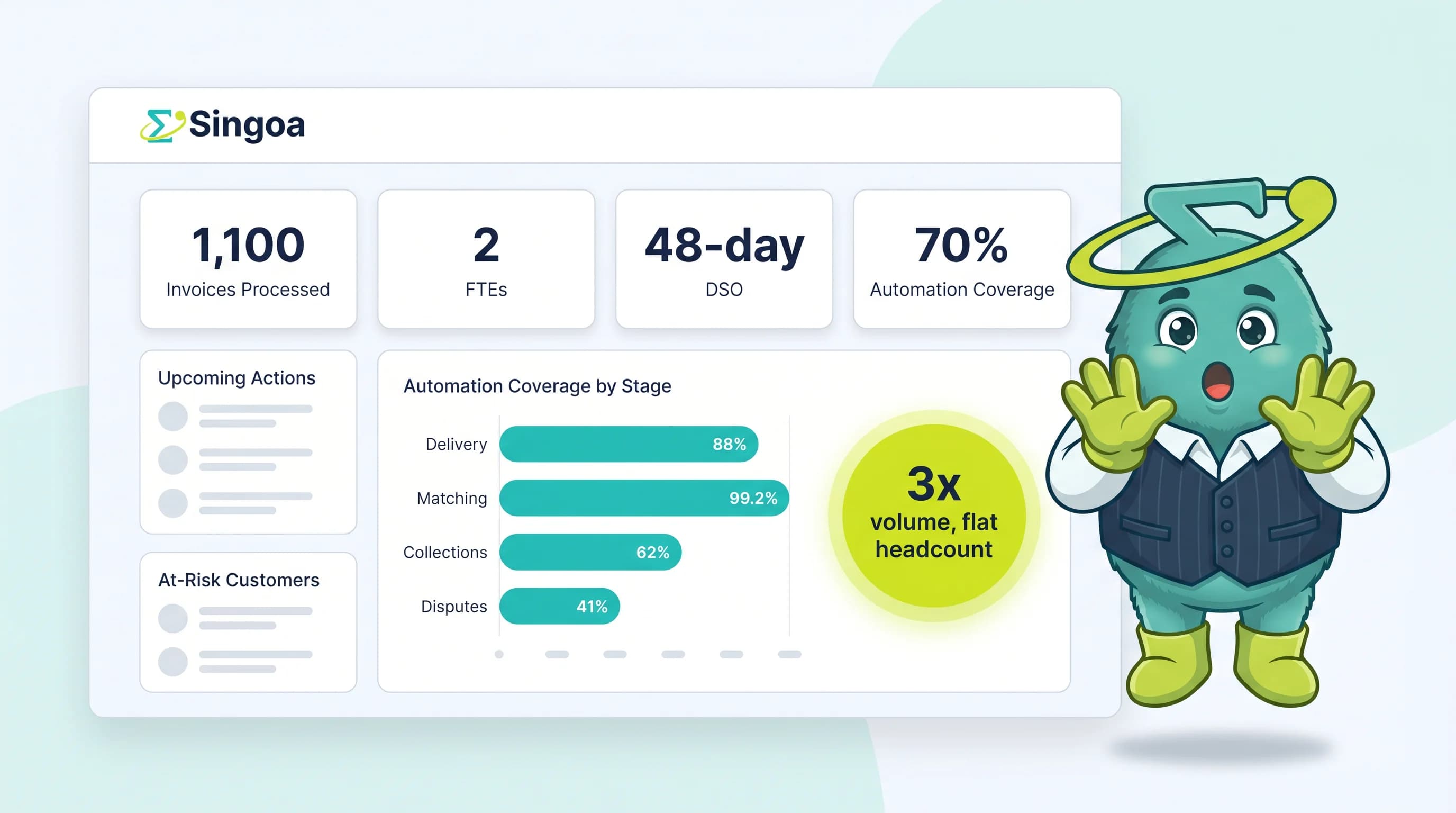
- AI-powered collections prioritization focuses team effort on the 20% of accounts representing 80% of outstanding AR value. Collections per FTE rise by 3x.
- Self-service payment portals with omnichannel options reduce average DSO by 12-18 days within the first quarter of deployment.
- Predictive risk scoring identifies deteriorating accounts 30-45 days before they become delinquent. Bad debt write-offs drop 30-50%.
- AR automation cuts cost per invoice from $15-40 manual to $1-3 automated. Companies processing 1,000+ invoices monthly see 300-500% first-year ROI.
Model the Cash Released by Every Day of DSO Reduction
Enter your revenue and current DSO. The calculator shows working capital freed per day of DSO reduction plus the 15-day and 25-day cumulative impact.
Why Does DSO Matter More Than Ever in 2026?
A $50M mid-market company running a 65-day DSO has roughly $8.9 million locked in receivables at any given time. That is capital that cannot fund payroll, equipment purchases, or growth initiatives. According to PYMNTS' 2025 B2B Payments report, 73% of mid-market businesses cite slow receivables collection as their primary cash flow constraint. The problem has intensified since 2023, as customers stretch payment terms to preserve their own liquidity, passing the cash flow burden upstream to suppliers and service providers.
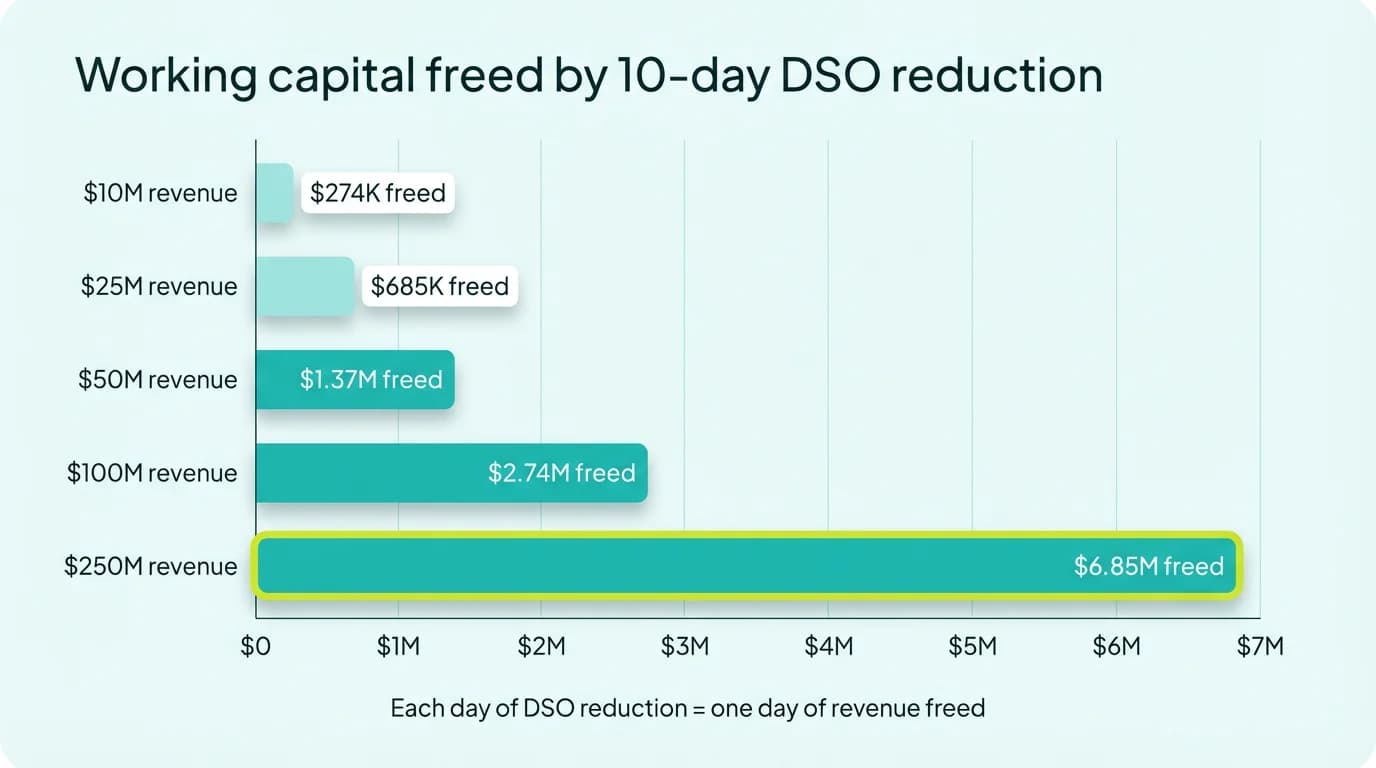
Every day you shave off DSO releases trapped working capital immediately. For a company with $10M in annual revenue and a 60-day DSO, reducing DSO by just one day frees approximately $27,400 in cash. A 15-day reduction unlocks over $411,000. A 25-day reduction releases $685,000 without increasing revenue by a single dollar. That math explains why CFOs at high-performing mid-market companies treat DSO reduction as a strategic priority at the board level, not an AR department metric.
The cost of inaction compounds quickly. Companies with above-average DSO borrow 40% more on lines of credit to cover cash shortfalls, according to the Association for Financial Professionals (AFP, 2024). They also write off 2-3x more bad debt because aged receivables have exponentially higher default rates. An invoice at 90 days past due has only a 69.6% probability of collection, per Commercial Collection Agency Association data. At 120 days, that drops to 52%. Speed matters, and the strategies in this guide are designed to create that speed systematically.
- Each day of DSO reduction frees $27,400 in working capital for a $10M revenue company
- 73% of mid-market businesses cite slow collections as their top cash flow constraint (PYMNTS, 2025)
- Invoices at 90 days past due have only a 69.6% collection probability, speed protects revenue
- Companies with high DSO borrow 40% more on credit lines to cover cash shortfalls (AFP, 2024)
- DSO reduction creates immediate cash impact without requiring revenue growth
Pro Tip
Calculate your company's cash-per-day-of-DSO figure right now: divide your annual credit sales by 365. That number is what each day of DSO reduction is worth. Post it where your AR team can see it daily, it transforms DSO from an abstract metric into a tangible dollar amount everyone understands.
Strategy 1: Establish Your DSO Baseline and Set Realistic Targets
Before implementing any DSO reduction strategy, you need a precise baseline, not the rough estimate most finance teams carry in their heads. Calculate your current DSO using the standard formula: (Accounts Receivable / Total Credit Sales) x Number of Days in the period. Pull this directly from your ERP or accounting system. According to a 2025 Growfin survey, most companies discover their actual DSO is 10-15 days higher than they assumed, because they exclude disputed invoices, unapplied cash, and partial payments from mental calculations.
Next, benchmark against your specific industry. Construction companies average 60-90 days, healthcare organizations 45-70 days, manufacturers 45-60 days, and SaaS companies 30-45 days, according to CreditPulse's 2025 industry benchmark report. Set a target of 15-25% below your current number, ambitious enough to generate meaningful working capital release, yet realistic enough to achieve within 90 days. Companies that set vague goals like 'improve DSO' almost never move the needle. Companies that target 'reduce DSO from 67 to 50 days by Q3' consistently do.
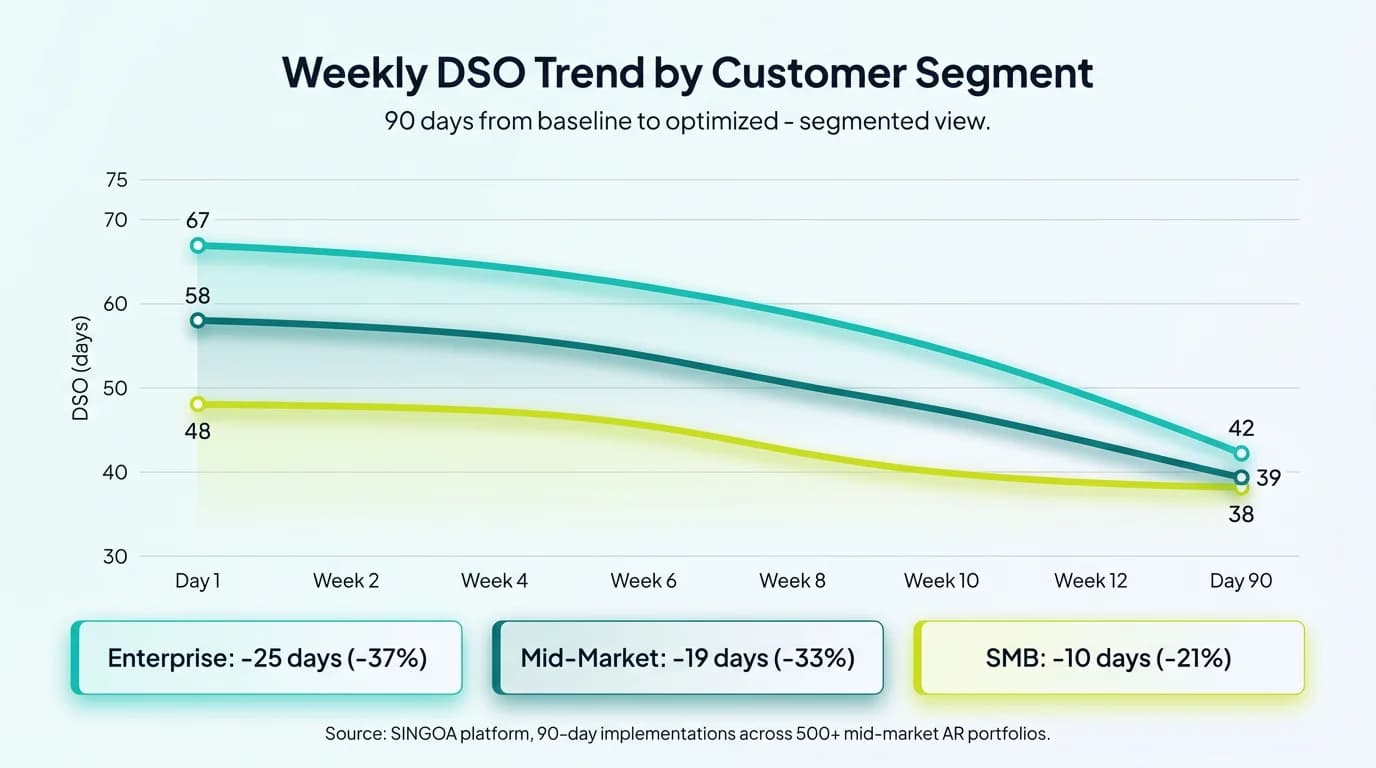
Track DSO weekly, not monthly. Monthly DSO reports arrive too late to catch deteriorating payment trends before they become collection problems. Weekly tracking with automated dashboards lets your team spot issues when accounts are 15 days past due, not 60. Segment your DSO by customer tier, payment method, and industry for deeper insight. You will often discover that 80% of your DSO problem originates from just 20% of your accounts, typically your largest customers paying on extended terms or your riskiest accounts slipping through without follow-up.
- Use the DSO formula: (Accounts Receivable / Total Credit Sales) x Days in Period
- Benchmark against your specific industry, construction 60-90 days, manufacturing 45-60 days, SaaS 30-45 days
- Set a specific target: 15-25% reduction within 90 days
- Switch from monthly to weekly DSO tracking for faster intervention
- Segment DSO by customer tier, industry, and payment method to find the root causes
Pro Tip
Segment your DSO by customer size and payment method. You will often find that 80% of your DSO problem comes from 20% of your accounts, typically your largest customers who pay on extended terms. Focusing automation on this high-impact segment delivers outsized results with minimal effort.
See the AI-Prioritized Collections Worklist
Watch a 15-minute walkthrough showing how AI surfaces your highest-impact accounts each morning, ranked by risk score and dollar impact.
Strategy 2: Automate Multi-Channel Payment Reminders
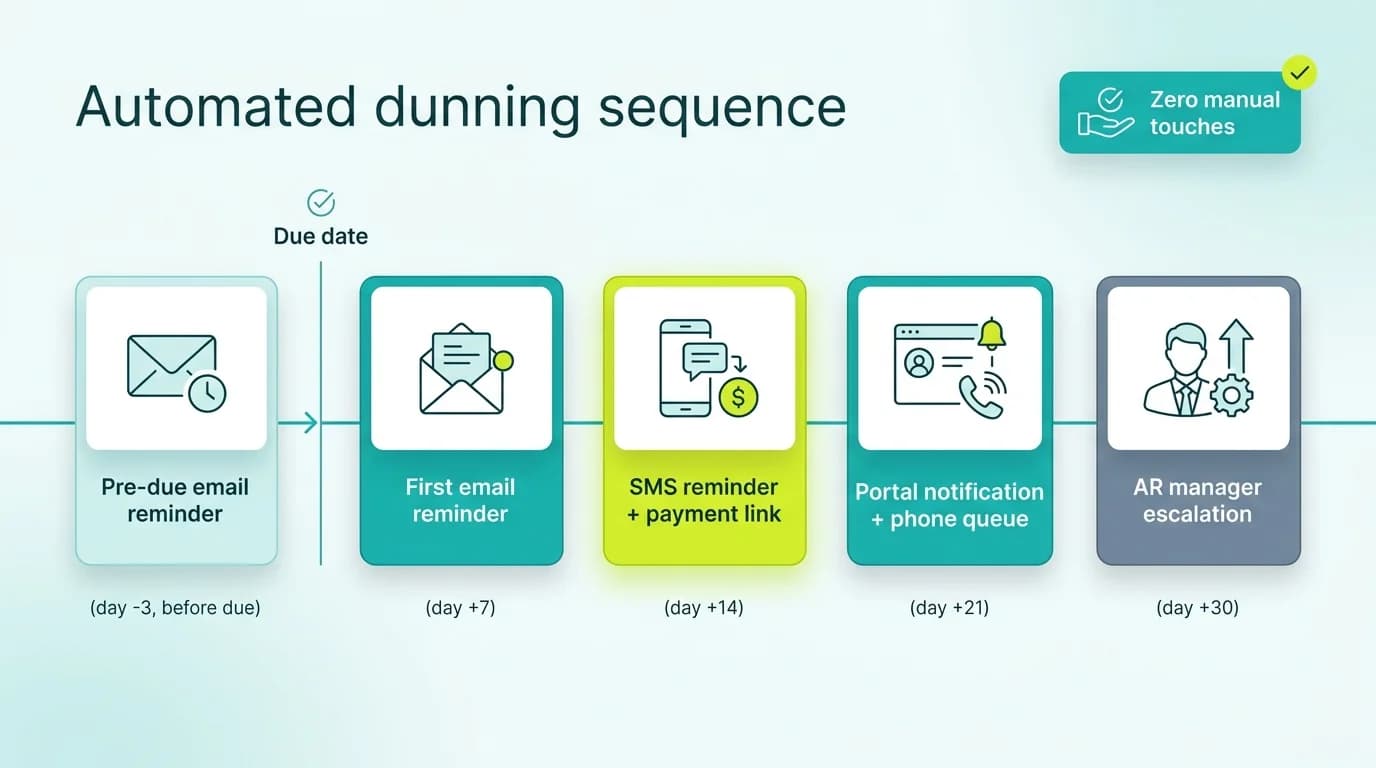
The single highest-impact DSO reduction strategy is automated payment reminders, and the data backs this up decisively. According to Esker's 2025 AR benchmark study, companies using automated dunning sequences collect 30% more past-due invoices compared to manual follow-ups. The reason is consistency: automated systems send reminders at precisely the right moment, 7 days before the due date, on the due date itself, and at escalating intervals after, without human forgetfulness or bandwidth constraints derailing the cadence.
Multi-channel reminders dramatically outperform email-only approaches. Your customers check email, SMS, and payment portals at different times throughout their workday. An automated system that sends an email reminder on day 1, a portal notification on day 3, and an SMS on day 7 covers all touchpoints. PYMNTS' 2025 research found that companies offering omnichannel payment notifications collect 40-60% faster than those relying on email alone. The goal is not aggressive collections, it is reducing the friction between your customer's intent to pay and the actual payment action.
Configure your dunning sequences by customer segment for maximum effectiveness. High-value, reliable customers receive gentle reminders with extended courtesy periods. New or high-risk accounts receive earlier, more frequent touchpoints with clearer escalation paths. This segmented approach respects your strongest relationships while protecting against your riskiest receivables. AI-powered [collections automation](/features) platforms like SINGOA automate this segmentation using behavioral analysis, selecting the optimal tone, timing, and channel for each customer based on their historical payment patterns and current risk profile.
- Pre-due reminders (7 days before) reduce late payments by 15-20%
- Multi-channel outreach (email + SMS + portal) collects 40-60% faster than email-only (PYMNTS, 2025)
- Segment dunning by customer risk tier: gentle for reliable payers, assertive for high-risk accounts
- Automate escalation paths: reminder, follow-up, account manager alert, formal demand
Pro Tip
Schedule payment reminders for Tuesday or Wednesday mornings between 9-11 AM in your customer's time zone. Research from Experian shows these windows achieve 2x higher open rates than Friday afternoons or Monday mornings, when AP teams are buried in other priorities.
Strategy 3: Prioritize Collections with AI-Powered Risk Scoring
Most AR teams work their aging report from top to bottom or by dollar amount. Both approaches waste significant time. A $50,000 invoice from a customer who consistently pays at day 35 does not need attention at day 31. A $5,000 invoice from a customer with deteriorating payment patterns needs immediate action. Risk-based collections prioritization uses payment history, credit signals, and behavioral patterns to surface the accounts that genuinely require human intervention, and filters out the noise that buries your team in low-value tasks.
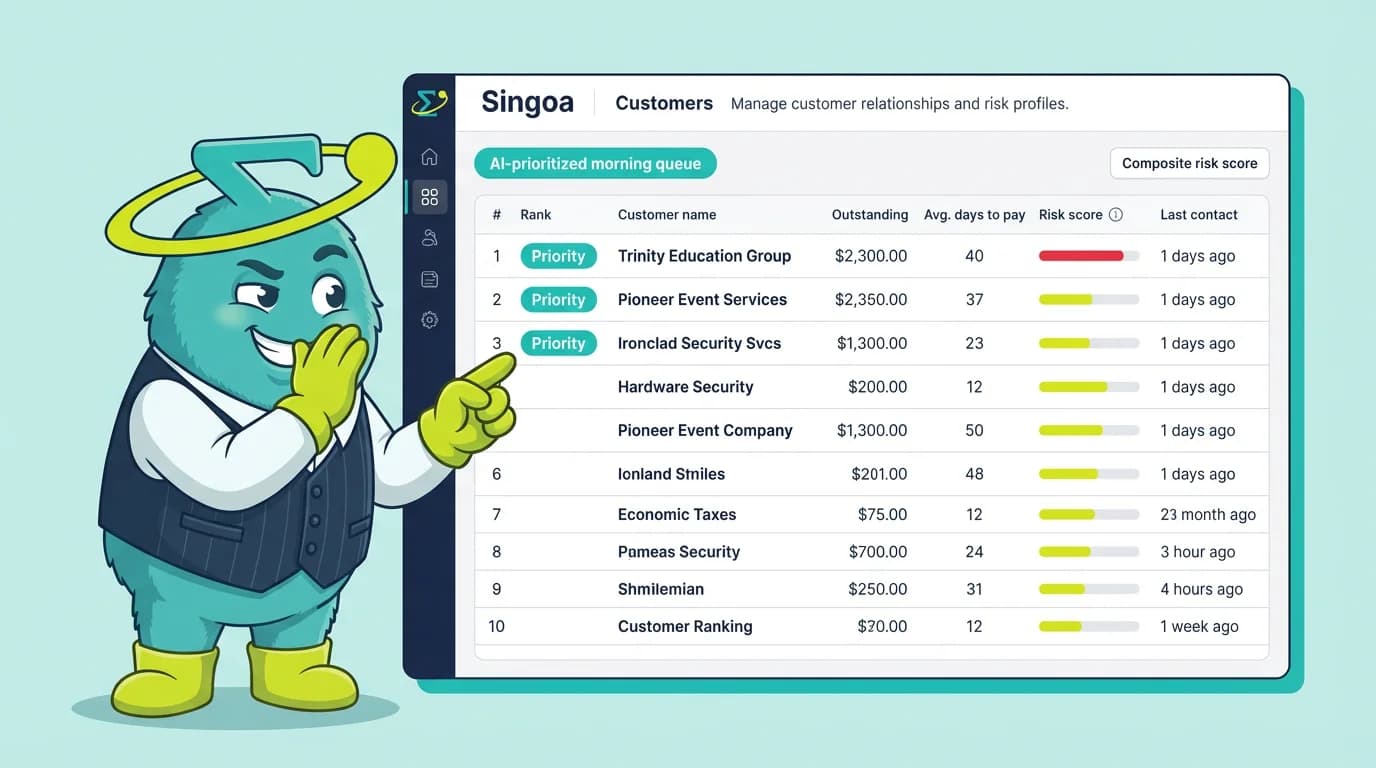
AI-powered risk scoring analyzes each account across dozens of variables: historical payment timing, recent payment trend changes, industry risk factors, public credit bureau signals, and communication engagement metrics such as email open rates. According to Billtrust's 2025 AR automation report, the system surfaces a prioritized daily worklist: 'These 12 accounts need attention today.' Your team spends zero time deciding who to call, they start collecting from the highest-impact accounts and move systematically through the queue, maximizing dollars collected per hour of effort.
Companies implementing risk-based prioritization report 25-35% improvements in collection effectiveness, measured as dollars collected per FTE hour, according to HighRadius' 2025 State of AR report. One manufacturing controller described it as turning the AR team from a reactive call center into a strategic collections unit. The AI handles routine reminders automatically; humans handle the exceptions that require judgment and relationship navigation. This division of labor materially reduces AR staff burnout while improving overall portfolio performance and customer satisfaction scores.
- AI risk scoring analyzes payment history, credit signals, and behavioral engagement patterns
- Prioritized daily worklists eliminate time spent deciding which accounts to pursue
- Focus human effort on the 20% of accounts representing 80% of outstanding AR value
- Early intervention on deteriorating accounts reduces bad debt write-offs by 30-50%
- Collection effectiveness improves 25-35% when measured as dollars collected per FTE hour
Strategy 4: Remove Payment Friction with Self-Service Portals
Customers rarely pay late because they want to. They pay late because the payment process creates unnecessary friction. The invoice arrived as a PDF attachment they cannot locate. The payment portal requires a login they have forgotten. The only accepted payment method is check or wire transfer, which requires multiple internal approvals on their end. According to PYMNTS' 2025 B2B payments research, companies offering omnichannel payment options collect 25% faster than those limited to traditional methods like checks and manual wire transfers.
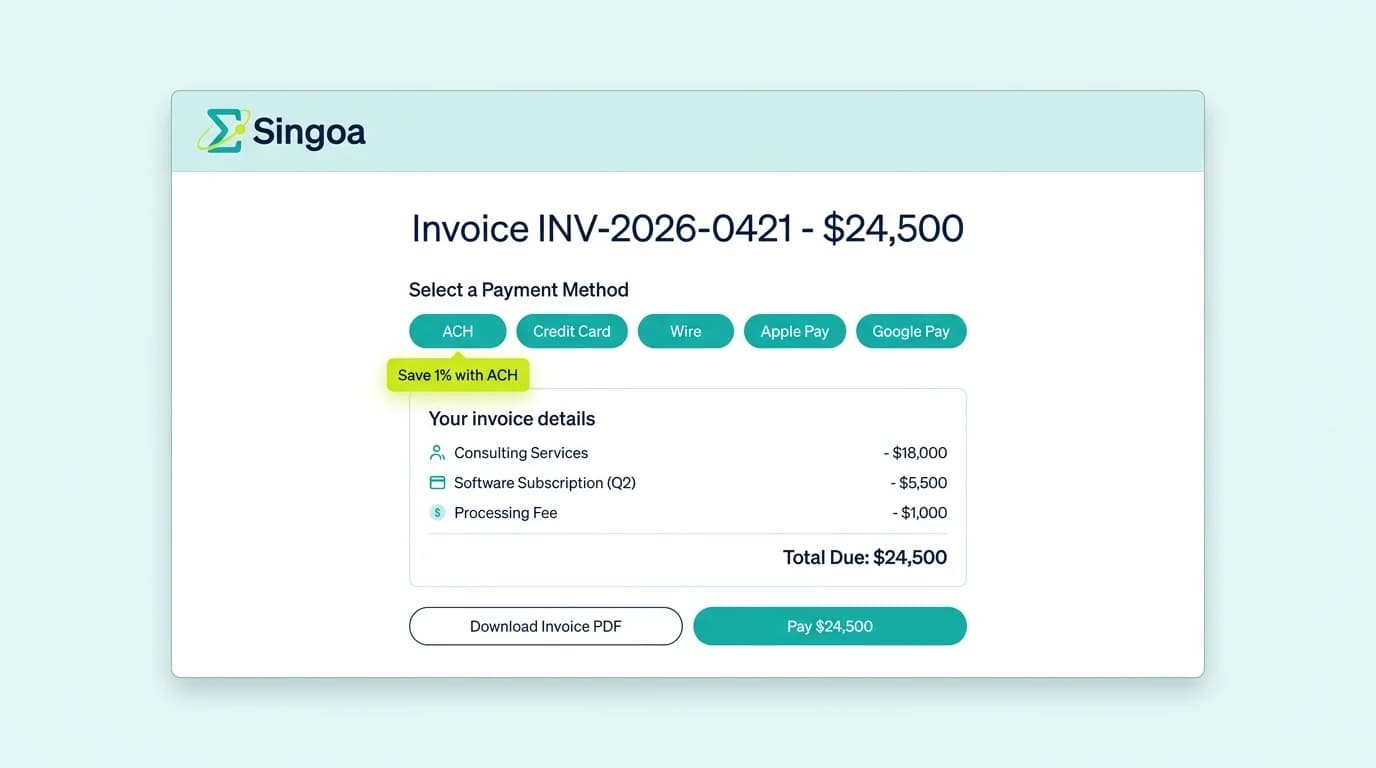
A branded self-service payment portal solves these friction points comprehensively. Customers click a link directly from their invoice email, see all open invoices in one place, and pay immediately via ACH, credit card, debit card, wire transfer, or digital wallet, whatever their AP department prefers. No login is required for one-time payments. No phone calls to your AR team asking for invoice copies. The portal handles payment plans, partial payments, and dispute submissions entirely without human intervention on your side, freeing your team for higher-value activities.
The data strongly supports this approach: organizations that implemented customer-facing payment portals reduced their average DSO by 12-18 days within the first quarter, according to Ardent Partners' 2025 AP/AR benchmark study. The portal also provides real-time payment visibility, your team sees payment initiations instantly, not 3-5 business days later when the bank file finally processes. This accelerates cash application and improves the accuracy of your weekly cash flow forecasts, giving your CFO the predictability they need for strategic planning.
- Omnichannel payment acceptance (ACH, card, wire, digital wallet) collects 25% faster (PYMNTS, 2025)
- Self-service portals eliminate phone calls and email requests for invoice copies
- No-login payment links reduce friction to a single click for your customers
- Real-time payment visibility accelerates cash application by 3-5 business days
- Payment portals reduce DSO by 12-18 days within the first quarter (Ardent Partners, 2025)
Pro Tip
Include a direct 'Pay Now' link in every invoice email and every payment reminder. Companies that embed payment buttons directly in email notifications see 45% higher payment conversion rates than those requiring customers to log into a separate portal, according to Versapay's 2025 payment experience survey.
Strategy 5: Accelerate Cash Application with AI Payment Matching
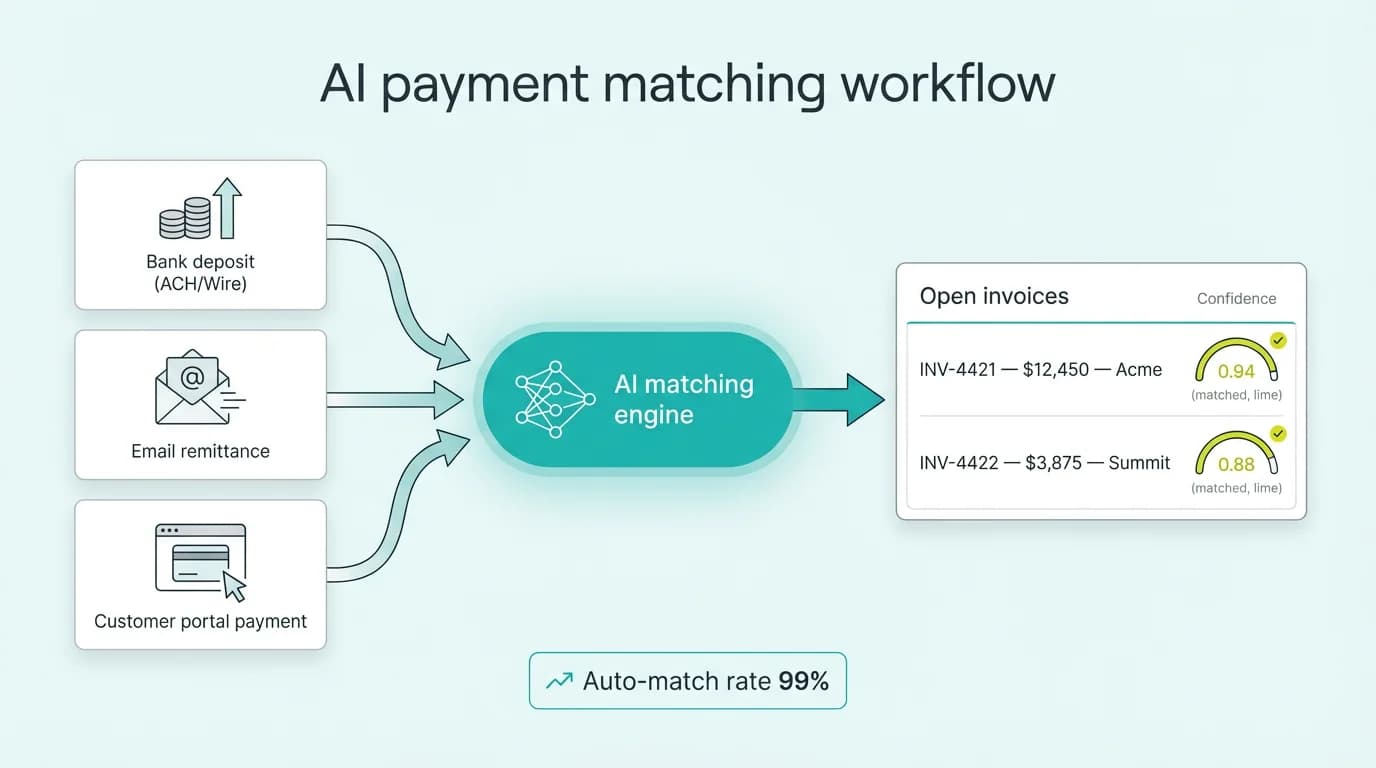
Cash application, the process of matching incoming payments to open invoices, is one of the most time-consuming bottlenecks in the entire accounts receivable cycle. Manual matching requires AR staff to cross-reference bank deposits with remittance details, customer PO numbers, and invoice amounts. When customers send lump-sum payments covering multiple invoices, or deduct amounts for early payment discounts, the matching complexity multiplies. According to the Institute of Finance and Management (IOFM, 2025), manual cash application takes an average of 4.2 days per payment cycle for mid-market companies.
AI-powered payment matching eliminates this bottleneck. Machine learning models analyze remittance data, payment amounts, customer history, and invoice details to automatically match payments to the correct invoices at 99%+ straight-through processing accuracy. Payments that would take an AR analyst 15-30 minutes to research and post are matched in seconds. SINGOA's [AI Payment Matching](/features), for example, achieves 99.2% accuracy across diverse payment types including partial payments, combined payments, and short-pays, reducing the manual cash application backlog that inflates DSO artificially.
The DSO impact of faster cash application is often underestimated. Every day a payment sits unmatched is a day it does not reduce your DSO, even though the customer has already paid. For companies processing 500+ payments per month, accelerating cash application from 4 days to same-day posting effectively reduces reported DSO by 3-4 days with zero change in customer payment behavior. That alone frees $82,000-$110,000 in working capital for a $10M revenue company, simply by posting cash faster through intelligent automation.
- Manual cash application takes an average of 4.2 days per cycle for mid-market companies (IOFM, 2025)
- AI payment matching achieves 99%+ straight-through processing accuracy
- Same-day cash posting reduces reported DSO by 3-4 days with no change in customer behavior
- Partial payments, combined payments, and short-pays are matched automatically
- AR staff time on cash application drops by 70-80% with AI automation
Strategy 6: Tighten Credit Policies with Predictive Analytics
The fastest path to lower DSO often starts before an invoice is ever created, at the credit approval stage. Companies that extend standard net-60 terms to every customer regardless of payment history, financial health, or industry risk are building DSO problems into their revenue pipeline from day one. According to the National Association of Credit Management (NACM, 2025), companies using data-driven credit policies achieve DSO 20-30% lower than peers relying on manual credit reviews and gut-feel term decisions.
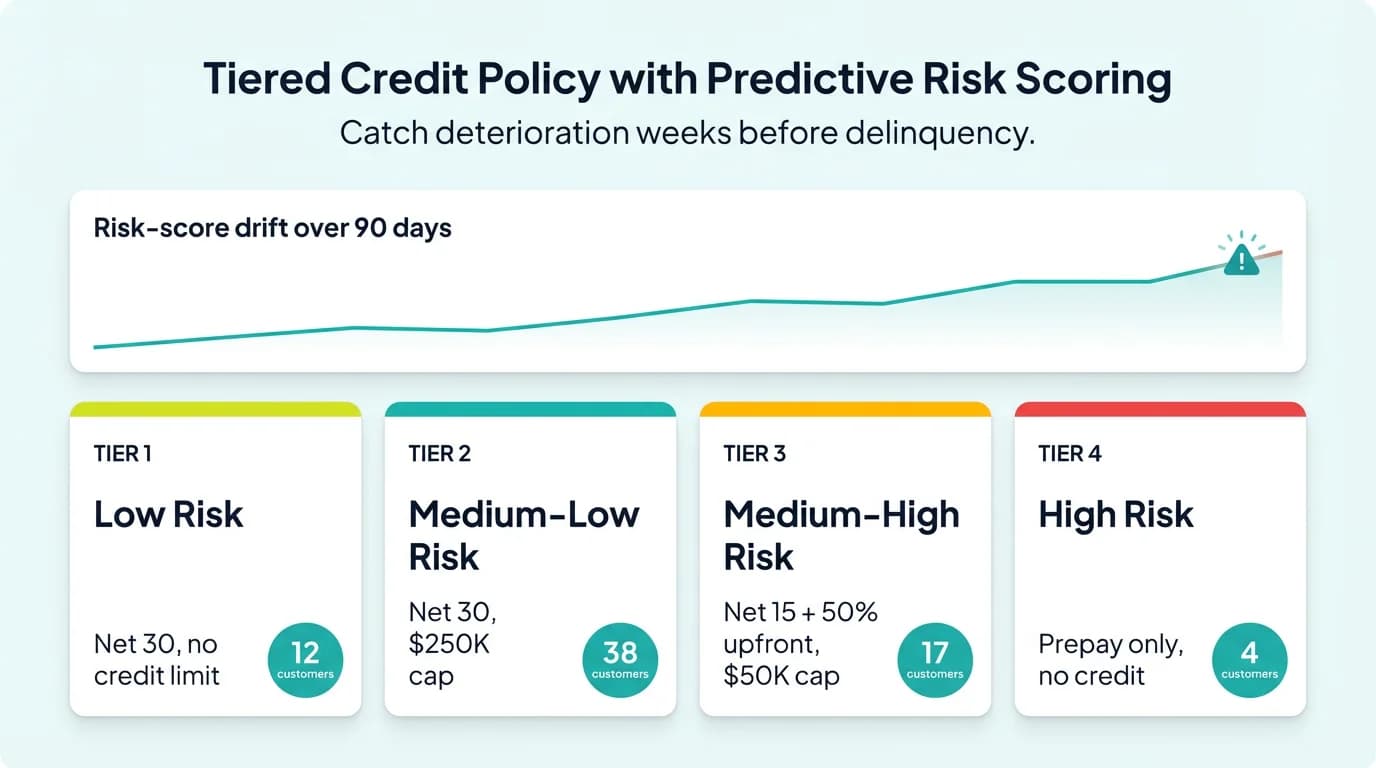
Predictive credit scoring transforms the credit approval process from a one-time checkbox into a continuous risk assessment. [AI risk scoring](/features) models analyze payment history trends, public financial filings, industry default rates, and real-time behavioral signals to assign dynamic risk scores to every customer account. A customer who paid reliably for 18 months but recently started slipping from net-30 to net-55 gets flagged automatically, not at the next quarterly credit review. This early detection window of 30-45 days before delinquency lets your team intervene proactively with adjusted terms or accelerated collection cadences.
Here is the practical application: instead of offering every customer net-45 terms, use risk scoring to tier your payment terms. Low-risk customers with strong payment history earn net-45 or net-60. Medium-risk accounts get net-30 with automated reminders starting at day 15. High-risk or new accounts start with net-15 or require deposits. This risk-aligned approach reduces your DSO without damaging relationships with your best customers. According to Dun and Bradstreet's 2025 credit risk report, tiered credit policies reduce average DSO by 8-12 days and bad debt write-offs by 35% compared to flat-term policies.
- Data-driven credit policies achieve DSO 20-30% lower than manual credit reviews (NACM, 2025)
- Predictive scoring identifies deteriorating accounts 30-45 days before delinquency
- Tier payment terms by risk: net-15 for high-risk, net-30 for medium, net-45+ for low-risk
- Dynamic risk scores update continuously rather than only at quarterly credit reviews
- Tiered credit policies reduce bad debt write-offs by 35% (Dun & Bradstreet, 2025)
Pro Tip
Review and adjust credit limits quarterly, not annually. Customer financial health changes faster than most companies monitor it. Automated credit monitoring tools flag material changes, missed payments to other vendors, credit rating downgrades, legal filings, so your team can adjust terms before a problem becomes a write-off.
Strategy 7: Offer Strategic Early Payment Incentives
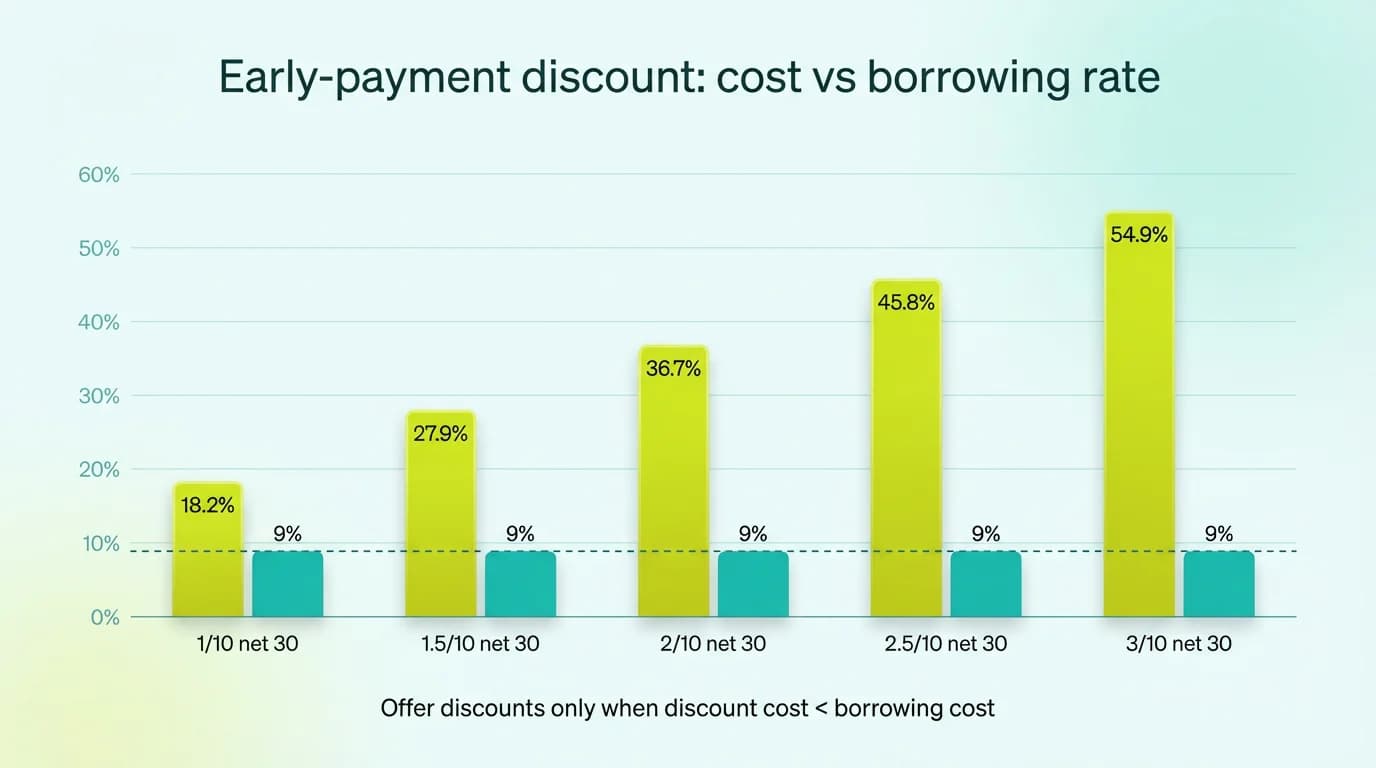
Early payment discounts remain one of the most straightforward DSO reduction tools available, yet many mid-market companies either do not offer them or structure them ineffectively. A standard 2/10 net-30 discount, 2% off for payment within 10 days, otherwise full amount due in 30, costs you 2% of invoice value but accelerates cash collection by 20+ days. According to Deloitte's 2025 working capital study, the annualized cost of borrowing to cover a 20-day cash shortfall at current interest rates (7-9% for most mid-market credit lines) exceeds 1.1%. The math strongly favors offering the discount.
The real value of early payment incentives is not the individual discount. It is the behavior change they create. Once a customer's AP department adds you to their early-pay vendor list, your invoices get prioritized in their payment queue permanently. According to TreviPay's 2025 B2B payment behavior analysis, 68% of customers who take an early payment discount on their first three invoices continue paying early even after the discount is removed. The upfront cost buys a permanent DSO improvement for that customer relationship.
Structure your discounts strategically rather than offering a blanket discount to every customer. Target discounts at your highest-DSO customer segments where accelerated payment creates the largest working capital impact. Offer dynamic discounts that scale: 2% for payment within 10 days, 1% for payment within 20 days. This sliding scale captures customers at every decision point. Track discount capture rates monthly, if fewer than 30% of eligible customers are taking discounts, the terms may need adjustment. If more than 80% are capturing them, you may be leaving margin on the table unnecessarily.
- 2/10 net-30 discounts accelerate cash collection by 20+ days for participating customers
- Annualized borrowing cost to cover a 20-day shortfall exceeds 1.1%, discounts are cheaper (Deloitte, 2025)
- 68% of customers who take early discounts on their first 3 invoices continue paying early permanently (TreviPay, 2025)
- Target discounts at your highest-DSO customer segments for maximum working capital impact
- Sliding-scale discounts (2%/10 days, 1%/20 days) capture more customers than a single threshold
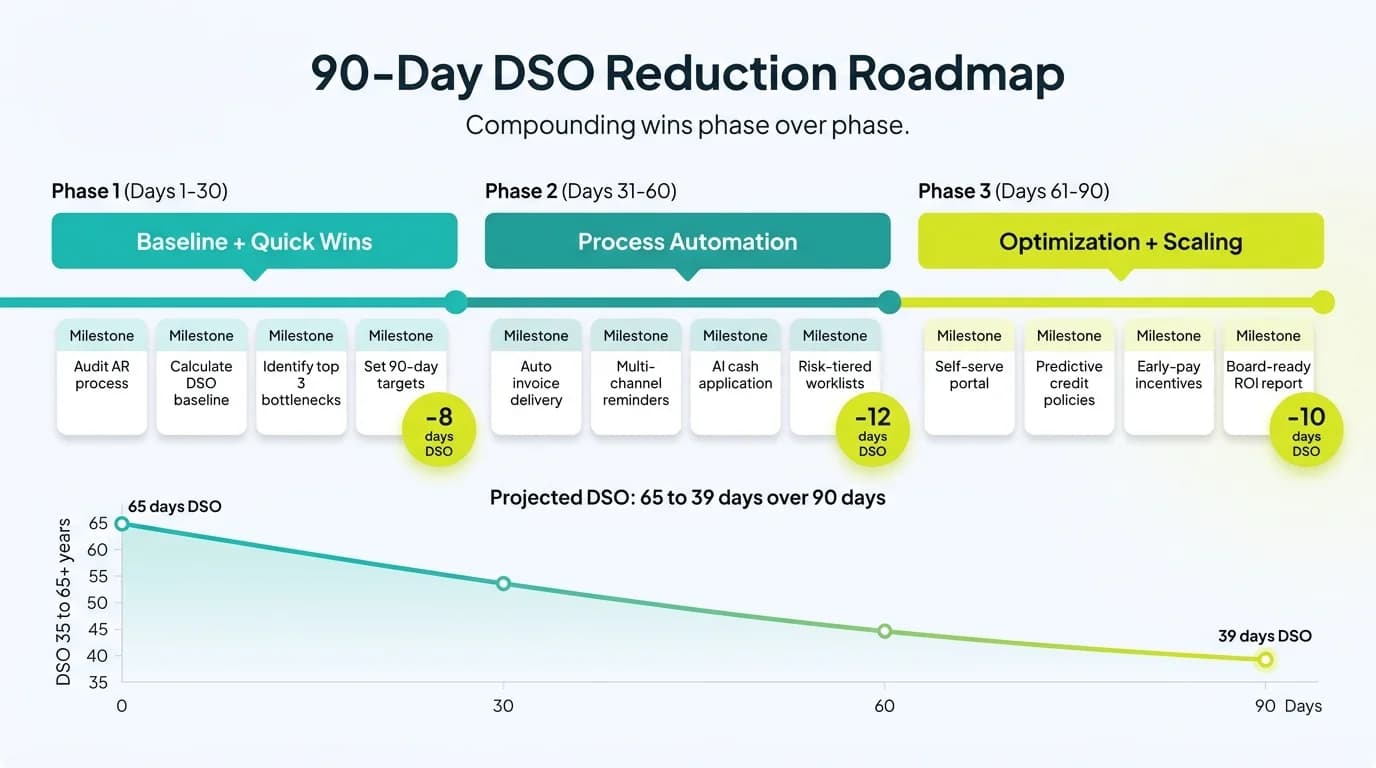
Your 90-Day DSO Reduction Roadmap
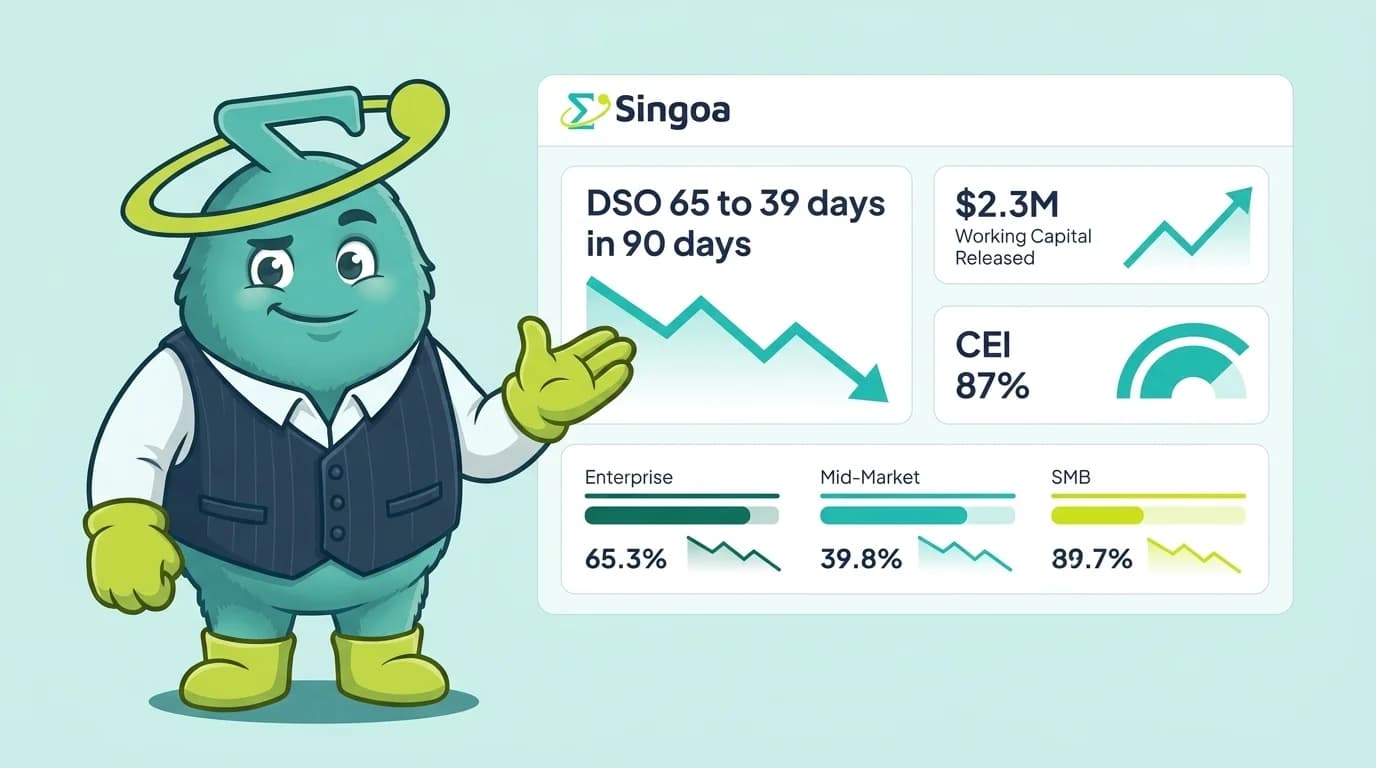
Implementing all seven strategies simultaneously overwhelms teams and delays results. The most effective approach is phased deployment, stacking each strategy on the results of the previous one. Based on SINGOA platform data across mid-market implementations, companies that follow a 30-60-90 day phased approach achieve 25-40% DSO reduction within the first quarter, versus only 10-15% for companies that attempt everything at once. Phase 1 (days 1-30) focuses on your baseline calculation, dunning automation, and payment portal deployment, the three strategies with the fastest time to impact.
Phase 2 (days 31-60) adds risk-based collections prioritization and AI payment matching. By this point, your automated reminders are already generating data on customer response patterns, which the AI risk scoring uses to fine-tune its prioritization models. Your payment portal is capturing payment preference data that accelerates future collections. Phase 3 (days 61-90) introduces credit policy adjustments and early payment incentives, the strategies that require the most customer-facing communication and internal policy alignment. By month three, all seven strategies are working together as an integrated system.
Measure your progress weekly against the specific DSO target you set in Strategy 1. If you started at 65 days and targeted a 25% reduction, your goal is 49 days by day 90. Track not just the headline DSO number but also supporting metrics: collection effectiveness ratio, average days delinquent, percentage of current AR, and cost per invoice. These leading indicators tell you whether your trajectory is on target before the DSO number itself moves. Companies that track these weekly metrics are 3x more likely to hit their 90-day DSO target, according to AFP's 2025 benchmarking survey.
- Phase 1 (Days 1-30): Baseline calculation + dunning automation + payment portal deployment
- Phase 2 (Days 31-60): Risk-based collections prioritization + AI payment matching
- Phase 3 (Days 61-90): Credit policy adjustments + early payment incentive programs
- Phased deployment achieves 25-40% DSO reduction vs. 10-15% for simultaneous rollout
- Track weekly: DSO, collection effectiveness ratio, average days delinquent, cost per invoice
Step-by-Step Process
Audit Your Current AR Process and Calculate DSO
Map every step from invoice creation to cash receipt. Identify manual bottlenecks: delayed invoice delivery, inconsistent follow-up, slow payment posting. Calculate your current DSO using the standard formula and benchmark against your industry average. This baseline reveals exactly where to focus first.
- Calculate current DSO from your ERP: (AR / Total Credit Sales) x Days
- Map the invoice-to-cash timeline and measure days at each step
- Identify the top 3 manual bottlenecks slowing your cash cycle
- Benchmark against industry DSO averages (Construction: 60-90d, Manufacturing: 45-60d, SaaS: 30-45d)
Deploy Automated Multi-Channel Dunning Sequences
Configure payment reminders that fire automatically at 7 days before due, on the due date, and at escalating intervals after. Use email, SMS, and portal notifications. Segment by customer risk tier. This single change typically recovers 30% more past-due invoices within the first 30 days.
- Set up pre-due reminders at 7-day and 3-day marks before the due date
- Configure multi-channel delivery: email, SMS, and portal notification
- Segment customers into risk tiers with different dunning cadences
- Set escalation triggers: auto-escalate to account manager at 45 days past due
Launch Self-Service Payment Portal
Give customers a branded portal to view invoices, pay via their preferred method, set up payment plans, and submit disputes. Embed 'Pay Now' links in all invoice emails. This removes payment friction and accelerates collection by 12-18 days on average within the first quarter.
- Set up branded payment portal with your company logo and colors
- Enable multiple payment methods: ACH, credit card, wire, digital wallet
- Embed direct 'Pay Now' links in every invoice email and reminder
- Configure self-service dispute submission to reduce phone call volume by 40%+
Activate AI Risk Scoring and Collections Prioritization
Replace manual aging report reviews with AI-driven prioritization. Connect risk scoring to your AR data so the system surfaces a daily worklist of highest-priority accounts. Your team focuses on accounts that need human judgment, while automation handles routine follow-ups.
- Connect AI risk scoring to your AR and payment history data
- Configure daily prioritized worklist delivery for your collections team
- Set risk thresholds: green (auto-remind), yellow (monitor), red (immediate action)
- Track collections effectiveness per FTE hour as your primary productivity metric
Measure Weekly, Optimize Monthly, Scale Quarterly
Track DSO weekly alongside supporting metrics: collection effectiveness ratio, average days delinquent, and cost per invoice. A/B test dunning timing and messaging monthly. Review AI model accuracy quarterly. Target 80%+ of routine collections handled by automation within 90 days.
- Set up weekly DSO tracking dashboard with customer segmentation
- A/B test reminder timing, subject lines, and channel preferences monthly
- Review and retrain AI risk scoring models quarterly
- Target: 80%+ of routine collections activity handled by automation within 90 days
| Metric | Manual AR Process | AI-Automated AR | Improvement |
|---|---|---|---|
| Average DSO | 55-83 days | 33-52 days | 25-40% reduction |
| Cost per invoice | $12-40 | $1-3 | 75-95% reduction |
| Payment reminder speed | 2-5 days after due | Instant (pre-programmed) | 100% faster |
| Payment matching accuracy | 92-95% | 99.2%+ | 4-7% improvement |
| Collections per FTE/day | 15-25 accounts | 50-80 accounts | 3x throughput |
| Bad debt write-off rate | 4-6% of AR | 1.5-3% of AR | 35-50% reduction |
| Cash application time | 4.2 days average | Same day | 3-4 day acceleration |