
Quick Summary
The 10 essential AR KPIs are Days Sales Outstanding, Collection Effectiveness Index, Average Days Delinquent, Bad Debt Ratio, AR Turnover Ratio, Collection Effectiveness by Channel, Invoice Dispute Rate, Cost Per Invoice, Aging Bucket Distribution, and Cash Conversion Cycle.
Key Takeaways
- DSO alone is misleading without CEI. Pair both to separate payment terms from actual collections performance and identify problems 30 days earlier.
- CEI above 95% is top quartile. Below 80% signals systemic collections breakdown requiring immediate process review, according to NACM benchmarks.
- Bad debt ratio above 2% of annual revenue indicates credit risk management gaps, not just poor collections. AI risk scoring reduces write-offs by 30-50%.
- Cost per invoice above $10 makes a clear automation business case. Top AR operations average under $3 per invoice versus the $15-40 manual processing cost.
- Aging bucket distribution is the most actionable daily metric. More than 10% in 60+ day buckets demands immediate escalation to prevent compounding losses.
- Cash Conversion Cycle is the strategic metric boards care about. Each day of CCC reduction frees working capital equal to one day of revenue.
Track All 10 KPIs Automatically
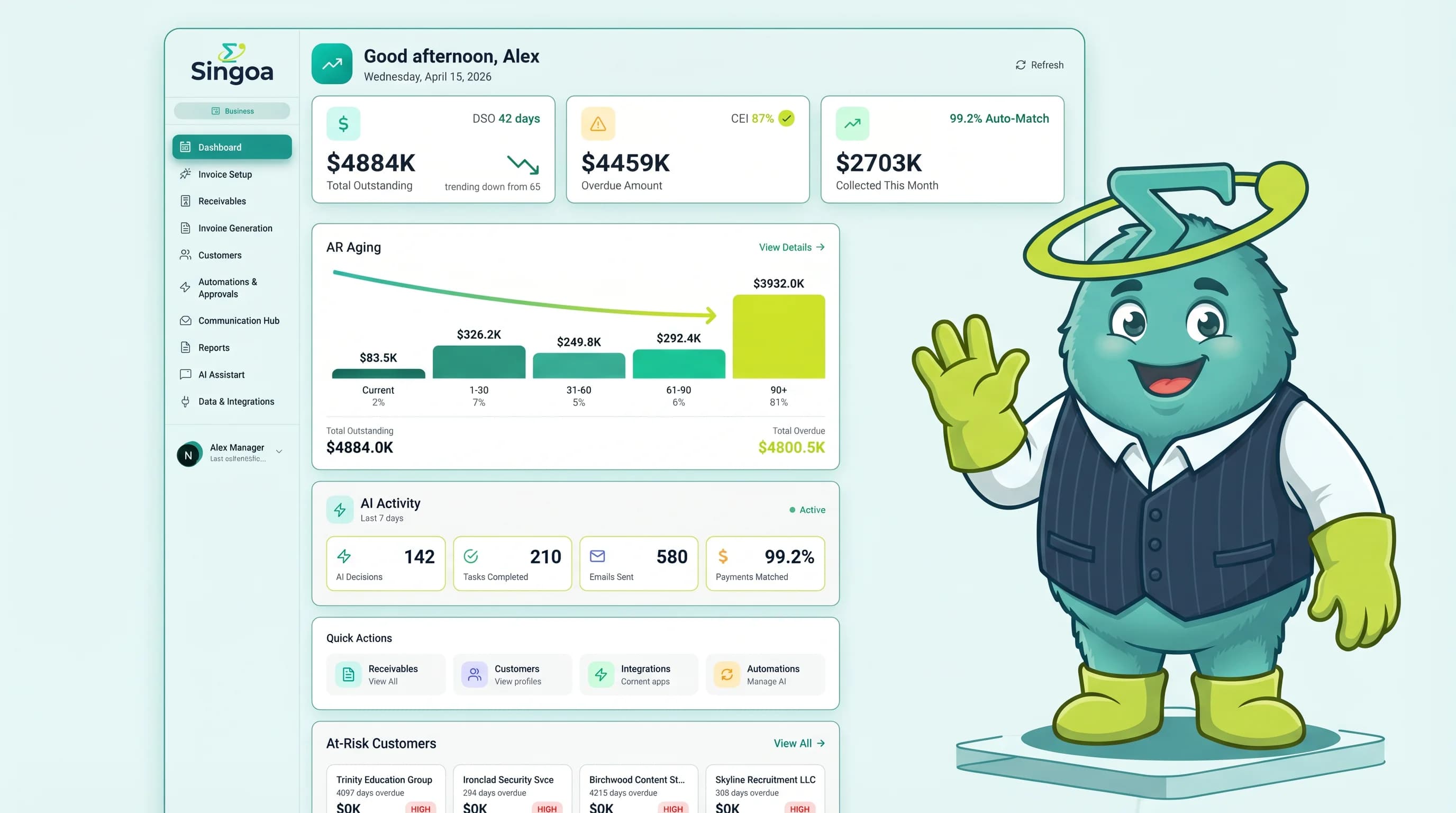
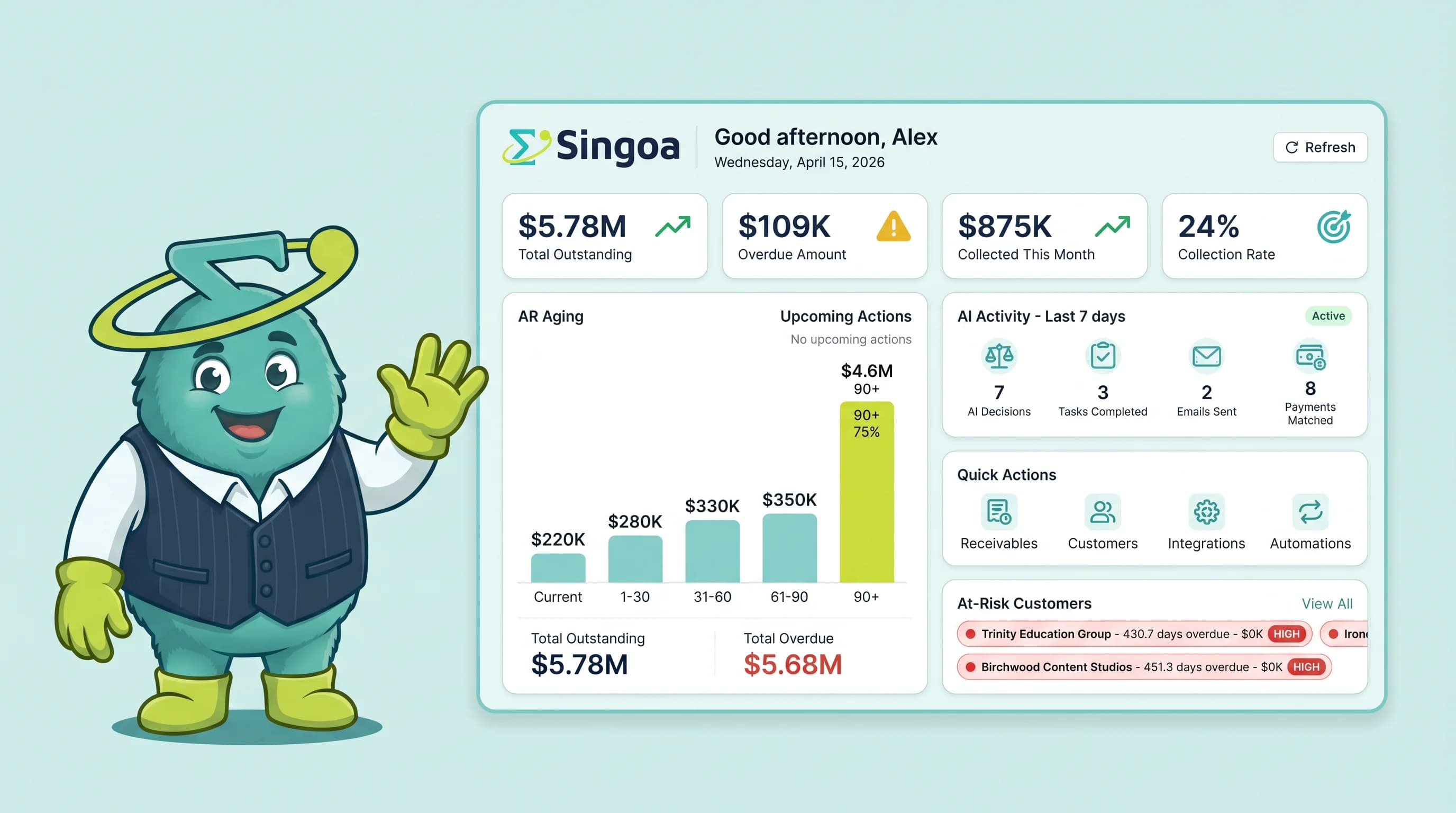
SINGOA's AI Report Builder calculates every metric in this guide from your live AR data, updated daily without manual spreadsheet work.
Days Sales Outstanding (DSO)
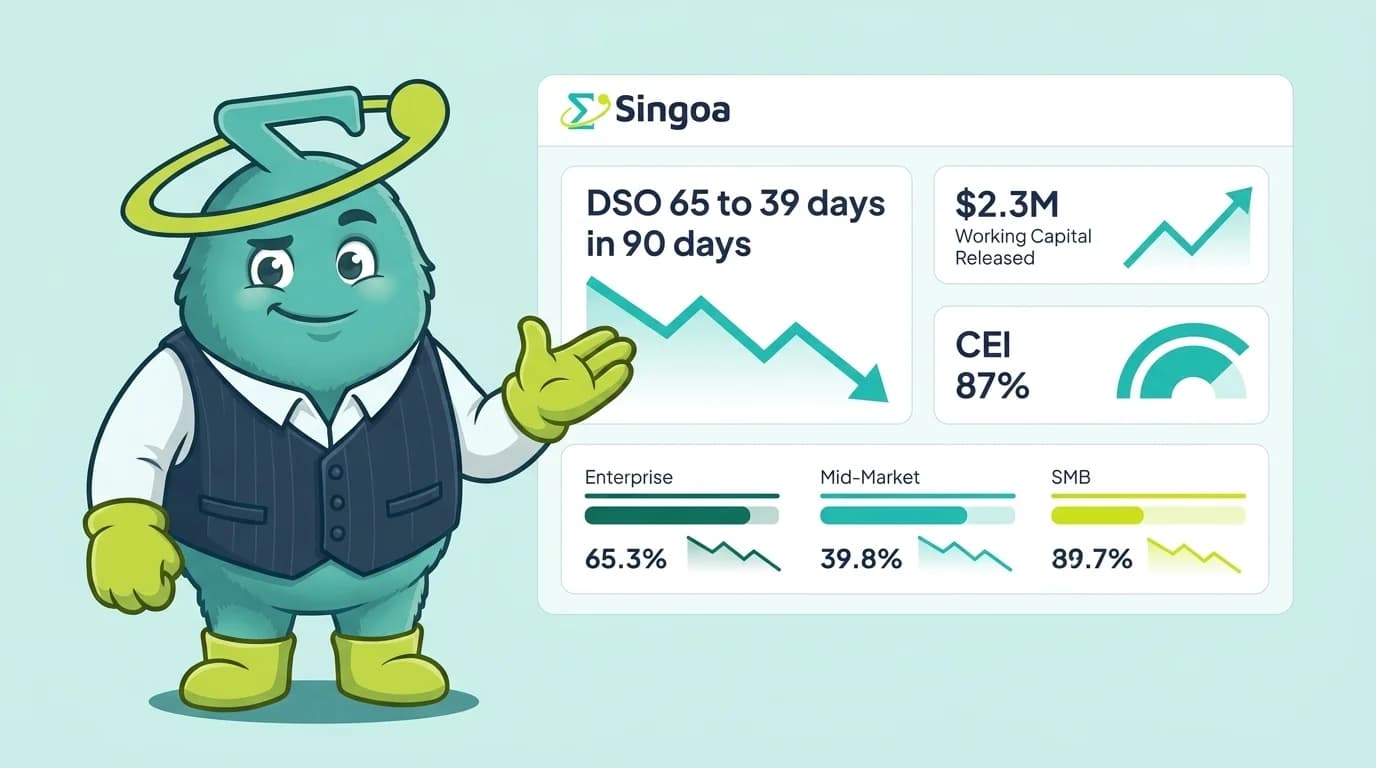
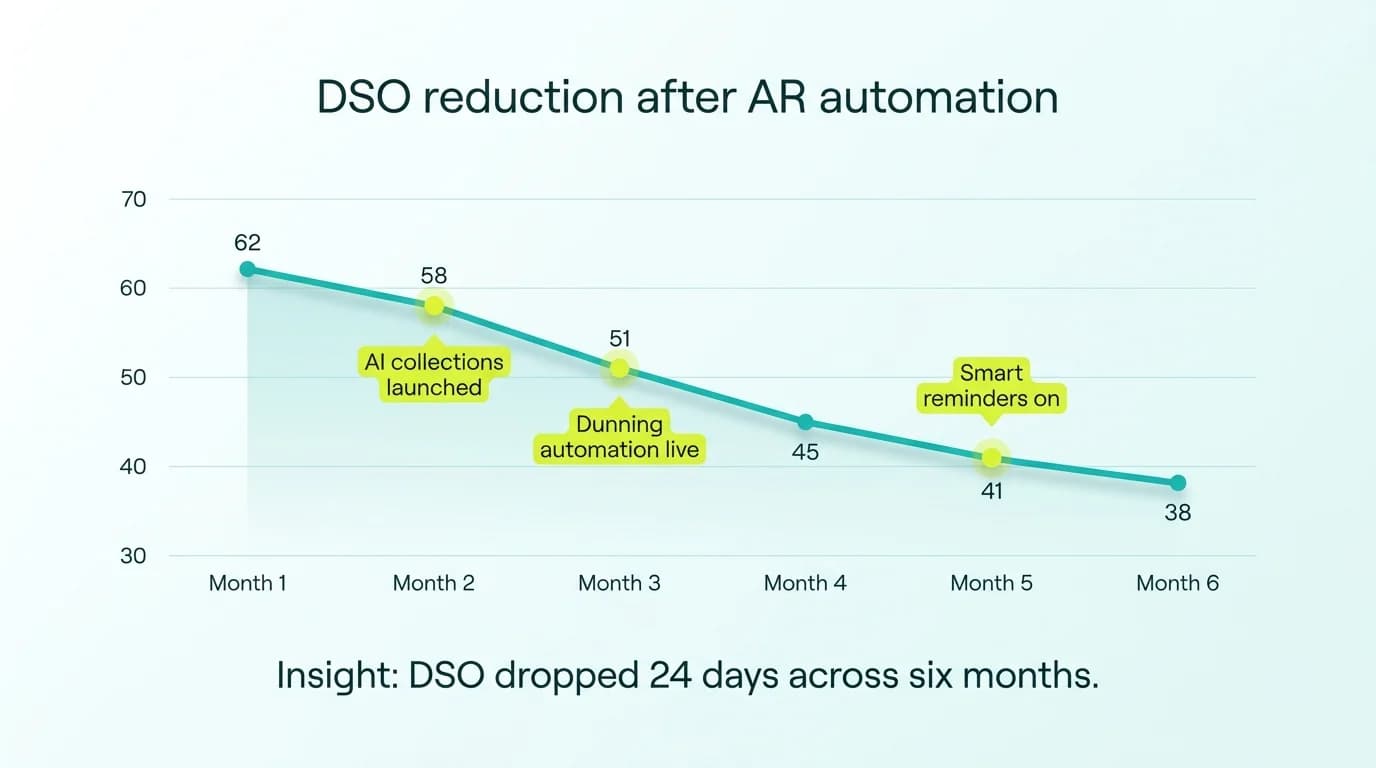
The most-cited AR metric measures how many days, on average, your company takes to collect payment after issuing an invoice.
The formula for DSO is straightforward: (Accounts Receivable / Net Credit Sales) multiplied by the Number of Days in the Period. Calculate DSO across trailing 30, 60, and 90-day windows to spot trends at different time horizons. A rising 30-day DSO while the 90-day number holds steady points to a recent deterioration in collections efficiency rather than a structural problem. This distinction matters because the corrective actions differ entirely. According to the Hackett Group's 2024 working capital survey, the median DSO across industries is 40 days.
Industry benchmarks from CreditPulse (2025) show wide variance: construction averages 60-90 days, manufacturing 45-60 days, healthcare 45-70 days, wholesale distribution 30-50 days, professional services 30-60 days, and SaaS 30-45 days. Your target should sit 15-25% below your industry average. Hitting that target releases working capital that compounds over every subsequent collection cycle, directly improving your cash position without requiring additional revenue growth.
Here is where most CFOs get tripped up. DSO blends payment terms and collections performance into a single number. A company offering 60-day terms with 65-day DSO is nearly on time. A company on 30-day terms with 65-day DSO has a severe collections problem. Separating DSO into 'current' (within terms) and 'delinquent' (past terms) gives a far more accurate picture. This is why DSO should never be tracked in isolation. Pair it with CEI and ADD for the complete view.
Pro Tip
Calculate Best Possible DSO alongside standard DSO using the formula: (Current AR / Net Credit Sales) x Days in Period. The gap between actual DSO and Best Possible DSO is your 'DSO gap,' representing the portion caused by collections inefficiency rather than payment terms. That gap is your controllable improvement opportunity.
Collection Effectiveness Index (CEI)
CEI measures the percentage of collectible receivables your team actually collected during a period, providing a purer gauge of collections performance than DSO.
CEI uses this formula: [(Beginning AR + Credit Sales - Ending Total AR) / (Beginning AR + Credit Sales - Ending Current AR)] x 100. A perfect score of 100% means every collectible dollar was collected on time. According to NACM's credit and collections benchmarking study, top-quartile companies maintain CEI above 95%, while the industry average for teams without automated collections hovers around 80-85%. The gap between these numbers represents real cash sitting uncollected in your receivables.
CEI eliminates the payment terms distortion embedded in DSO. Two companies can post identical DSO figures yet have radically different CEI scores if they operate on different payment terms. A manufacturer offering net-60 terms and a SaaS company on net-30 terms might both report 45-day DSO, but the manufacturer's CEI could be 98% while the SaaS firm's sits at 72%. CEI directly measures what your AR team controlled: what they collected versus what was available to collect.
Watch these red flags closely. CEI below 80% indicates systemic collections issues requiring a full process review, not just tactical fixes. A CEI declining month-over-month for three or more consecutive periods signals a worsening trend even when the absolute level appears acceptable. Track both the absolute level and the direction of change. A company with 88% CEI trending downward needs intervention sooner than one with 82% CEI trending upward.
Pro Tip
Calculate CEI separately by customer segment: top 20 accounts, mid-tier, and small accounts. You may discover that large strategic customers have lower CEI than smaller ones, indicating overly deferential collection behavior toward high-value relationships that is quietly draining your working capital.
Average Days Delinquent (ADD)
ADD isolates payment lateness from payment terms, revealing how many days past due invoices actually are when paid.
The formula is simple: ADD equals DSO minus Best Possible DSO. If your DSO is 58 days and your Best Possible DSO (based on current AR only) is 34 days, your ADD is 24 days. That means customers are paying, on average, 24 days after their invoice due date. This metric strips away the noise of varying payment terms and directly reflects the urgency your customers feel about paying you on time.
ADD above 15 days indicates meaningful room for improvement in your dunning process. ADD above 30 days suggests customers have learned they can pay late without consequences, which is a collections culture problem requiring both process change and selective enforcement. According to Atradius Payment Practices Barometer (2025), 50% of B2B invoices globally are paid late. Automated reminder sequences typically reduce ADD by 40-60% within the first dunning cycle by reaching customers before the habit of late payment becomes entrenched.
Track ADD by customer segment and by individual AR staff member to pinpoint where delinquency concentrates. The pattern often follows the 80/20 rule: 80% of delinquency traces back to 20% of customers or to specific account managers who avoid difficult collections conversations. Making ADD visible at the account-manager level creates accountability and reveals coaching opportunities that aggregate metrics cannot surface.
How Does Your AR Stack Up?
Compare your DSO, CEI, and collection effectiveness against 500+ mid-market companies in your industry.
Bad Debt Ratio
Bad Debt Ratio measures the percentage of receivables written off as uncollectible, directly reflecting credit risk management quality.
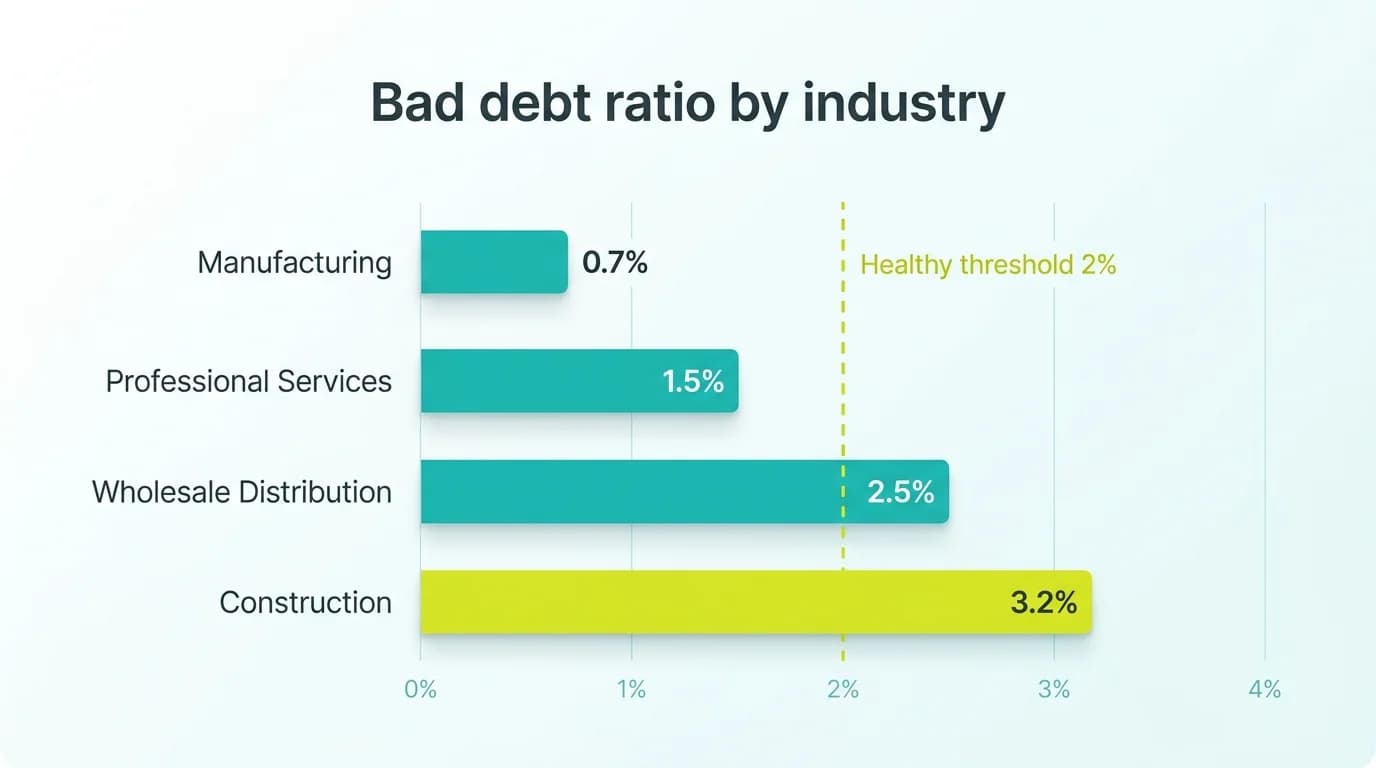
Calculate Bad Debt Ratio as (Bad Debt Write-Offs / Net Credit Sales) x 100. According to HighRadius's 2023 Fortune 1000 analysis, manufacturing companies average 0.07-1.37%, professional services 1-2%, wholesale distribution 2-3%, and construction 2.5-4%. Healthcare is an outlier at 0.25-55% depending on payer mix. A ratio above your industry benchmark signals either inadequate credit screening, delayed collections action, or both working against your cash position simultaneously.
Bad Debt Ratio is a lagging indicator. Today's write-offs reflect credit decisions you made 90-180 days ago. The leading indicators that predict future bad debt are the percentage of AR sitting in the 90+ day aging bucket and the trend direction of customer risk scores. AI-powered credit scoring platforms reduce bad debt write-offs by 30-50% by flagging deteriorating accounts before they cross the uncollectible threshold. According to Gartner's 2024 finance technology survey, companies using predictive credit analytics cut unexpected write-offs by 38%.
For board-level reporting, track Allowance for Doubtful Accounts as a percentage of gross AR alongside the Bad Debt Ratio. Best practice calls for a roll-rate method that applies historical write-off rates to each aging bucket individually rather than applying a flat percentage to total AR. The roll-rate approach accurately reflects risk distribution and prevents both over-provisioning (which depresses reported earnings) and under-provisioning (which creates audit surprises).
Pro Tip
Review bad debt write-offs monthly by customer industry and company size. Patterns reveal whether credit problems are systemic (concentrated in one customer industry during a downturn) or idiosyncratic (scattered across customers that passed screening but changed behavior). Systemic patterns demand policy changes. Idiosyncratic patterns demand individual account management.
AR Turnover Ratio
AR Turnover measures how many times per year you collect your average receivables balance, with higher numbers indicating faster collection velocity.
The formula is Net Credit Sales divided by Average Accounts Receivable (beginning balance plus ending balance, divided by two). An AR Turnover of 8 means you collect your average receivables balance 8 times per year, equivalent to roughly 45-day DSO. A turnover of 12 maps to approximately 30 days. A turnover of 6 maps to 60 days. Higher is better, with industry benchmarks providing the reference point for performance evaluation.
AR Turnover is the version of DSO used in financial ratio analysis and external credit assessment. Banks, investors, and rating agencies include it in liquidity analysis when evaluating your company's creditworthiness. According to JPMorgan's 2024 working capital benchmarking study, maintaining AR Turnover at or above the industry median is a prerequisite for favorable credit terms and investment-grade financial health assessments from lenders and institutional investors.
Trend analysis delivers more value than the absolute number alone. A declining trend where turnover falls from 9 to 8 to 7 over three consecutive quarters signals deteriorating collections effectiveness before DSO formally breaches your alarm threshold. Include a rolling 12-month AR Turnover trend chart in your quarterly board reporting alongside the headline DSO figure to give the board a forward-looking indicator rather than a backward-looking snapshot.
Collection Effectiveness by Channel
Measuring collection rates by outreach channel (email, SMS, phone, portal) reveals where your dunning investment delivers the highest return on effort.
Track conversion rate (payment within 7 days of contact) separately for each channel. The five channels worth measuring are email reminders, SMS notifications, phone calls, payment portal prompts, and escalated account manager outreach. According to PYMNTS' 2024 B2B Payments report, SMS reminders and payment portal links generate 40-60% higher conversion rates than email-only outreach across mid-market companies. Yet email remains the dominant collections channel at most organizations purely due to inertia rather than effectiveness data.
Channel effectiveness varies by customer segment and invoice size. Enterprise customers tend to respond better to account manager-initiated calls for invoices above $50,000. SMB customers convert at higher rates through self-service portal links and automated SMS reminders. Mapping channel effectiveness by customer segment enables intelligent routing: automated channels handle routine follow-up while human outreach focuses on strategic accounts and large-balance exceptions, maximizing the return on every hour your team invests.
AI-powered AR platforms like SINGOA track channel-level metrics automatically, surfacing the data finance teams need to optimize their dunning mix without building separate tracking spreadsheets. The platform analyzes which channel, tone, and timing combination produces the highest collection probability for each customer profile, then routes outreach accordingly. This behavioral approach to [collections](/features) turns a static dunning sequence into an adaptive system that improves with every interaction.
Pro Tip
Measure channel effectiveness by net revenue collected per outreach contact, not just raw conversion rate. A phone call with 80% conversion on $500 invoices generates less revenue per hour than an SMS with 30% conversion on $5,000 invoices. Allocate your channel investment by value-adjusted effectiveness, not by conversion rate alone.
Invoice Dispute Rate
Dispute Rate tracks the percentage of invoices disputed by customers, bridging AR performance and upstream billing process quality.
Calculate Invoice Dispute Rate as (Number of Disputed Invoices / Total Invoices Issued) x 100. A rate above 3% typically points to billing process problems upstream of AR: pricing mismatches, data entry errors, quantity discrepancies, or delivery issues that create legitimate customer objections. According to the Aberdeen Group's 2024 order-to-cash study, rates above 5% require a root cause audit across the full quote-to-cash process, not just AR-level remediation efforts.
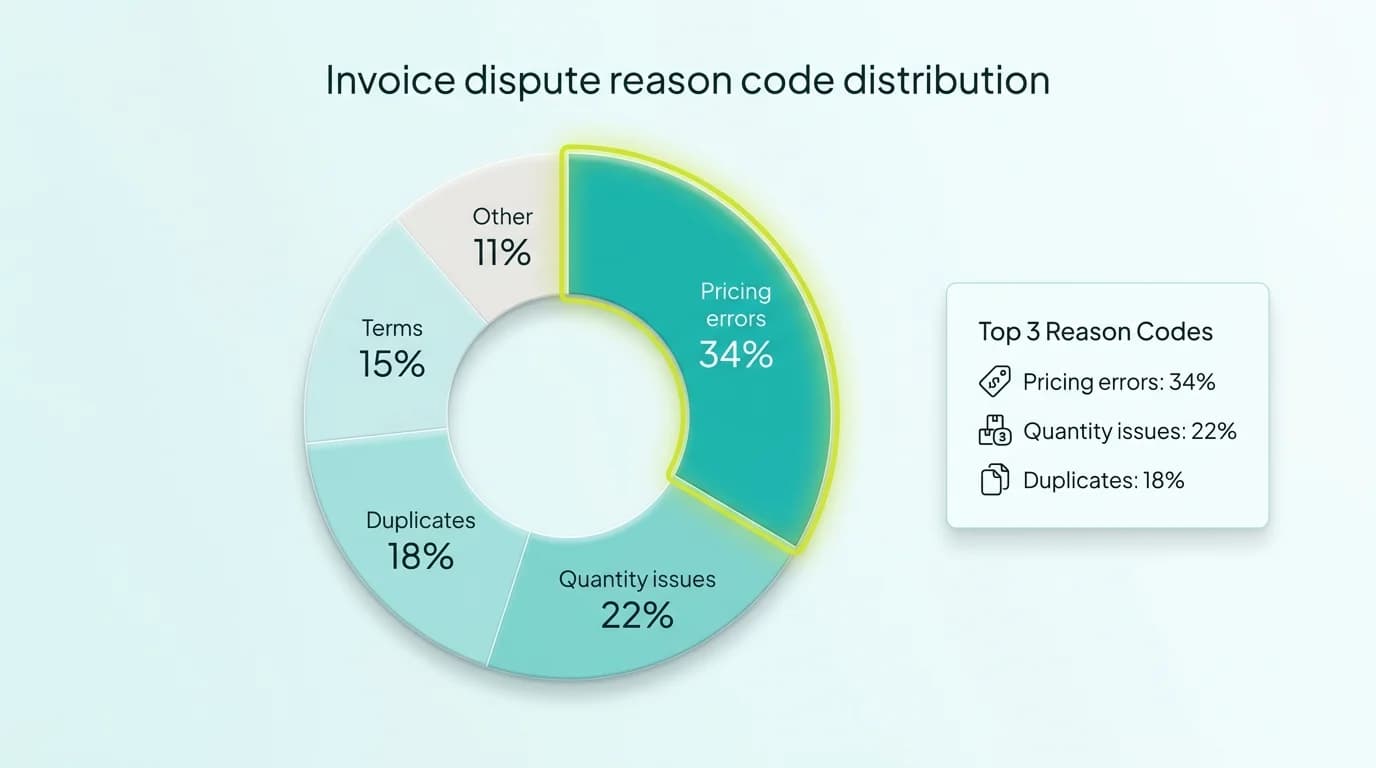
Classify every dispute by reason code: pricing errors, quantity discrepancies, duplicate invoices, terms disagreements, and service quality issues. The distribution across reason codes reveals which upstream process needs attention. Pricing errors originating from manual ERP data entry require automation at the billing stage. Delivery disputes require tighter integration between operations and your billing system. Without reason code classification, your AR team treats symptoms instead of causes.
Dispute resolution time matters as much as dispute rate itself. An average resolution cycle above 15 days ties up cash and erodes customer trust. Automated dispute workflows route each dispute to the correct internal owner immediately, track resolution against SLAs, and escalate overdue items. According to Esker's 2024 AR benchmark report, automated dispute management cuts average resolution time from 30+ days to 8-12 days, releasing trapped cash 60% faster than manual processes.
Pro Tip
Run a quarterly dispute reason code review with your VP of Sales or Head of Operations. AR disputes are often the symptom; the root cause lives in quoting, contract management, or order fulfillment. Making dispute data visible to non-finance stakeholders creates cross-functional pressure to fix upstream problems faster than AR-only fixes ever could.
Cost Per Invoice
Cost Per Invoice captures the fully loaded cost of processing one invoice through your AR cycle and provides the clearest ROI case for automation.
The formula is Total AR Operations Cost divided by Total Invoices Processed. Include AR staff salaries and benefits, postage and printing, software subscriptions, and an allocation of management oversight time. According to IOFM benchmarks, top-quartile AR operations process invoices at under $5 each. Average performers land at $12-18 per invoice. Companies running primarily manual processes spend $15-40 per invoice when all costs are accounted for, including the hidden cost of error correction cycles.
The cost gap between manual and automated processing is the most defensible number in any AR automation business case. A company processing 2,000 invoices monthly at $25 average cost spends $600,000 annually on AR operations. At $2 per invoice with an automated platform, that drops to $48,000, representing $552,000 in annual savings before factoring in working capital improvements or bad debt reduction. [SINGOA's per-invoice pricing](/pricing) of $1-3 with no setup fees makes this calculation straightforward for mid-market finance teams evaluating the switch.
Track cost per invoice by invoice type in addition to the overall average. Complex invoices with multiple line items, custom billing formats, or high dispute rates cost significantly more than standard invoices. Identifying your highest-cost invoice types focuses your automation investment on the segments delivering the highest return, allowing you to prioritize implementation where the payback period is measured in weeks rather than months.
Aging Bucket Distribution
Aging Distribution shows the percentage of total AR in each time-past-due bucket and serves as the most actionable daily AR management metric.
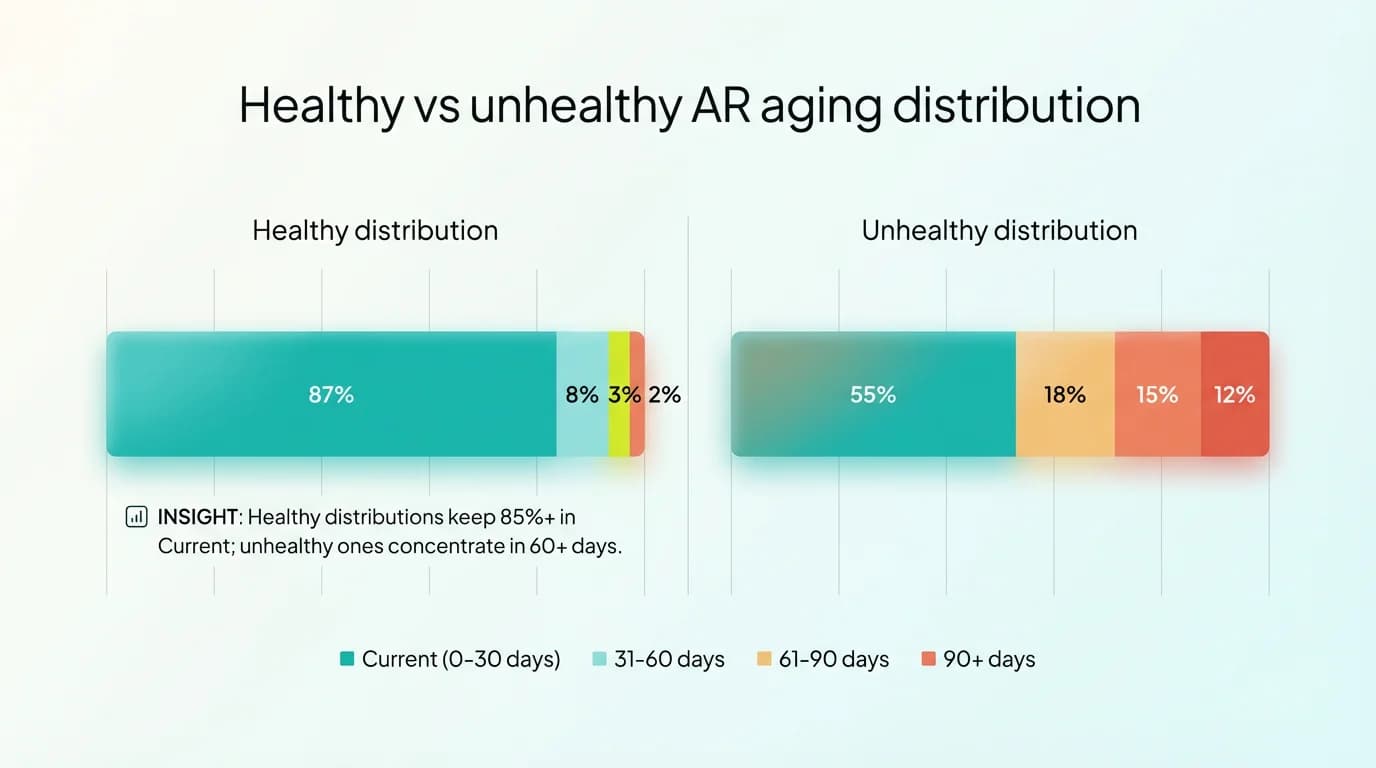
Standard aging buckets are Current (0-30 days), 31-60 days, 61-90 days, and 90+ days. Healthy targets from NACM benchmarks: 85%+ current, under 8% in 31-60, under 5% in 61-90, under 2% in 90+. Companies with weak collections discipline routinely see 20-30% of AR concentrated in 60+ day buckets, representing both a cash flow risk and an elevated bad debt probability that compounds with each passing week.
Aging distribution functions as a leading indicator for both cash flow and bad debt. According to the Credit Research Foundation's 2024 analysis, invoices reaching the 60-day bucket have a statistically lower collection probability than those at 30 days. At 90+ days, collection probability drops below 50% for most industries. Automated systems detect when accounts approach the 30-day mark and intensify outreach before aging progresses, preventing the compounding cycle where delinquent invoices quietly become uncollectible invoices.
Always review aging distribution by both invoice count and dollar value, not just one dimension. An aggregate that looks healthy can mask concentration risk: a handful of large customers sitting in the 90+ bucket can represent 40% of total AR value while appearing as a small percentage of invoice count. The dollar-weighted view reveals the risk concentration that the count-weighted view hides. Build your [AR reporting dashboard](/features) to display both views side by side.
Pro Tip
Set automated alerts for any single customer whose AR exceeds a defined threshold in the 61-90 day bucket. The threshold should match your bad debt tolerance, typically the dollar amount you cannot write off without material financial impact. Early alert systems catch single-customer credit deterioration before it reaches write-off levels.
Cash Conversion Cycle (CCC)
Cash Conversion Cycle combines AR, inventory, and accounts payable into the complete measure of how efficiently your business converts operations into cash.
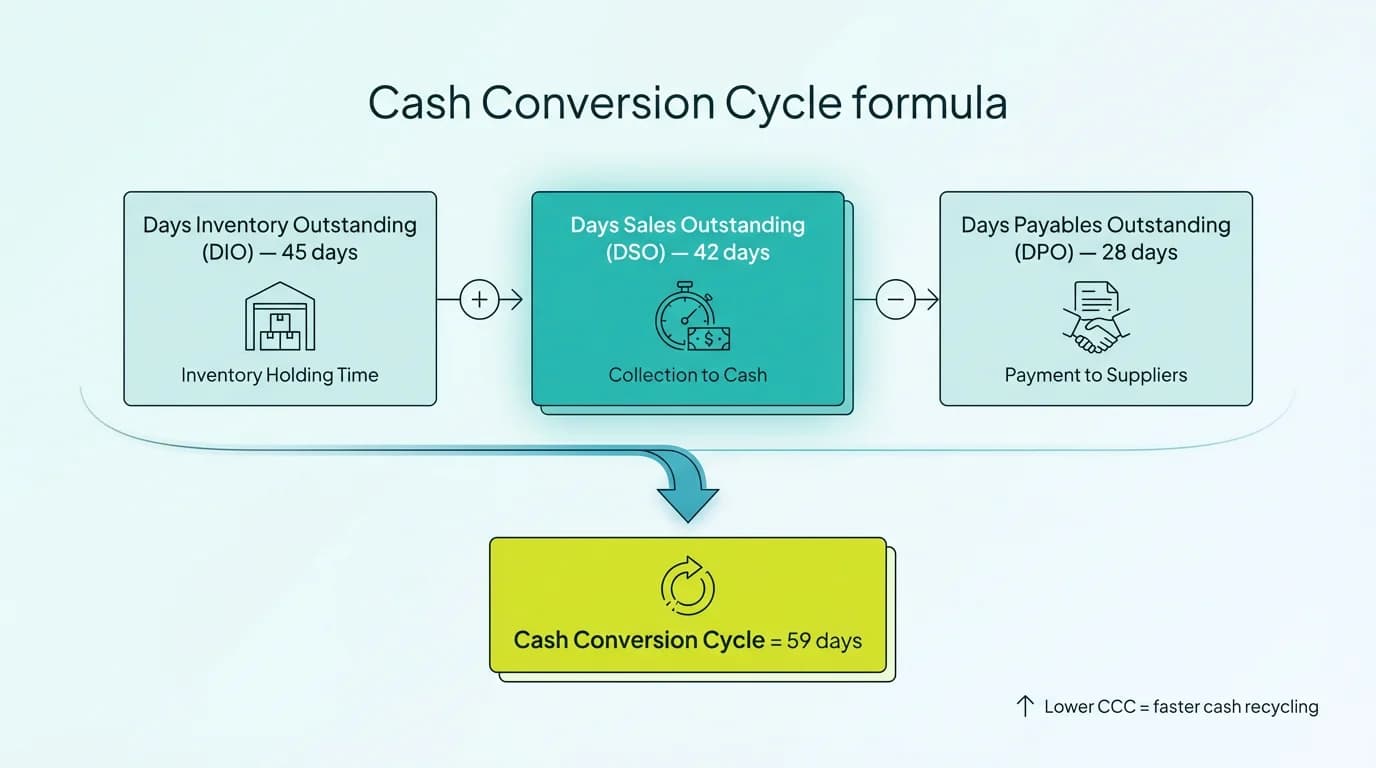
The formula is Days Sales Outstanding + Days Inventory Outstanding - Days Payables Outstanding. CCC measures the total number of days between spending cash on inputs and receiving cash from customers. A lower CCC means faster cash recycling and less working capital tied up in operations. According to the Hackett Group's 2024 study of the 1,000 largest US non-financial companies, the average CCC improved to 37 days. Top-quartile manufacturers target CCC under 40 days. Wholesale distributors target under 30 days.
AR automation directly reduces CCC through DSO reduction, the most controllable component for most businesses. Reducing DSO by 15 days reduces CCC by 15 days, freeing working capital equivalent to 15 days of revenue. For a $20M revenue company, each day of CCC reduction releases approximately $54,795 in working capital. The CFO who reports a declining CCC trend to the board demonstrates operational efficiency improving without additional capital investment, which is the narrative investors and lenders want to hear.
Track CCC monthly alongside its three components. CCC deterioration can originate from any leg of the triangle: rising DSO (AR collections slowing), rising DIO (inventory turnover declining), or falling DPO (paying suppliers faster). Isolating which component is driving CCC change points you toward the correct corrective action rather than applying generic working capital fixes. According to a 2024 Visa CFO survey, 8 in 10 CFOs now view working capital optimization as a strategic priority rather than a tactical finance function.
Pro Tip
Present CCC as your primary working capital metric to the board instead of DSO alone. CCC contextualizes AR performance within the full operating cycle and elevates the conversation from 'how many days to collect invoices' to 'how efficiently are we deploying capital through the entire business.' Boards and investors respond more favorably to CCC as a strategic metric than to DSO as an operational one.
6 Quick Wins to Improve Your AR KPIs This Week
Each of these actions takes under two hours to implement and collectively moves multiple KPIs within 30 days.