
Executive Summary
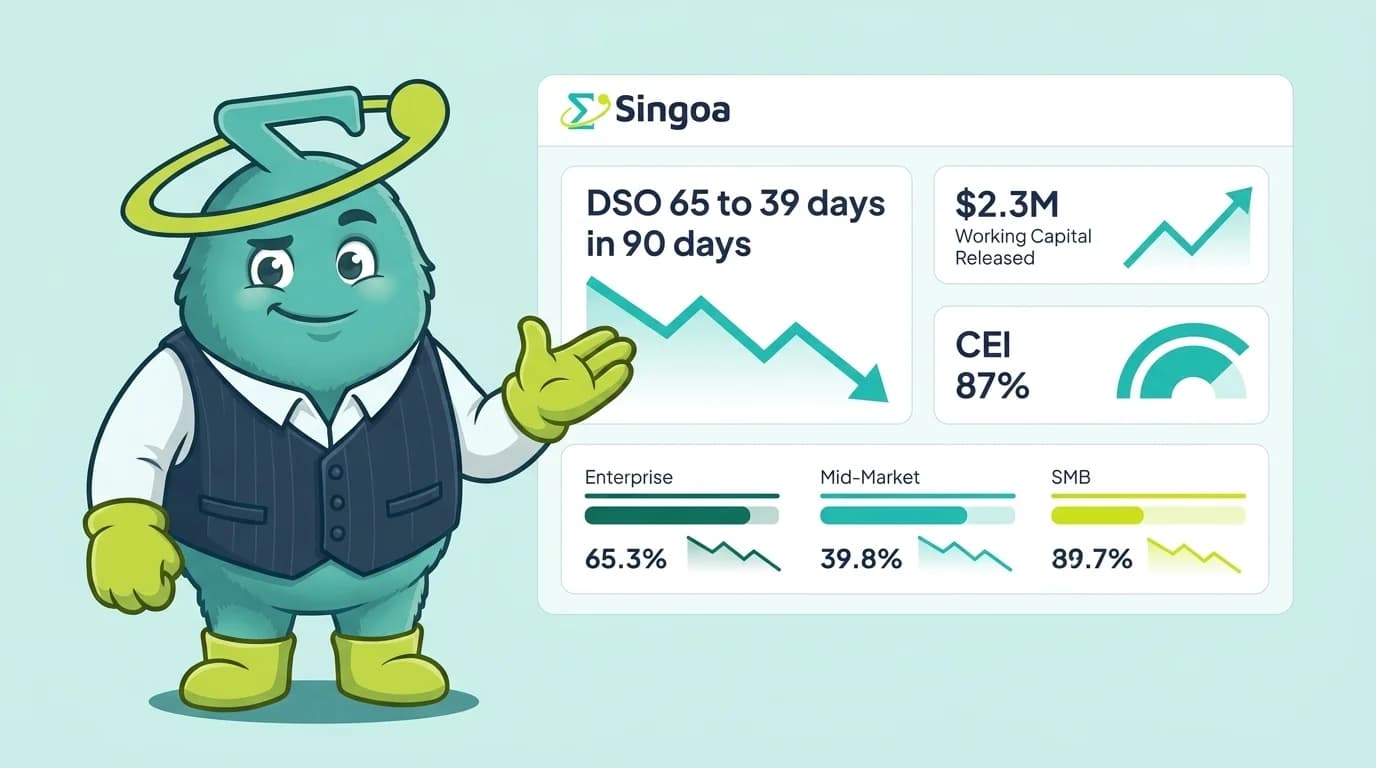
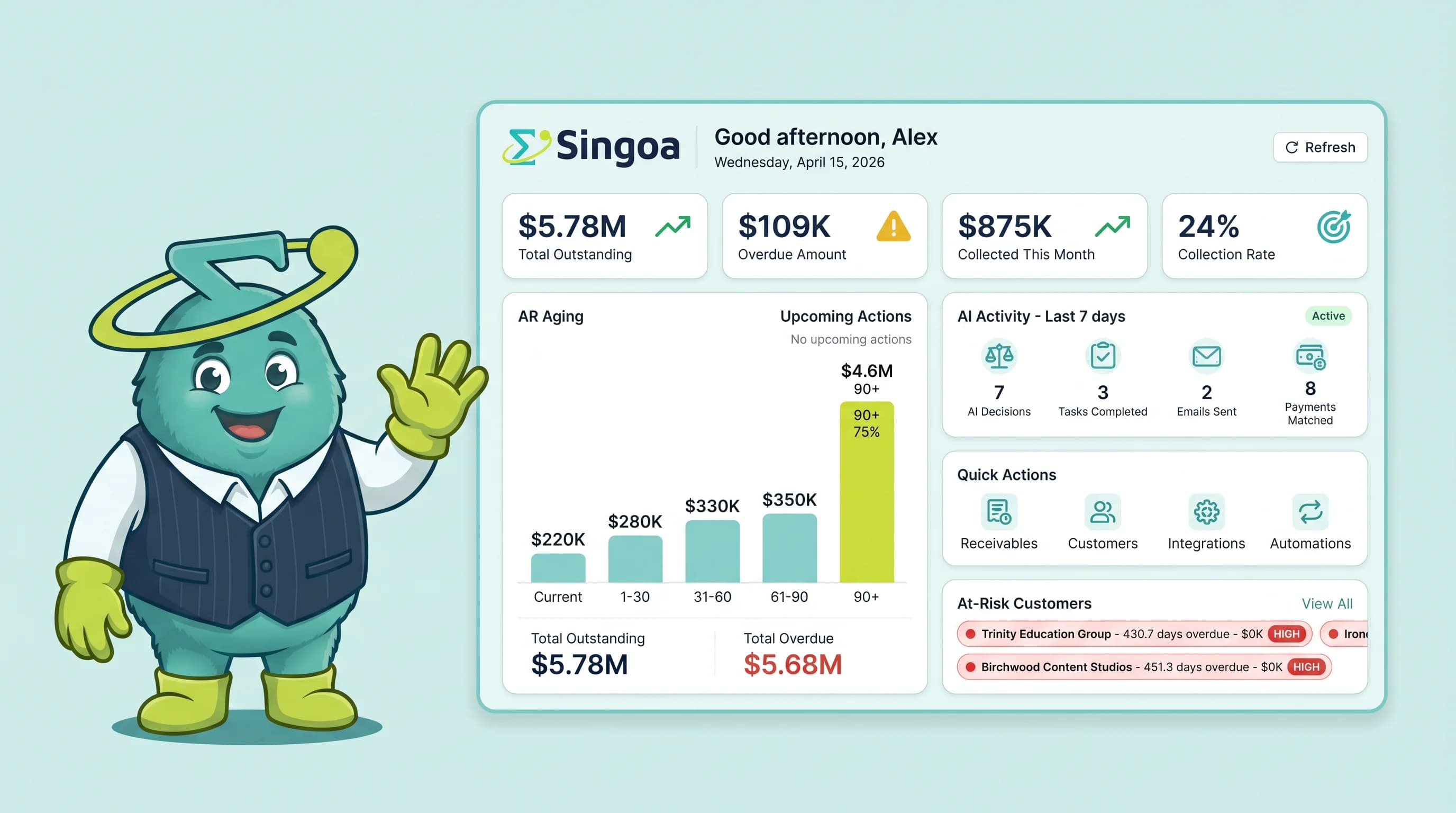
Accounts receivable automation uses AI and workflow software to handle invoice delivery, payment matching, collections, and cash application, reducing DSO by 25-40% and cutting cost per invoice from $15-40 to $1-3 for mid-market companies.
Key Takeaways from This Guide
- AR automation reduces DSO by 25-40% within 90 days. That frees $27,400 in daily working capital for every $10M in annual revenue.
- Cost per invoice drops from $15-40 manual to $1-3 automated. The 75-95% reduction typically pays back within three to six months.
- AI payment matching achieves 99.2% straight-through processing accuracy versus 92-95% for rule-based systems. Manual cash application nearly disappears.
- Over 68% of mid-market companies still process invoices manually. The competitive cash flow gap compounds every quarter.
- Industry-specific AR platforms handle construction retainage, healthcare claims, and SaaS subscription billing natively, not through generic workarounds.
- Existing AR teams handle 3-5x more accounts with automation. Revenue can grow without proportional headcount increases.
- The global AR automation market will reach $6.5B by 2031 per The Business Research Company. Early adopters gain compounding data advantages as AI models improve.
- Implementation follows four phases: connect, configure, automate, optimize. Most companies reach full automated operations within 30-90 days.
Model Your AR Automation ROI
Enter your invoice volume and current DSO. The calculator shows annual cost savings, working capital released from DSO reduction, and projected bad debt avoidance.
What Is Accounts Receivable Automation?
Accounts receivable automation is software that manages the entire process of billing customers and collecting payment with minimal human intervention. It replaces manual steps, invoice generation, email follow-up, payment reconciliation, aging report analysis, with automated, AI-driven workflows that operate continuously. According to Mordor Intelligence, 2025, the AR automation market reached $3.4 billion globally, growing at 11.6% annually as mid-market adoption accelerates.
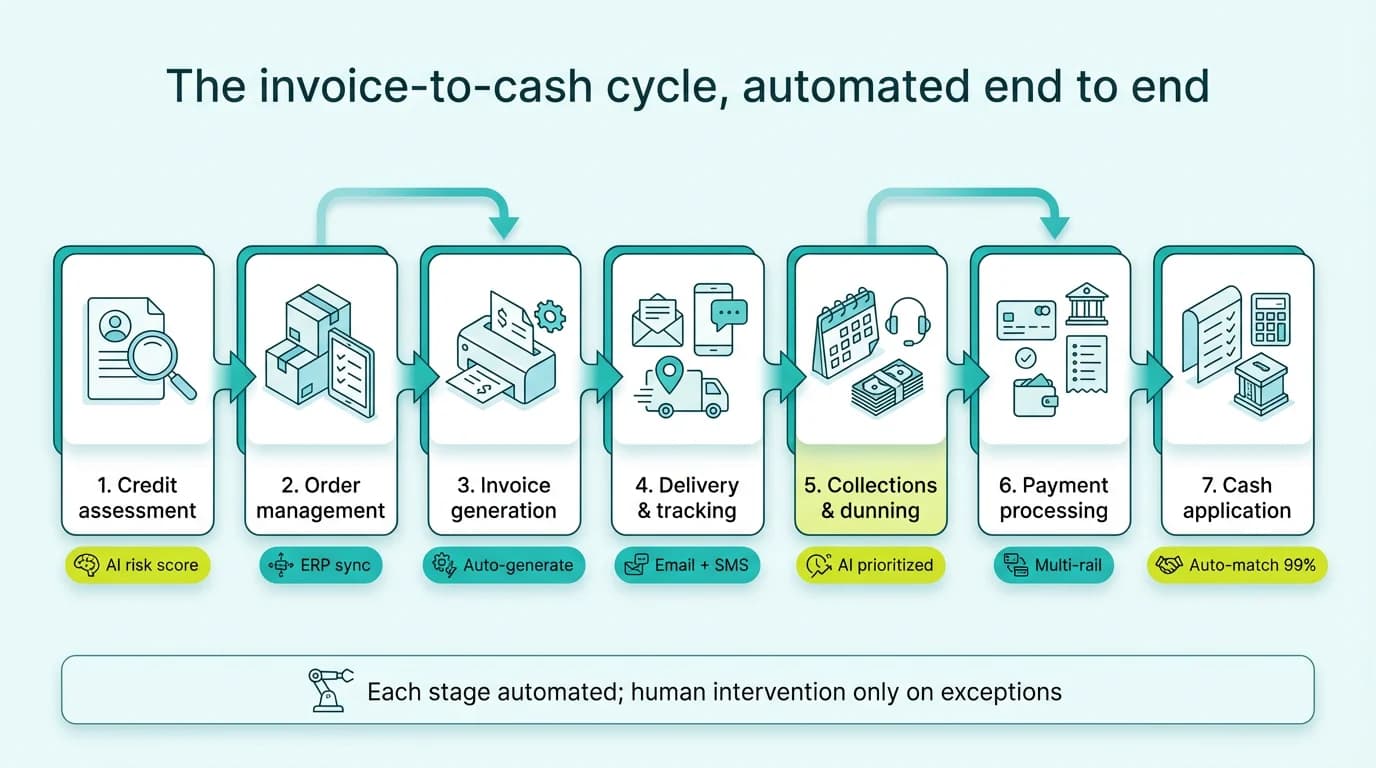
The invoice-to-cash cycle consists of seven distinct stages: credit assessment, invoice creation, invoice delivery, payment reminders, dispute resolution, payment processing, and cash application. Manual processes introduce delays, errors, and inconsistencies at every stage. A single mis-keyed payment posting takes an average of 22 minutes to identify and correct, according to the Institute of Finance and Management (IOFM), 2024. Automation applies systematic precision to each step, compressing what typically takes 45-83 days into 30-50 days without adding staff.
AR automation is fundamentally different from simple billing software or payment processors. A billing tool sends invoices. A payment processor accepts payments. AR automation connects these bookends and manages everything between them: intelligent follow-up sequences, risk-based collections prioritization, exception handling for disputes and deductions, and real-time cash flow reporting. The distinction matters during vendor evaluation because many tools marketed as 'AR automation' address only one or two stages of the full invoice-to-cash cycle.
Modern platforms are cloud-based, API-connected, and powered by machine learning models trained on millions of invoice transactions. They integrate directly with major ERPs and accounting systems, QuickBooks, NetSuite, SAP, Sage Intacct, Microsoft Dynamics, pulling real-time data on open invoices, customer payment history, and incoming payments. This integration eliminates duplicate data entry and ensures the AR system always reflects your current receivables position accurately.
- Covers the full invoice-to-cash cycle, not just invoice delivery or payment acceptance
- Combines rule-based workflows with AI and machine learning for intelligent decision-making
- Connects to ERPs and accounting systems via API for real-time bidirectional data sync
- Eliminates manual steps: data entry, follow-up emails, payment posting, report generation
- Distinct from billing software (sends invoices) and payment processors (accepts payments)
Pro Tip
When evaluating AR platforms, ask vendors to map their features to each of the seven invoice-to-cash stages explicitly. Many tools handle two or three stages well and use marketing language to imply full-cycle coverage. Gaps between invoicing and cash application are where DSO leaks occur, and where your team spends the most manual hours.
Why AR Automation Matters in 2026
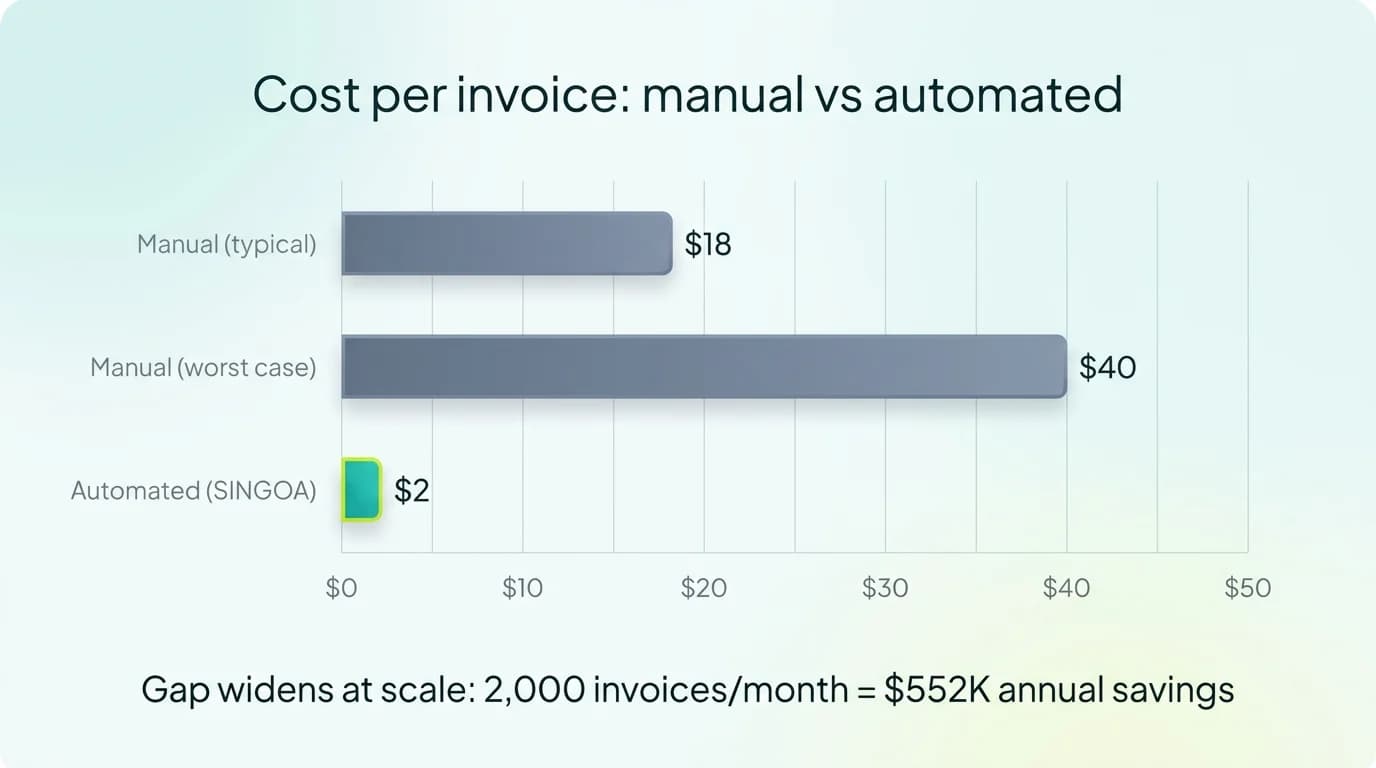
The cost of manual AR processes is measurable and substantial. According to PYMNTS.com's 2025 B2B Payments Report, mid-market companies processing invoices manually spend $15-40 per invoice on staff time, error correction, and follow-up, compared to $1-3 with automation. For a company processing 3,000 invoices monthly, that gap represents $504,000 to $1.33 million per year in avoidable AR operations cost. These are not theoretical projections; they are direct labor and error costs that appear on every income statement.
Cash flow impact amplifies the operational cost dramatically. Companies with DSO 15 or more days above their industry benchmark are effectively extending customers an unplanned, interest-free line of credit. A $50 million revenue business with 65-day DSO against a 45-day benchmark has $2.7 million in working capital permanently locked in receivables. That capital is unavailable for payroll, inventory purchases, or growth investment. Each day of DSO reduction releases approximately $137,000 for that business, money that was always yours but operationally inaccessible.
The competitive dimension is accelerating. According to Ardent Partners' 2025 AP/AR Metrics Report, companies in the top quartile of AR performance, those with fully automated processes, collect 40% faster and carry 55% less bad debt exposure than the median. As more mid-market companies automate, manual operators face a compounding disadvantage. Slower cash cycles limit growth investment, while peers use freed capital to expand capacity, improve pricing flexibility, and fund acquisition strategies.
Staff capacity constraints make manual AR unsustainable at scale. A trained AR specialist can actively manage 200-300 accounts manually, according to IOFM's 2024 Staffing Benchmark Report. The same specialist using AI-assisted tools can effectively manage 800-1,200 accounts. As businesses grow, AR teams on manual processes face a binary choice: hire proportionally (adding cost with every revenue dollar) or let collection discipline deteriorate. Automation breaks this linear relationship between revenue growth and AR headcount.
- $15-40 per invoice (manual) vs. $1-3 per invoice (automated), a 75-95% cost reduction
- A $50M revenue business frees approximately $137,000 per day of DSO reduced
- Top-quartile AR performers collect 40% faster and carry 55% less bad debt (Ardent Partners, 2025)
- Manual AR specialists manage 200-300 accounts; AI-assisted specialists manage 800-1,200
- 87% of companies with AR automation report improved process speed (Billtrust, 2025)
The 7 Core Capabilities of Accounts Receivable Automation
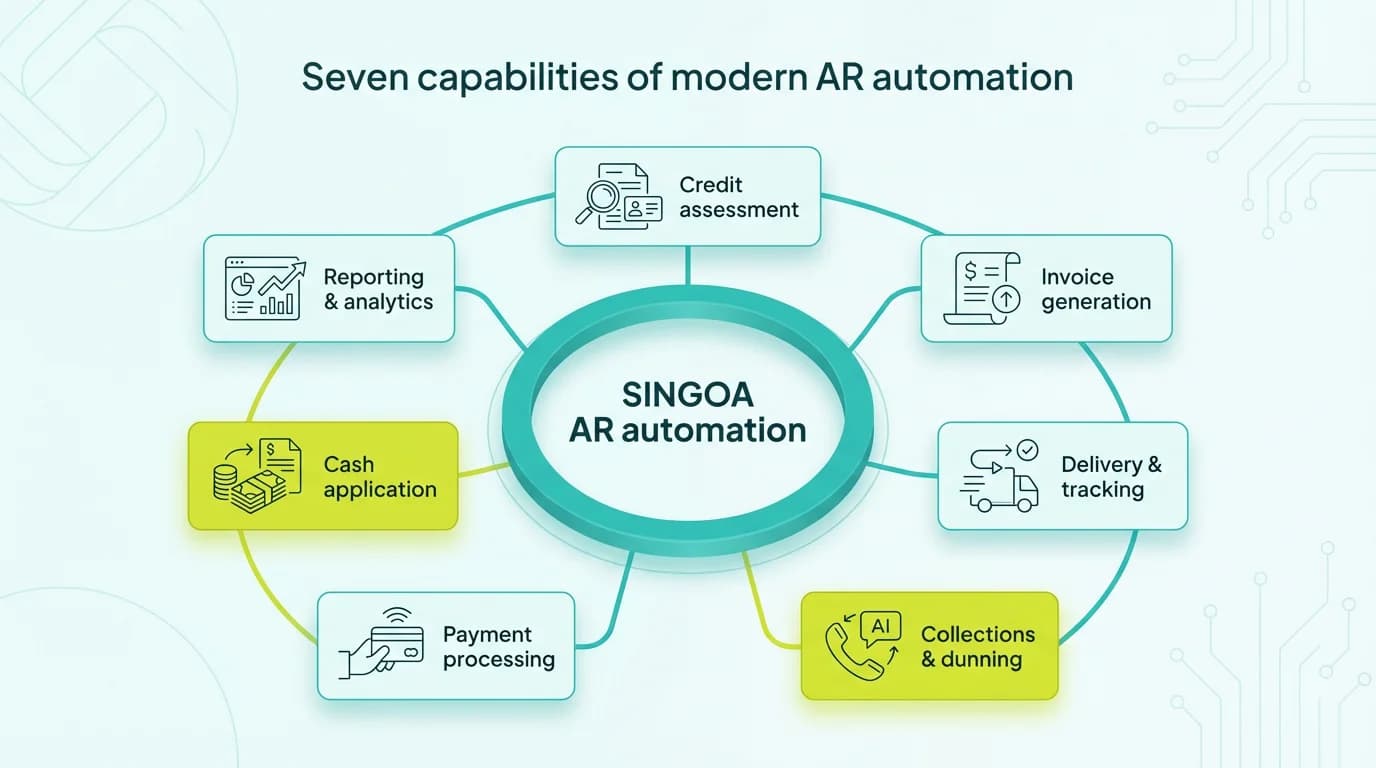
Not all AR automation platforms offer the same breadth of functionality. Some specialize in dunning and collections; others focus on payment processing or cash application. Understanding the seven core capabilities, and how they interact, equips you to evaluate platforms against your specific bottlenecks rather than being swayed by demo polish or feature count alone.
These seven capabilities work as an interconnected system. Better credit data feeds risk scoring, which improves collections prioritization, which reduces bad debt, which improves the portfolio quality that AI payment matching processes. Implementing only two or three capabilities delivers partial results. The compounding benefits, where each capability amplifies the others, emerge when the full stack operates together on shared data.
Pricing models vary significantly across vendors and capabilities. Per-invoice pricing ($1-3 per invoice) aligns vendor incentives with your volume and provides predictable scaling costs. Per-user licensing penalizes adoption by creating a cost barrier to expanding platform access across your finance team. Per-module pricing adds up quickly when you need the full capability stack. According to Gartner's 2025 Mid-Market Finance Technology Survey, usage-based pricing models deliver 23% higher adoption rates than seat-based alternatives.
1. Credit Risk Assessment and Scoring
Credit risk assessment evaluates customer creditworthiness using internal payment history, external credit bureau data, industry risk factors, and real-time behavioral signals. AI-powered systems update risk scores continuously rather than only at customer onboarding, detecting deterioration before accounts become delinquent. According to Dun & Bradstreet's 2025 Credit Risk Report, continuous monitoring catches 45% more risk events than annual review cycles.
Early detection prevents 30-45% of bad debt write-offs by identifying at-risk accounts while they remain collectible. A customer whose average payment time gradually extends from 30 to 45 to 60 days reveals a pattern that static rule-based systems miss entirely. AI models surface this trend weeks before the account crosses the 90-day past-due threshold where collection probability drops below 50%.
- Integrates external credit data (D&B, Experian Business) with internal payment history
- Continuous risk scoring updates, not just onboarding assessment
- Early warning alerts triggered by pattern changes, not just threshold breaches
- Automated credit limit adjustments based on updated risk profiles
2. Automated Invoice Delivery
Automated invoice delivery ensures invoices reach the right contact, in the correct format, through the preferred channel, immediately upon issuance. Manual processes introduce a one-to-three-day delay where AR staff batch-print or manually email invoices. For companies with complex billing requirements, EDI 810, AIA G702 forms, or HIPAA-compliant formats, automation handles format transformation without manual intervention.
Delivery confirmation tracking reveals exactly when each invoice was opened, allowing collections reminders to be timed relative to confirmed receipt rather than assumed delivery. An invoice that bounced to a wrong email address gets flagged within hours, not discovered 45 days later when the account appears on the overdue aging report. According to IOFM's 2024 AR Metrics Survey, companies with delivery confirmation reduce invoice disputes by 28%.
- Multi-format delivery: email, EDI, portal upload, fax, or physical mail
- Open-tracking and delivery confirmation for accurate reminder timing
- Automatic format conversion for industry standards (AIA, EDI 810, HIPAA X12)
- Failed delivery alerts with suggested contact corrections within 24 hours
3. Intelligent Collections and Dunning
[Intelligent collections automation](/features) sends personalized, multi-channel payment reminders on optimized schedules based on each customer's payment behavior and risk profile. High-value, reliable accounts receive gentle pre-due reminders. High-risk or deteriorating accounts receive earlier, more frequent outreach through email, SMS, phone prompts, and payment portal notifications simultaneously.
AI-powered dunning sequences adapt based on results. If a customer consistently opens emails but never clicks payment links, the system routes to SMS or phone contact. If a customer pays immediately after receiving a Tuesday morning reminder, the AI schedules future reminders on the same day and time. According to the Association for Financial Professionals (AFP), 2025, adaptive collections sequences recover 30-40% more past-due invoices than static, rule-based reminder schedules.
- Multi-channel outreach: email, SMS, phone, portal notifications, and postal mail
- Customer-specific timing optimization based on historical payment response patterns
- Risk-tiered dunning: gentle reminders for reliable payers, assertive for high-risk
- Adaptive AI learning, sequences update automatically based on payment outcomes
4. AI Payment Matching and Cash Application
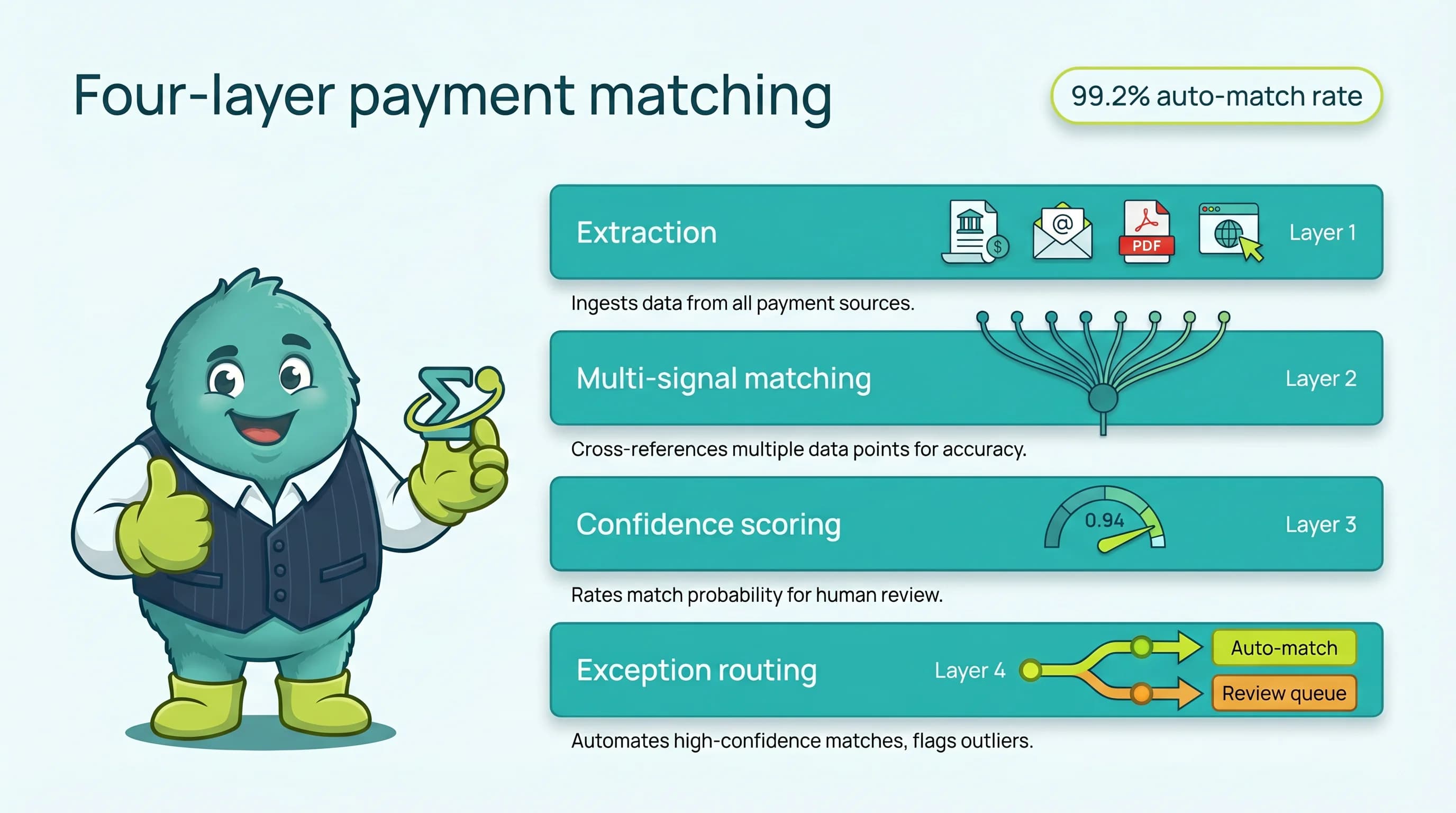
Payment matching, reconciling incoming payments to open invoices, is the most time-intensive manual AR task for most finance teams. Payments arrive with incomplete remittance information, partial amounts, or combined across multiple invoices. [AI-powered matching](/features) achieves 99.2% straight-through processing compared to 92-95% for rule-based systems, according to Ardent Partners, 2025. This accuracy gap eliminates 65-80% of manual exception handling.
The AI handles complex matching scenarios automatically: short pays with deduction reasons, overpayments requiring credit application, payments splitting across multiple invoices, and foreign currency conversions. Exceptions requiring human review surface with AI-suggested matches and confidence scores, so AR staff resolve items in seconds rather than the typical eight to twelve minutes per manual match.
- 99.2% straight-through matching accuracy, drastically smaller exception queue
- Handles partial payments, deductions, overpayments, and multi-invoice payments
- Remittance extraction from PDF attachments, email bodies, EDI 820, and bank files
- Exception queue with AI-suggested matches and confidence scores for fast resolution
5. Customer Self-Service Payment Portal
A branded self-service portal lets customers view invoices, make payments, dispute line items, and set up payment plans without contacting your AR team. The portal accepts ACH, credit card, wire transfer, and digital wallets, removing the friction of limited payment options. According to Ardent Partners, 2025, companies deploying customer payment portals reduce DSO by 12-18 days within the first quarter of deployment.
Portal adoption metrics correlate directly with DSO improvement. Companies achieving 40% or more of payments through the portal consistently outperform those relying on check or wire transfer. Embedding one-click payment links directly in invoice emails and reminder notifications drives adoption without requiring customers to remember login credentials or navigate to a separate website.
- Accepts ACH, credit card, wire, and digital wallet payments in one portal
- Self-service dispute submission reduces AR team phone calls by up to 60%
- No-login payment links embedded directly in invoice emails and reminders
- Payment plan setup and management without human AR team involvement
6. Dispute and Deduction Management
Invoice disputes are the most common reason for delayed payment, yet most AR platforms treat dispute management as an afterthought. Full-cycle AR automation provides structured dispute workflows: customers submit disputes with reason codes and supporting documents, internal routing assigns disputes to the appropriate department, and resolution timelines are tracked with SLA compliance reporting. According to NACM's 2024 Credit Management Survey, structured dispute workflows resolve issues 42% faster than email-based processes.
Unresolved disputes age invisibly in manual systems. In automated platforms, dispute aging is tracked separately from payment aging, so overdue disputes, not just overdue invoices, surface for management review. This prevents the scenario where a $50,000 invoice sits in dispute for 90 days without anyone escalating it because it fell between departmental responsibility gaps.
- Structured workflow with customer-submitted reason codes and document attachments
- Automatic internal routing to billing, sales, or operations based on dispute type
- SLA tracking on dispute resolution time, separate from invoice payment aging
- Deduction validation workflows that recover 40-60% of invalid short-pays
7. Real-Time Reporting and Analytics
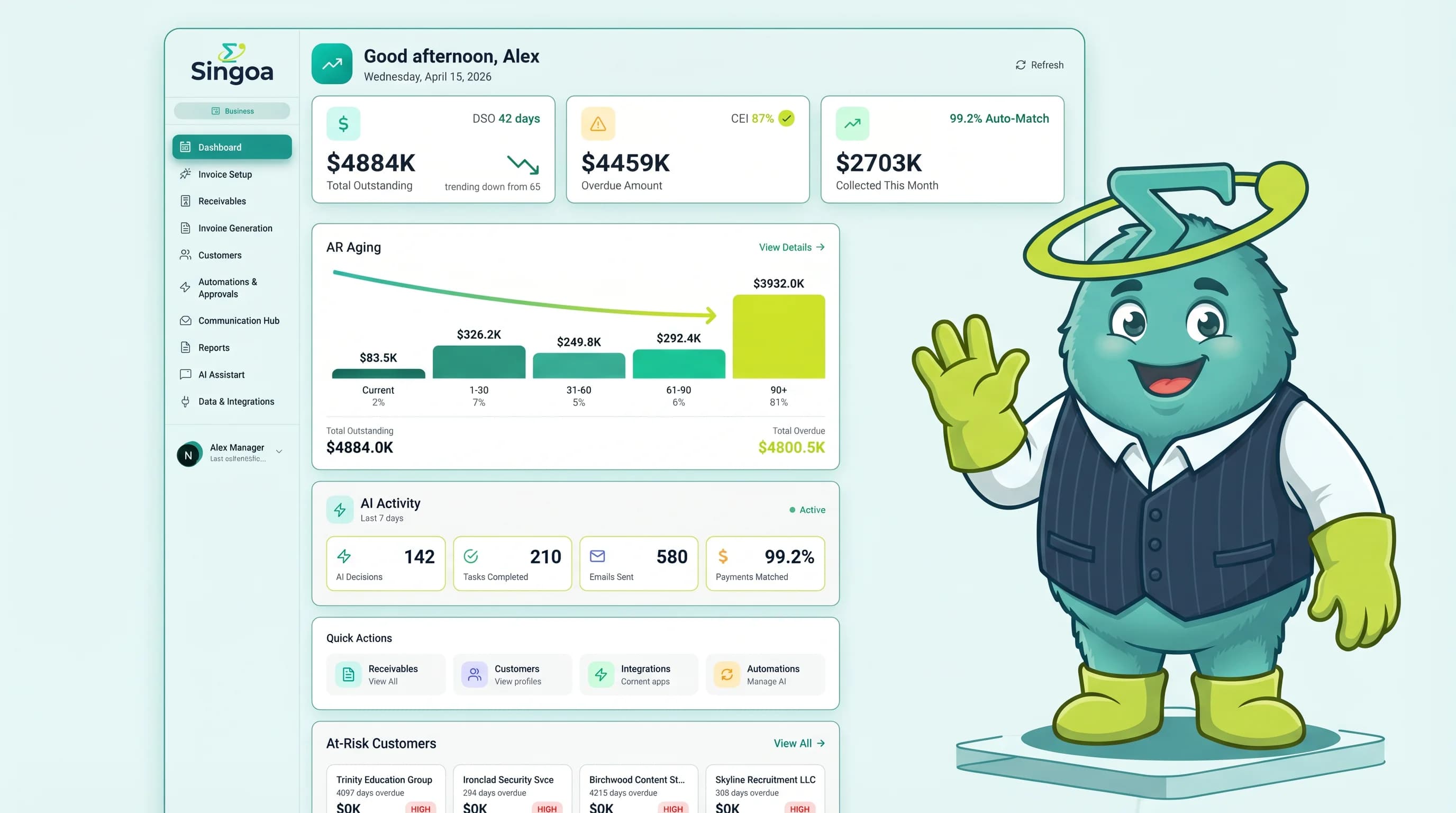
AR reporting in manual systems is backward-looking: monthly Excel exports showing what happened last period. Automated platforms provide real-time dashboards showing current AR health, predicted cash receipts, collection effectiveness trends, and customer risk distribution. CFOs and controllers see cash position updates daily or intraday, not at month-end. According to AFP's 2025 Liquidity Survey, 73% of finance leaders rank real-time AR visibility as their top technology priority.
Advanced platforms include predictive analytics, forecasting which invoices are likely to be paid late based on customer payment history and behavioral patterns. A forecast identifying $400,000 in likely-late receivables two weeks before they become overdue gives collections teams actionable lead time. This shift from reactive reporting to predictive intelligence is what separates modern AR platforms from legacy invoice management tools.
- Real-time DSO, CEI, and aging bucket dashboards updated daily or intraday
- Predictive cash receipt forecasting based on customer payment probability models
- Collections effectiveness metrics per team member and per customer segment
- Natural language report builder for ad-hoc queries without analyst involvement
Pro Tip
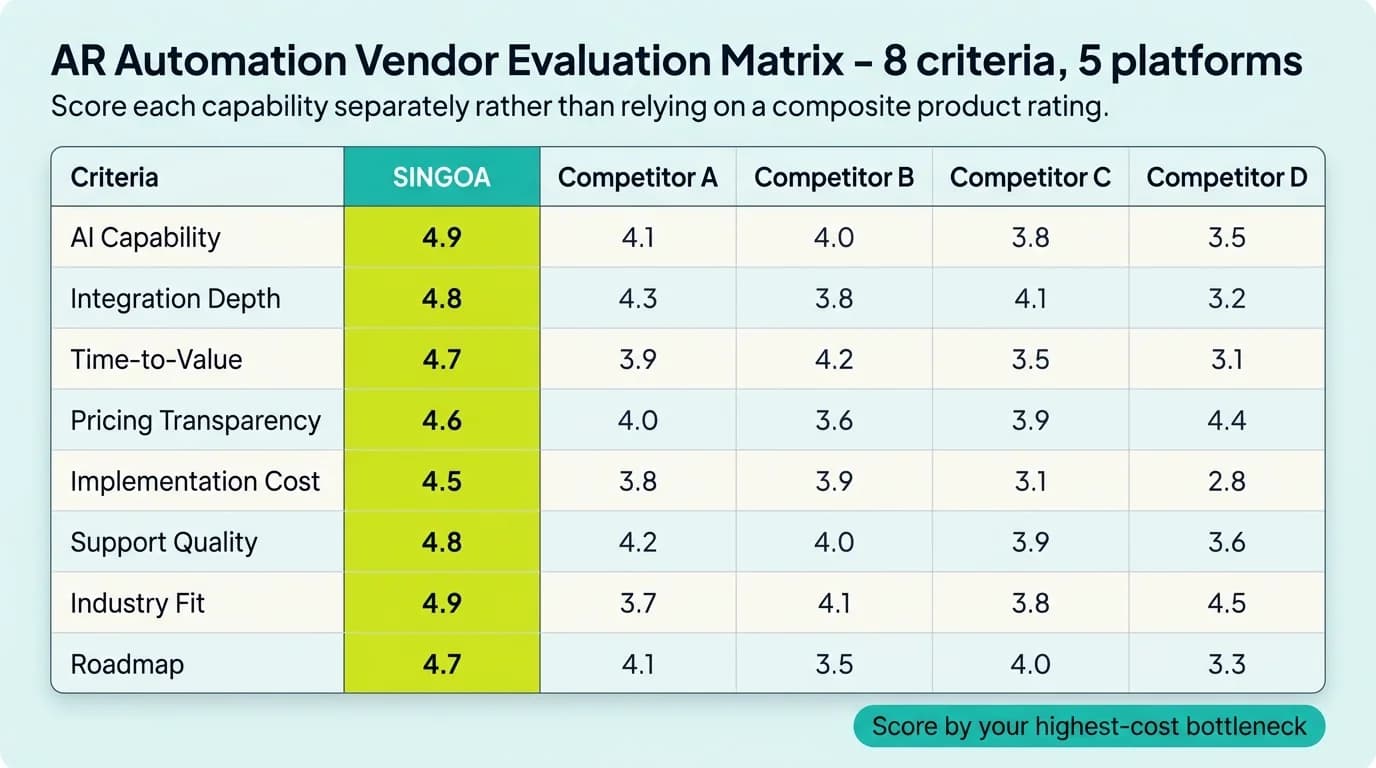
Score each of the seven capabilities separately during vendor evaluation rather than accepting a composite product rating. A platform that excels at invoice delivery but has weak payment matching will still burden your team with manual cash application. Identify your highest-cost bottleneck first and prioritize platforms that solve it best.
See the Full AR Stack in a Single Demo
AI payment matching, automated collections, risk scoring, and SINGOA Assist working together on a real mid-market AR portfolio in 15 minutes.
Manual vs. Automated AR: A Side-by-Side Comparison
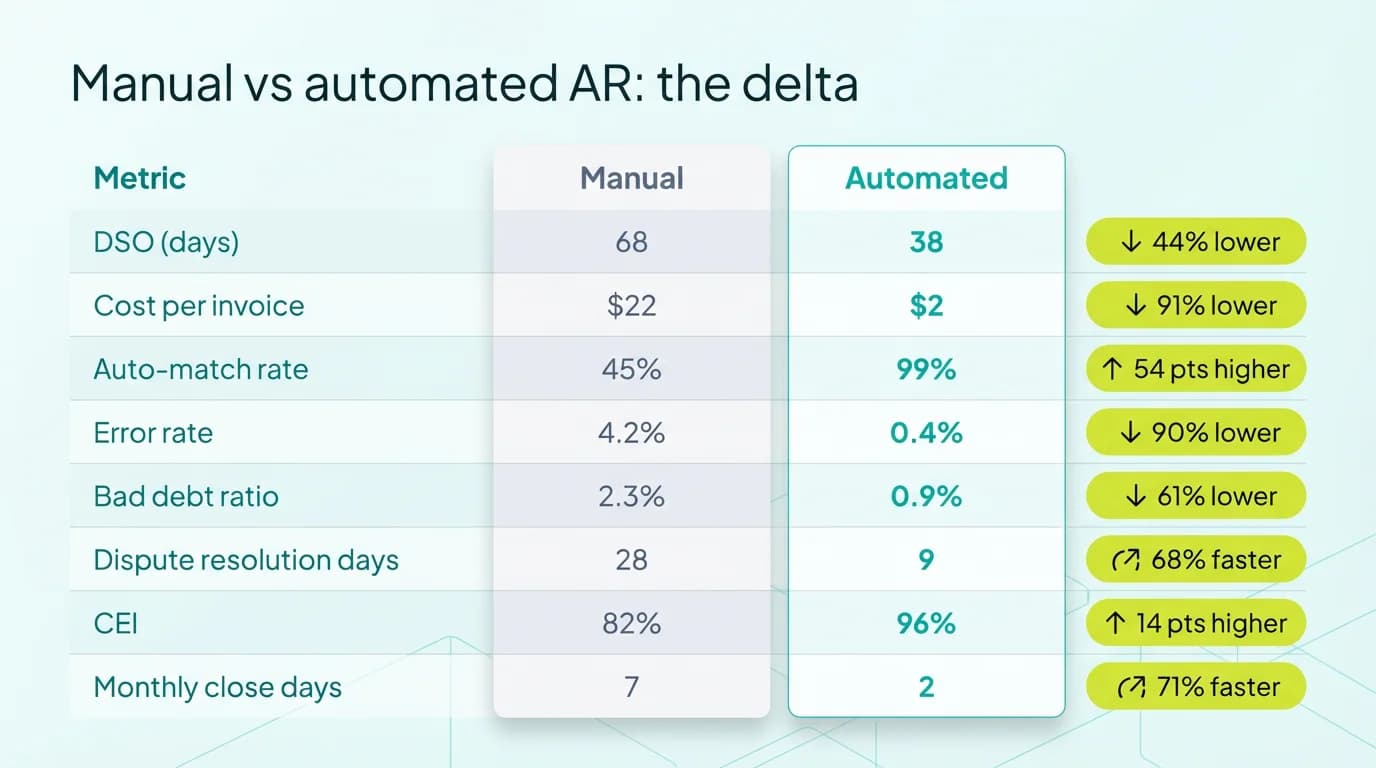
The gap between manual and automated AR is not a matter of marginal efficiency gains. It represents a fundamentally different operating model for your finance function. Manual AR is linear: each additional dollar of revenue requires proportional human effort to bill, collect, and reconcile. Automated AR is scalable: the same platform handles 500 invoices or 50,000 with negligible marginal cost. According to Forrester's 2026 AR Technology Report, companies that automate AR operations grow revenue 2.3 times faster than manual peers because their finance infrastructure does not constrain capacity.
The comparison table below uses data from IOFM's 2024 Receivables Benchmark Study, Ardent Partners' 2025 AP/AR Metrics Report, and SINGOA platform benchmarks across 500+ mid-market implementations. These are median values; your actual results will depend on invoice volume, customer mix, and industry complexity. But the directional difference is consistent across every company size and sector we have measured.
The operational difference shows up across eight key metrics. Cost per invoice drops from $15-40 to $1-3. Payment matching accuracy rises from 85-92% to 99.2%. Average DSO falls by 25-40%. Collection effectiveness index improves from 55-70% to 85-95%. Dispute resolution time shrinks from 15-30 days to 3-7 days. Accounts per AR specialist jump from 200-300 to 800-1,200. Month-end close time for AR shrinks from 5-8 days to 1-2 days. Bad debt write-off rates drop from 2-5% to 1-2% of revenue.
The most strategically significant metric is accounts per AR specialist. Manual teams that manage 200-300 accounts each must hire proportionally as the business grows. A $50 million company growing to $100 million on manual processes needs to roughly double its AR headcount. The same company on automated AR handles the growth with its existing team, redirecting what would have been $200,000-$400,000 in annual hiring costs to technology investment that delivers compounding returns.
- Cost per invoice: $15-40 (manual) vs. $1-3 (automated), 75-95% reduction
- Payment matching accuracy: 85-92% (manual) vs. 99.2% (AI-powered), near-zero exceptions
- DSO improvement: 0% baseline vs. 25-40% reduction within 90 days
- Accounts per AR specialist: 200-300 (manual) vs. 800-1,200 (automated), 4x capacity
- Bad debt write-off rate: 2-5% (manual) vs. 1-2% (automated), 50%+ reduction
Pro Tip
When building your business case, focus on the accounts-per-specialist metric. CFOs and boards respond strongly to capacity arguments because they directly tie to growth planning. Frame automation as 'we can grow revenue 3x without adding AR headcount' rather than 'we can save $X per invoice', the growth framing gets approved faster.
How AR Automation Applies Across Industries
The single strongest predictor of AR automation success is industry fit. A construction subcontractor billing AIA G702 progress invoices with 10% retainage has fundamentally different requirements than a SaaS company billing monthly subscriptions or a healthcare provider submitting claims to insurance networks. Generic AR automation addresses the common denominator; industry-specific platforms handle the exceptions that account for most of the DSO variation within each sector.
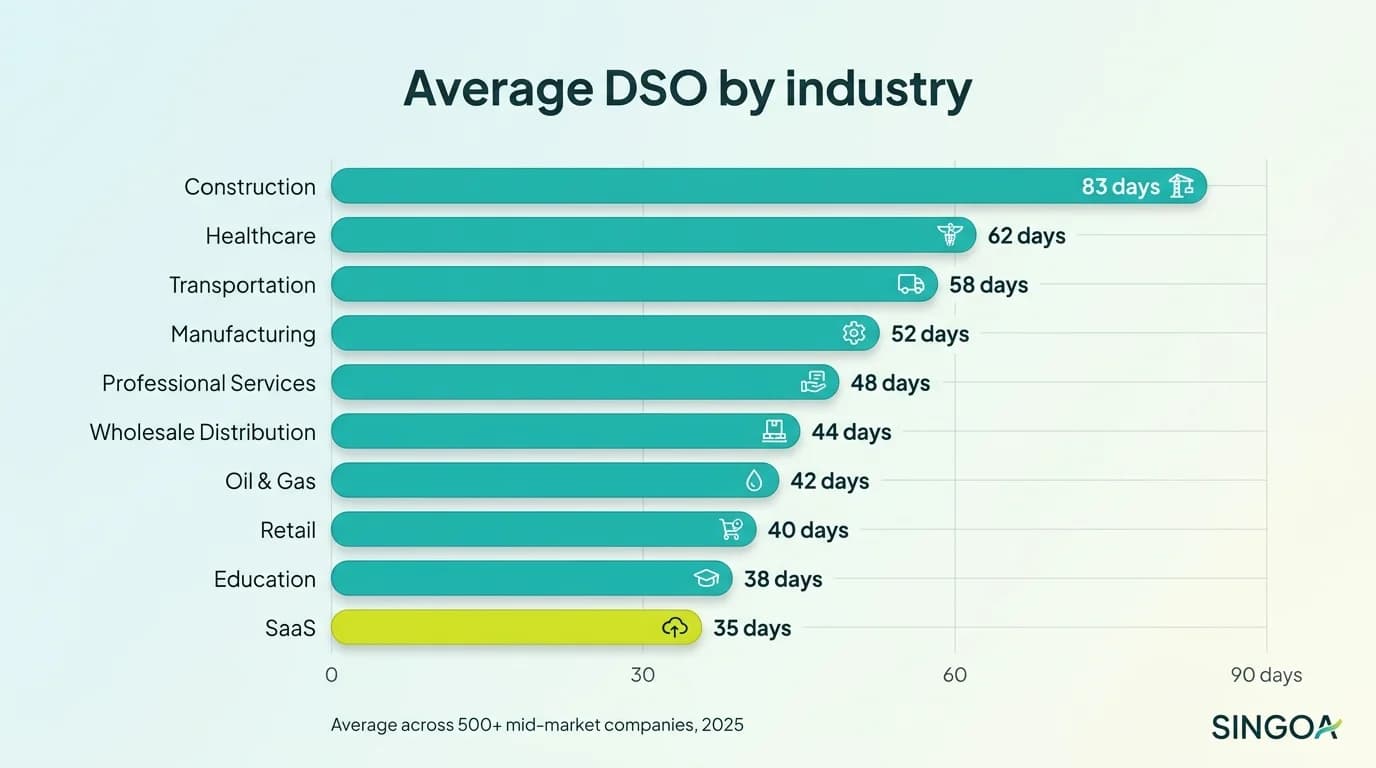
DSO benchmarks vary by more than 45 days across industries. According to PYMNTS.com's 2025 Industry Payments Report, construction averages 83 days, oil and gas 65 days, legal services 55 days, healthcare 52 days, wholesale distribution 48 days, manufacturing 42 days, professional services 42 days, transportation 45 days, education 38 days, and SaaS 35 days. These differences reflect billing complexity, payment term norms, regulatory requirements, and customer concentration, not just industry culture or habit.
Before evaluating vendors, document your three highest-volume invoice exception types. A construction firm might list retainage disputes, change order reconciliation delays, and lien waiver tracking failures. A manufacturer might list unauthorized deductions, EDI validation rejections, and multi-location remittance matching. Verify that each vendor handles your specific exceptions within the standard product, not through custom development or manual workarounds that reintroduce the bottlenecks you are trying to eliminate.
Construction: Taming the 83-Day DSO
[Construction AR](/industries/construction) requires AIA G702/G703 billing format support, retainage tracking at 5-10% withholding until project completion, lien waiver management, schedule of values tracking, and progress billing against contract milestones. Manual management of these requirements across 50-200 active projects is the primary driver of construction's industry-high 83-day DSO. Automation reduces construction DSO to 55-65 days by streamlining pay application submission and automating retainage release tracking.
General contractors using automated payment portals approve subcontractor pay applications 60% faster than those relying on paper-based processes, according to the Construction Financial Management Association (CFMA), 2024. Integration with project management platforms like Procore ensures billing aligns with project progress data automatically, eliminating the reconciliation bottleneck that delays most construction payment cycles.
Healthcare: Managing Multi-Payer Complexity
Healthcare AR involves insurance claim submission, ERA/EFT payment processing, denial management, patient responsibility billing, and strict HIPAA compliance requirements. The multi-payer environment, commercial insurance, Medicare, Medicaid, and self-pay, creates matching complexity that overwhelms manual systems. Denial rates of 5-10% on initial claims require systematic resubmission workflows that most generic AR tools cannot handle.
Healthcare-specific AR automation integrates with clearinghouses for claim submission and ERA processing, routes denials by reason code for systematic resubmission, and handles patient billing separately from insurance billing. According to the Healthcare Financial Management Association (HFMA), 2025, organizations automating denial management reduce their average days-in-AR by 12-18 days and improve clean claim rates from 85% to above 95%.
Manufacturing: Recovering Lost Deductions
Manufacturing AR complexity stems from high customer deduction rates (3-7% of invoice value), EDI transaction requirements from major retail and distribution customers, and complex pricing arrangements involving volume discounts and rebates. Deduction management, validating whether customer short-pays are legitimate, consumes the largest share of manual work hours for manufacturing AR teams.
Automated deduction management classifies short-pays by reason code, routes valid deductions to sales for pricing dispute resolution, and sends invalid deductions back to customers with supporting documentation. According to the National Association of Credit Management (NACM), 2024, manufacturers automating deduction workflows recover 40-60% of invalid deductions that were previously written off because manual follow-up bandwidth simply could not keep pace.
SaaS: Preventing Involuntary Churn
SaaS AR complexity centers on subscription billing with variable consumption, usage-based pricing calculations, mid-cycle contract amendments, and the critical metric of net revenue retention. AR automation for SaaS integrates with subscription management platforms and handles automated dunning for failed card charges, the highest-volume collection task in recurring revenue businesses.
Failed payment recovery automation, sending card update requests before invoices lapse, retrying failed charges on optimized intervals, and offering alternative payment methods, typically recovers 15-25% of what would otherwise become involuntary churn. For a $10M ARR SaaS company with 2% monthly involuntary churn, that represents $240,000-$300,000 in annual recurring revenue that stays on the books instead of silently disappearing.
Pro Tip
Ask AR platform vendors for a reference customer in your specific industry with comparable company size and ERP system. Generic case studies across industries are insufficient to validate industry-specific capabilities. Request a live demonstration of your highest-complexity billing scenario using your actual data format, not a pre-recorded product tour.
How to Evaluate and Select an AR Automation Platform
Platform evaluation starts with a clear definition of your primary problem. Companies with DSO 20 or more days above their industry benchmark need collections and payment matching capabilities first. Companies spending heavily on manual invoice processing need invoice automation and cash application. Companies with high bad debt rates need credit risk scoring. Defining your primary problem prevents the common mistake of selecting a platform based on demo quality rather than capability depth in the area that matters most financially.
ERP integration is non-negotiable. An AR platform that does not integrate natively with your ERP requires manual data transfer, which reintroduces the errors and delays you are trying to eliminate. Verify integration at the transaction level: does the platform write payments back to your ERP in real time, or does it require a nightly batch sync? According to Gartner's 2025 Mid-Market Finance Technology Survey, companies with real-time ERP integration achieve full ROI 40% faster than those using batch synchronization.
Pricing model alignment determines total cost of ownership over three to five years. [Per-invoice pricing](/pricing), as platforms like SINGOA offer at $1-3 per invoice, scales proportionally with volume and makes ROI calculation straightforward. Per-user licensing penalizes adoption by discouraging finance team members from accessing the platform. Per-module pricing fragments the full-cycle automation benefit. Before committing, model your three-year cost at current volume and at 2x projected growth to identify which pricing structure serves you best at scale.
Evaluate implementation support by asking for median time-to-first-value, not best-case timelines. The fastest-implementing platforms provide templated ERP connectors and guided configuration workflows that deliver a first automated collections cycle within 14 days. Platforms requiring three-to-six-month professional services engagements introduce switching costs that reduce your flexibility as needs evolve. According to Forrester's 2026 AR Technology Report, 78% of failed AR implementations cite extended timelines as the primary reason for abandonment.
- Define your primary problem first: DSO reduction, cost per invoice, bad debt, or visibility
- Require native ERP integration with real-time bidirectional data sync (not nightly batch)
- Model three-year pricing at current volume and 2x growth to find the best cost structure
- Validate implementation timeline: target first automated workflow within 14 days
- Require reference customers in your specific industry and ERP ecosystem
- Test AI matching accuracy with your actual invoice and payment data, not vendor samples
- Confirm security certifications: SOC 2 Type II minimum for financial data handling
Pro Tip
During evaluation, run a 30-day parallel process where your manual team and the new platform process the same invoice batch simultaneously. Compare actual matching accuracy, exception rates, and processing time. The real performance gap often surprises teams in both directions, and the data gives you unassailable evidence for the business case.
The 90-Day AR Automation Implementation Roadmap
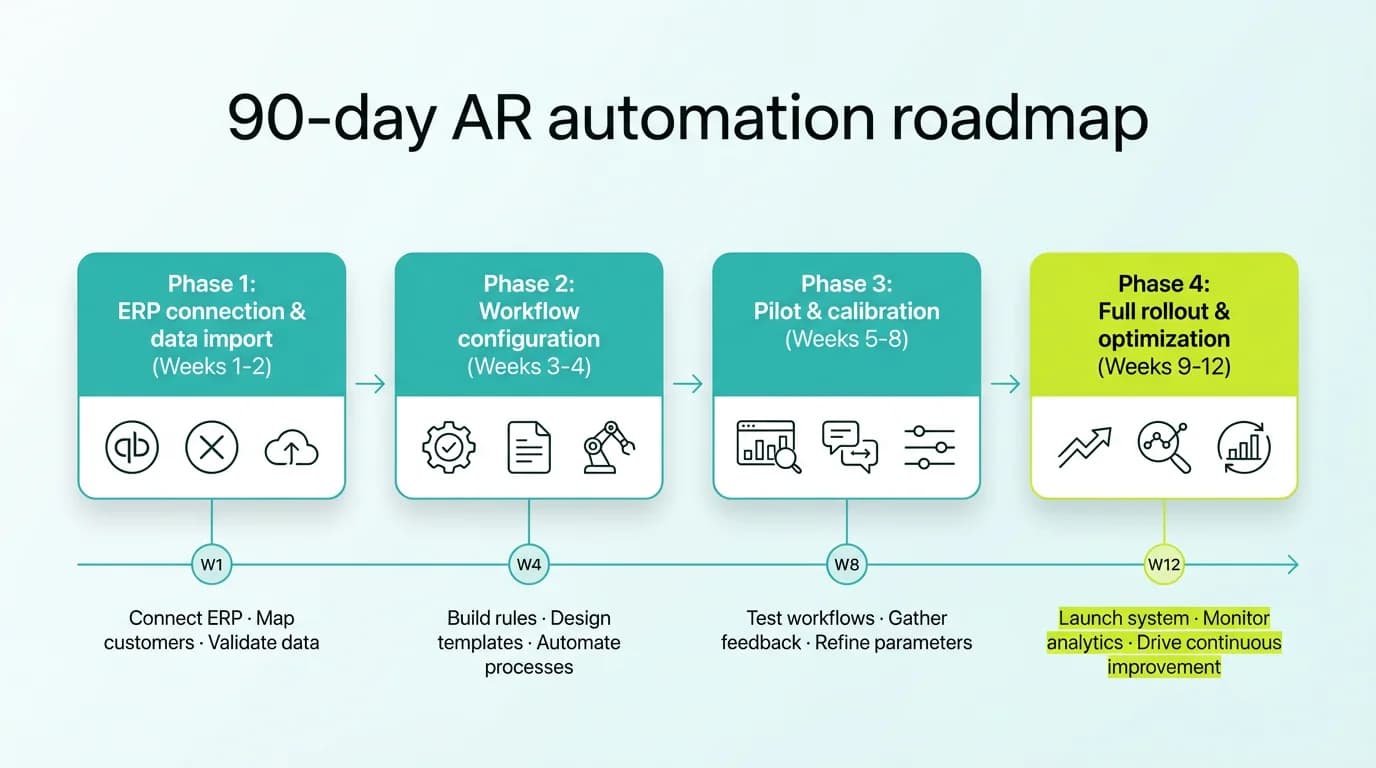
Successful AR automation implementation follows a four-phase sequence: connect, configure, automate, and optimize. Rushing phases or skipping configuration steps is the primary cause of implementation failure. According to Quadient's 2026 AR Best Practices Survey, companies that follow a structured phased approach achieve target ROI 2.1 times faster than those attempting a single big-bang deployment.
The roadmap below is based on cloud-based AR platforms connecting to standard ERP systems. Complex multi-ERP environments or heavily customized legacy systems may require additional time in Phase 1. The key principle is to start automating your highest-volume, most standardized invoice type first, prove the system works, then expand to more complex billing scenarios in Phase 4.
Phase 1, Connect (Days 1-7): Establish data connections, configure your ERP integration, and validate data integrity before activating any automation. Connect your AR platform to your ERP via API. Validate that invoice, customer, and payment data syncs accurately. Configure user roles and access permissions. Set up bank account connections for payment receipt. Complete security review and confirm SOC 2 compliance documentation.
Phase 2, Configure (Days 8-21): Build customer segments, configure dunning sequences, set risk scoring thresholds, and prepare your first automated workflows. Segment customers by risk tier and payment behavior. Configure dunning sequences for each segment with channel and timing preferences. Set risk scoring thresholds for early-warning alerts. Configure payment portal branding and accepted payment methods. Build AR reporting dashboards for daily management review.
Phase 3, Automate (Days 22-60): Launch automation for your highest-volume invoice types, process your first automated collections cycle, and measure initial results against your manual baseline. Activate automated dunning for all active customer accounts. Enable AI payment matching for all incoming payment types. Launch the customer payment portal and embed payment links in all invoice communications. Run weekly DSO reviews using real-time dashboards. Compare results to pre-automation baseline metrics.
Phase 4, Optimize (Days 61-90): Use data from your first full automated cycle to refine sequences, improve AI accuracy, and expand automation to complex edge cases. Review dunning sequence performance across open rates, click rates, and payment conversion. A/B test reminder timing and messaging for high-volume customer segments. Validate AI matching accuracy and retrain on exception corrections. Expand automation to dispute management and complex billing scenarios. Generate a 90-day ROI report comparing DSO, cost per invoice, and bad debt to your pre-automation baseline.
- Phase 1 (Days 1-7): ERP connection, data validation, security review
- Phase 2 (Days 8-21): Customer segmentation, dunning configuration, portal setup
- Phase 3 (Days 22-60): Activate automation, first collections cycle, baseline comparison
- Phase 4 (Days 61-90): Performance optimization, A/B testing, edge case expansion
Pro Tip
Do not try to automate every invoice type simultaneously in Phase 3. Start with your highest-volume, most standardized invoice format. Once the system demonstrates accuracy on straightforward transactions, expand to complex scenarios like retainage billing, deductions, or multi-currency invoices. This approach builds team confidence and provides clean baseline data for measuring improvement.
Measuring and Maximizing Your AR Automation ROI
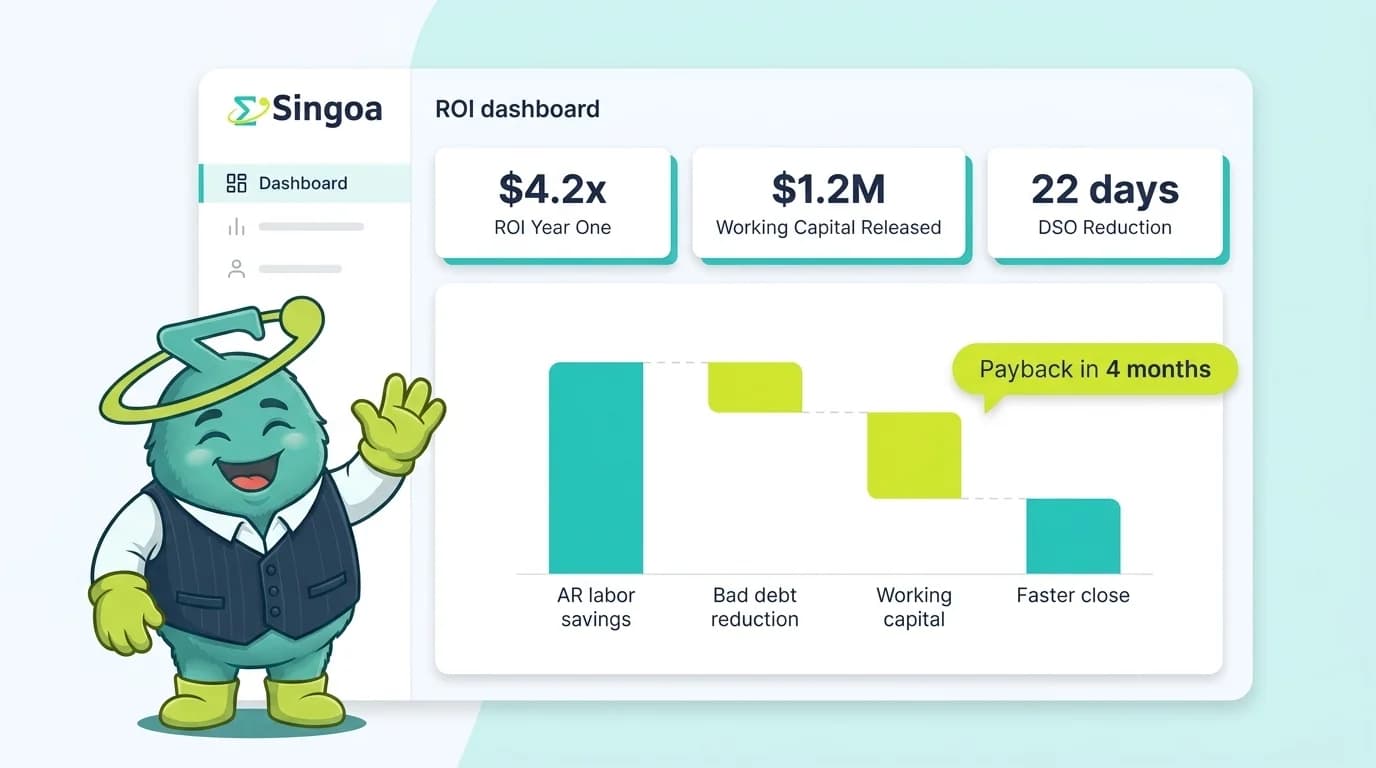
The business case for AR automation rests on four quantifiable value streams that you can model before purchase and verify after implementation. Cost reduction is the most straightforward calculation. Multiply your current cost per invoice by monthly volume, subtract the platform cost at $1-3 per invoice, and the difference is direct savings. A company processing 2,000 invoices monthly at $25 average cost saves $44,000-$46,000 per month, $528,000-$552,000 annually, from this single component.
Working capital release from DSO reduction is typically the largest value stream for mid-market companies. The formula: (Annual Revenue divided by 365) multiplied by DSO Days Reduced. For a $30 million revenue company reducing DSO by 15 days, the calculation yields approximately $1.23 million in permanently freed working capital. This is not a recurring annual savings, it is a one-time permanent balance sheet improvement, with ongoing value from reduced borrowing costs on the freed capital.
Bad debt reduction provides a third value stream. According to NACM's 2024 Credit Management Survey, companies implementing AI risk scoring and proactive collections reduce bad debt write-offs by 30-40%. For a $30 million revenue company with a 2% bad debt rate ($600,000 annually), a 35% reduction saves $210,000 per year. Risk-adjusted revenue, what you actually collect versus what you invoice, improves measurably within the first 90 days of AI-assisted collections.
Staff capacity reallocation is the fourth stream and often the most strategically important. When AR automation handles 70-80% of routine collections activity, existing staff redeploy to strategic credit management, customer relationship building, and financial planning support. This transformation from transactional to strategic function delivers compounding returns as your team builds deeper analytical capabilities that improve decision quality across the entire finance organization.
- Cost reduction formula: (Current cost per invoice - Automated cost) x Monthly volume
- Working capital release: (Annual Revenue / 365) x DSO Days Reduced
- Bad debt savings: Current write-off rate x 30-40% reduction x Annual Revenue
- Staff capacity: AR FTE hours saved x fully-loaded hourly cost
- Total Year 1 ROI for mid-market implementations typically ranges 300-500%
Pro Tip
Build your business case using conservative assumptions: 20% DSO reduction (not 40%), 25% bad debt reduction (not 35%), and $15 current cost per invoice (not $40). Conservative projections survive CFO and board scrutiny, and when actual results exceed them, which they typically do, you build credibility for future automation investments across the finance function.
The Future of AR: AI, Embedded Payments, and Autonomous Operations
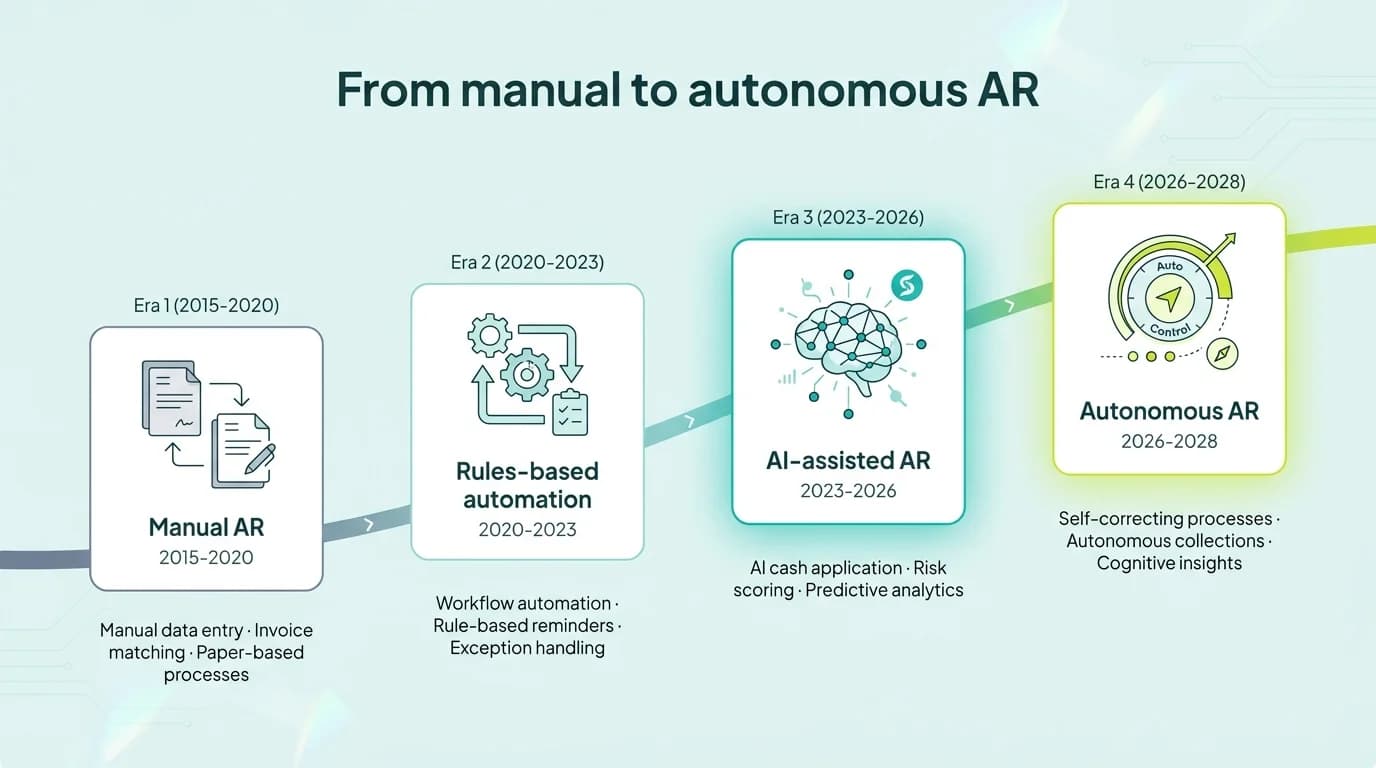
The next wave of AR innovation centers on autonomous operations, systems that not only automate predefined workflows but dynamically adapt strategies based on outcomes without human direction. Current platforms automate execution; next-generation platforms optimize strategy. An AI system that observes Tuesday morning SMS reminders outperforming Thursday email reminders for a specific customer segment will automatically shift the entire segment's dunning sequence. According to Forrester's 2026 AR Technology Predictions report, 35% of mid-market AR platforms will offer autonomous strategy optimization by 2028.
Conversational AI interfaces are transforming how finance teams interact with AR data. Tools like SINGOA Assist enable AR managers to query their portfolio in plain language: 'Show me customers whose payment time has extended by more than 10 days in the last quarter' or 'What is our projected cash receipt for the next two weeks?' The answer arrives in seconds, without building a custom report or waiting for analyst availability. This democratizes AR intelligence so controllers, CFOs, and operational leaders all access real-time insights on demand.
Embedded payments, integrating payment processing directly into business workflows rather than requiring customers to navigate to a separate portal, will compress DSO further over the next two to three years. When a contractor receives a pay application for approval in their project management system, the approval flow includes a direct payment trigger. When a wholesale buyer accepts a delivery in their inventory system, payment initiates automatically against pre-agreed terms. According to PYMNTS.com's 2025 Embedded Finance Report, embedded payment workflows reduce average collection time by 8-12 days compared to traditional invoice-then-pay models.
Predictive credit management will shift from reactive monitoring to proactive strategy. AI models trained on payment behavior across industries and geographies will recommend credit extension strategies that optimize portfolio growth while maintaining risk-adjusted return targets. The AR function transforms from a collections team into a revenue optimization engine, a strategic partner in customer acquisition and retention decisions that directly influences top-line growth.
- Autonomous AR: systems that optimize collection strategy dynamically, not just execute workflows
- Conversational AI: plain-language queries replace manual report building for AR intelligence
- Embedded payments: payment triggers built into business workflows, eliminating the reminder cycle
- Predictive credit: AI recommends which customers to extend credit to, not just which to restrict
Pro Tip
Evaluate AR platforms on their AI roadmap, not just current features. Vendors investing in machine learning infrastructure and conversational interfaces are building compounding advantages. Vendors focused primarily on static workflow automation are building features that will commoditize within two to three years. Ask specifically: how does your AI model improve with more customer data over time?
AR Automation Implementation Roadmap: From Zero to Optimized in 90 Days
Phase 1: Connect
Days 1-7Establish data connections between your AR platform and ERP, validate data integrity, and complete security review before activating any automation.
- Connect AR platform to ERP via API (QuickBooks, NetSuite, SAP, Sage, or Dynamics)
- Validate invoice, customer, and payment data synchronization accuracy
- Configure user roles and access permissions for all AR team members
- Set up bank account connections for payment receipt and cash application
- Complete security review and confirm SOC 2 Type II compliance documentation
Phase 2: Configure
Days 8-21Build customer segments, configure dunning sequences and risk scoring thresholds, set up the payment portal, and prepare your first automated workflows.
- Segment customers by risk tier: low, medium, high, and strategic accounts
- Configure dunning sequences for each segment with channel and timing preferences
- Set AI risk scoring thresholds for early-warning alerts and collections escalation
- Configure payment portal branding, accepted payment methods, and self-service options
- Build AR reporting dashboards for daily management review and board reporting
Phase 3: Automate
Days 22-60Activate automation for your highest-volume invoice types, process your first automated collections cycle, and measure results against your manual baseline.
- Activate automated dunning sequences for all active customer accounts
- Enable AI payment matching for all incoming payment types and formats
- Launch customer payment portal and embed payment links in invoice emails
- Configure AI risk scoring for continuous customer creditworthiness monitoring
- Run weekly DSO review meetings using real-time dashboards instead of manual reports
Phase 4: Optimize
Days 61-90Use data from the first full automated cycle to refine collection sequences, improve AI accuracy, and expand automation to complex billing edge cases.
- Review dunning sequence performance: open rates, click rates, payment conversion by segment
- A/B test reminder timing and messaging for your five highest-volume customer segments
- Validate AI payment matching accuracy and retrain the model on exception corrections
- Expand automation to dispute management, deductions, and complex billing scenarios
- Generate a 90-day ROI report comparing DSO, cost per invoice, and bad debt to your pre-automation baseline
Download the AR Automation Implementation Checklist
A 47-point checklist covering every step from ERP connection to your first fully automated collections cycle. Used by 500+ finance teams implementing AR automation for the first time.
Download Free Checklist (PDF)