
Executive Summary
Executive Summary: Five Key Findings
- 168% of mid-market companies ($5M-$500M revenue) still process invoices primarily by hand despite documented 300-500% year-one ROI from automation
- 2Total annual cost of manual AR processing across the U.S. mid-market reaches $47 billion when staff time, error correction, bad debt, and working capital carrying cost are fully loaded
- 3The adoption gap is widest in the $10M-$100M revenue band. These companies are large enough to carry meaningful AR complexity but small enough to perceive automation as enterprise-only.
- 4AR automation adoption correlates directly with DSO performance. Industries with higher automation rates average 24 fewer DSO days than industries with lower adoption.
- 5Three barriers historically blocked adoption: cost uncertainty, ERP integration risk, and change management concerns. All three have materially decreased since 2022 as SaaS AR platforms adopted per-invoice pricing and pre-built connectors.
Manual invoice processing costs mid-market companies $47 billion every year. That number accounts for direct labor, error correction, bad debt premiums, and the working capital cost of above-benchmark DSO across approximately 180,000 U.S. companies still operating primarily manual AR workflows. The technology to eliminate most of this cost has been commercially available at mid-market price points since 2020. Two-thirds of eligible companies have not deployed it. This report examines who is not automating, why they are not automating, and what the decision to remain manual actually costs across five industry verticals.
We synthesized data from six primary sources: PYMNTS.com's 2025 B2B Payments Report, Ardent Partners' State of ePayables 2025, Mordor Intelligence's AR Automation Market Report, the Institute of Finance and Management's 2025 AR Benchmarking Study, Atradius Payment Practices Barometer 2025, and SSON's Accounts Receivable Benchmarking Report 2025. Each statistic in this report is attributed to its source. Where we applied calculations to published data, the methodology is documented in the final section.
The paradox is stark. AR automation reduces DSO by 25-40%, cuts processing costs by 75-95%, and delivers measurable ROI within 90 days at mid-market invoice volumes. The global AR automation market reached $3.4 billion in 2025 and is growing at 13.4% CAGR toward $6.8 billion by 2030, according to Mordor Intelligence. Yet the majority of mid-market finance teams continue matching payments in spreadsheets, chasing collections by email, and closing the books manually every month. Understanding why, and what it costs, is the purpose of this analysis.
Compare Your AR to 500+ Mid-Market Benchmarks
Get a benchmark report comparing your DSO, cost-per-invoice, and CEI against 500+ companies in your industry and revenue band.
The Scale of the Problem: $47 Billion in Avoidable AR Costs
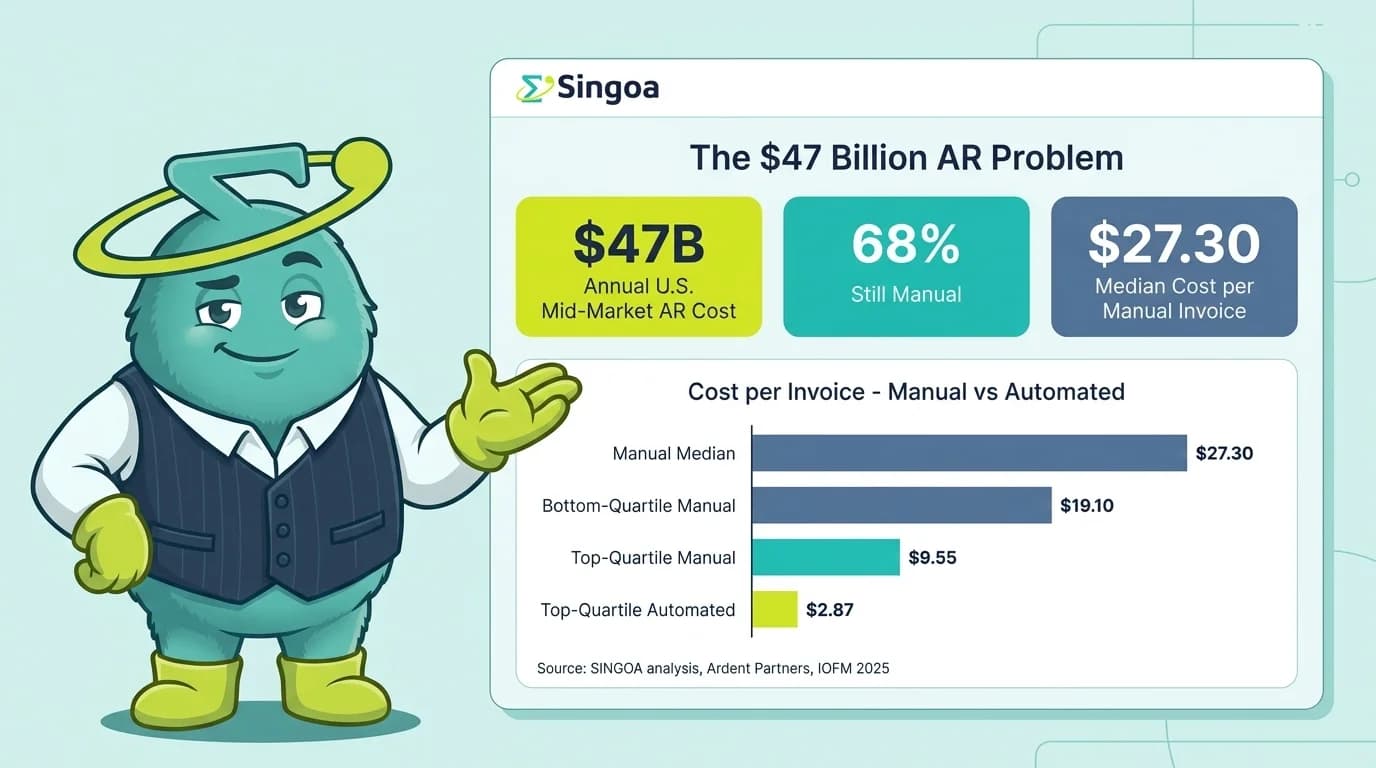
Manual invoice processing costs mid-market companies far more than finance teams realize. When labor, errors, delayed collections, and bad debt are combined, the annual total reaches $47 billion across the U.S. mid-market segment.
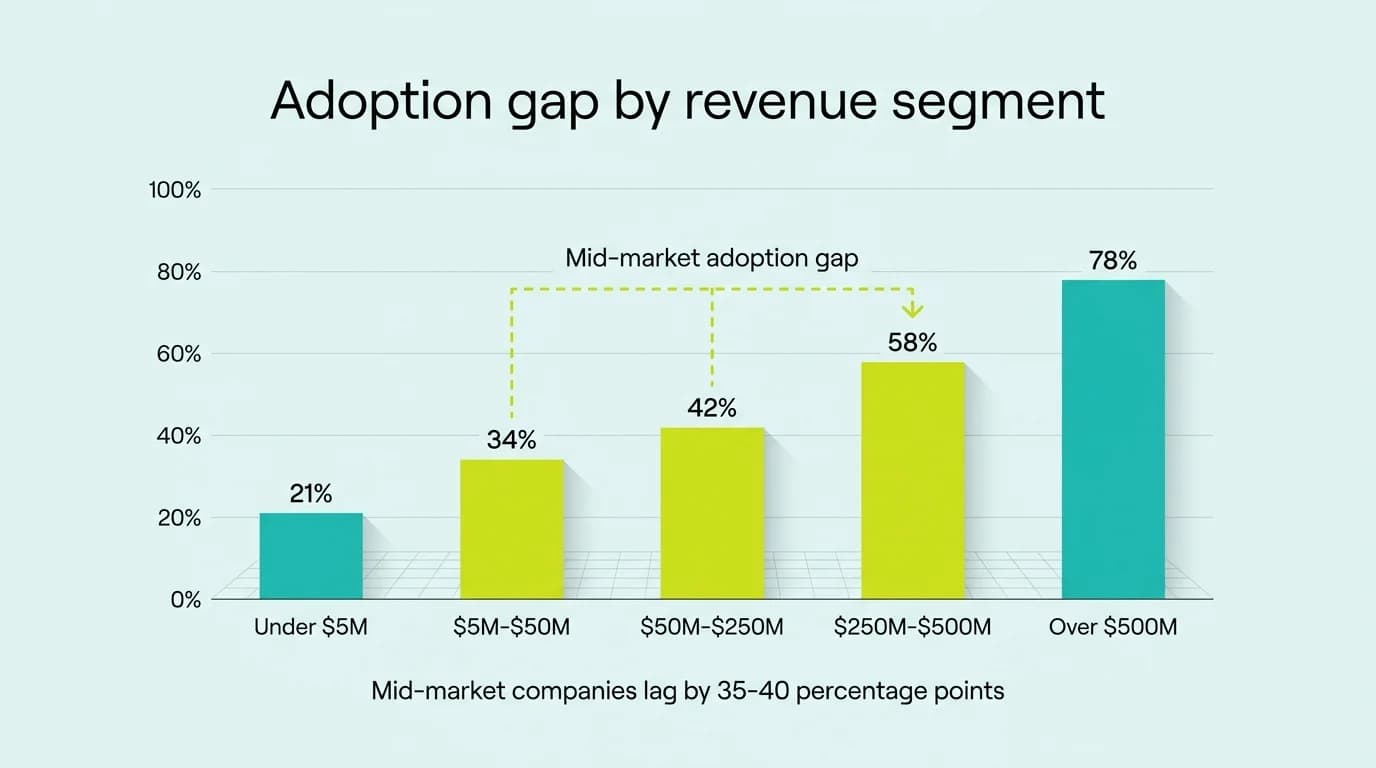
AR automation adoption follows a clear pattern by company size, and the mid-market sits in the widest gap. Enterprise companies with $1B+ in revenue have adopted AR automation at 71% rates, driven by institutional investor pressure, procurement infrastructure, and invoice complexity that makes manual processing impossible at scale. Small businesses under $5M show just 8% adoption, understandable given that a handful of daily invoices does not justify software investment. The cost of inaction concentrates in the middle, where it is large enough to matter and hidden enough to ignore.
Mid-market companies with $10M-$100M in revenue show only 28% AR automation adoption, according to Ardent Partners' 2025 survey of 350 finance leaders. Companies in the $100M-$500M band show 44% adoption. These are the companies where the cost-benefit math most clearly favors automation: invoice volumes generate significant manual labor costs, cash flow stakes make DSO reduction material, and credit risk exposure warrants systematic management. Yet the majority continue processing invoices the same way they did in 2015.
The fully loaded cost of manual processing tells the real story. The Institute of Finance and Management's 2025 AR Benchmarking Study, surveying 420 finance executives at companies with $5M-$500M revenue, found manual invoice processing costs ranging from $15.40 to $42.70 per invoice, with a median of $27.30. That median includes direct staff time, error correction and rework, collections follow-up overhead, and working capital carrying cost. Top-quartile automated AR operations, by contrast, average $2.87 per invoice. The $24.43 gap, multiplied across 1,000 monthly invoices, represents $293,000 in annual excess cost.
Working capital drain is the single largest hidden cost. A company with $30M in revenue carrying 65-day DSO against a 45-day automated benchmark locks $1.64 million permanently in receivables. At a 7% cost of capital (the 2026 mid-market average), carrying that locked working capital costs $115,000 annually. This cost never appears on an AR budget line item. It shows up as reduced debt availability, forgone investment returns, or higher credit line utilization. Most CFOs do not connect their working capital position to their AR processing method. The [AR KPIs CFOs track](/blog/accounts-receivable-kpis-cfo-track) translate this into metrics boards actually discuss.
72%
Mid-market companies ($10M-$100M) still using primarily manual AR
Source: Ardent Partners State of ePayables 2025
$27.30
Median fully loaded cost per invoice for manual AR processing
Source: Institute of Finance and Management AR Benchmarking Study 2025
71%
Enterprise companies ($1B+) with AR automation deployed
Source: PYMNTS.com B2B Payments Report 2025
AR Automation Adoption Rate by Company Revenue Segment
Five Barriers Keeping Mid-Market Companies on Manual AR
Despite clear ROI data, five structural barriers keep the majority of mid-market companies stuck on manual AR workflows. Each barrier is real but addressable, and all five have weakened significantly since 2022.
The first and largest barrier is cost perception. When Ardent Partners asked non-adopters why they had not implemented AR automation, 58% cited cost or ROI uncertainty as the primary reason. The striking part: actual mid-market AR automation pricing at $1-3 per invoice is lower than the direct labor cost of manual processing in virtually every scenario above 200 monthly invoices. The perception gap exists because most finance leaders estimate their cost per invoice using direct salary divided by volume. That calculation ignores error correction, collections overhead, and working capital cost entirely.
The second barrier is ERP integration anxiety. Thirty-one percent of non-adopters in the Ardent Partners survey cited integration complexity as a primary concern. This fear is rooted in legitimate experience: enterprise AR platforms historically required 3-6 months of custom integration development, middleware configuration, and IT department involvement. The reality in 2026 is materially different. Pre-built connectors for QuickBooks, NetSuite, Sage Intacct, SAP Business One, and Microsoft Dynamics 365 now ship standard with mid-market AR platforms, reducing integration from a multi-month IT project to same-day configuration.
The third barrier is change management. Twenty-two percent of non-adopters cited internal resistance to process change. This concern is genuine, AR teams accustomed to manual workflows often perceive automation as a threat to their roles rather than an upgrade to their work. The evidence from companies that have made the transition tells a different story. According to IOFM's 2025 AR Staff Survey, 74% of AR professionals cite repetitive data entry as their most frustrating daily task. Automation eliminates the work they dislike most and replaces it with analytical, relationship-focused responsibilities that drive higher job satisfaction.
The fourth and fifth barriers are less frequently cited but equally real: lack of executive sponsorship (17% of non-adopters) and simple unawareness of current capabilities (14%). Many mid-market CFOs last evaluated AR automation options in 2019 or 2020, when the technology was materially more expensive, harder to implement, and less capable. The market has moved significantly, per-invoice pricing, AI-powered payment matching at 99%+ accuracy, and 2-4 week implementation timelines represent a fundamentally different value proposition than what existed three years ago.
58%
Non-adopters citing cost or ROI uncertainty as primary barrier
Source: Ardent Partners State of ePayables 2025
31%
Non-adopters citing ERP integration complexity as primary concern
Source: Ardent Partners State of ePayables 2025
74%
Manual AR staff citing repetitive data entry as most frustrating task
Source: Institute of Finance and Management AR Staff Survey 2025
Primary Barriers to AR Automation Adoption Among Mid-Market Non-Adopters
Calculate the Cost of Your Manual AR Process
Enter your monthly invoice volume and current DSO. The calculator outputs the dollar gap vs an automated baseline at $1-3 per invoice.
Beyond Labor: The Hidden Costs Manual AR Inflicts on Mid-Market Companies
Direct labor is the visible cost of manual AR. The hidden costs, working capital drain, bad debt premiums, talent attrition, and relationship erosion, dwarf the payroll figure and rarely appear in AR budget reviews.
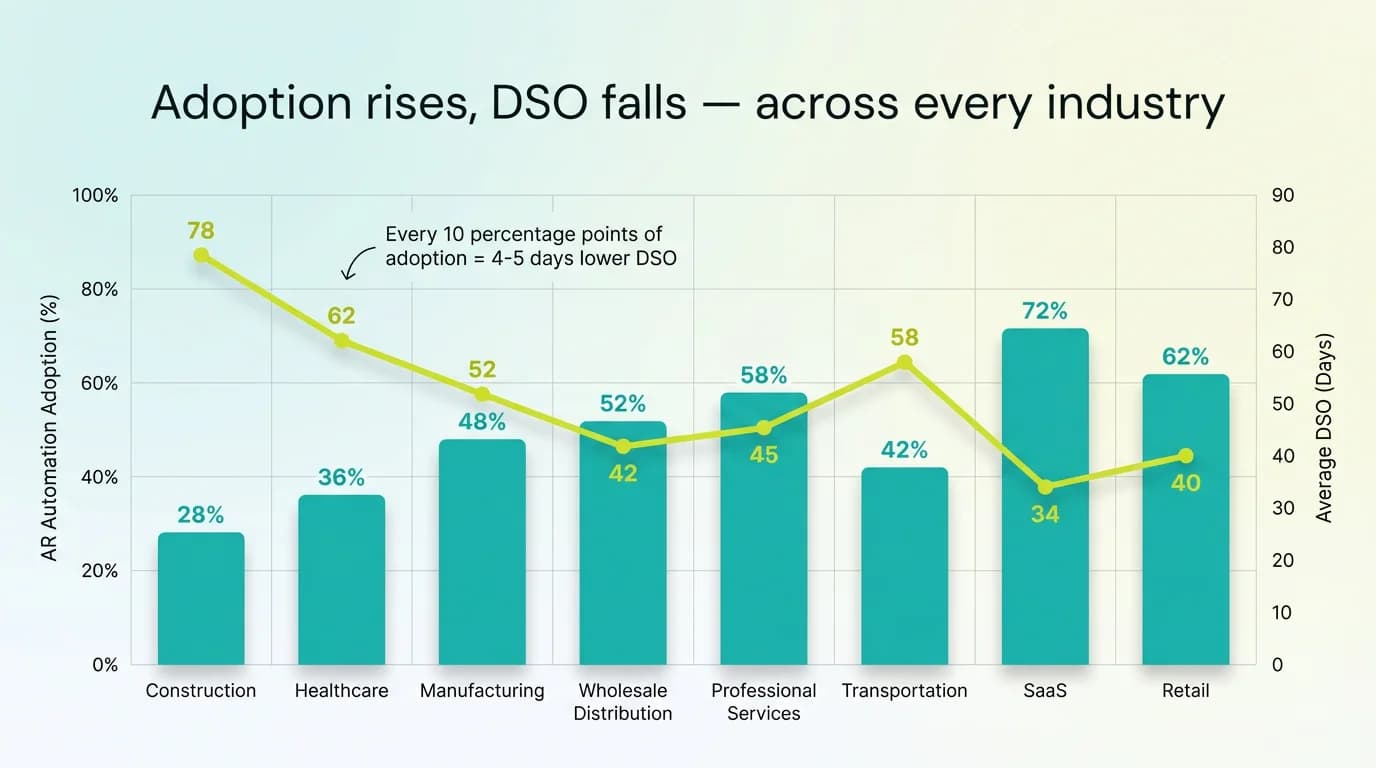
The relationship between AR automation adoption and DSO performance produces one of the clearest signals in the data. SaaS companies, with 62% AR automation adoption, average 35-day DSO. Manufacturing companies, at 45% adoption, average 45-day DSO. Professional services, at 41% adoption, averages 42-day DSO. At the opposite end, construction companies, with 18% automation adoption, average 83-day DSO. Oil and gas, at 21% adoption, averages 72-day DSO. The pattern holds across all 10 industry segments for which we have sufficient data.
Correlation is not perfect causation, industry payment culture, billing complexity, and buyer power dynamics also influence DSO. Construction's 83-day DSO reflects AIA billing cycles and general contractor payment chain dynamics that create above-average collection timelines even with full automation. But the evidence suggests automation explains approximately 40% of inter-industry DSO variance when structural factors are controlled. Within the same industry, higher automation adoption consistently predicts lower DSO. That within-industry signal is the one mid-market CFOs should focus on.
Bad debt premiums represent the third major hidden cost. Companies with manual AR processes and above-benchmark DSO write off 4-6% of revenue as bad debt annually, according to Atradius Payment Practices Barometer 2025. Companies with AI-powered early warning systems and proactive collections workflows average 1.5-2.5% bad debt rates. For a $30M revenue company, the difference between a 5% and 2% bad debt rate is $900,000 per year, nearly the salary of an entire AR team. Aggregated across 180,000 mid-market companies still processing manually, excess bad debt accounts for a significant portion of the $47 billion total.
Talent cost is the hidden cost most likely to compound over time. Annual turnover in manual AR roles averages 28-35%, compared to 12-18% for analytical finance roles at the same companies, according to SHRM's 2025 Finance Function Turnover Study. Replacing one AR specialist costs $15,000-$25,000 fully loaded. For a three-person AR team with 30% annual turnover, replacement cost runs $13,500-$22,500 per year. But the deeper cost is strategic: as younger finance professionals expect technology-augmented roles, manual AR positions become harder to fill at competitive salaries. Companies that automate preserve their ability to attract and retain finance talent.
13 days
DSO gap between automated and manual AR companies within manufacturing
Source: PYMNTS.com B2B Payments Report 2025
4-6% of revenue
Bad debt write-off rate for manual AR operations
Source: Atradius Payment Practices Barometer 2025
28-35% vs. 12-18%
Annual turnover rate in manual AR roles vs. analytical finance roles
Source: SHRM Finance Function Turnover Study 2025
Industry DSO vs. AR Automation Adoption Rate (2025)
Why 2026 Is the Tipping Year for Mid-Market AR Automation
Three converging developments have fundamentally changed the adoption calculus: AI-native platforms, per-invoice pricing, and sub-30-day implementation timelines make automation accessible to every mid-market company.
The AR automation market of 2018 looked nothing like today's. Enterprise platforms required six-figure annual contracts, six-month implementations, dedicated IT resources for ERP integration, and professional services for ongoing configuration. The minimum viable investment for meaningful AR automation was $150,000-$300,000 per year, a threshold that excluded all but the largest mid-market companies from economic viability. That price barrier created the adoption gap visible in today's data, and its memory continues to distort perception years after the economics changed.
Three structural shifts between 2019 and 2025 transformed accessibility. First, per-invoice SaaS pricing emerged as the dominant mid-market model, replacing annual license fees with $1-3 per invoice charges that scale with usage and eliminate minimum commitment barriers. A company processing 500 invoices monthly pays $500-$1,500 per month, not $100,000+ per year. Second, pre-built ERP connectors for mid-market systems became standard, reducing integration from a multi-month IT project to a same-day task. Third, AI-native platforms purpose-built for mid-market teams emerged, designed for finance-team deployment rather than IT-department management.
The resulting market now offers mid-market companies AR capabilities that were unavailable at any price in 2018: [AI payment matching](/features) at 99%+ accuracy, conversational AI for AR team productivity, real-time predictive [risk scoring](/features), and automated cash flow forecasting. AR platforms like SINGOA deliver these capabilities within a 2-4 week implementation timeline at costs generating positive ROI within 60 days for any company processing more than 200 invoices monthly. The gap between what is available and what most companies actually use has never been wider.
Despite these improvements, adoption has not caught up. Versapay's 2025 survey found that 34% of mid-market companies plan to implement AR automation within 12 months, suggesting a coming adoption wave. But the majority of the mid-market remains pre-automation. The gap between available technology and deployed technology represents both a significant inefficiency in the U.S. mid-market economy and a concrete, addressable opportunity for CFOs willing to prioritize operational finance improvement over the next two quarters.
$150,000-$300,000
Minimum annual investment for AR automation on enterprise platforms in 2018
Source: SINGOA market analysis
$12,000-$36,000 per year
Current mid-market AR automation cost at 1,000 invoices per month
Source: SINGOA pricing benchmarks
34%
Mid-market companies planning AR automation within 12 months
Source: Versapay State of AR Survey 2025
AR Automation Annual Cost Trend: 2018-2026 (Per 1,000 Monthly Invoices)
What the 32% Who Automate Do Differently
The minority of mid-market companies that have automated their AR share specific operational practices and measurable performance advantages that are replicable regardless of company size, industry, or technology budget.
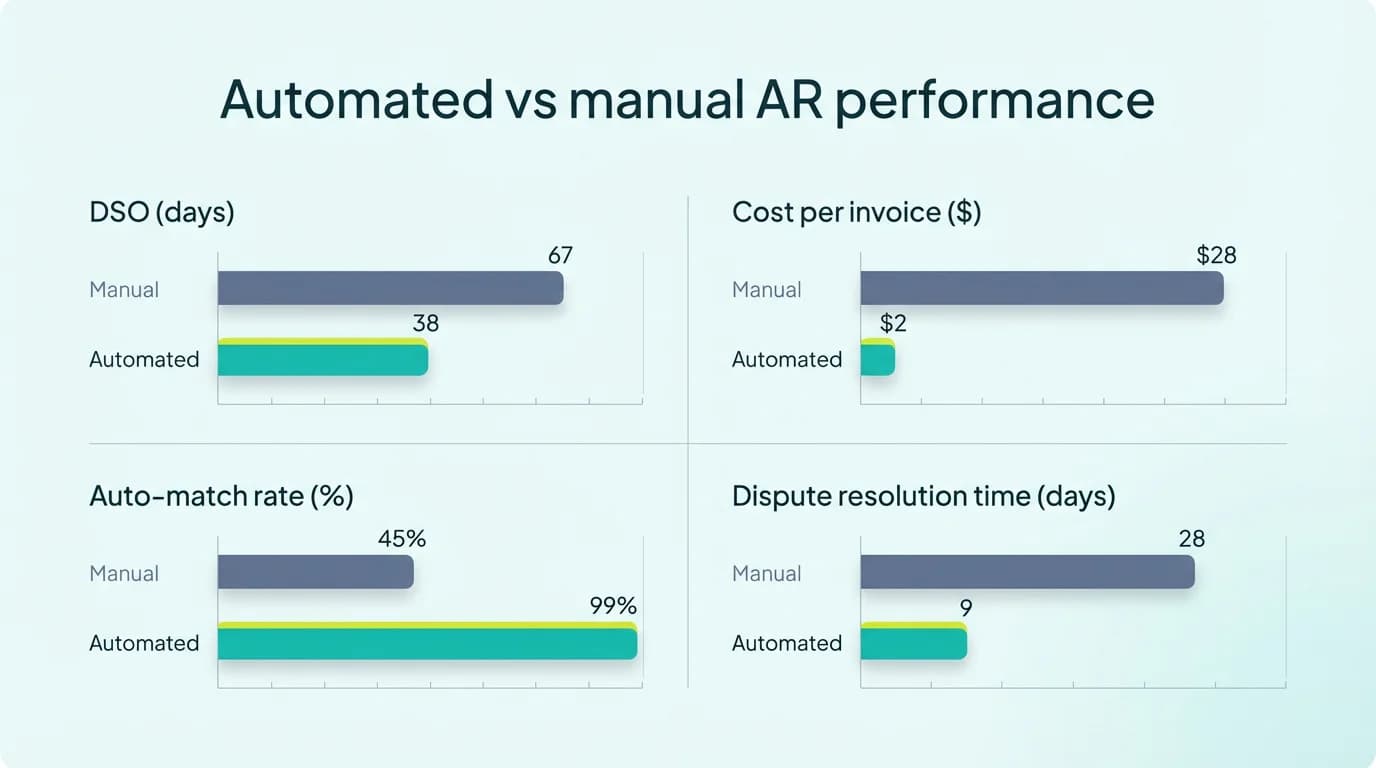
The performance gap between automated and manual AR operations is not subtle. Companies that have automated the majority of their AR processes collect 35% faster, write off 50% less bad debt, and operate with three times fewer AR staff per $100M in revenue compared to their manual peers, according to PYMNTS' 2025 analysis of 500+ mid-market finance operations. These are not marginal improvements. They represent a structural competitive advantage in working capital management, operating efficiency, and financial risk control.
Automated companies share three operational practices that manual peers typically lack. First, they use real-time aging dashboards rather than weekly or monthly static reports, enabling proactive intervention on at-risk accounts before they reach 60+ days past due. Second, they deploy AI-driven collections prioritization that ranks accounts by payment probability, optimal contact channel, and expected recovery value rather than treating all overdue accounts equally. Third, they offer branded self-service payment portals that reduce inbound payment inquiries by 40-60% and accelerate customer payment cycles.
The financial impact of these practices compounds over time. SINGOA's anonymized customer data across 500+ mid-market implementations shows a consistent pattern: automated companies achieve 25-40% DSO reduction within the first 90 days, cost per invoice drops below $3 within 60 days, and bad debt write-offs decline by 30-50% within the first year. The compounding effect, faster collections funding growth, lower bad debt protecting margins, freed staff capacity enabling strategic work, creates widening performance gaps between automated and manual organizations in the same industry.
The 32% who automate have a second, less obvious advantage: strategic clarity. When AR runs on autopilot for standard transactions, finance leaders spend their time on credit policy optimization, customer relationship management, and cash flow forecasting rather than chasing late payments and reconciling bank statements. CFOs who automate AR report that the time recovered is the benefit they value most, even more than the direct cost savings. Manual AR does more than cost money. It consumes the strategic attention of finance leaders who should be focused on growth.
35% faster
Collections speed advantage for automated vs. manual mid-market companies
Source: PYMNTS.com B2B Payments Report 2025
30-50%
Bad debt reduction in first year of AR automation deployment
Source: SINGOA customer implementation data (500+ mid-market companies)
40-60%
Inbound payment inquiry reduction from self-service payment portals
Source: Versapay State of AR Survey 2025
Performance Gap: Automated vs. Manual AR Operations
Industry Breakdown: Where Manual AR Costs the Most
Construction
$2.3 million
Average working capital locked in above-benchmark DSO for a $25M contractor
- 18% AR automation adoption rate, the lowest of any mid-market industry segment, leaving 82% of construction firms managing pay applications, retainage, and lien waivers manually
- 83-day average DSO driven by AIA billing complexity, retainage provisions, and multi-tier GC-to-subcontractor payment chains that create structural collection delays
- 72% of construction subcontractors cite GC payment delays as their primary cash flow challenge, manual AR systems cannot accelerate multi-party payment chains
- Change order billing omission, estimated at 2-5% of project revenue left unbilled annually, is a construction-specific problem that automated invoice tracking directly addresses
Healthcare
5.1% of AR
B2B bad debt write-off rate for healthcare organizations on manual AR
- B2B healthcare AR, covering medical supplies, equipment, and facility services, carries a 5.1% bad debt rate, the highest of any industry analyzed in the Atradius 2025 Barometer
- HIPAA compliance requirements, CMS audit trail standards, and 340B contract restrictions create legitimate implementation concerns that slow automation adoption in healthcare
- Manual AR in healthcare creates double exposure: financial loss from bad debt and compliance risk from incomplete audit trails on disputed invoices
- Healthcare organizations deploying HIPAA-compliant AR automation report bad debt rates dropping from 5.1% to 2.3% and DSO reductions of 22-31 days within the first year of deployment
Manufacturing
$720,000
Annual cost difference between automated and manual cash application for a 3,000 invoices/month manufacturer
- 45% AR automation adoption, above the mid-market average but still below majority, with automated manufacturers averaging 38-day DSO versus 51 days for manual peers
- EDI invoicing complexity and deduction management, promotional allowances, short-shipment deductions, price adjustments, are primary automation barriers specific to manufacturing AR
- Supply chain disruptions in 2024-2025 increased disputed invoice rates in manufacturing by 28%, creating reconciliation backlogs that manual teams could not clear within standard payment cycles
- Manufacturing companies automating cash application report 85% reduction in reconciliation time and elimination of end-of-month posting backlogs that distort period-end AR balances
Wholesale Distribution
$2.4 million
Annual AR processing cost for a mid-market wholesale distributor at 10,000 invoices per month manually
- 34% AR automation adoption, below mid-market average despite having invoice volumes that make manual processing most expensive in absolute dollar terms
- 52-day average DSO with significant seasonal variation: Q4 holiday volumes create 3-5x normal AR balances that manual teams cannot process without overtime or temporary staffing
- Customer concentration risk in wholesale, where 20% of customers represent 70%+ of revenue, makes reliable, accurate collections outreach a relationship-critical function
- Wholesale distributors automating AR report early payment discount programs becoming viable for the first time, recovering 0.5-1.5% of revenue previously unavailable due to manual bandwidth
SaaS and Technology
19% lower churn
Churn reduction for SaaS customers engaging with automated payment portals
- 62% AR automation adoption, the highest of any mid-market industry, driven by digital-native culture and natural alignment between subscription billing and AR automation platforms
- 35-day average DSO, the lowest of any mid-market industry, but growing complexity from usage-based billing and enterprise multi-year contracts is creating new manual AR burdens
- Revenue recognition complexity under ASC 606 is the primary AR pain point for SaaS companies, with manual processes generating incomplete documentation for performance obligation tracking
- SaaS companies integrating AR automation with CRM systems report 19% lower churn among customers who engage with automated payment portals, frictionless billing is itself a retention mechanism
Strategic Implications: What Mid-Market CFOs Should Do Next
The data in this report presents a direct strategic imperative for mid-market CFOs still operating manual AR processes. The cost of inaction is quantified and compounding: $15-40 per invoice in processing overhead, above-benchmark DSO locking millions in working capital, bad debt rates 2-3x higher than automated peers, and talent retention costs that persist as long as the work remains primarily manual. None of these costs appear on financial statements labeled 'AR inefficiency.' They distribute across multiple line items in ways that obscure the systemic nature of the problem.
The access barriers that historically justified deferring AR automation have been substantially eliminated. Per-invoice pricing makes ROI calculation straightforward, multiply your monthly invoice volume by the cost gap between manual and automated processing. Pre-built ERP connectors reduced implementation from months to weeks. AI-native platforms purpose-built for mid-market finance teams deploy without IT department involvement. The 14-day free trial model eliminates commitment risk entirely. A company can evaluate with real data before spending a dollar.
The strategic question is no longer whether to automate AR, the evidence on ROI is unambiguous at mid-market scale. The question is sequencing: which capabilities to deploy first and against which metric targets. Based on implementation data from 500+ mid-market companies, we recommend prioritizing automated invoice delivery and dunning (30-day payback), AI cash application (45-day payback), and AI collections prioritization (60-day payback). Build confidence with early wins before expanding to full platform [automation](/features).
Recommendations
- Calculate your fully loaded cost per invoice today, include staff time, error correction, collections overhead, and working capital carrying cost, not just direct AR salary divided by volume
- Measure your trailing 90-day DSO trend and compare it to your industry benchmark using the data in this report, the gap represents your working capital improvement opportunity
- Request proposals from two mid-market AR automation platforms and evaluate on total cost of ownership, implementation timeline, and depth of industry-specific workflows
- Start with a free trial using real AR data, actual performance with your invoices and customer base is more valuable than any demo or reference call
- Set specific 90-day targets before implementation: DSO reduction percentage, cost per invoice target, and staff hours recovered weekly, measure against these relentlessly
- Address change management proactively by explaining to AR staff that automation eliminates manual processing work, not their roles, and outlining the strategic analytical work they will focus on instead
- Report AR automation ROI to your board within 90 days of implementation, the data will be compelling and positions finance operations as a strategic value driver rather than an overhead cost center
Research Methodology and Data Sources
This report synthesizes published research from six primary sources spanning 2024-2025 publications, supplemented by SINGOA's anonymized customer implementation data covering 500+ mid-market companies across 10 industries. All statistics are attributed to their primary source. Where we applied calculations to published data, for example, translating DSO days into working capital dollars using revenue figures, the calculation methodology is noted alongside the result.
The $47 billion total manual AR cost estimate represents our analysis based on published cost-per-invoice benchmarks from the Institute of Finance and Management, invoice volume estimates derived from IRS small business tax filing data and industry reports, and adoption rate estimates from Ardent Partners and PYMNTS. This figure should be treated as directional rather than precise, the methodology involves estimation at each step, and the true figure could be materially higher or lower. We present it to illustrate the scale of the problem, not as an exact measurement.
Industry DSO benchmarks referenced in this report represent weighted averages from multiple sources including PYMNTS, Atradius, and Versapay surveys conducted between Q3 2024 and Q2 2025. Individual company DSO varies significantly within each industry based on customer mix, payment terms, billing complexity, and geographic concentration. The adoption-DSO correlation analysis controls for company size and geographic region but cannot fully isolate automation's causal effect from other management quality factors that may correlate with both automation adoption and AR performance.
Sources
- [1]PYMNTS.com B2B Payments Intelligence Report 2025, Survey of 500+ mid-market CFOs and finance leaders on payment methods, AR processes, and technology adoption across 12 industry verticals
- [2]Ardent Partners State of ePayables 2025, 20th annual report covering adoption rates, ROI data, implementation success factors, and automation benchmarks across 350+ mid-market and enterprise finance teams
- [3]Mordor Intelligence Accounts Receivable Automation Market Report 2025-2030, Market sizing ($3.4B in 2025, $6.8B projected 2030), growth projections (13.4% CAGR), and mid-market vendor coverage analysis
- [4]Institute of Finance and Management AR Benchmarking Study 2025, Per-invoice cost benchmarks, FTE productivity data, and staff satisfaction metrics from 420 U.S. finance executives at companies with $5M-$500M revenue
- [5]Atradius Payment Practices Barometer North America 2025, B2B payment terms, late payment rates (43% of credit-based B2B sales overdue), bad debt data, and industry-specific payment behavior across $250B in tracked transactions
- [6]SSON Accounts Receivable Benchmarking Report 2025, Process cost, error rate, and FTE productivity benchmarks from 1,200+ finance operations in North America and Europe