
Quick Answer
Manual invoice processing costs $15-40 per invoice; invoice automation software cuts that to $1-3, an 85-93% reduction. Mid-market AR teams above 300 invoices per month typically see payback in 3-6 months.
Key Takeaways
- Manual invoices cost $15-40 each; automated invoices cost $1-3, an 85-93% per-invoice cost reduction (APQC, 2026).
- Roughly 60% of the manual cost is AR clerk labor, 20% is exception handling, 20% is materials and follow-up cycles.
- A team processing 5,000 invoices monthly saves about $960K annually by moving from $18 to $2 per invoice.
- Add 25-40% DSO reduction and 35% faster collections as upside on top of direct per-invoice savings.
- Automation pays back in 3-6 months above 300 invoices/month; below that volume, payback can stretch past 18 months.
The real cost of processing an invoice in 2026
Your AR team processed 4,200 invoices last month. At APQC's median manual cost of $21.40 per invoice, that single month cost roughly $89,880 in labor, materials, and exception time. Annualized, the line runs north of a million dollars, and it sits inside a spreadsheet nobody at the board level has been asked to defend. Most CFOs see the AR headcount line, not the per-invoice line. The gap between those two numbers is where the real money hides.
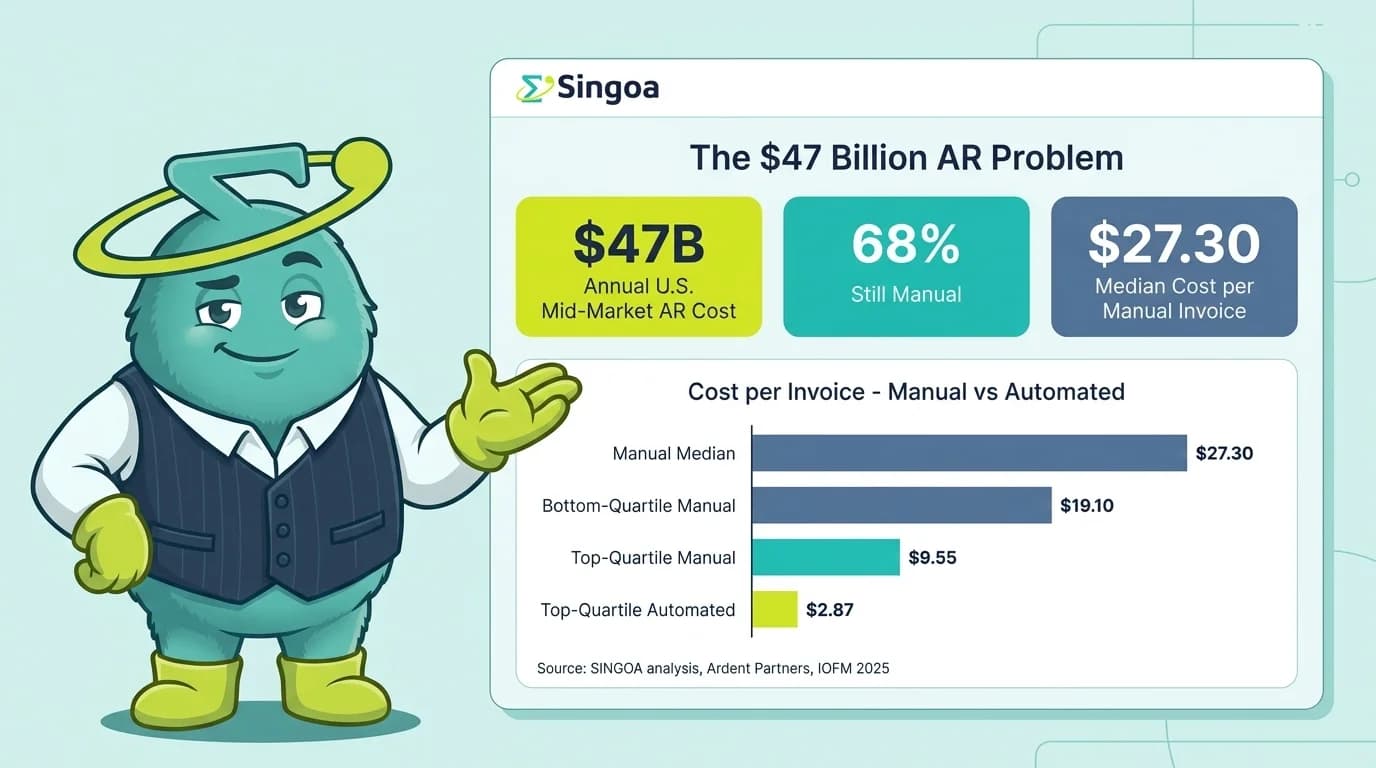
Invoice automation software changes that math in a way you can put on one page. APQC's top-quartile manual benchmark is $10.18 per invoice; the median sits at $21.40; AR-side estimates that include follow-up, dunning, and disputes land in the $15-40 range. Automated processing pulls that number to $1-3 per invoice, an 85-93% reduction backed by the canonical $15.97 to $2.36 benchmark cited across industry research from Ardent Partners and Spend Matters.
This post walks through the unit economics in plain numbers. We cover what goes into the manual cost, what automation actually replaces, the ROI math for a 5,000-invoice-per-month mid-market team, and the volume floor where automation stops paying back. No vendor pitch math, no hidden assumptions. You should be able to forward this to your controller and rebuild the calculation against your own invoice volume in under twenty minutes.
Processing a single AR invoice manually costs $15-40 in 2026 when you include labor, error correction, materials, and downstream follow-up time. Automated invoice processing using OCR, AI matching, and digital delivery brings that figure down to $1-3 per invoice, a reduction APQC and Ardent Partners benchmarks consistently confirm across mid-market AR operations.
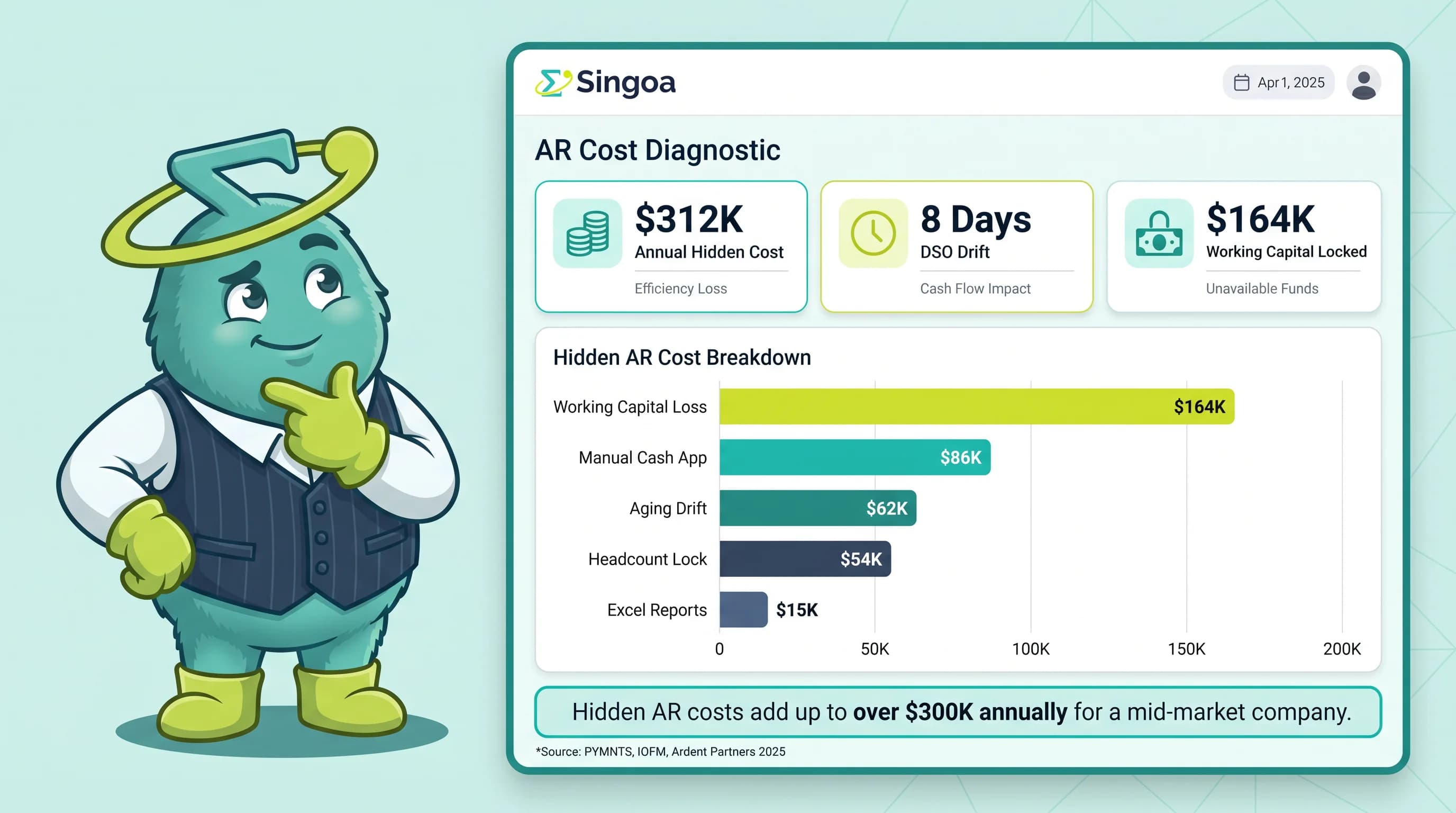
Cost per invoice is not the same as the cost of stamps. The honest number includes four buckets: the AR clerk minutes spent generating and sending the invoice, the cost of fixing exceptions when something goes wrong, the materials line (paper, envelopes, postage, e-fax credits), and the follow-up tax of dunning calls, dispute resolution, and re-sending lost invoices. CFOs who only count the first bucket routinely understate their true cost by 40-60%.
The APQC benchmark sets the reference points most finance leaders quote. Top-quartile companies process an invoice for $10.18; the median sits at $21.40. SINGOA's AR-side data, drawn from mid-market customers before they move to automation, lands in the $15-40 range once exception handling and follow-up are included properly. That spread is why two companies of similar revenue can have radically different AR economics, and why benchmarking before evaluating software matters more than picking the prettiest demo.
Why do CFOs underestimate this number? Because nobody tracks the exception tax in the GL. A disputed invoice that takes three weeks to resolve is logged as a collections delay, not a per-invoice cost. Understanding [the $47 billion manual AR problem](/blog/47-billion-ar-problem-manual-invoice-processing) starts with rebuilding the unit cost from scratch. Here is where it gets interesting: the bigger the company, the bigger the underestimation.
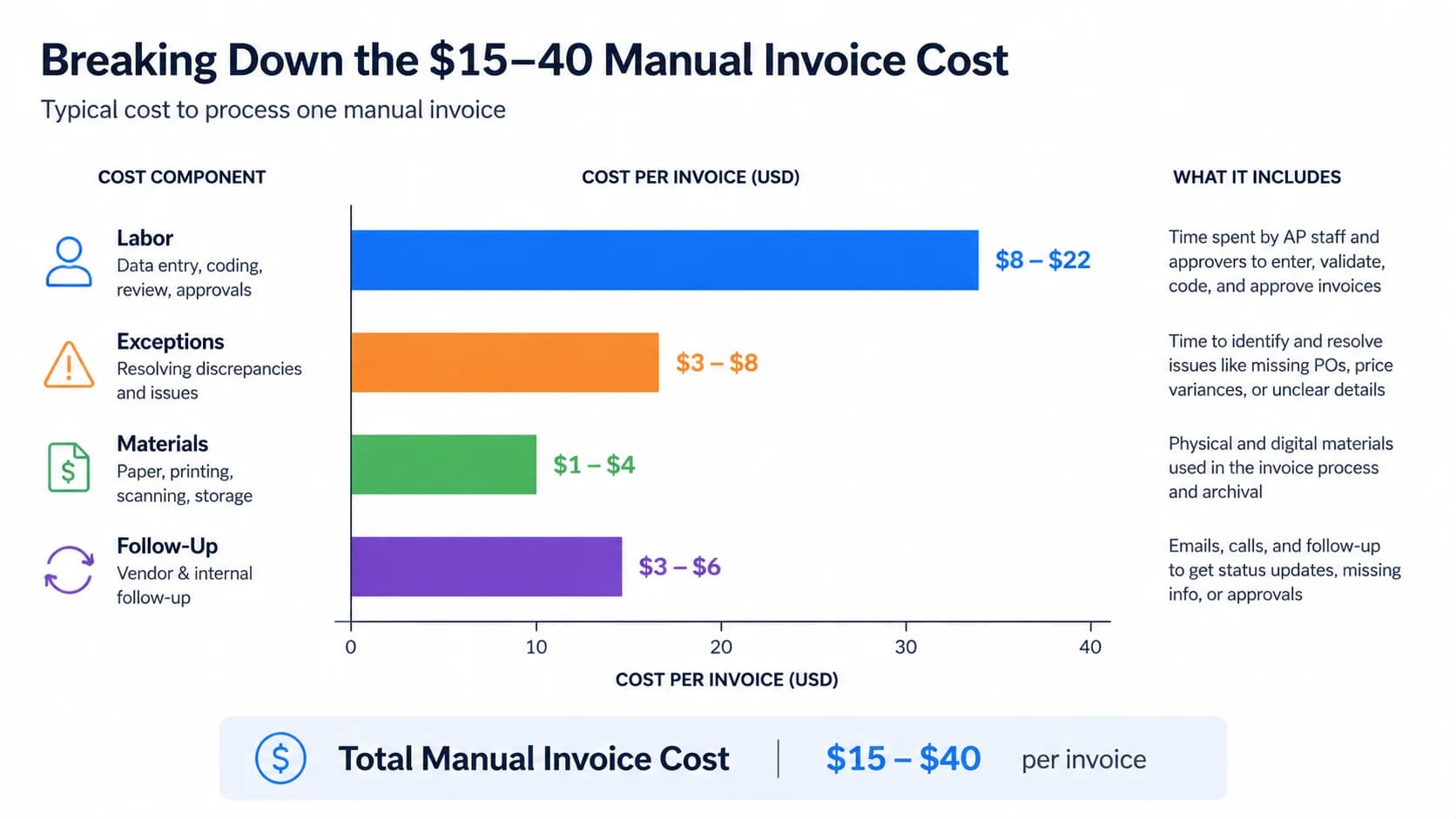
What goes into the $15-40 manual cost
The $15-40 manual invoice cost breaks down roughly as 60% labor (AR clerk time generating, formatting, and sending invoices), 20% exception handling (disputes, missing POs, mismatched line items), 10% materials (paper, postage, e-fax, archiving), and 10% downstream follow-up like dunning calls and re-sends.
Labor is the largest bucket and the easiest one to validate. An AR clerk needs 8-12 minutes per invoice to pull the order, format the document, attach supporting paperwork, and deliver it via the channel the customer requires. At a fully-loaded hourly rate of $25-45 for mid-market AR staff, that single step lands between $3.50 and $9 per invoice before anything goes wrong. Multiply by 60,000 invoices a year and labor alone runs $210K-$540K.
The exception tax is the bucket controllers miss most. Industry data from Ardent Partners and SINGOA customer baselines shows 18-22% of invoices need a manual touch: a missing PO, a quantity mismatch, a unit-price disagreement, a tax-jurisdiction question. Each exception adds 12-30 minutes of clerk time plus a sales-rep or customer ping. A disputed invoice can absorb $50-150 in fully-loaded staff cost before payment ever clears, which is 3-5x the original processing cost.
Materials and follow-up round out the picture. Paper, envelopes, postage, and the occasional certified delivery still add $0.80-$2 per invoice, even for hybrid digital teams. Dunning calls, re-sends to lost emails, and dispute coordination tack on 2-4 minutes per invoice across the receivables lifecycle. These are the [signs your AR process is costing more than you think](/blog/signs-ar-process-costing-more-than-you-think). The real question is: how much of this work is actually irreducible?
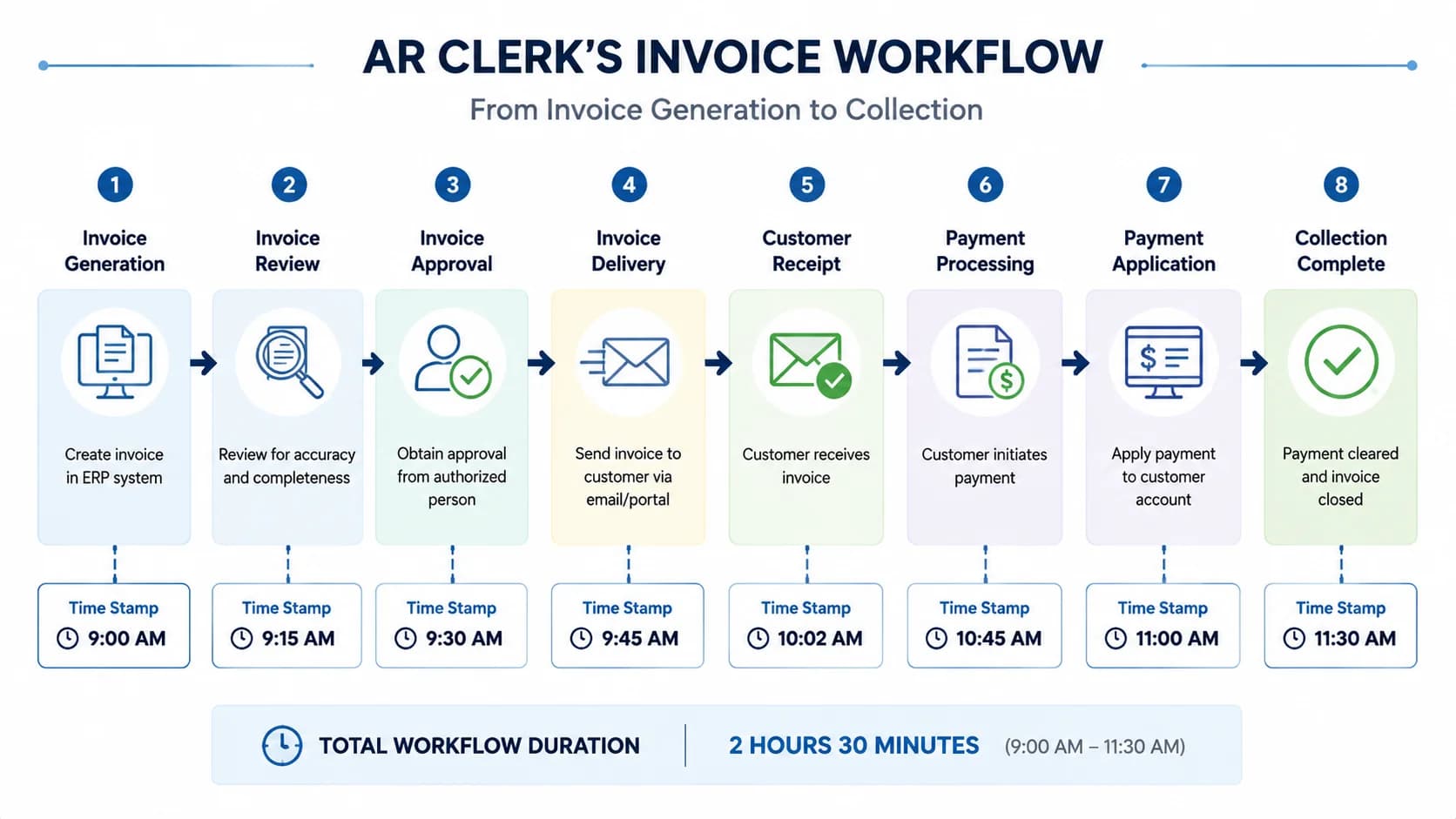
Pro Tip
Most AR managers track only labor and miss the exception tax. A single disputed invoice can cost $50-150 to resolve, 3-5x the original processing cost. Pull last quarter's dispute log and divide by invoice count before you build your business case.
See your invoice automation ROI in numbers
Enter your monthly invoice volume and current cost-per-invoice to see annual savings and payback in real numbers.
What 'automated' actually means in invoice processing
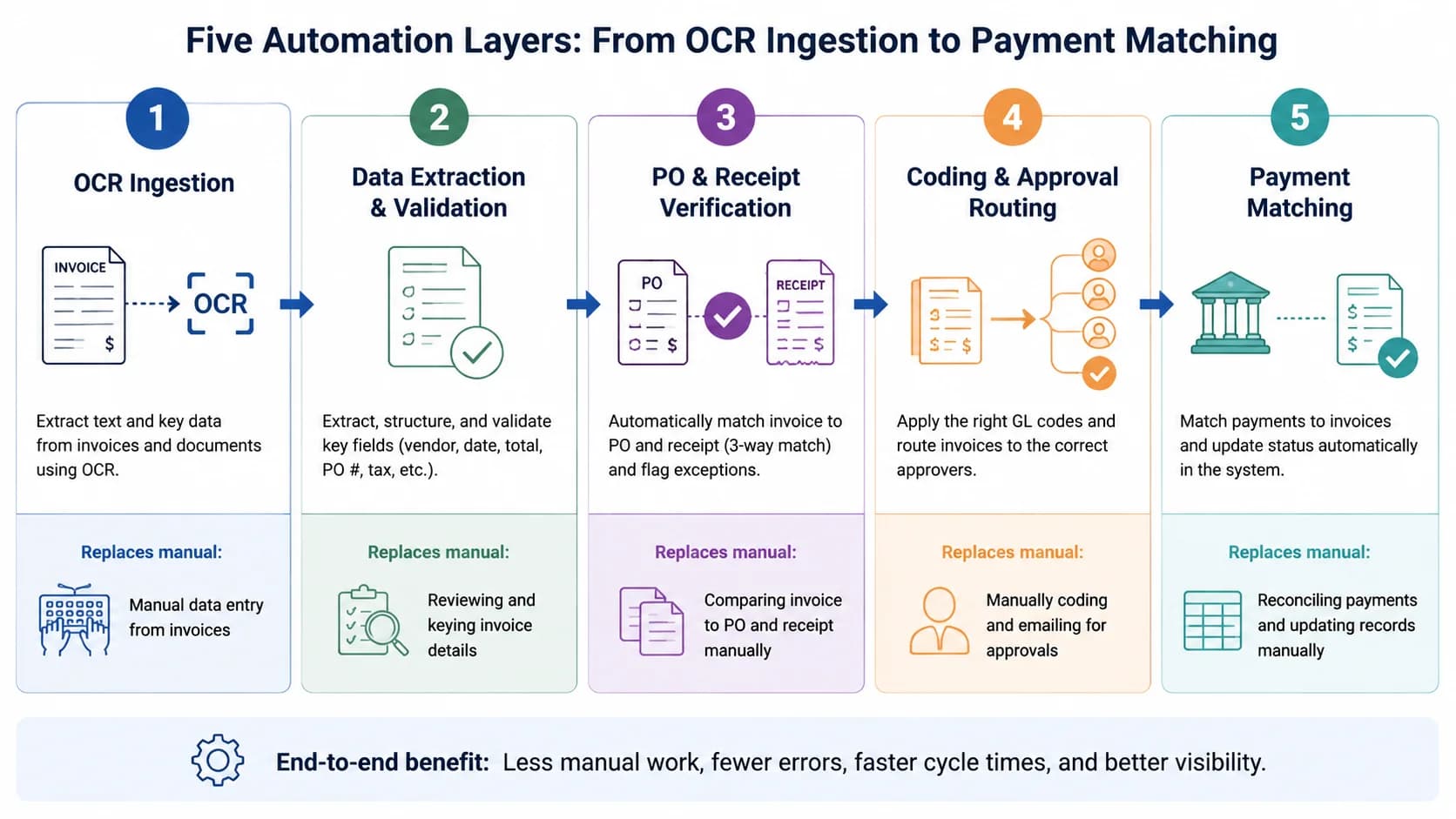
Automated invoice processing replaces five manual steps with software layers: invoice OCR for inbound documents, bulk and recurring invoice generation, multi-channel auto-delivery (portal, email, EDI), AI payment matching at 95-99% accuracy, and automated dunning workflows. Together these layers eliminate roughly 80% of human touchpoints across the receivables cycle.
Invoice OCR handles the inbound side: customer-supplied bill-back documents, attached POs, and scanned remittance advice. Modern OCR engines hit 95%+ accuracy on standard formats and flag the rest for human review rather than dropping them silently. This matters on the AR side because every mis-keyed line item becomes a dispute three weeks later, which is where the $50-150 exception tax kicks in. Bulk invoicing software and recurring invoice software then handle the outbound flow, batching thousands of invoices through one click instead of one clerk-minute each.
Auto-delivery is the underrated layer. A modern AR platform sends each invoice through the channel the customer actually accepts: a buyer portal upload for Walmart-style trading partners, EDI 810 for retailers, plain email PDF for small accounts, and printed mail for the 5-10% of customers who still demand it. The clerk stops being a routing decision-maker and starts being an exception handler, which compresses the labor bucket by 70-80% on its own.
The matching layer is where margin lives. AI payment matching reconciles incoming payments to open invoices at scale, with [AI payment matching accuracy](/blog/ai-payment-matching-accuracy) of 99.2% in best-in-class deployments. That accuracy is the difference between auto-applying a $1.2M ACH batch in 30 seconds versus a controller spending three hours unwinding short-pays. What most people miss: automation is not one tool, it is a stack.
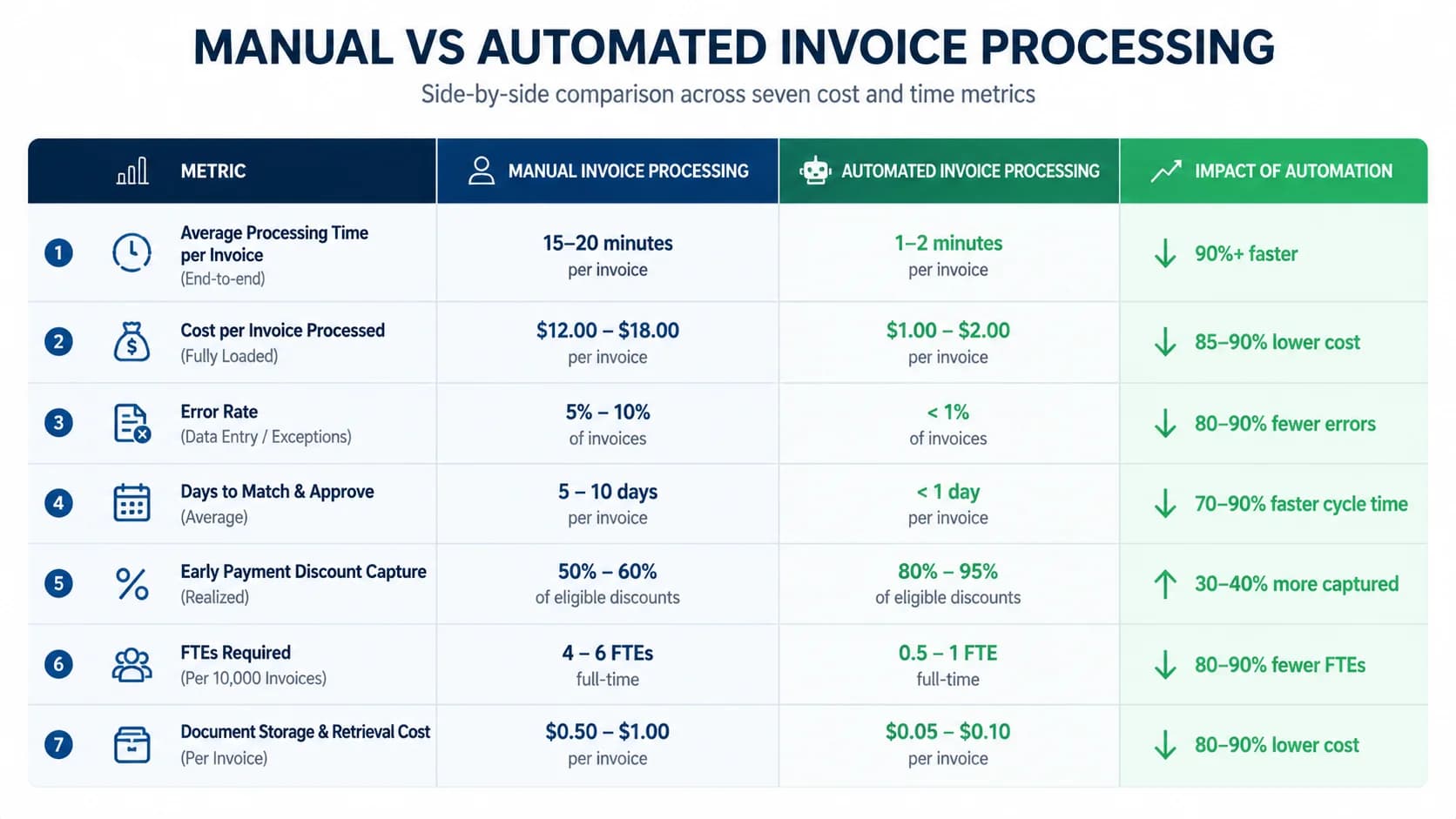
The manual vs automated cost comparison
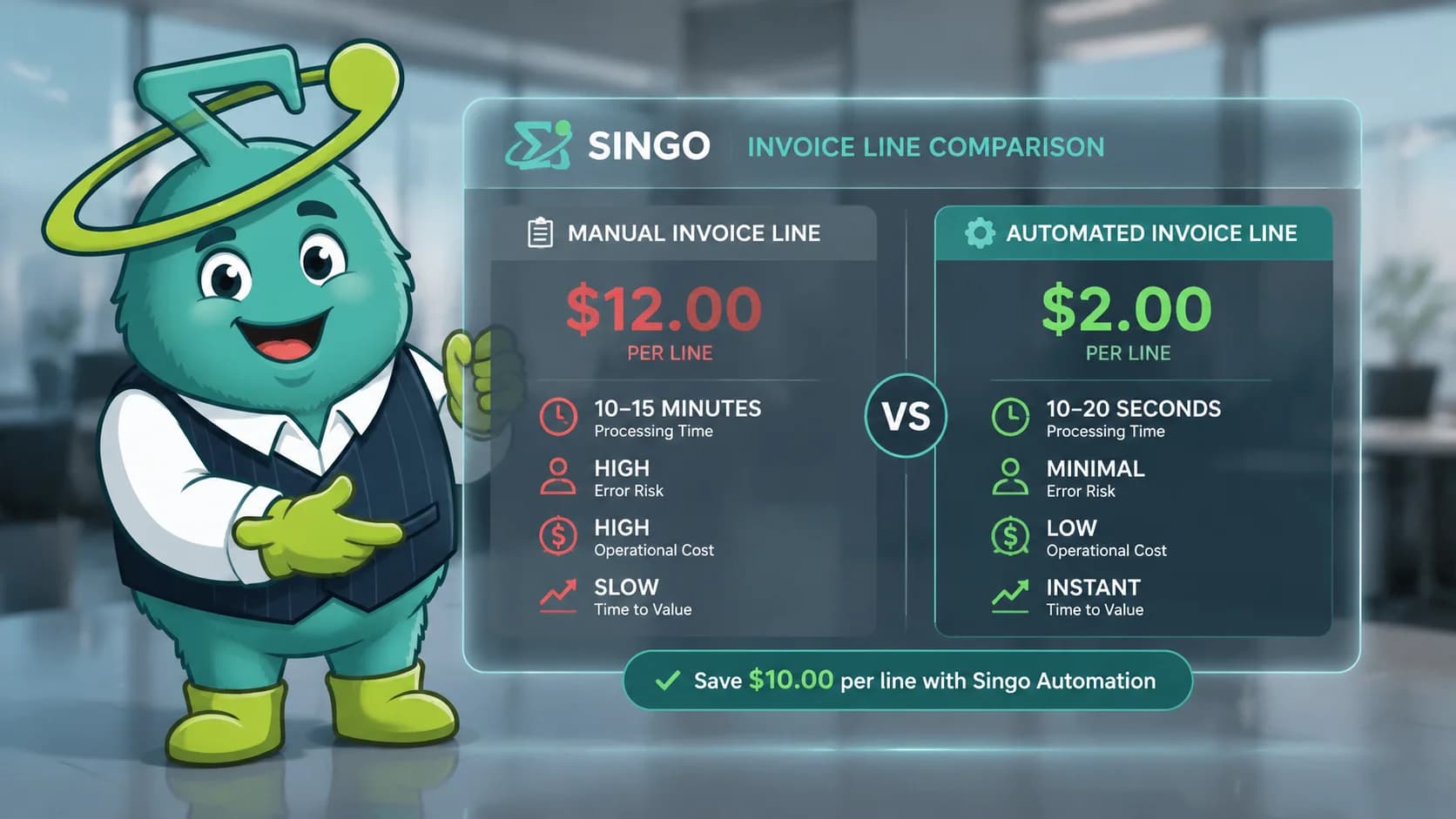
Across labor, exception handling, materials, follow-up, and cycle time, automated invoice processing reduces per-invoice cost by 85-93% and shortens cycle time from 8-12 minutes to under 60 seconds. APQC and PYMNTS data shows automated AR teams also see 70-80% time savings and 25-40% DSO reduction within the first year.
The cleanest way to read the comparison is one metric at a time. Labor drops from 8-12 minutes per invoice to under 60 seconds of human attention (mostly exception triage). Exception rates fall from 18-22% to 4-6% because OCR and validation catch errors before they ship. Materials collapse from $0.80-$2 to roughly $0.10 per invoice for digital-first delivery. Follow-up shrinks from 2-4 minutes to seconds per invoice once dunning runs on a schedule instead of a clerk's memory.
The anchor benchmark cited across the SERP comes from APQC: $15.97 manual to $2.36 automated, an 85% reduction. SINGOA's customer data sits in the same band: a typical mid-market AR team at $18-22 per invoice today lands at $1.80-$2.60 per invoice after 90-120 days on the platform. The full PYMNTS B2B Payments 2025 dataset extends the picture with DSO impact: automated teams collect 35% faster on average, which moves working capital before it ever shows up in the P&L.
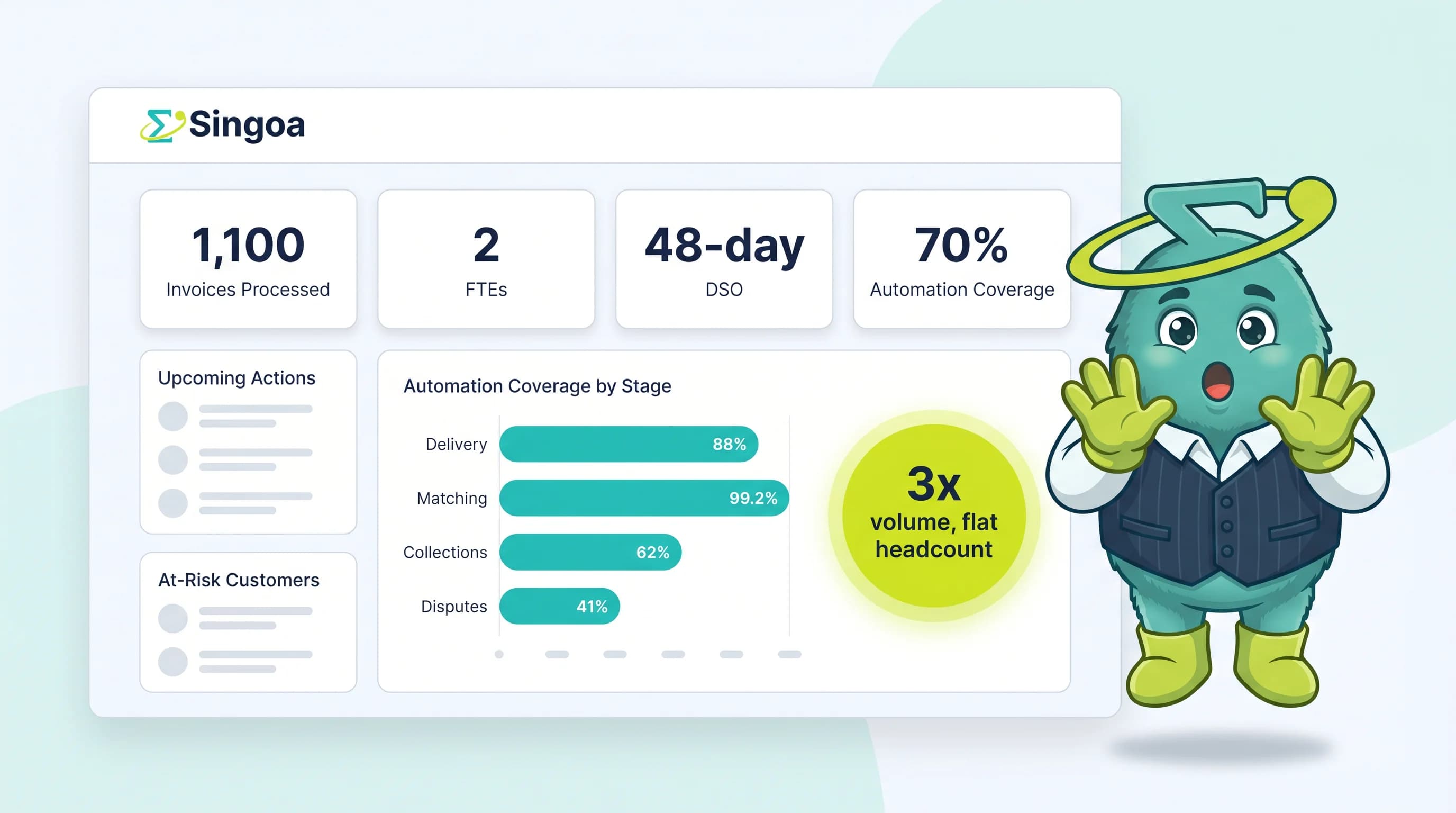
Why does mid-market see the largest delta? Because mid-market AR sits in the awkward middle: too many invoices to keep on spreadsheets, not enough scale to absorb the exception tax with extra headcount. Adding bodies to the problem stops working around 3,000 invoices a month. The teams that win the cost-per-invoice war [scale AR operations without adding headcount](/blog/scale-ar-operations-without-adding-headcount) by letting software absorb volume. But there is a catch: the headline number only holds when invoice volume is high enough to amortize software cost, which is the topic of the next two sections.
Process invoices at $1-3 each, not $15-40
SINGOA's transparent per-invoice pricing and 99.2% payment matching accuracy help mid-market AR teams cut per-invoice cost 85% without setup fees.
Working the ROI math: payback in plain numbers
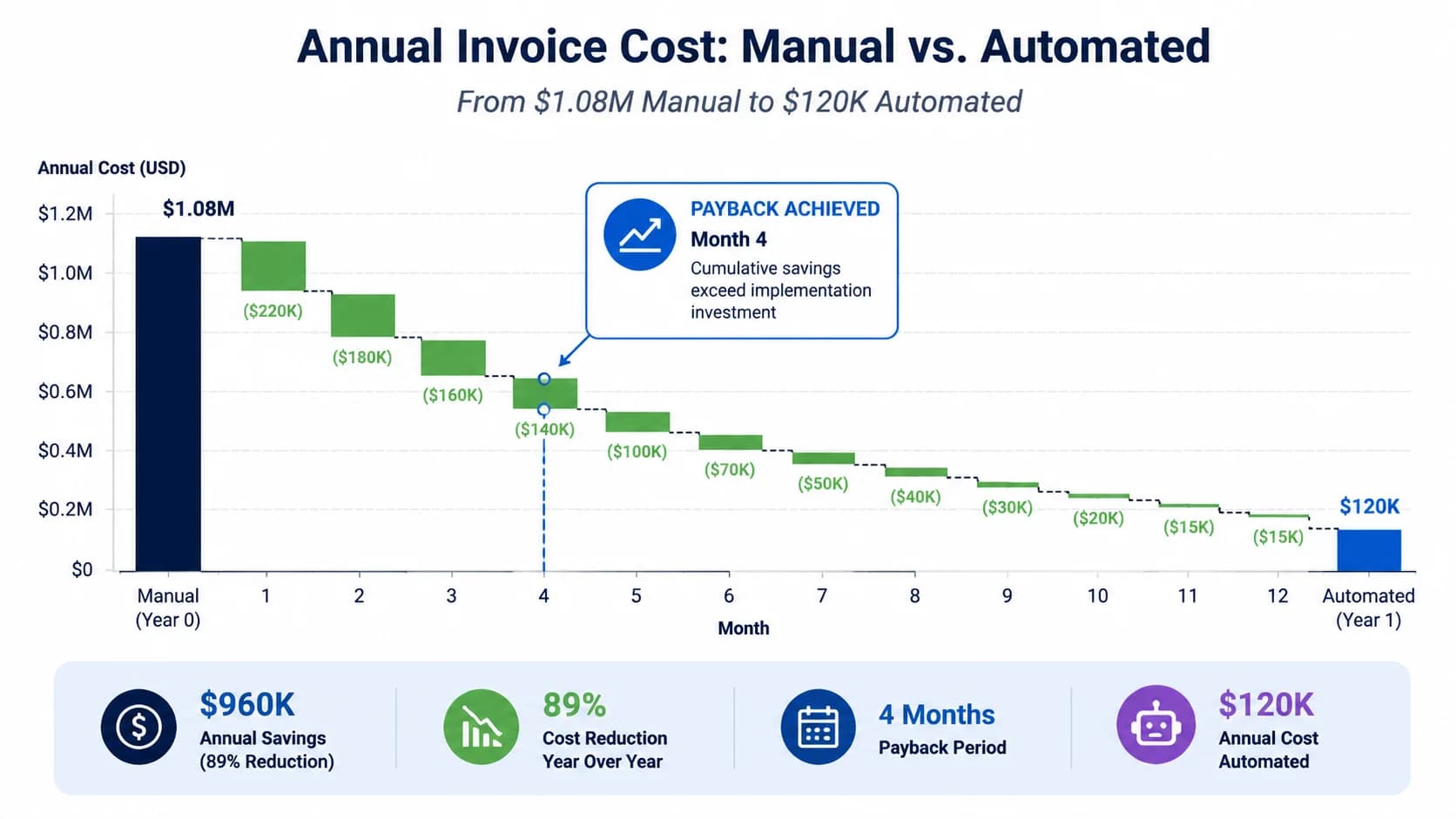
A mid-market company processing 5,000 invoices per month at $18 manual cost spends $1.08M annually on AR operations. Automating at $2 per invoice cuts that to $120K, freeing roughly $960K per year. Software cost for that volume typically lands at $120K-$180K annually, putting payback in the 3-6 month window for most mid-market teams.
Start with the simplest model your CFO can defend on one slide. Take monthly invoice volume, multiply by your current fully-loaded cost-per-invoice, annualize, then subtract the same calculation at $2 per invoice. For a 5,000-invoice-per-month operation at $18 today, the math reads: $1.08M current annual cost minus $120K automated annual cost equals $960K gross savings. Software fees on platforms like SINGOA's [$1-3 per invoice pricing](/pricing) get netted out of that number, leaving roughly $780K-$840K net annual savings.
Then layer the working-capital upside. Ardent Partners and SINGOA customer benchmarks consistently show 25-40% DSO reduction and 35% faster collections after automation. A company carrying $4M in AR with 65-day DSO that cuts to 45 days unlocks roughly $1.2M of working capital, money that stops sitting in receivables and starts earning interest, paying down debt, or funding inventory. At 8% cost of capital, that is another $96K of annual value the board sees in cash, not just labor savings.
Payback math is conservative when you build it on labor alone. A $150K annual software contract against $960K in labor savings pays back in 6-8 weeks of run-rate. Most controllers add a 90-day implementation buffer and call it a 3-6 month payback, which is exactly the window Ardent Partners reports across their invoice processing maturity study. The real question is when this story breaks, which is the next section.
Pro Tip
Build your business case on labor savings alone, then treat DSO reduction and exception cost as upside. Boards approve faster when the base case stands on the easiest-to-defend number and the bonus value sells itself.
When automation does NOT pay back (be honest about it)
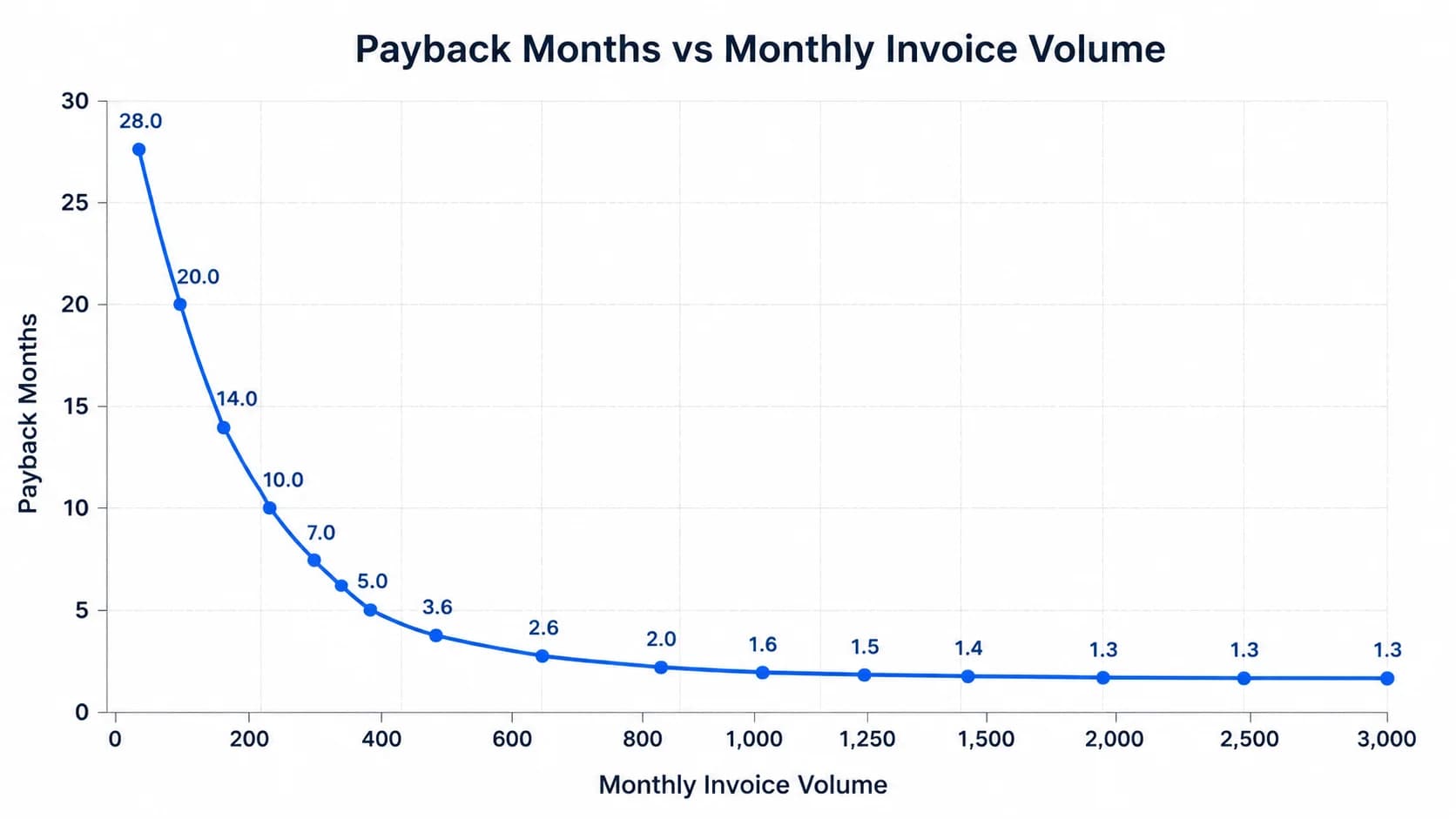
Invoice automation underperforms when monthly volume is below 300 invoices, when invoices require heavy line-item judgement (custom-priced services, milestone billing), or when AR is already outsourced to a BPO. In those cases, payback can stretch beyond 18 months and the business case loses to other priorities.
The volume floor is the most common deal-breaker. Below roughly 300 invoices per month, the fixed cost of any reasonable platform outpaces the labor savings. Spend Matters 2026 exception economics data backs this up: at 200 invoices monthly, a $36K annual software fee against $7K-$10K in labor savings makes no sense. Companies in this band should solve invoicing with better templates and a stricter billing calendar before chasing automation, then revisit when volume crosses 300-500 invoices a month.
Exception-heavy invoice profiles are the other common miss. Custom-priced professional services, milestone-based construction draws, and one-off engineering work orders need workflow design before they need OCR. If 40%+ of your invoices require sales-team review of pricing or line items, automation amplifies the underlying mess rather than fixing it. Map the exception flow first, automate the clean 60% second, then expand. The same caution applies during M&A integrations or ERP swaps: sequence the automation after the dust settles, not during.
There is a third honest caveat: if your AR is already outsourced to a BPO at a fixed per-invoice rate, the savings calculus changes. You are trading one variable cost for another, and the gap is narrower than the marketing math suggests. The takeaway most vendors will not tell you: the answer is sometimes 'not yet,' and a serious vendor will say so.
What to look for in invoice automation software
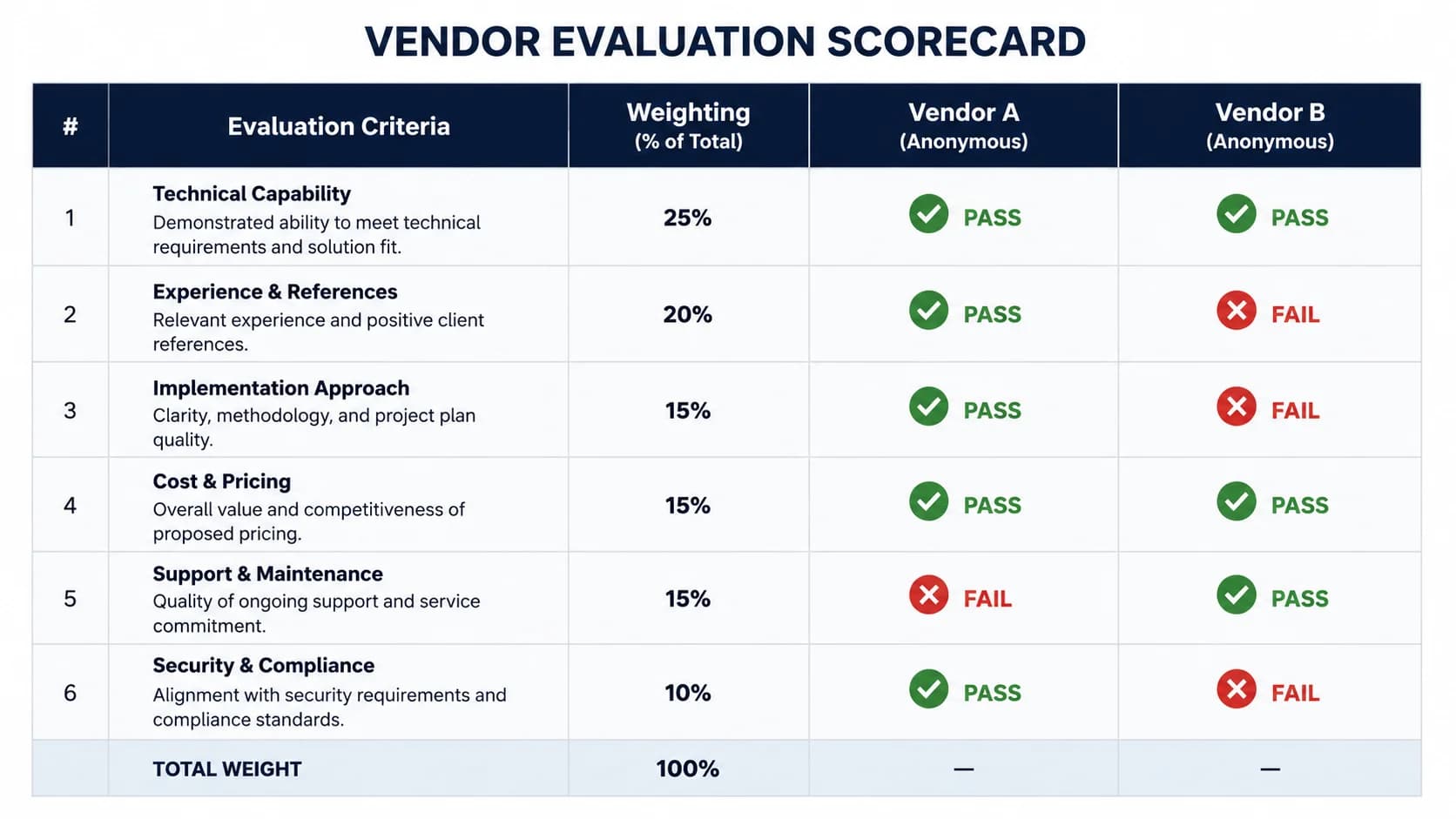
Evaluate invoice automation software on six dimensions: per-invoice pricing transparency, OCR accuracy (95%+ on standard formats), payment matching accuracy (95%+, with best-in-class at 99.2%), bulk and recurring invoice support, ERP and CRM integration depth, and time-to-value under 30 days for mid-market deployments.
Per-invoice pricing transparency is the first filter. If a vendor refuses to quote a per-invoice number in writing, you are the one absorbing variability when volume spikes or exception rates climb. Real per-invoice pricing in the $1-3 range is now the market standard for AR automation. Pricing pages that read 'contact us for a custom quote' usually mean the price scales with your discomfort, not with your usage. Walk the [complete guide to AR automation in 2026](/blog/what-is-accounts-receivable-automation-2026-guide) before any vendor call so you arrive with the questions priced in.
Accuracy benchmarks are the second filter and the hardest to verify on a sales call. Demand documented OCR accuracy on standard invoice formats (95%+) and payment matching accuracy (95%+ at minimum, with best-in-class platforms like SINGOA hitting 99.2%). Ask for the methodology behind those numbers: what dataset, what time window, what exception class is included. Vendors who answer crisply are the ones you can trust on a production volume. Vendors who fall back to 'AI-powered' without numbers are signaling that the numbers are not strong.
Functional coverage and time-to-value round out the scorecard. Bulk and recurring invoice generation, automated dunning, dispute workflows, and native ERP/CRM integrations (NetSuite, QuickBooks, Sage Intacct, Salesforce) should be table stakes. Time-to-value matters as much as accuracy: a 30-day go-live keeps the ROI clock running; a 6-month implementation eats half the year-one savings before the first invoice clears.
Pro Tip
Ask every vendor for their per-invoice price in writing. If they will not quote it, that is your answer: you are the one absorbing the variability when volume or exceptions spike.
The bottom line: put your own numbers against the model
Invoice economics are simpler than most finance leaders treat them. A manual invoice costs $15-40 once you count labor, exceptions, materials, and follow-up. An automated invoice costs $1-3. The math holds across APQC, Ardent Partners, and PYMNTS datasets, and the 85-93% reduction shows up in customer-by-customer data, not just industry averages. The hard part is not the calculation, it is having the discipline to count all four cost buckets honestly before signing a software contract.
Build your business case on labor savings first. A 5,000-invoice-per-month team moving from $18 to $2 per invoice saves roughly $960K annually, with payback in 3-6 months. Treat the 25-40% DSO reduction and 35% faster collections as upside that strengthens the story without anchoring it. And be honest about the floor: below 300 invoices a month, or on exception-heavy invoice profiles, the math gets thinner and the payback window stretches.
The next move is to put your own numbers against the model. Pull last quarter's invoice volume, your fully-loaded AR labor cost, your exception rate, and your DSO. Twenty minutes with a spreadsheet will tell you whether your per-invoice cost sits at $12, $18, or $28 today, and what that gap looks like at $2. Once you have that number on paper, the rest of the evaluation, vendor pricing, OCR accuracy, time-to-value, becomes a checklist instead of a guessing game.