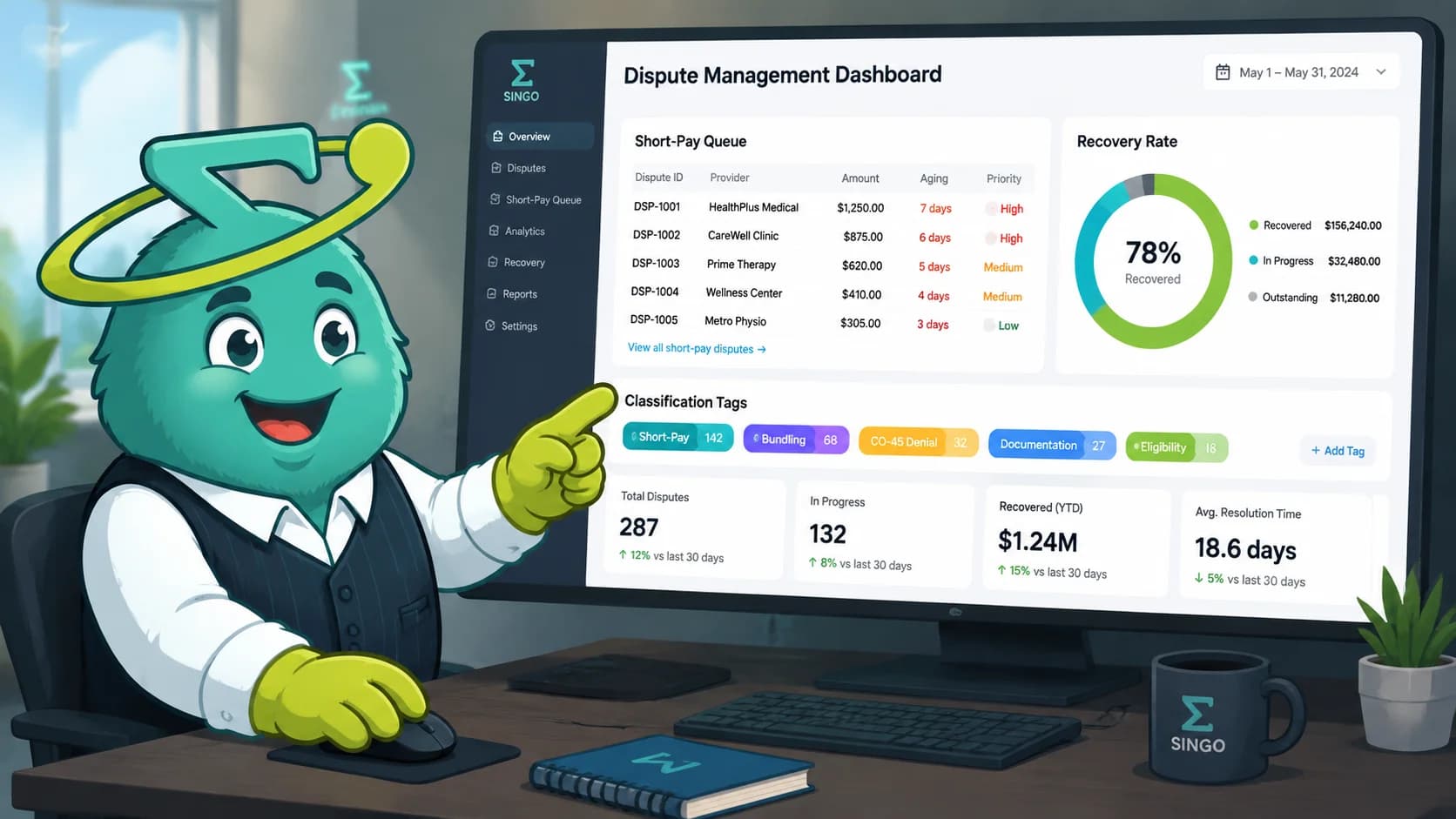

Quick Answer
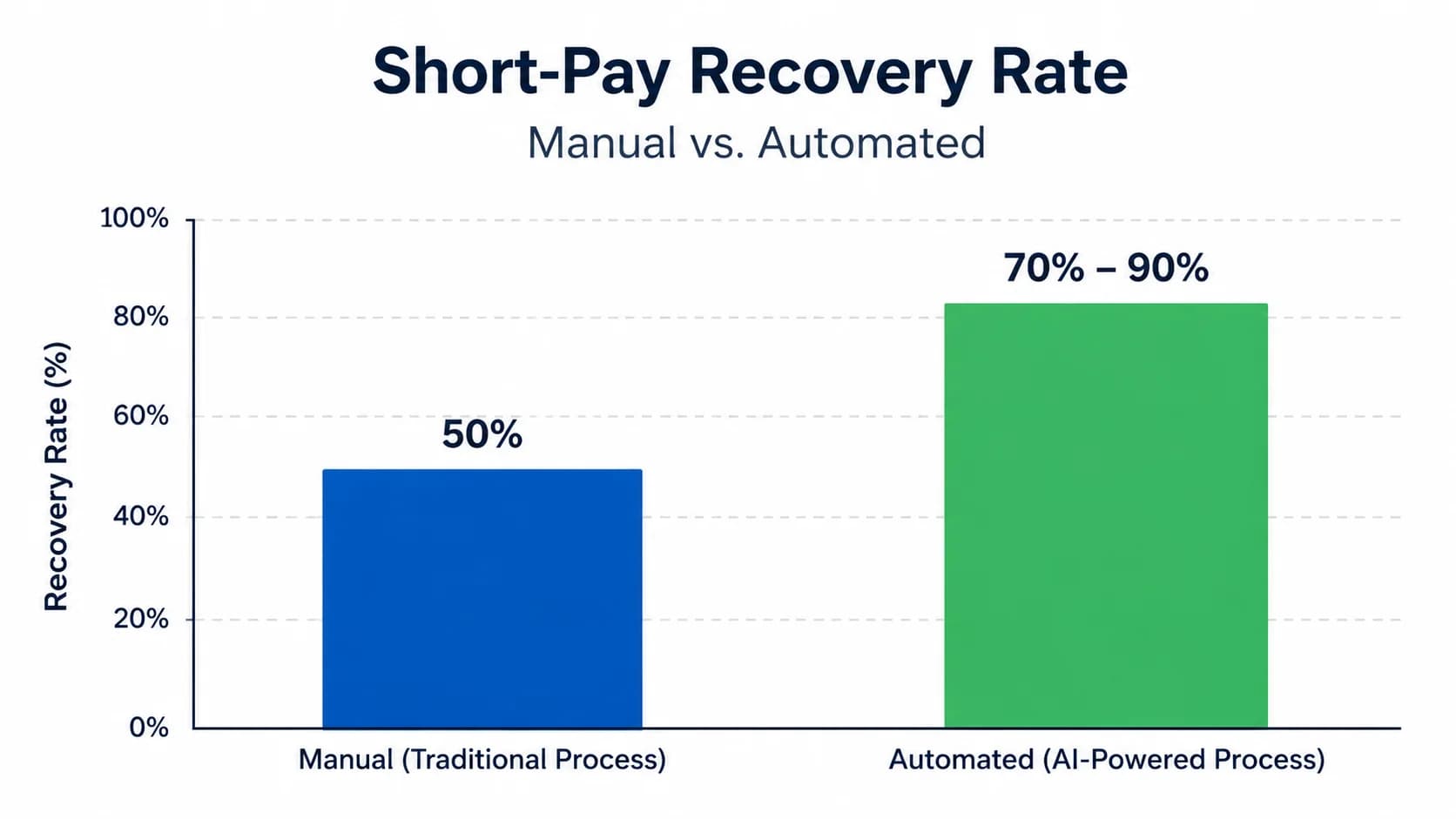
Dispute management in AR is the structured process of capturing, classifying, routing, validating, and resolving customer short-pays. A 5-step workflow with automation recovers 40 to 60% of short-pays manual processes miss, lifting recovery rates from 50% to 70-90%.
Key Takeaways
- Disputes, deductions, and short-pays are not synonyms. Mislabeling them inflates DSO and breaks recovery reporting.
- Companies lose 5-20% of annual revenue to poor dispute handling; invalid deductions alone are 5-10% of claims.
- A structured 5-step workflow (capture, classify, route, validate, resolve) recovers 40-60% of short-pays manual teams miss.
- Automation lifts recovery from ~50% manual to 70-90% and cuts per-invoice cost from $15-$40 to $1-$3.
- When buying dispute software, evaluate five criteria: capture, classify, route, integrate, and per-invoice price.
See what 40-60% short-pay recovery is worth to you
Plug in your monthly invoice volume and short-pay rate to see the working-capital impact of a structured dispute workflow.
What Dispute Management in Accounts Receivable Actually Is
Most AR Managers describe dispute handling as "the part of collections where customers argue." That framing is a trap. Collections is about getting paid on time. Dispute management is about getting paid in full once a customer has already paid something. The two functions overlap in your inbox, but they need separate workflows, owners, and metrics. Treating disputes as a collections subset is one reason the average mid-market team recovers under 50% of contested revenue, per HighRadius and Smyyth aggregated research.
Inside the order-to-cash cycle, dispute management lives between cash application and reporting. A customer pays an invoice for $9,640 instead of the billed $10,000, and that $360 gap has to be captured, explained, and either recovered or written off. Without a defined process, that $360 sits in an aging report as past due, distorts DSO, and quietly ages out of recoverability. With a defined process, the same $360 gets a reason code, an owner, an SLA, and a documented outcome inside two weeks.
The framing that wins is treating disputes as a recovery problem with its own P&L, not a side effect of collections. AR teams that adopt this mindset build the kind of structured pipeline outlined in our [complete guide to AR automation](/blog/complete-guide-ar-automation), and they stop letting margin leak through unresolved short-pays. The next question, which most teams answer wrong, is what counts as a dispute in the first place.
- Define dispute management in one sentence
- Position it inside the order-to-cash cycle
- Frame it as a recovery problem, not a collections problem
Disputes vs. Deductions vs. Short-Pays: Why the Distinction Matters
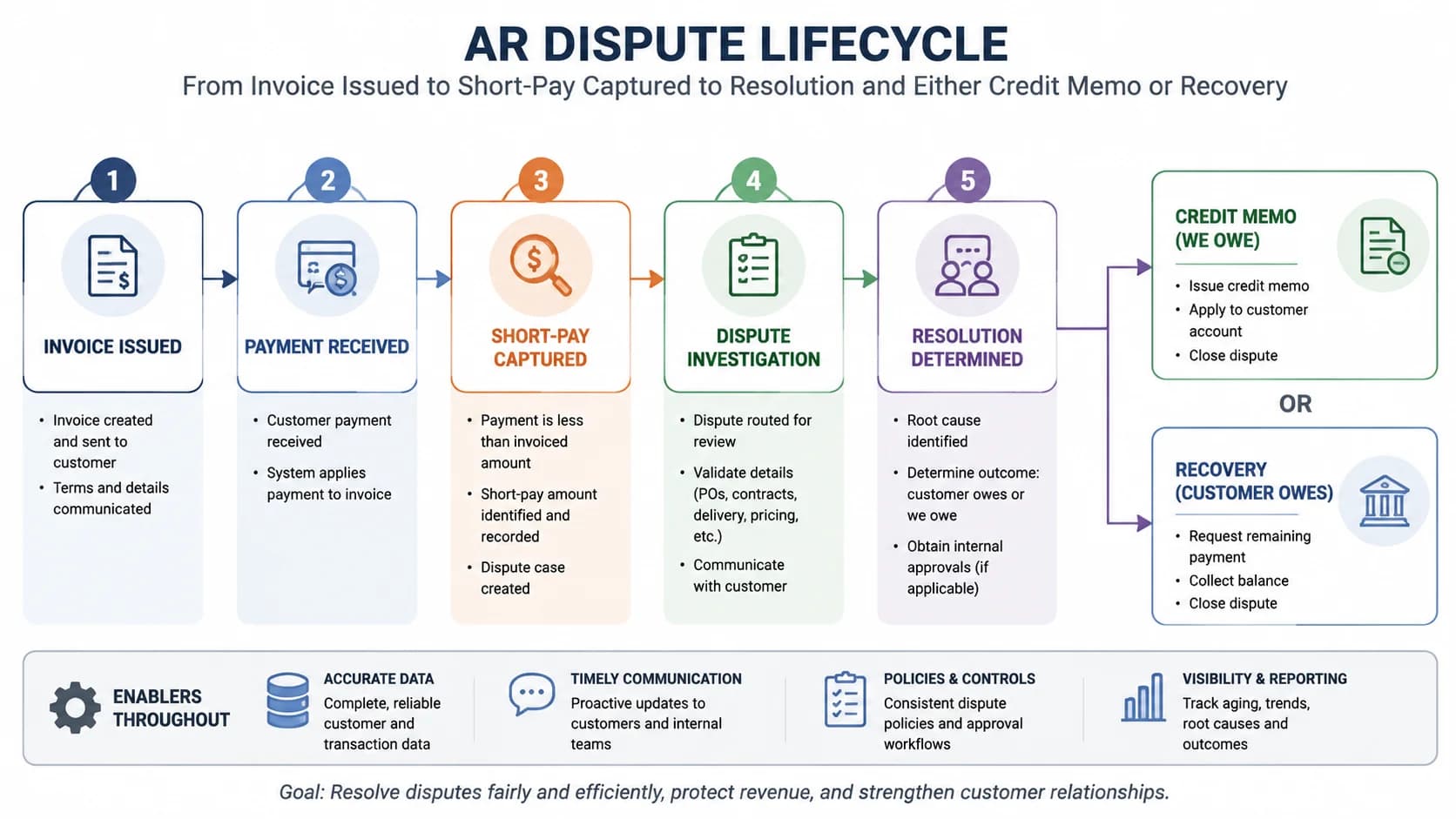
A dispute is a stated objection. The customer tells you, in writing or by phone, that something is wrong: wrong price, missing PO, damaged goods, late delivery. A deduction is the dollar action they take to enforce that objection: they remit $9,640 on a $10,000 invoice and put a chargeback code on the remittance. A short-pay is the broader category, any payment received for less than billed, whether the customer flagged a reason or simply paid what they felt like paying. Roughly 30% of mid-market short-pays arrive with no stated reason at all.
Why this matters operationally: each label routes to a different workflow. A dispute needs investigation and customer dialogue. A deduction needs validation against the contract and either a credit memo or recovery action. An unexplained short-pay needs a reason code applied before it can be routed anywhere. If your AR aging report buckets all three as "past due," your DSO inflates by 5 to 12 days on paper, your CFO sees a collections problem that does not exist, and your team chases customers who have already paid in full minus a legitimate $360 deduction.
The reporting consequence is bigger than the labeling. Recovery rate, dispute aging, and reason-code analytics all depend on clean classification at intake. Get the taxonomy wrong and every downstream metric lies.
- Define each term with one clear example
- Show that all deductions are short-pays but not all short-pays are deductions
- Explain why mislabeling these breaks reporting and recovery
Pro Tip
If your AR aging report classifies every short-pay as "past due," you are conflating disputes with delinquency, and your DSO will mislead the CFO. Bucket short-pays into a separate category from day one.
Recover the short-pays your spreadsheet forgot
Mid-market AR teams using SINGOA recover 40-60% more short-pays without adding headcount. See the workflow live.
The Hidden Cost of Unstructured Dispute Handling
The cost shows up in three buckets. The first is direct margin leak: industry research aggregated across HighRadius, Smyyth, and Versapay puts annual revenue lost to poor deduction and dispute handling at 5 to 20%. For a $50M company, that is $2.5M to $10M of revenue arriving as 95-cent dollars or never arriving at all. Most controllers will tell you their number sits closer to 2-4%, but that estimate excludes the short-pays they have already given up on, which is exactly the population structured workflows recover.
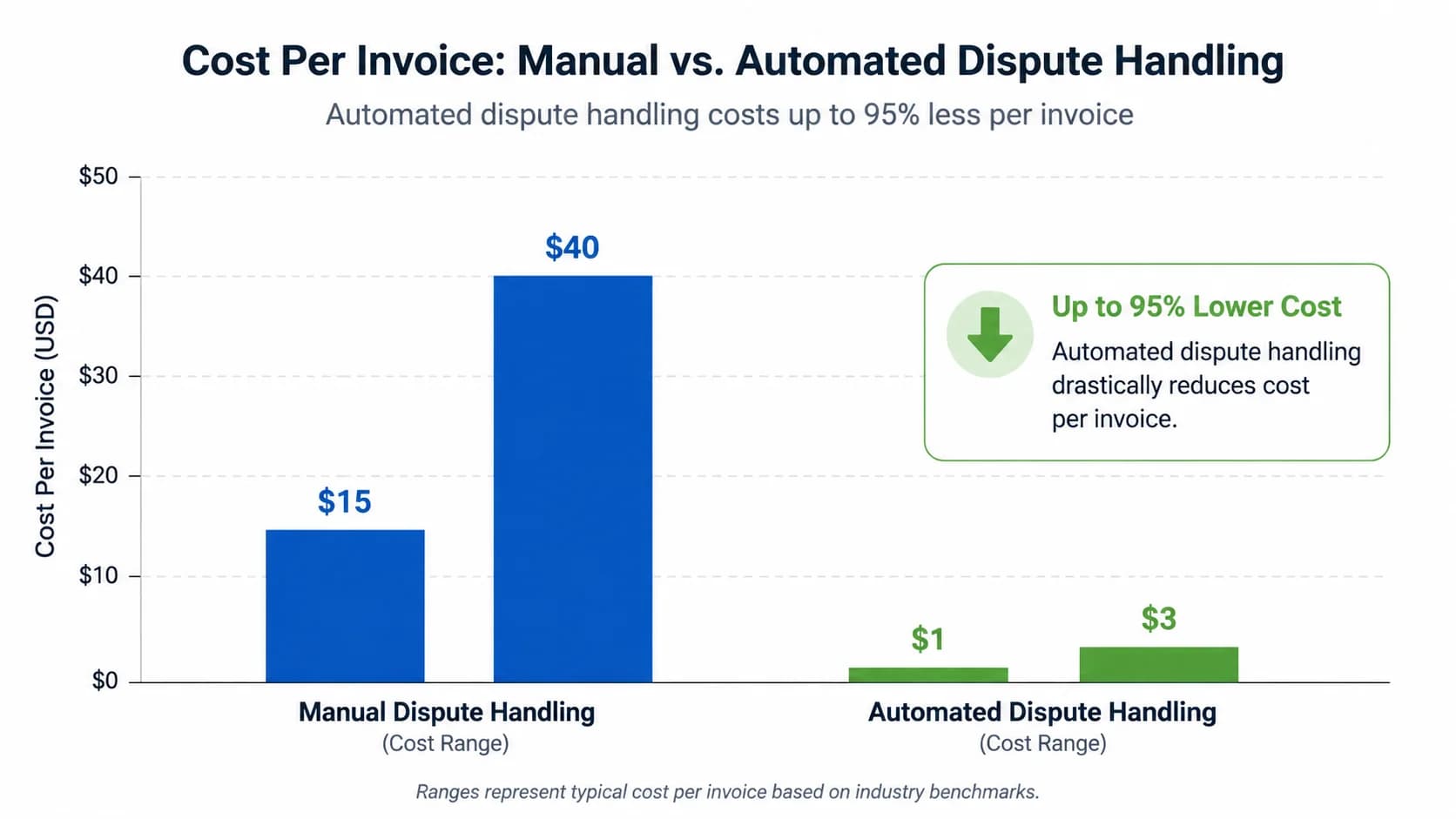
The second is processing cost. Manual dispute handling, including remittance review, internal email chains, document retrieval, and credit-memo routing, runs $15 to $40 per invoice in fully loaded labor cost. Automated workflows compress that to $1 to $3. Across a portfolio of 2,000 short-pays per quarter, that is the difference between a $60,000 quarterly burn and a $5,000 one. Read more on [signs your AR process is costing more than you think](/blog/signs-ar-process-costing-more-than-you-think) for the full economics.
The third bucket is the recoverability cliff. Disputes that idle past 90 days see recovery rates collapse from 70%+ to under 25%, per Smyyth's analysis of unauthorized deductions. Customers close their books, the buyer who initiated the deduction moves teams, and your case file goes cold. Every week of delay costs measurable basis points of recovery. The hidden cost is not that disputes are hard to win. It is that they age out before anyone gets to them.
- 5-20% of annual revenue lost to poor deduction handling
- $15-40 manual cost vs $1-3 automated cost per invoice
- Stale disputes age past recoverability inside 90 days
The 5-Step Structured Dispute Resolution Workflow
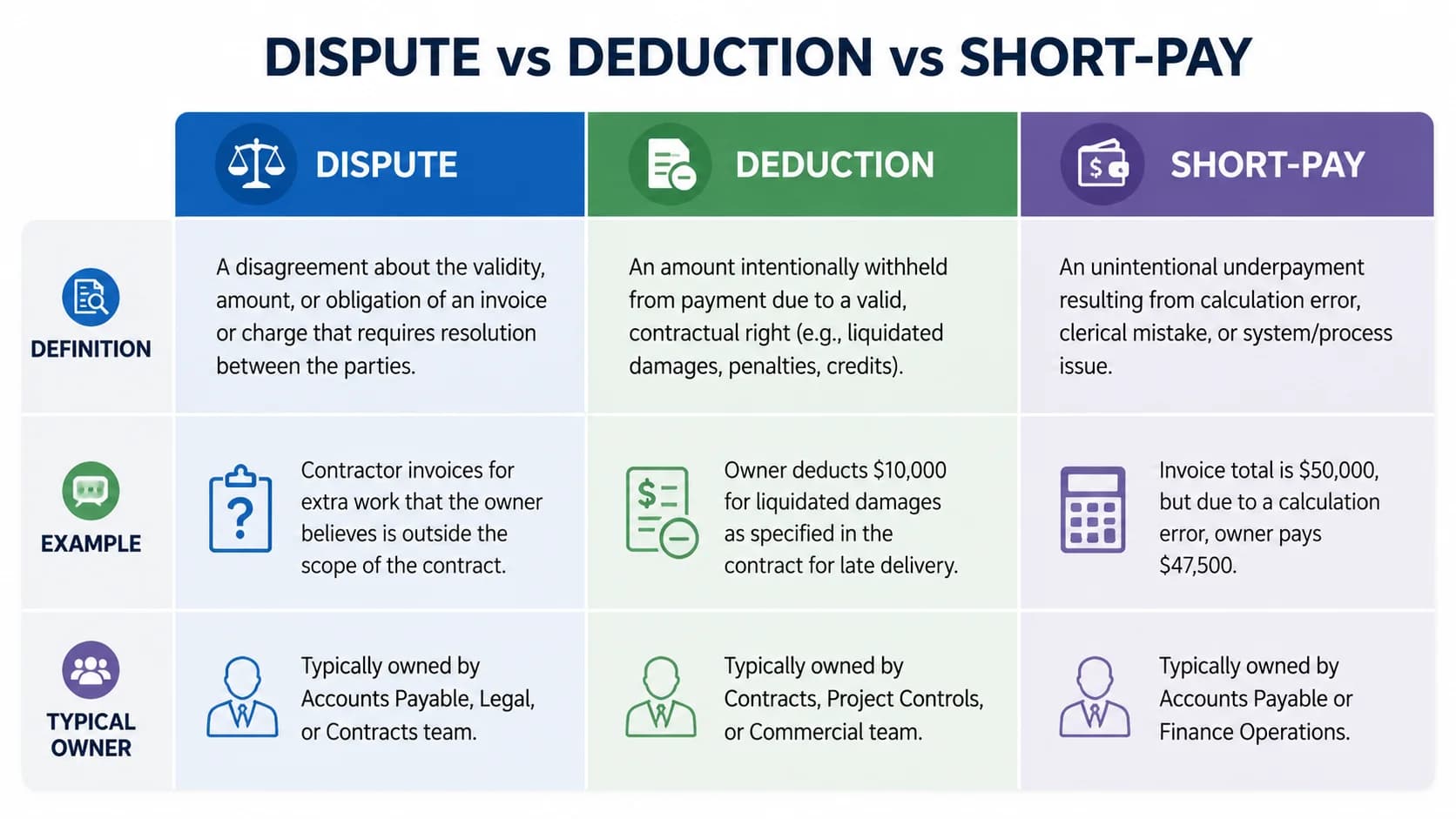
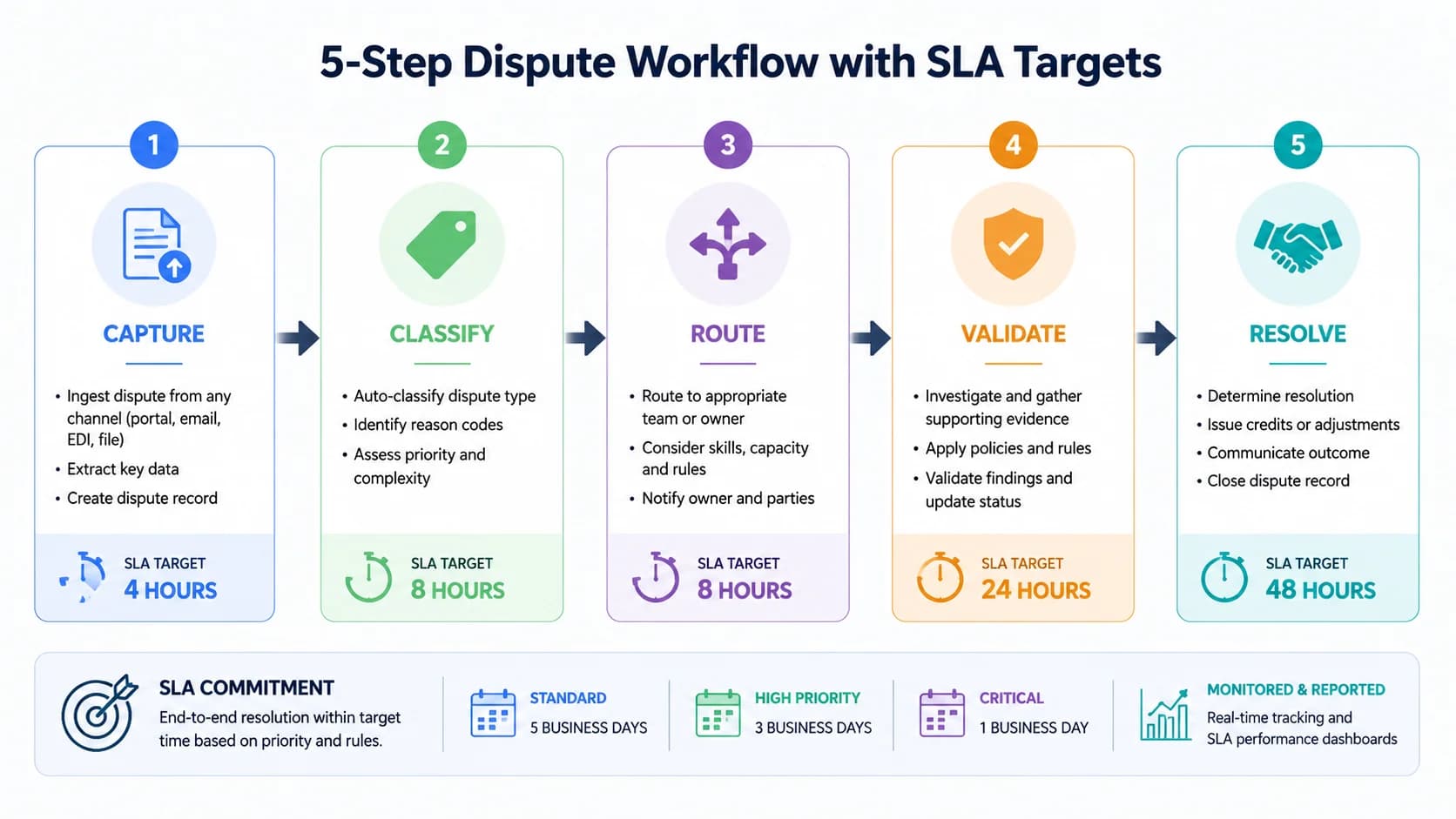
Step 1, capture, happens at cash application. Every payment that does not match its invoice in full triggers a short-pay record automatically, with the gap amount, customer, invoice ID, and any remittance text or chargeback codes attached. Manual teams skip this step because cash application is treated as a tie-out exercise. Automated teams treat capture as the first event in a dispute case, not an afterthought. This is where [AI payment matching captures short-pays at cash application](/features) earns its keep, because human reviewers consistently miss the smallest 10-15% of short-pays.
Step 2, classify, assigns a reason code. Pricing variance, quantity discrepancy, missing PO, damaged goods, late delivery, promotional chargeback, tax error, contract dispute. AI parses remittance text and prior dispute history to pre-tag the reason; humans review edge cases. The classification step is where most homegrown spreadsheets break, because reason codes drift across reps and reporting becomes meaningless inside six months.
Step 3, route, sends each dispute to the right owner with a service-level agreement. Pricing disputes go to sales ops. Quality disputes go to operations or warehouse. Missing PO goes to the AR analyst. Each owner gets an SLA, typically 5 business days from capture to first action. The owner is not the resolver in every case; they are accountable for moving the case forward.
Step 4, validate, is the documentation step. The system pulls the original PO, BOL, signed contract, shipping confirmation, and any prior credit memos into a single view. The owner compares what was billed to what was contracted and what was delivered. Validation determines whether the deduction is authorized (process it as a credit memo) or unauthorized (pursue recovery).
Step 5, resolve, closes the case. Authorized deductions become credit memos posted against the customer account. Unauthorized deductions trigger a recovery letter and follow-up sequence. Either way, the case closes with a documented outcome, and the reason-code data feeds back into upstream process improvement, so the same dispute does not recur next quarter.
- Step 1: capture short-pays automatically at cash application
- Step 2: classify by reason code (pricing, quantity, quality, missing PO, etc.)
- Step 3: route to AR, sales, ops, or credit owner with SLA
- Step 4: validate documentation against contract and shipment
- Step 5: resolve with credit memo or pursue recovery
Pro Tip
Set a hard SLA: 5 business days from capture to first owner action. Disputes that idle past day 10 see recovery rates collapse from ~70% to under 30%.
How AI and Automation Change Dispute Recovery Rates
The recovery-rate lift comes from three compounding effects, not one magic feature. First, AI classification on remittance text turns a 15-minute manual triage into a 5-second tag. That sounds incremental until you multiply it by 800 short-pays a month and realize the AR team gets 200 hours back to actually investigate the disputes worth investigating. Second, document surfacing pulls PO, BOL, contract, and prior credit memos into a single pane, so the validation step that used to require three system logins happens in one screen.
Third, and most underestimated, SLA enforcement keeps cases from aging out. Manual teams miss SLAs because nobody is watching the queue at 4:30 PM on a Friday. Automated systems escalate at the SLA boundary regardless of who is on PTO. That alone moves a meaningful chunk of disputes from the under-30% recovery cohort (90+ days old) to the 70%+ recovery cohort (under 30 days old). Versapay's collaborative dispute research and platforms like SINGOA both report this aging-curve effect as the dominant driver of recovery improvement.
There is a real lift number to anchor the conversation: roughly 50% manual to 70-90% automated, depending on dispute mix and customer responsiveness. Mid-market AR teams typically see 40 to 60% of previously "lost" short-pays come back into the recovery pipeline once structured workflows go live. The compounding effect across the entire AR cycle is covered in our analysis of [how AI payment matching accuracy compounds across AR](/blog/ai-payment-matching-accuracy). The honest caveat: some short-pays are valid and should not be "recovered." The point of automation is not to fight every customer, it is to give the team the bandwidth to know which fights are worth picking.
- AI classifies dispute reason from remittance text
- Automation pulls PO, BOL, and contract into one view
- SLA enforcement prevents stale disputes
- Recovery rate lift: ~50% manual to 70-90% automated
Industry-Specific Dispute Patterns
Construction AR teams live with back-charges, retainage holds, and change-order short-pays. A general contractor pays 90% of a pay application and holds the remaining 10% as retainage, which is contractual, not a dispute. The trouble starts when back-charges show up against the same invoice for cleanup, damage, or schedule slips. The same payment can carry a legitimate retainage hold and an unauthorized $4,200 back-charge, and your workflow has to separate the two cleanly or you write off real money.
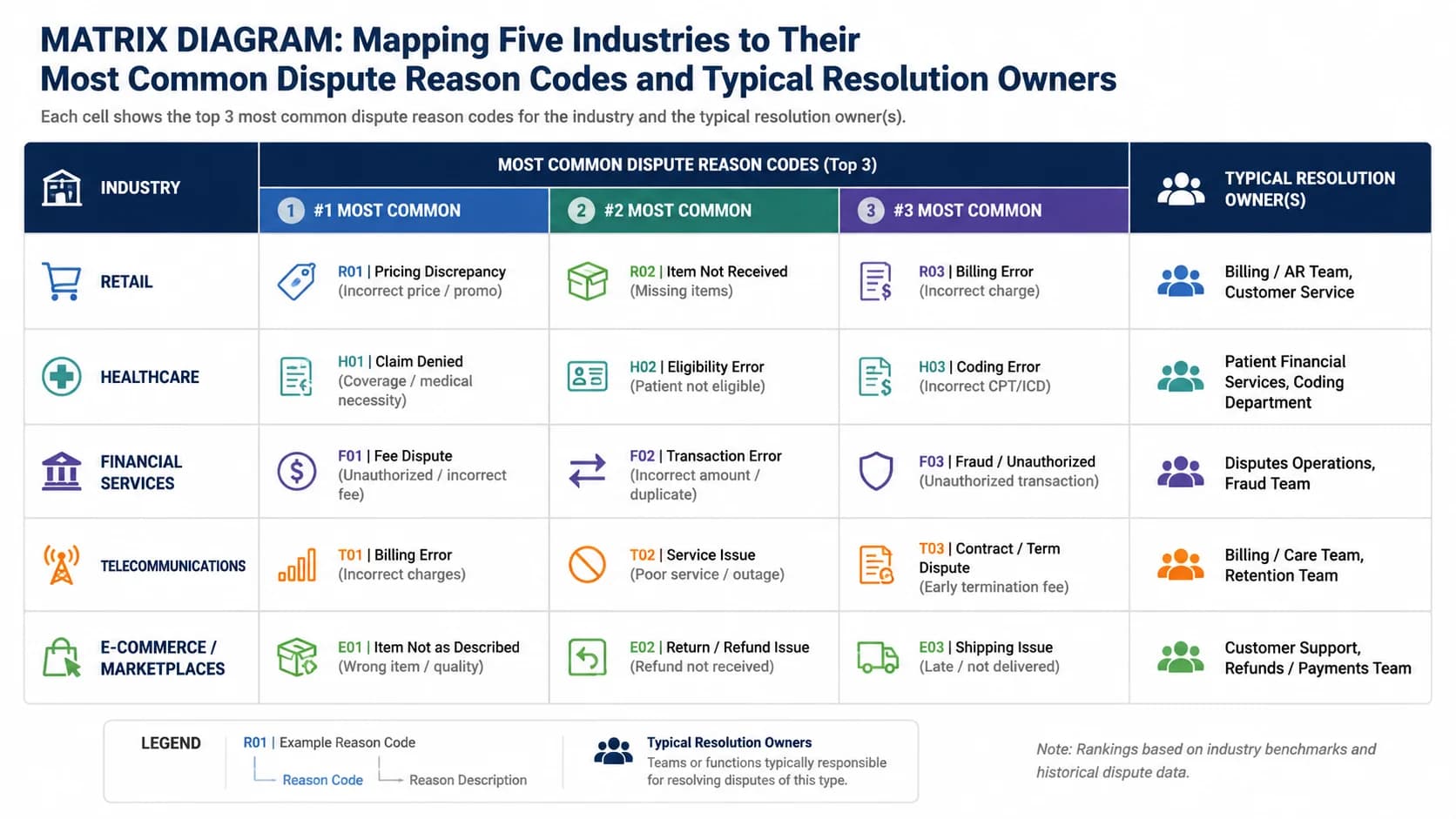
Healthcare providers and medical billing teams treat claim denials and adjustments as functional disputes, even though the terminology comes from payer language rather than AR language. Denial reason codes (CO-45 contractual adjustment, CO-97 bundled service, PR-1 deductible) are the healthcare equivalent of deduction reason codes. Manufacturing and wholesale distributors see the highest dispute volume of any industry: pricing variances against contracted rates, quantity short-shipments, and promotional chargebacks from retail customers running 5 to 10% of total claims. CPG suppliers selling into national retailers can see deduction rates of 8% or more.
Transportation carriers fight detention and accessorial short-pays where shippers refuse line items they consider out-of-contract. Professional services firms running retainer or project billing see scope-of-work disputes: a client pays for 80 hours and queries the other 12. Each industry's reason codes look different, but the structural workflow is identical. Capture, classify, route, validate, resolve. The reason-code taxonomy is what changes; the operating model does not. That is why a single dispute platform can serve all five industries cleanly, as long as the reason-code library is configurable rather than hardcoded.
- Construction: back-charges, retainage holds, change-order short-pays
- Healthcare: claim denials and adjustments treated as disputes
- Manufacturing & Wholesale: pricing, quantity, promo chargebacks
- Transportation: detention and accessorial short-pays
- Professional Services: scope-of-work disputes on retainers
Pro Tip
If 60%+ of your disputes cluster around a single reason code, the fix is upstream. Repair the order-entry, pricing, or shipping process before scaling dispute software, or you will just automate the same defect.
How to Choose Dispute Management Software
Capture is the first filter. Ask the vendor to demo what happens when a $9,640 payment arrives against a $10,000 invoice with no remittance text. Does the system auto-create a short-pay record, or does it bury the gap in a cash-application exception queue a human has to triage? If the demo only works on clean remittances, you will be writing the rules for the messy 30% yourself. The vendors that win on capture treat every variance as a dispute candidate from second one.
Classify and route are the next two. AI reason-coding should pre-tag at least 70% of disputes from remittance text and chargeback codes, with humans reviewing edge cases. Routing should be configurable by reason code, dollar threshold, and customer segment, with SLAs that escalate automatically. Avoid systems where every routing change requires a vendor services ticket. Integrate is fourth: native connectors to your ERP (NetSuite, Sage Intacct, Microsoft Dynamics), payment portal, and document repository, not CSV imports refreshed nightly.
Price is the criterion most buyers underweight. Enterprise dispute platforms charge flat licenses of $80K to $250K annually, which makes the math work for billion-dollar AR books and not for $50M ones. Per-invoice pricing aligns vendor incentives with your actual volume. Solutions like SINGOA's [$1-3 per invoice transparent pricing](/pricing) let mid-market AR teams pay for what they process rather than for an enterprise seat count. The right software is the one whose pricing model survives a board-level ROI conversation, not just the demo.
- Capture: does it auto-detect short-pays from remittance?
- Classify: AI reason-coding vs manual tagging
- Route: SLAs, owner assignment, escalation
- Integrate: ERP, payment portal, document repository
- Price: per-invoice economics vs flat enterprise license