
Why wholesale AR is uniquely brutal in 2026
Your last EDI 820 from a top-five retailer landed with 47 short-pay lines totaling $184,000, and by 9 PM your AR analyst had classified maybe 12 of them. The rest went into the "we'll get to it" pile, where 62% of dispute-worthy deductions die per Gartner. That single remittance is the wholesale distribution AR problem in one file, and the write-off line at the bottom of the P&L is the receipt.
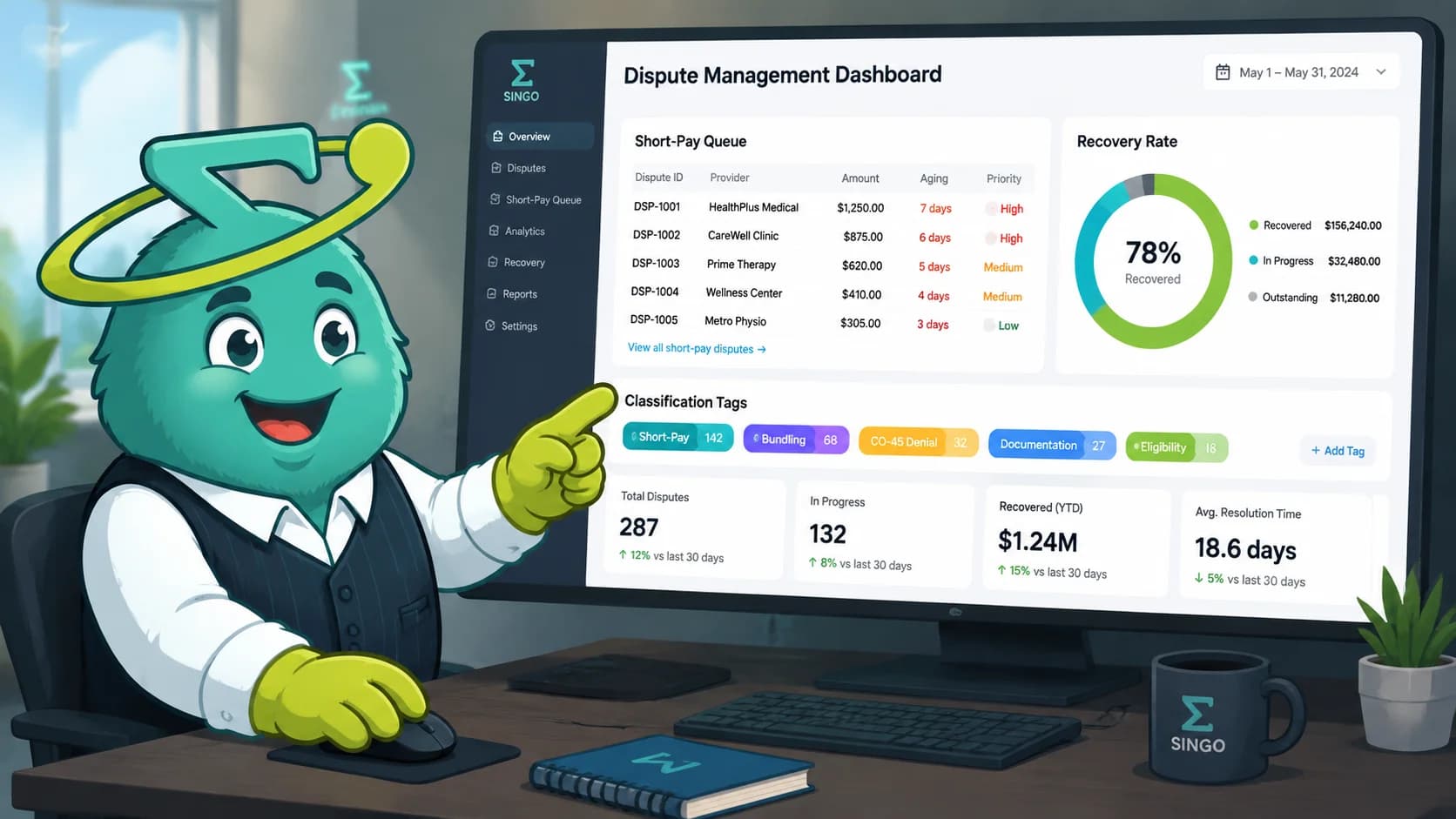
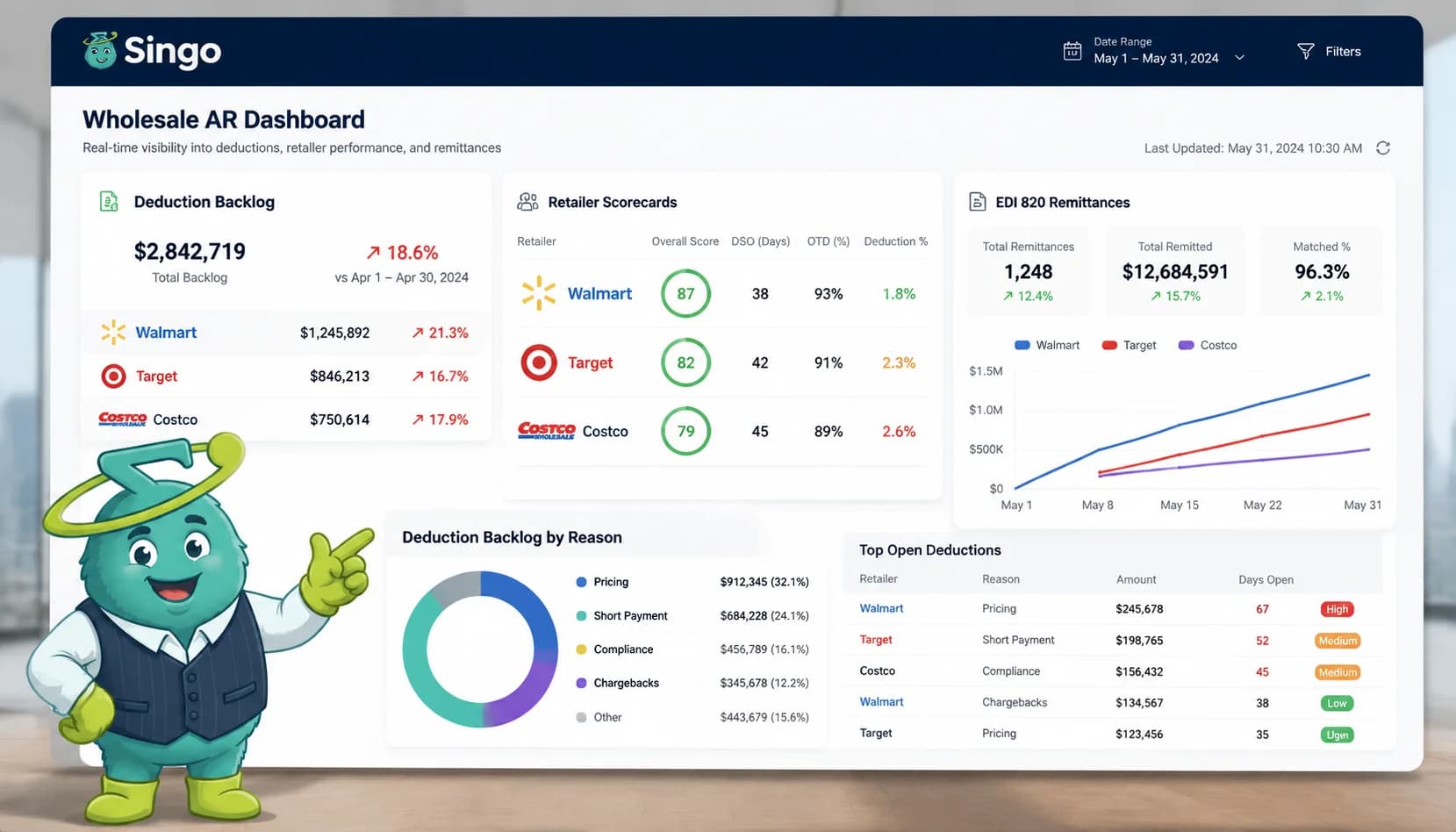
Wholesale distributors absorb 5-15% of gross sales into deductions, compliance chargebacks, and trade promotion billbacks according to Hackett Group. The Retail Value Chain Federation puts unauthorized deductions alone at $24 billion lost every year across the industry. Yet most AR teams treat these three problems as one messy short-pay bucket, worked reactively in spreadsheets, month after month, until the backlog reaches 90 days old and the dispute windows have quietly closed.
The teams recovering that money have stopped treating deductions, chargebacks, and trade promotions as separate disciplines. They run one unified workflow that ingests the EDI 820, classifies every line by reason code, pulls the BOL, POD, and promotion authorization automatically, and files disputes before the retailer's 30, 60, or 90-day cliff. RVCF benchmarks show that workflow lifts recovery from 38% manual to 82% automated.
Most industries collect a full invoice or fight one clear dispute. Wholesale AR does neither. Every retailer remittance is a partial payment with dozens of coded reductions that could be legitimate trade spend, an accidental short-pay, a compliance fine, or a fully unauthorized deduction. Your team has to decide which is which before a dispute window closes, using evidence that lives across the ERP, the WMS, the carrier's TMS, and a shared drive full of promo authorizations. That is a research job disguised as an AR job.
The numbers explain the pressure. The Retail Value Chain Federation puts unauthorized retail deductions at $24 billion lost annually, and Gartner reports 62% of dispute-worthy deductions never get challenged. Hackett Group's wholesale benchmark shows 2-5% of revenue routinely disappears into short-pays and retailer fines, and the SINGOA industry data set pegs wholesale DSO at 48 days versus 30-35 for automated peers. When a $200M distributor loses 3% of gross to deductions, that is $6M sitting in a spreadsheet nobody has time to work.
The root cause is not laziness or headcount. It is that deductions, chargebacks, and trade promotions live in three different mental models. AR treats deductions as a cash-application problem. Logistics treats chargebacks as an ops problem. Sales and finance argue over trade spend as a marketing budget. Nothing ties them to a single record, so patterns stay hidden. A recurring MABD chargeback on the same carrier lane looks like three separate retailer disputes instead of one broken lane. Learn how [SINGOA for wholesale distribution](/industries/wholesale) unifies the trilogy into one workflow.
Here is where it gets interesting. The best-run wholesale AR teams have stopped fighting deductions retailer by retailer and started running them as one operating model with shared reason codes, shared evidence packs, and shared root-cause analytics. That shift is what the rest of this playbook builds, section by section, using the [RVCF Deduction Management Benchmark Study](https://rvcf.com/deduction-management-benchmark) as the recovery-rate baseline.
$24 billion
Annual industry loss to unauthorized retail deductions
RVCF Deduction Management Benchmark Study
2-5%
Wholesale revenue absorbed into deductions, short-pays, and compliance fines
Hackett Group Wholesale Distribution Report
38% vs 82%
Manual vs automated deduction recovery rate
RVCF Deduction Management Benchmark Study
62%
Share of dispute-worthy deductions never challenged
Gartner AR Automation Survey
6 hours
Manual cash application time per complex EDI 820 remittance
Aberdeen Group Cash Application Study
48 days
Average wholesale distribution DSO
SINGOA wholesale industry benchmark
Common Pain Points
- Deduction backlogs of 60-90 days lock millions in write-offs while 62% of dispute-worthy short-pays never get filed (Gartner)
- EDI 820 remittances arrive with hundreds of reason codes spanning shortage, pricing, promotional, compliance, and EPD that AR analysts must classify by hand
- Compliance chargebacks (Walmart OTIF, ASN defects, MABD misses) recur every quarter because AR never closes the feedback loop back to logistics and warehouse ops
- Trade promotion billbacks land on the EDI 820 without event ID or SKU detail, forcing manual reconciliation against TPM systems and broker records
- One EDI 820 covering 12 stores, 40 POs, and 60 invoices takes 6 hours to post manually per Aberdeen, eating an entire analyst day per file
- Retailer-specific dispute windows (Walmart 30-60 days, Target 60 days, Amazon under 30 days) close silently, and post-audit firms then split recovery 50/50 with the vendor
- Cross-functional ownership gaps: AR treats deductions as cash application, logistics owns chargebacks, sales owns trade spend, and no shared record ties patterns together. See [structured dispute workflows](/blog/dispute-management-ar-structured-workflows) for the unified alternative
Industry Terminology Guide
See what unauthorized deductions are costing you
Plug in your monthly retail revenue and current recovery rate to see how much revenue moves from write-off back to cash under 82% automated recovery.
Four AR solutions that unify deductions, chargebacks, and trade promotions
Each solution targets one layer of the wholesale AR trilogy. Together they form a closed-loop workflow sitting on top of your ERP and EDI VAN, with a shared reason-code taxonomy, shared evidence packs, and shared root-cause analytics.
Deduction management: taxonomy, reason codes, and dispute mechanics
Wholesale deduction management receives retailer short-pays, decodes the reason code, gathers evidence (BOL, POD, invoice, PO, price file), and either writes off legitimate claims or files disputes before the retailer-specific window expires (typically 30-90 days). Manual recovery averages 38%; automated recovery reaches 82% (RVCF).
Every wholesale deduction starts with a reason code. Shortage codes (SC on Walmart, code 24 on Target) claim the retailer received fewer units than the invoice billed. Pricing codes claim the invoice price does not match the current price file loaded to the retailer. EPD codes take an early-payment discount, sometimes legitimately, often past the discount window. Promotional and billback codes cover trade spend. Compliance codes cover routing, MABD, and ASN. Unsaleables cover damaged or expired product returned to the DC. Each code has a signature.
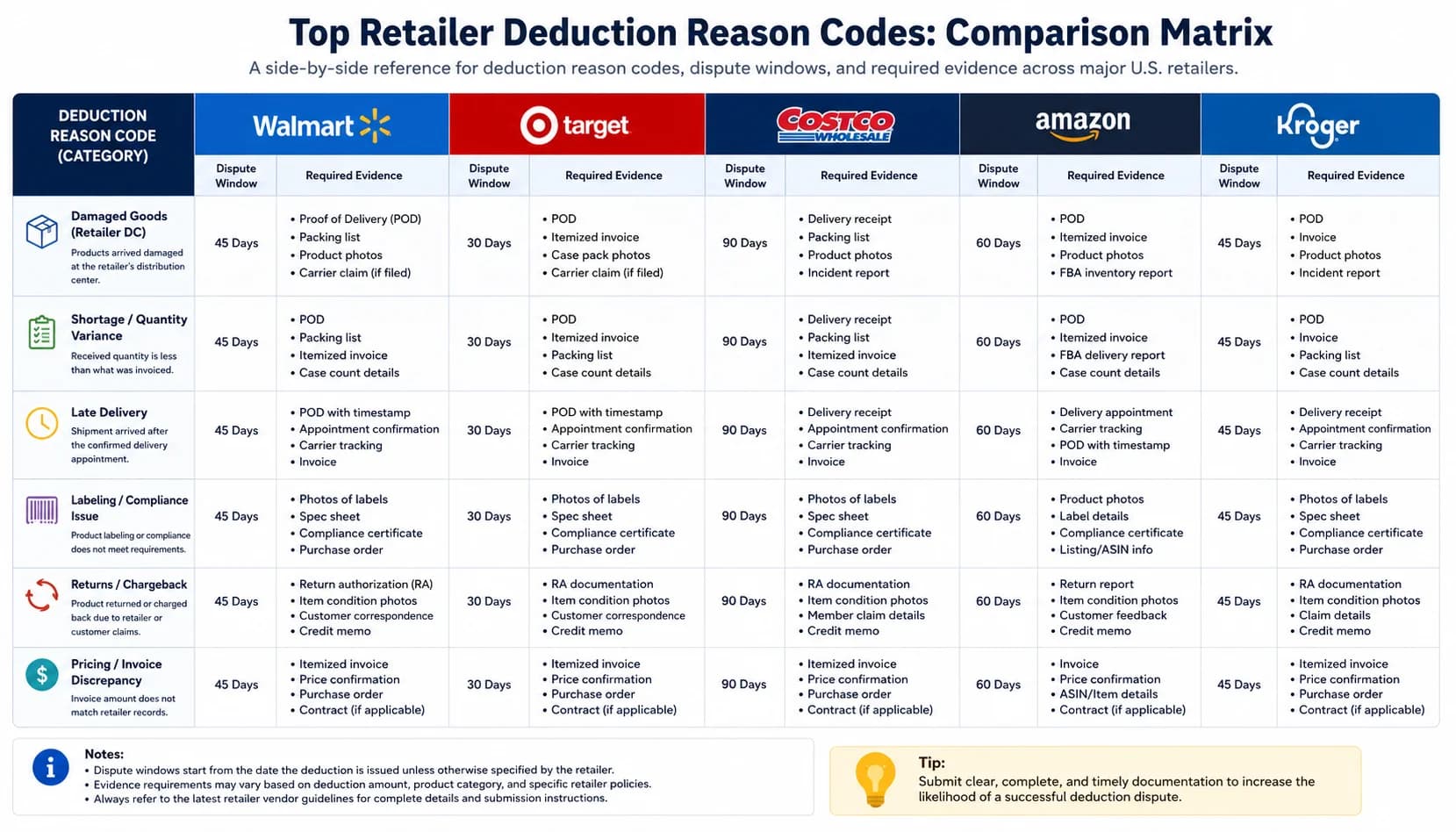
Retailer portals gate the dispute mechanics. Walmart Retail Link runs the APDP tool with a 60-day window for post-audit deductions and a much shorter window for shortage claims. Target Partners Online centralizes deduction backup and requires the specific promotion or price-file exhibit. Costco vendor portal enforces its own reason-code set and a tight submission cadence. Amazon Vendor Central packages chargebacks and shortage claims into cases that expire quickly. Missing the window is the same as writing off the deduction, and Gartner shows 62% of dispute-worthy deductions never get filed at all.
The evidence pack is where disputes are won or lost. A shortage dispute needs the signed BOL, the delivery POD, the packing list, and the original PO. A pricing dispute needs the current price file with the effective date, plus the invoice showing the same price. A promotional dispute needs the event authorization with SKU list, funding rate, and date range. A compliance dispute needs the carrier tender, the ASN transmission log, or the labeling QA record. When your AR team has to hunt for these across four systems, disputes miss their window.
The 30 / 60 / 90 day cliff drives every recovery calculation. Walmart shortage deductions typically forfeit at 30 days if unchallenged. Target post-audits often close at 60. Costco varies by category. Post-audit firms come in years later, after the wholesaler already wrote the money off, and split recovery 50/50 with the vendor. Every day a deduction sits unclassified is a day closer to that cliff, and every dollar recovered by a post-audit firm is a dollar your team could have kept with a real-time workflow driven by [structured dispute workflows](/blog/dispute-management-ar-structured-workflows).
The recovery-rate gap is the single biggest AR ROI in wholesale. RVCF benchmarks manual deduction recovery at 38%. Automated recovery, driven by reason-code classification, auto-assembled evidence packs, and portal filing, reaches 82%. On a $200M distributor absorbing 3% into deductions ($6M annual), moving from 38% to 82% recovery is $2.6M in cash returned to the balance sheet. That is not a rounding-error improvement. That is a funded finance hire, a warehouse upgrade, or a full-year of trade promotion budget.
The real question is how many of the deductions your team is writing off today are actually valid. Most wholesalers do not know, because they never classified them. That gap is what a proper deduction operating model closes.
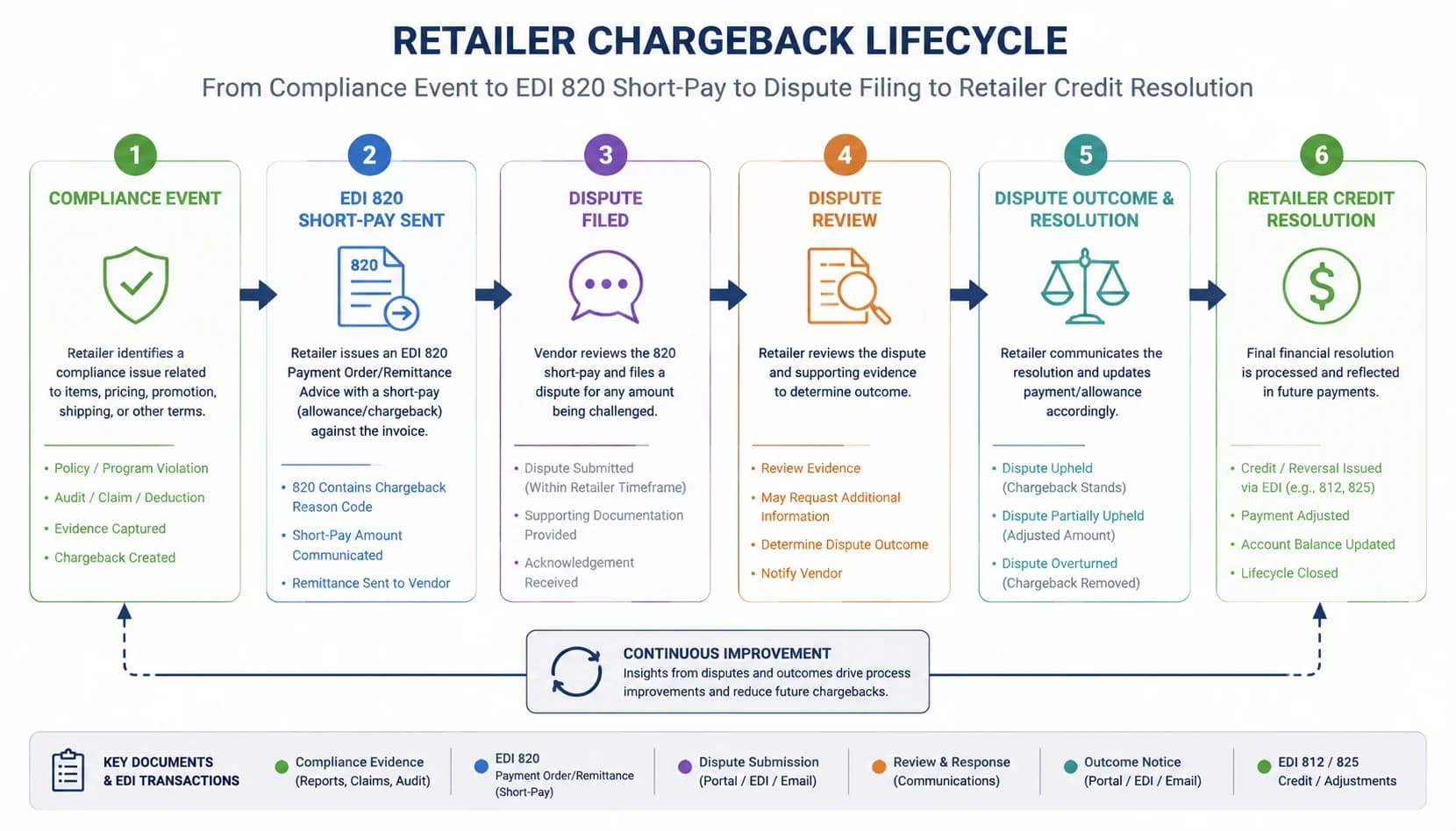
Chargeback lifecycle: from compliance failure to dispute resolution
Retailer chargebacks are compliance penalties for shipment defects such as late MABD, missing ASN, routing violations, or labeling errors. Wholesalers must trace each chargeback to the root-cause event, gather carrier and warehouse evidence, and file through the retailer's vendor portal within a strict window (typically 30-60 days).
A chargeback starts long before it hits the EDI 820. It starts when a warehouse crew loads a pallet on the wrong lane, an EDI 856 ASN goes out with the wrong container count, a carrier misses a Walmart delivery appointment, or a GS1 barcode prints a digit off. Weeks later, that operational miss shows up as a coded fine on the remittance. The AR team sees the deduction. The people who caused it never learn what happened. That feedback gap is why the same chargeback keeps repeating.
Walmart's OTIF (on-time-in-full) program is the most-cited chargeback engine in the industry, with fines running up to 3% of the cost of goods on missed deliveries and pattern-based escalations for repeat offenders. Kroger, Target, and Home Depot run parallel compliance programs with their own thresholds. Costco layers routing and appointment penalties. Amazon Vendor Central issues chargebacks for ASN defects, PO acknowledgment failures, and packaging violations. Each program has its own portal, its own window, and its own evidence rules, and 75% of pharmaceutical wholesaler chargebacks contain errors per industry data, meaning a well-run dispute process pays back fast.
Root-cause analysis is what turns chargebacks from a recurring tax into a fixable process. If the same MABD pattern appears across three retailers on the same lane, the problem is the lane, not the retailers. If ASN chargebacks spike in one warehouse, the problem is the WMS-to-EDI transmission there, not the retailers. If routing chargebacks concentrate on one carrier, the problem is the carrier. Tools like [SINGOA dispute management](/features) tag each chargeback with warehouse, carrier, lane, and root cause so patterns surface in the analytics instead of dying in a spreadsheet.
The dispute-versus-absorb-versus-prevent decision framework is where finance earns its keep. Disputable chargebacks with clean evidence packs and time on the clock get filed. Ambiguous chargebacks where the root cause is genuinely on the wholesaler's side get absorbed, but only after being tagged for prevention work. Preventable chargebacks feed a monthly loop back to logistics and warehouse ops with the fine data attached so the ROI on process fixes is visible. The Hackett Group Wholesale Distribution Report benchmarks that closed-loop process against peer wholesalers.
The catch is that most AR teams stop at file-or-write-off and never close the loop. So the same OTIF fines keep hitting the P&L quarter after quarter, and finance argues with logistics over budgets that could have been rerouted to fix the carrier lane. Chargeback data is operational intelligence disguised as a deduction. Read it that way. Cited: [Hackett Group Wholesale Distribution Report](https://hackettgroup.com/wholesale-distribution-report).
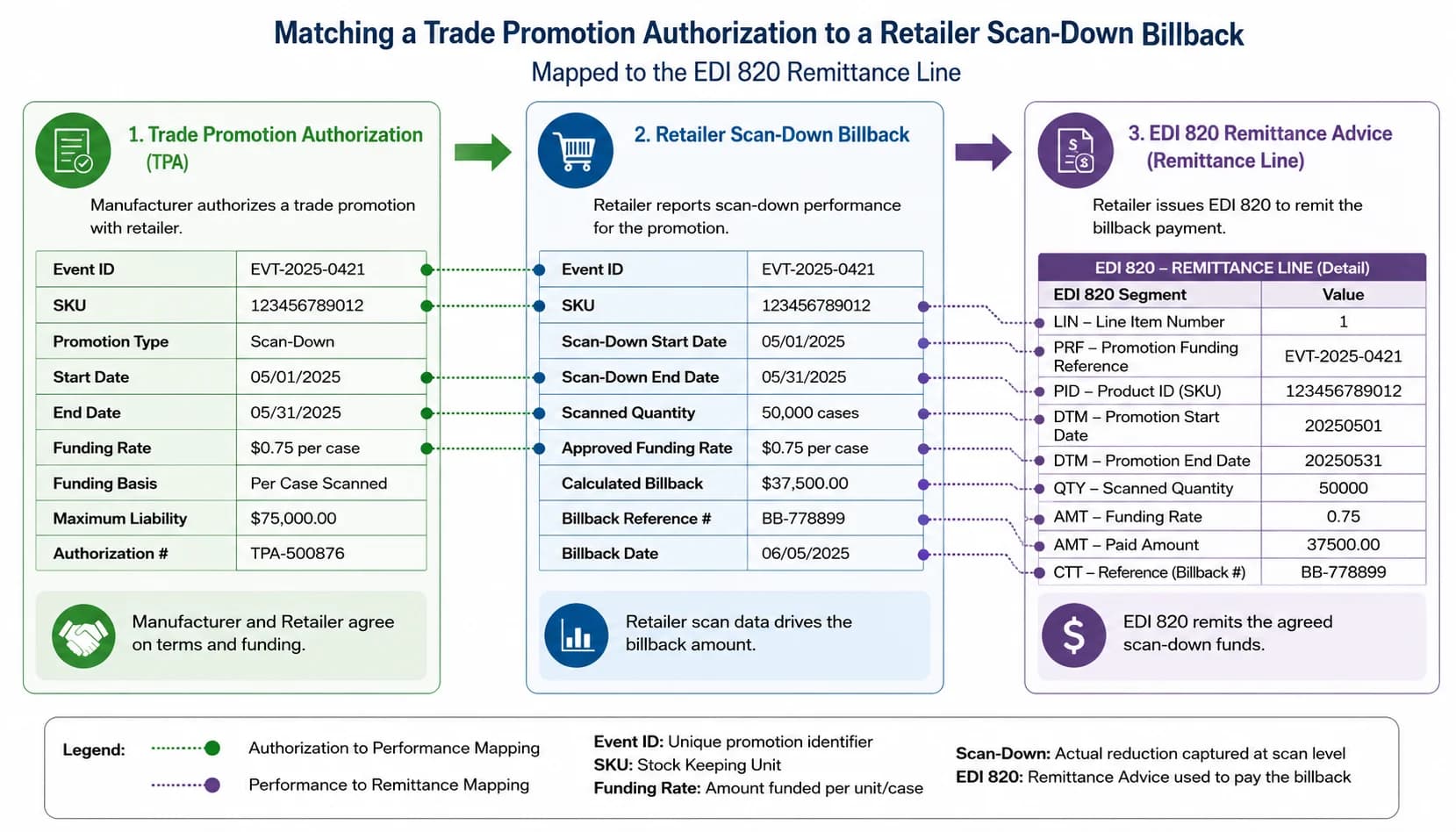
Recover trade spend the retailers took without authorization
SINGOA's deduction workflow ties EDI 820 lines back to your promotion authorizations, flags mismatches, and files disputes before the window closes.
Trade promotion reconciliation: turning marketing spend into a matched deduction
Trade promotion reconciliation matches retailer-taken billbacks and scan-down deductions back to the original promotion authorization (event ID, SKU list, dates, funding rate) so wholesalers can validate legitimate trade spend and dispute unauthorized promotional deductions before the retailer window closes.
Trade promotion money is the largest discretionary line item on most CPG wholesaler P&Ls, often 15-20% of gross sales per industry surveys, and the least-controlled. Sales negotiates the promotion with the retailer buyer, marketing tracks the campaign, finance accrues the spend, and AR sees the deduction land on the EDI 820 weeks or months later with a reason code and, if you are lucky, an event ID. Nothing connects the four systems, so validating whether the retailer took what was authorized becomes a manual scavenger hunt.
The reconciliation problem has a specific shape. Off-invoice allowances reduce the invoice up-front and rarely cause disputes. Scan-downs and billbacks arrive as retailer-taken deductions, often bundled without SKU-level detail. MDF and co-op should tie to submitted advertising proof of performance. Slotting fees should tie to signed new-item agreements. When the EDI 820 line reads "promotional deduction $18,400" with no event reference, your AR analyst has three days of research ahead unless the promotion authorization is already loaded and searchable.
Brokers and TPM (trade promotion management) systems add complexity. Wholesalers running Vividly, Vistex, T-Pro, or an in-house TPM built on the ERP still have to bridge that authorization data into AR at the reason-code and SKU level. Otherwise the AR platform sees a $18,400 deduction and the TPM system sees a $22,000 event, and the $3,600 gap is either an unauthorized deduction to dispute or a legitimate over-accrual to settle. That gap is where trade money leaks quietly.
The accrual-versus-settlement fight between finance and sales is the human version of that gap. Finance accrues based on planned events. Sales commits based on negotiated allowances. Retailers take based on actual scans or their own math. When the three numbers do not align, quarterly close turns into a debate about which promotion budget owns the write-off. A clean reconciliation loop, where every EDI 820 promotional line is matched to an event ID within days of arrival, ends that debate with data.
The lesson most wholesalers learn late is that trade promotion data has to move upstream into AR before the deduction hits, not after. When the authorization is loaded into the AR platform on approval, the incoming deduction is auto-matched. When it arrives after, every deduction is manual research. What most people miss: unauthorized promotional deductions are often a bigger recovery pool than compliance chargebacks, because they are larger dollars per line and the evidence (the missing authorization) is inarguable.
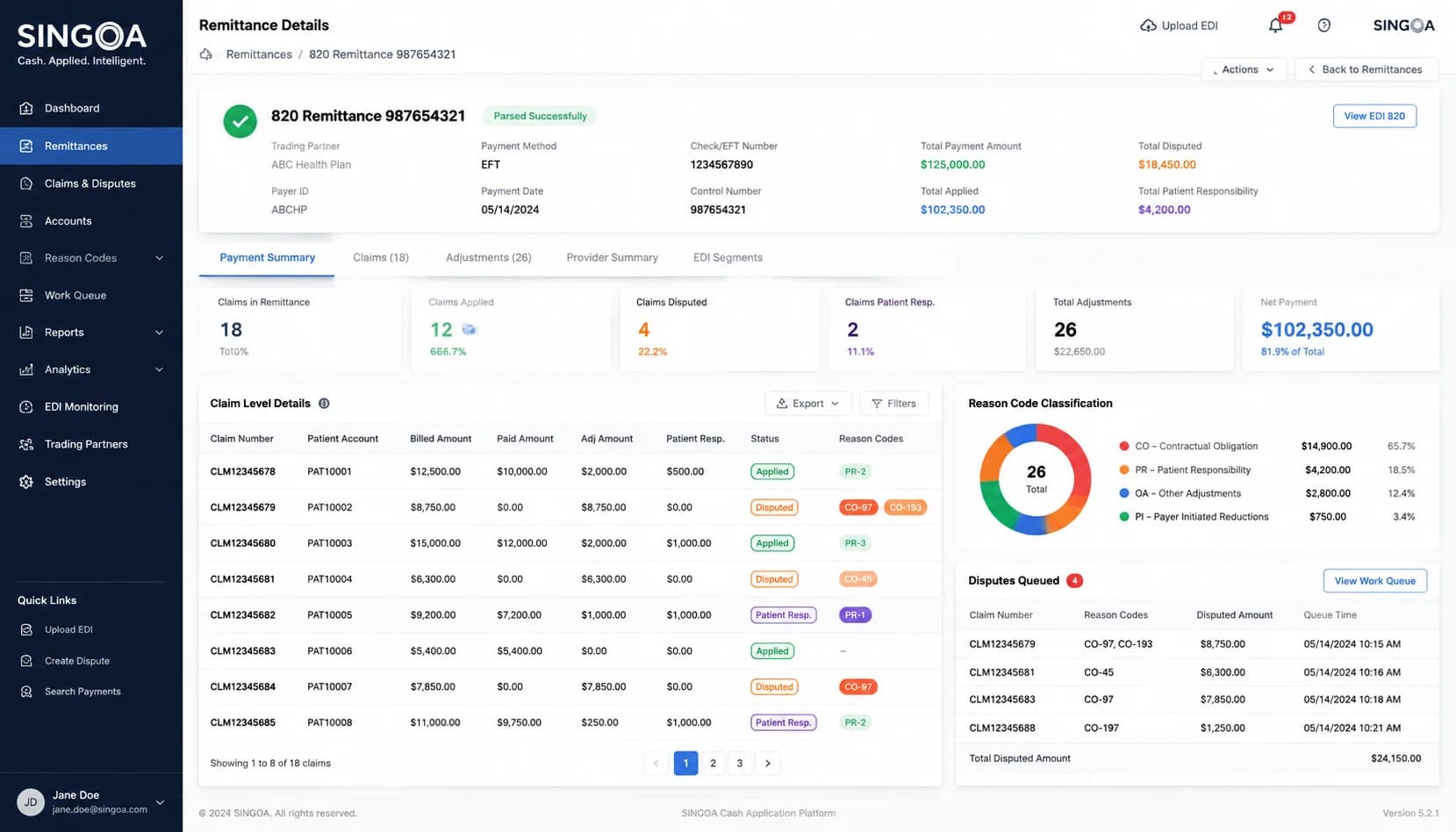
EDI 820 cash application and remittance parsing
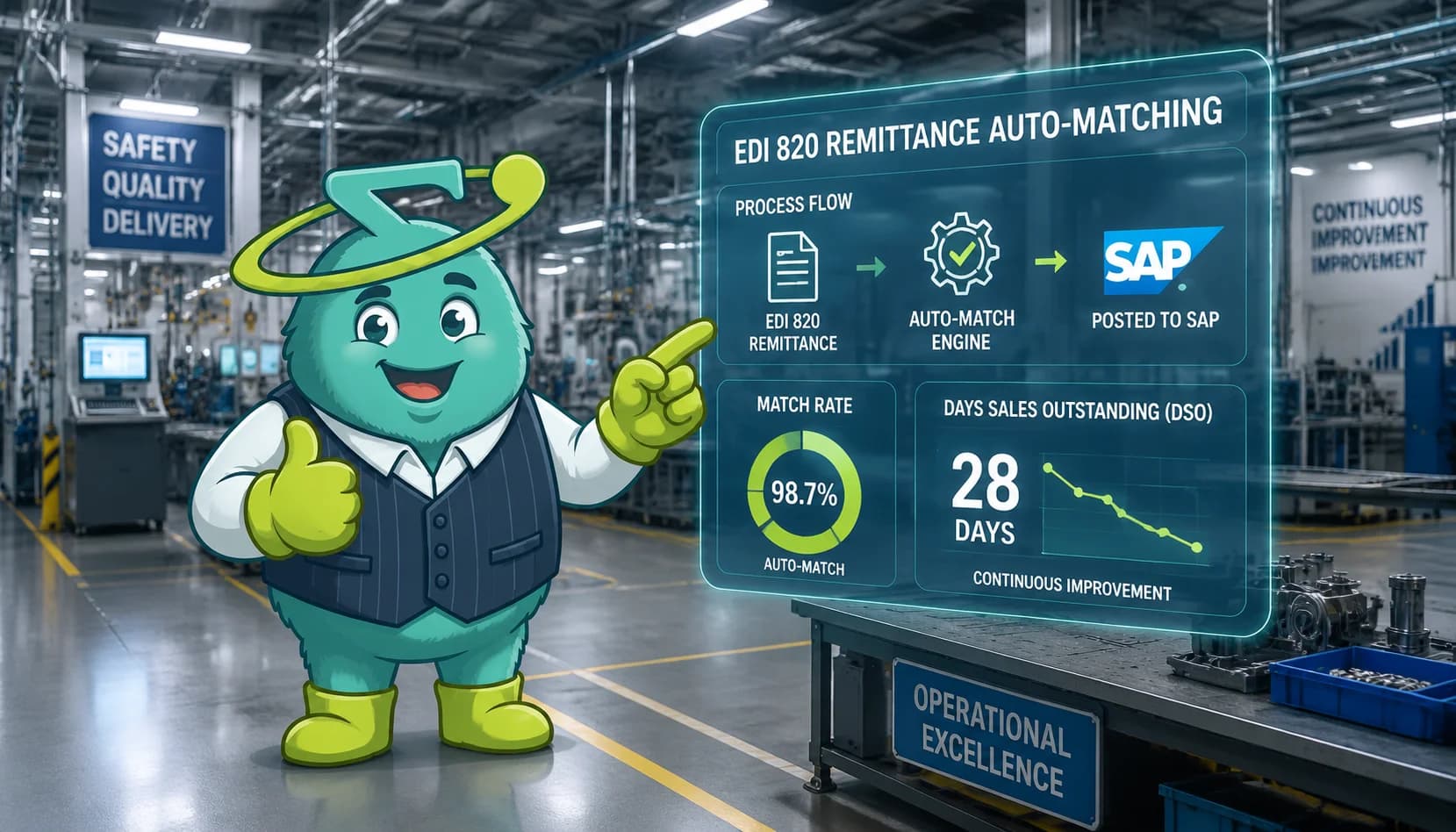
EDI 820 remittances arrive with hundreds of line items and cryptic reason codes. Automated cash application parses each line, applies the payment to the correct invoice, classifies short-pays into deduction categories, and routes disputes into a structured workflow, cutting posting time from 6 hours to under 15 minutes per file (Aberdeen).
An EDI 820 is not a single payment. It is a stack of segments describing one wire and hundreds of individual invoice applications, adjustments, and deductions. BPR carries the payment header and total. TRN carries the trace number. RMR segments carry each remittance line: invoice number, amount paid, and adjustments. IT1 carries item-level detail. ADX carries adjustments with reason codes. Parsing this manually is the six-hour job Aberdeen measured, and complex retailers like Walmart or Amazon Vendor Central can generate 820s with hundreds of ADX segments per file.
The invoice-to-remittance match is where automation earns its first hour back. Fuzzy matching handles the mismatches that break rigid rules: PO number in one field, invoice number in another, store number embedded in a memo line, an OCR quirk from a scanned check remittance. When 82% of lines auto-match on the first pass, the AR analyst only touches the exceptions. That is the shift from clerk work to review work, and it is the reason automated cash application benchmarks land at sub-15-minutes per file versus the 6 hours Aberdeen recorded for manual teams.
Deduction line classification is the second hour. Reason-code mapping tables convert retailer-specific codes (Walmart 24, Target D07, Costco WHSE-SHRT) into standardized internal categories (shortage, pricing, promotional, compliance, EPD). Each category routes into the correct dispute workflow with the correct evidence pack template. Platforms offering [AI cash application](/features) apply this mapping across every retailer's code set so the AR team stops maintaining spreadsheets of reason-code translations.
Combined remittances break simple systems. One payment covering 12 stores, 40 POs, and 60 invoices is normal for a mid-size distributor selling into Kroger or Walmart. Handling this requires the remittance parser to split at the invoice level, apply payments proportionally, and hold deductions against the correct originating invoice for downstream dispute filing. When the parser gets this wrong, aging reports lie, DSO calculations lie, and the collections team calls customers about invoices that were already paid weeks ago.
The Aberdeen benchmark is the number to quote in the internal business case: 6 hours to under 15 minutes per file. On a distributor receiving 40 EDI 820s per month, that is 230 hours per month returned to the AR team, roughly one and a half full-time analyst equivalents. Source: [Aberdeen Group Cash Application Study](https://aberdeen.com/cash-application-study).
ERP and EDI integrations: SAP, NetSuite, Epicor, SPS Commerce
Wholesale AR automation integrates on two axes: the ERP (SAP S/4HANA, NetSuite, Epicor Prophet 21, Acumatica, Sage X3) for invoices, credits, and customer master, and the EDI VAN (SPS Commerce, TrueCommerce, DiCentral, Cleo) for the 810 invoice, 856 ASN, 820 remittance, and 812 chargeback documents. ERP choice tracks revenue band, VAN choice tracks retailer mix, and the pre-built connector versus middleware versus custom decision decides go-live speed. See [SINGOA integrations](/integrations) and the [manufacturing AR + ERP integration guide](/blog/manufacturing-ar-automation-erp-integration-guide) for the parallel manufacturing view.
SAP S/4HANA
Native FI-AR write-back with FB05 / F-28 incoming payment objects and deduction split codes posted to reason-code GL accounts. Standard for wholesale distributors above $100M revenue and CPG suppliers selling into top-five grocers.
Oracle NetSuite
SuiteTalk integration writing Customer Payment records linked to original invoice transactions. Deductions posted as discounts or as separate credit memos with full audit trail. Dominant ERP for $25M-$250M wholesalers.
Epicor Prophet 21
Distributor-focused ERP integration for durable goods and specialty distribution channels. Native REST endpoint for AR receipt posting with deduction reason codes and dispute notes synced back to the customer ledger.
Acumatica
Cloud-first ERP connector for growth-stage wholesalers ($20M-$100M) with full FI-AR posting, EDI VAN bridge, and multi-warehouse inventory reconciliation for shortage-dispute evidence.
Sage X3
Mid-market ERP integration for food, beverage, and CPG wholesalers with process-manufacturing modules. Cash application posting with deduction taxonomy tied to trade-spend accrual accounts.
QuickBooks Enterprise
Small-to-mid-market wholesaler connector for distributors under $50M revenue, with invoice, credit memo, and cash receipt posting plus EDI VAN bridge for retailer 810/820 flows.
SPS Commerce
Dominant mid-market EDI VAN. Ingests 810 invoices, 856 ASNs, 820 remittances, 812 chargebacks, and 997 acknowledgments across the full retailer network. Handles the majority of Walmart, Target, and Kroger wholesale volumes.
TrueCommerce
Large installed base among CPG suppliers with fully managed EDI services and pre-mapped retailer profiles for Walmart, Target, Costco, Amazon, Home Depot, and specialty grocery accounts.
DiCentral and Cleo
Higher-end retail-integrated distributor VANs supporting direct AS2, SFTP, and API routing for wholesalers with heavier compliance requirements or specialty-channel retailer mixes.
Amazon Vendor Central
Portal-and-API special case (not pure EDI). Portal-native integration pulls case-level chargeback and shortage-claim data, maps to the same reason-code taxonomy used for retail EDI, and files disputes through the Vendor Central case interface.
Wholesale AR compliance: retailer scorecards, EDI standards, and dispute-window rules
Wholesale AR operates inside a compliance framework set by retailer vendor scorecards, EDI X12 transaction standards, and strict retailer-specific dispute windows. AR automation has to handle these natively or the deduction recovery numbers do not hold up under audit.
Retailer vendor compliance scorecards (Walmart OTIF, Target OTIF, Kroger, Amazon ASN accuracy)
Walmart, Target, Kroger, and Amazon publish vendor scorecards that drive unilateral chargebacks for on-time-in-full failures, ASN mismatches, and label compliance violations. AR automation surfaces compliance deductions by retailer, warehouse, and carrier lane so operations can act on the root cause, not just AR can chase the chargeback.
EDI X12 transaction set adherence (810, 820, 856, 812, 997)
Retailers enforce strict EDI X12 compliance. A malformed 810 triggers a 997 rejection that delays the entire payment cycle. Cash application requires precise parsing of BPR, TRN, RMR, IT1, and ADX segments. AR automation validates outbound 810s before transmission and parses inbound 820s and 812s end to end.
Retailer dispute-window enforcement (30 / 60 / 90 day cliffs)
Walmart Retail Link APDP enforces 30-60 day windows depending on reason code. Target Partners Online runs 60-day windows on many categories. Amazon Vendor Central windows close inside 30 days. Costco varies by category. Missing the window forfeits the recovery entirely.
Trade promotion authorization audit trail
Promotional deductions taken by retailers must tie to a signed promotion authorization with event ID, SKU list, dates, and funding rate. Without that audit trail, unauthorized promotional deductions look identical to authorized trade spend and finance writes them off, creating GAAP and revenue-recognition risk on gross-versus-net accrual.
ROI: what unified deduction, chargeback, and trade promotion automation delivers
Unifying deductions, chargebacks, and trade promotions in one AR platform recovers 2-4x more short-pay revenue, cuts DSO from 48 to 30-35 days, drops cash application time roughly 90%, and lifts dispute-recovery rates from 38% (manual) to 82% (automated). Mid-market wholesalers ($50M-$300M) typically hit payback in 3-6 months.
The recovery-rate lift is the anchor number. RVCF benchmarks manual deduction recovery at 38% and automated recovery at 82%. On a $200M distributor with 3% of gross absorbed into deductions ($6M annual pool), that gap moves $2.6M per year from write-off back to cash. Even on a $50M distributor with a $1.5M pool, the lift is roughly $660K per year. The Gartner AR Automation Survey confirms similar ranges across mid-market wholesale, and the pattern holds whether the distributor sells into big-box retail or specialty channels.
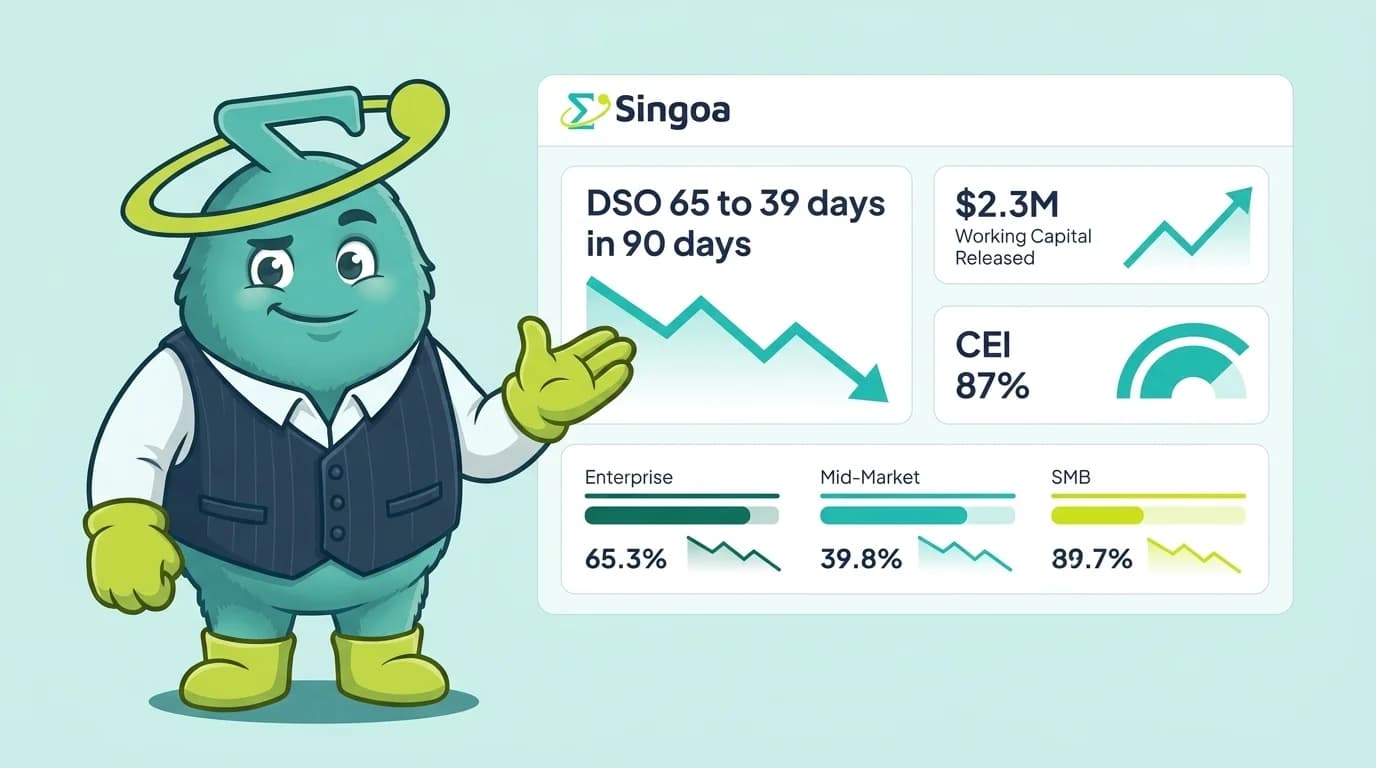
DSO reduction compounds the recovery win. Wholesale industry benchmark DSO is 48 days per the SINGOA reference data set. Unified automation, faster cash application, and reduced deduction backlog typically move DSO to 30-35 days for the same customer mix. On a $200M distributor, ten days of DSO is roughly $5.5M in working capital freed. Combined with the recovery lift, the annual benefit clears $8M before counting the AR analyst hours returned to higher-value work.
The other operational metrics fall out of the same shift. Cash application time drops from 6 hours per EDI 820 to under 15 minutes (Aberdeen). Deductions taken without any review drop from 62% baseline (Gartner) to under 10%. Dispute-filing rates on eligible deductions climb from roughly one-third to over 90%. Payback for mid-market wholesalers between $50M and $300M runs 3-6 months on typical AR automation pricing, and larger distributors often see payback inside a single quarter.
The forward-looking piece is that these benefits are cumulative. Every quarter of clean reason-code data feeds better root-cause analytics on chargebacks. Every promotion authorization loaded early prevents the next unauthorized deduction. Every retailer scorecard improved raises the ceiling on volume commitments. Compare with [DSO reduction strategies](/blog/reduce-dso-proven-strategies-2026) for the working-capital math, and read the [Gartner AR Automation Survey](https://gartner.com/ar-automation-survey) for the peer benchmarks.
The wholesale AR problem is not a headcount problem or a discipline problem. It is a classification problem hiding inside every EDI 820 file. When your team can tag a short-pay as a shortage deduction, a compliance chargeback, or a promotional billback within seconds of the remittance landing, the rest of the workflow (evidence pack, portal filing, dispute tracking) starts running itself. When the classification takes hours, the 30/60/90-day cliffs close and $24 billion of industry money quietly gets written off.
The most actionable step is the smallest one: pick one retailer, load 90 days of EDI 820 history into a reason-code taxonomy, and measure what percentage of your write-offs were actually disputable. Most wholesalers doing this exercise find 40-60% of the pool was recoverable and never worked. That single-retailer proof of concept is the internal case for a unified deductions, chargebacks, and trade promotion program, and it is usually enough to fund the automation that produces the RVCF 82% recovery benchmark.
The wholesale distributors moving fastest right now are the ones treating deductions as data instead of write-offs, chargebacks as operational intelligence instead of retailer fines, and trade promotions as a matched AR line instead of a marketing argument. Every one of those shifts turns a P&L drain into a working-capital lever, and every quarter of clean data compounds the next quarter's recovery rate. The tooling is ready. The playbook is above. The next remittance is already on its way.
38% to 82%
Dispute-recovery rate uplift, manual to automated
RVCF Deduction Management Benchmark Study
48 days to 30-35 days
Wholesale DSO reduction with unified automation
SINGOA wholesale industry benchmark and Hackett Group
6 hours to under 15 minutes
Cash application time per complex EDI 820 remittance
Aberdeen Group Cash Application Study
62% to under 10%
Deductions taken without review, baseline to automated
Gartner AR Automation Survey
3-6 months
Payback period for mid-market wholesalers ($50M-$300M)
SINGOA customer data
$2.6M / year
Recovered cash on a $200M distributor moving 38% to 82% on a $6M deduction pool
Calculated: $6M pool x (82% - 38%)
- Dispute-recovery uplift from 38% to 82% moves $2.6M per year from write-off back to cash on a $200M distributor with a $6M deduction pool
- DSO compression from 48 to 30-35 days releases roughly $5.5M of working capital on a $200M revenue base, combining with recovery uplift for over $8M annual benefit
- Cash application drops from 6 hours to under 15 minutes per EDI 820, returning 230+ hours per month on a 40-file distributor, roughly 1.5 FTE equivalents
- Deductions taken without review fall from 62% baseline to under 10%, and dispute-filing rates on eligible deductions climb from one-third to over 90%
- Payback runs 3-6 months for mid-market wholesalers ($50M-$300M), with larger distributors often hitting payback inside a single quarter
- Cumulative benefits compound quarter over quarter as clean reason-code data feeds better root-cause analytics, tighter promotion accruals, and improved retailer scorecards