
The state of manufacturing AR in 2026: three structural drivers of DSO
Retailers take $34 billion a year in deductions out of manufacturer remittances, according to the Deloitte and NACM Deduction Management Survey 2024. That is roughly 1 to 3 percent of gross revenue evaporating between the EDI 810 invoice you sent and the EDI 820 remittance that lands in your bank file. For a $100M discrete or CPG manufacturer, those are seven-figure leaks hiding inside what looks like a clean cash receipt.
Meanwhile, the average manufacturing AR team is running on a 52 to 58 day DSO (NACM Industry Credit Survey 2024) while Walmart, Amazon, and Tier-1 OEMs keep stretching terms to Net 60, Net 90, and Net 120. The AR Manager is matching multi-invoice EDI 820 remittances by hand on a Tuesday night, and the ERP, whether SAP S/4HANA, NetSuite, or Epicor Kinetic, has no native place to code shortages versus pricing disputes versus OTIF fines.
Walk into any $25M to $500M manufacturer and the AR story rhymes. Three structural drivers explain most of that gap. First, ERP integration friction. SAP S/4HANA, NetSuite, Epicor Kinetic, and Dynamics 365 do AR posting well, but none ship with native retailer deduction taxonomies, EDI 820 line-item matching, or portal-based dispute evidence assembly. Second, long payment terms. When Walmart pays Net 90 and a Tier-1 OEM pays Net 120, the calendar is fixed. Third, supply chain payment chain visibility. A Tier-2 supplier rarely knows when the OEM pays the Tier-1, which means cash forecasting at the bottom of the chain is guesswork. Retailers take $34 billion a year in deductions from manufacturers, per the [Deloitte / NACM Deduction Management Survey 2024](https://www.deloitte.com/global/en/services/audit/research/deduction-management-2024.html), and 1 to 3 percent of gross revenue leaks out per manufacturer per year. Hackett pegs manual deduction recovery at 35 percent versus 78 percent for AI-assisted teams. Only one of the three drivers (long payment terms) is genuinely immovable. The other two are squarely solvable on your current ERP, this quarter. Learn more about [SINGOA for manufacturing](/industries/manufacturing).
$34 billion
Annual unauthorized deductions taken by retailers from manufacturers
Deloitte / NACM Deduction Management Survey 2024
52-58 days
Average manufacturing DSO across discrete and CPG
NACM Industry Credit Survey 2024
1-3%
Gross revenue lost to deductions per manufacturer per year
Gartner Supply Chain Finance Report 2024
35% vs 78%
Deduction recovery rate, manual vs automated
Hackett Group O2C Benchmark 2024
41%
Manufacturer cash applications still requiring human matching
IOFM AR Automation Survey 2023
Common Pain Points
- Retailer deductions and chargebacks: trade deductions (promo, MCB, slotting) and non-trade (shortages, damages, OTIF fines, compliance penalties) ride in on the EDI 820 with reason codes that do not match your invoice line. Treat them as one bucket and you under-recover both
- EDI 820 remittance complexity: a single Walmart payment can carry thirty invoices, six short pays, and a 250-line credit-debit adjustment (EDI 812), taking four hours to reconcile manually per the IOFM Cash Application Benchmark 2024
- ERP integration friction: AR analysts re-key cash receipts, deduction codes, and dispute notes between the bank file, the EDI VAN, and SAP or NetSuite, eating 30+ hours per week per FTE
- Long payment terms (Net 60, 90, 120): structural to selling into Walmart, Kroger, Target, Amazon Vendor Central, or a Tier-1 automotive OEM, the honest job for automation is to compress the rest of the cycle, not fight the calendar
- Supply chain payment chain visibility: a Tier-2 supplier feeding a Tier-1 building for an OEM sees three layers of remittance timing it cannot otherwise model, and EDI 820 parsing lights up that forecast
- Manual cash application: 41 percent of manufacturer cash applications still require human intervention (IOFM 2023), most of it matching a partial payment against multiple invoices with a deduction layered on top, exactly what AI matching solves. See [structured dispute workflows for chargebacks](/blog/dispute-management-ar-structured-workflows)
Industry Terminology Guide
See what 24 days of DSO is worth on your revenue
Plug in your annual revenue and current manufacturing DSO to see working capital unlocked, deduction recovery uplift, and AR FTE hours reclaimed.
Four AR automation solutions that cut manufacturing DSO from 52 to 28 days
Each solution targets one structural driver behind the 52-58 day manufacturing DSO. Together they form a closed-loop O2C layer sitting on top of your existing SAP, NetSuite, or Epicor ERP without rip and replace.
ERP integration: what 'native' really means for SAP, NetSuite, Epicor, and Dynamics
Native ERP integration for manufacturing AR means bidirectional API sync with FI-AR write-back of cash receipts, deduction codes, and dispute notes posting back to the ERP of record, not flat-file dumps or middleware.
Three integration tiers exist in the wild, and only one of them deserves the word 'native'. Tier one is flat-file: nightly CSV exports of open invoices, manual import of a cash batch, no return path. Tier two is middleware: an iPaaS layer (Boomi, MuleSoft, Workato) maps fields between an AR platform and the ERP, but the integration is a customer build, fragile across ERP version upgrades. Tier three is native: published API contracts, vendor-maintained connectors, FI-AR write-back of the cash receipt, deduction line, and dispute note with full audit trail.
FI-AR write-back is the test. Ask the vendor exactly which API object they post into. For SAP S/4HANA, that should be the FB05 / F-28 incoming payment with deduction split codes posted to the right reason-code GL accounts. For NetSuite, it is a Customer Payment record (not a Cash Sale) with the deduction posted as a discount or as a separate credit memo, linked to the original invoice transaction. For Epicor Kinetic, it is the AR Receipt transaction via the REST v2 endpoint. If the vendor cannot name those objects, the integration is middleware in a marketing skin.
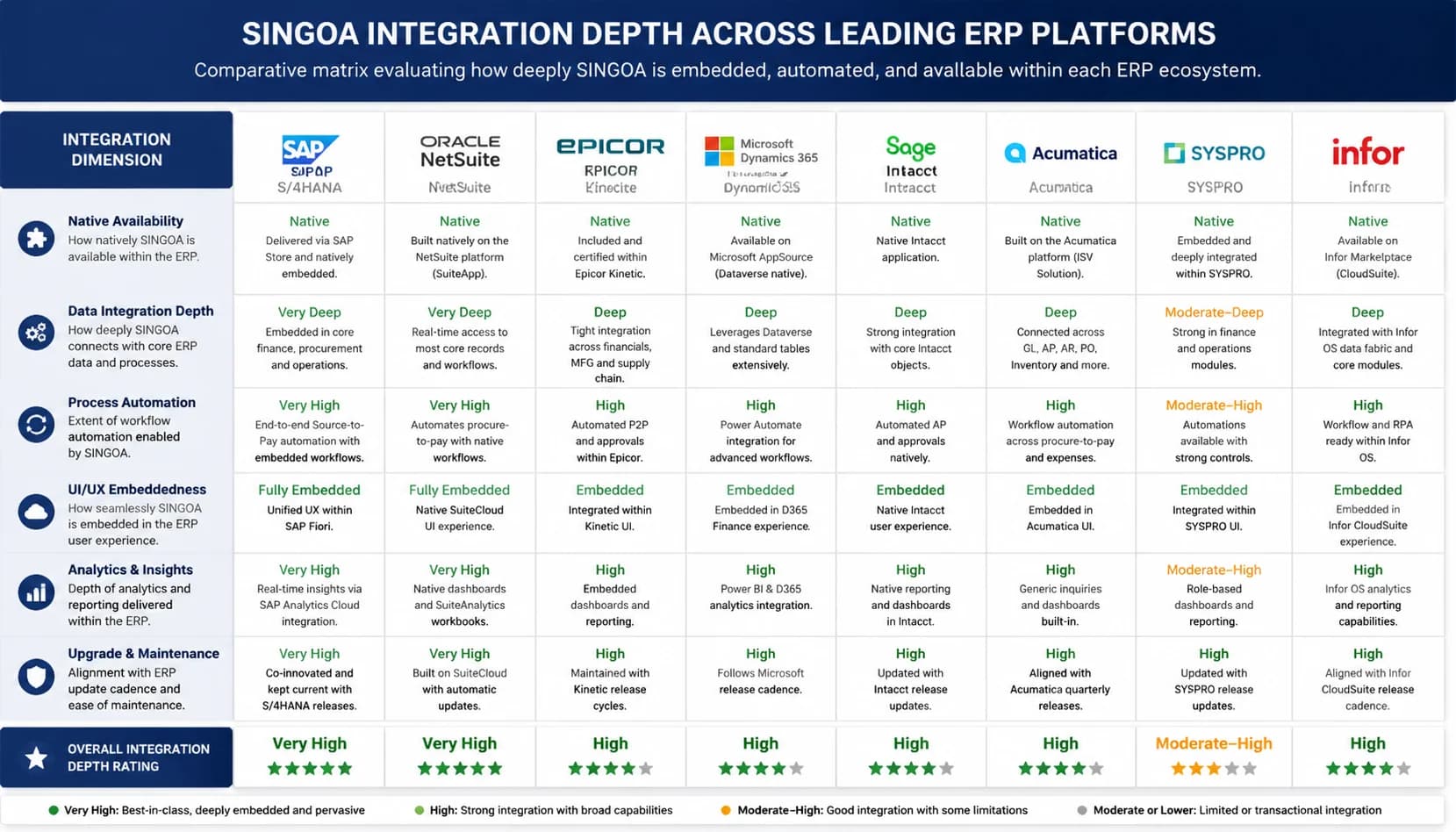
The integration matrix matters because manufacturing ERPs cluster: SAP S/4HANA and ECC for global discrete and CPG, NetSuite for $25M-$250M growth, Epicor Kinetic for discrete machining and metals, Dynamics 365 Finance for mixed-mode, Sage 100/300 for sub-$50M, Acumatica for cloud-first, SYSPRO for process industries, and Infor CloudSuite / LN for automotive Tier-N. Any platform claiming to serve manufacturers needs depth across at least six of those, plus an EDI VAN connector layer. See the [full integration catalog](/integrations) for the current matrix.
Why does 'native' matter beyond bragging rights? Because the alternative breaks at every ERP patch, every new chart-of-accounts entry, and every retailer-onboarded reason code. Your AR team ends up maintaining the integration on top of doing AR. Native means the vendor owns the connector, ships updates, and stays current with each ERP release cycle, so your team gets to focus on recovery and forecasting, not on schema mapping.
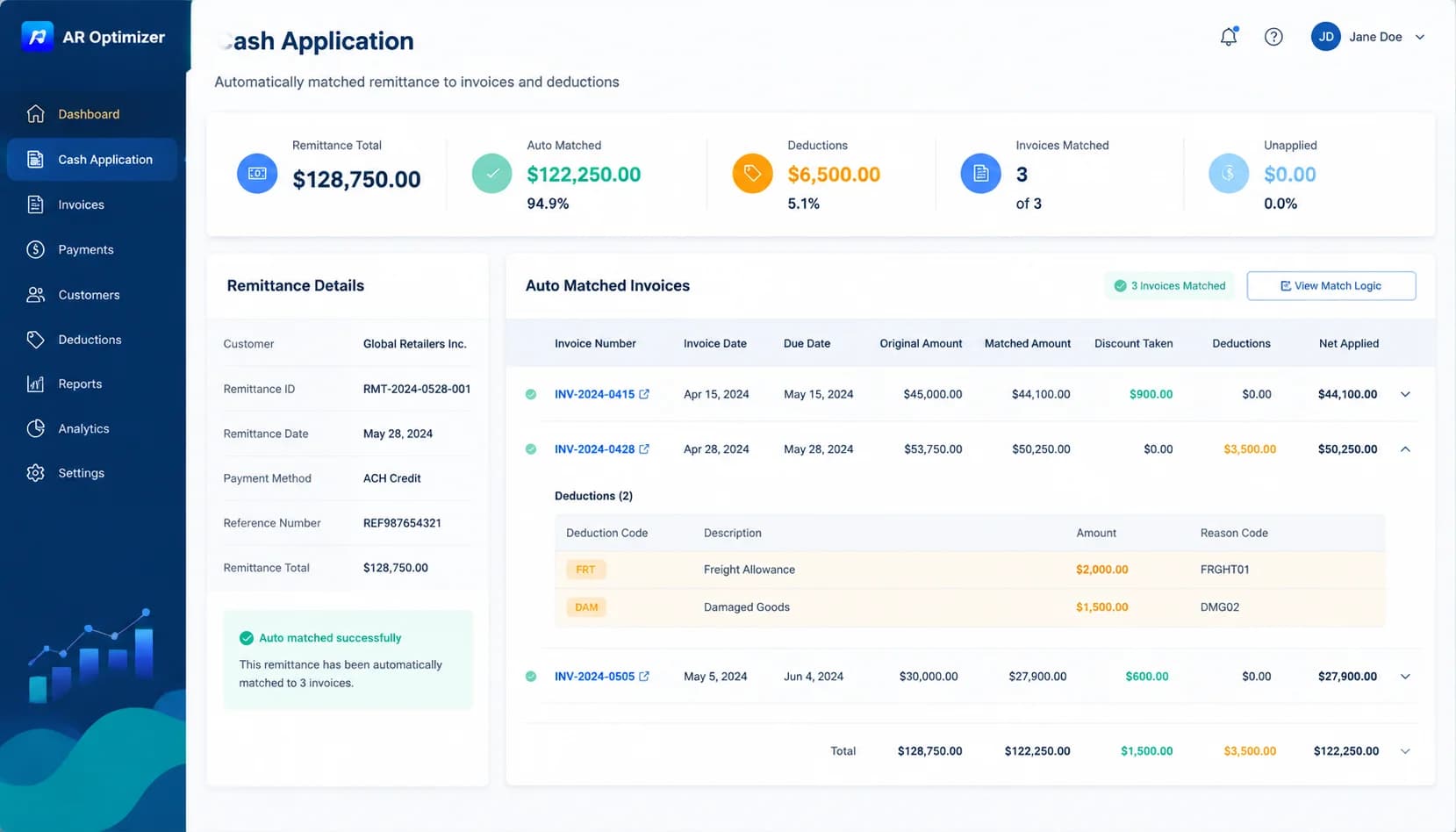
Solving EDI 820 cash application: from 4 hours to 20 minutes per remittance
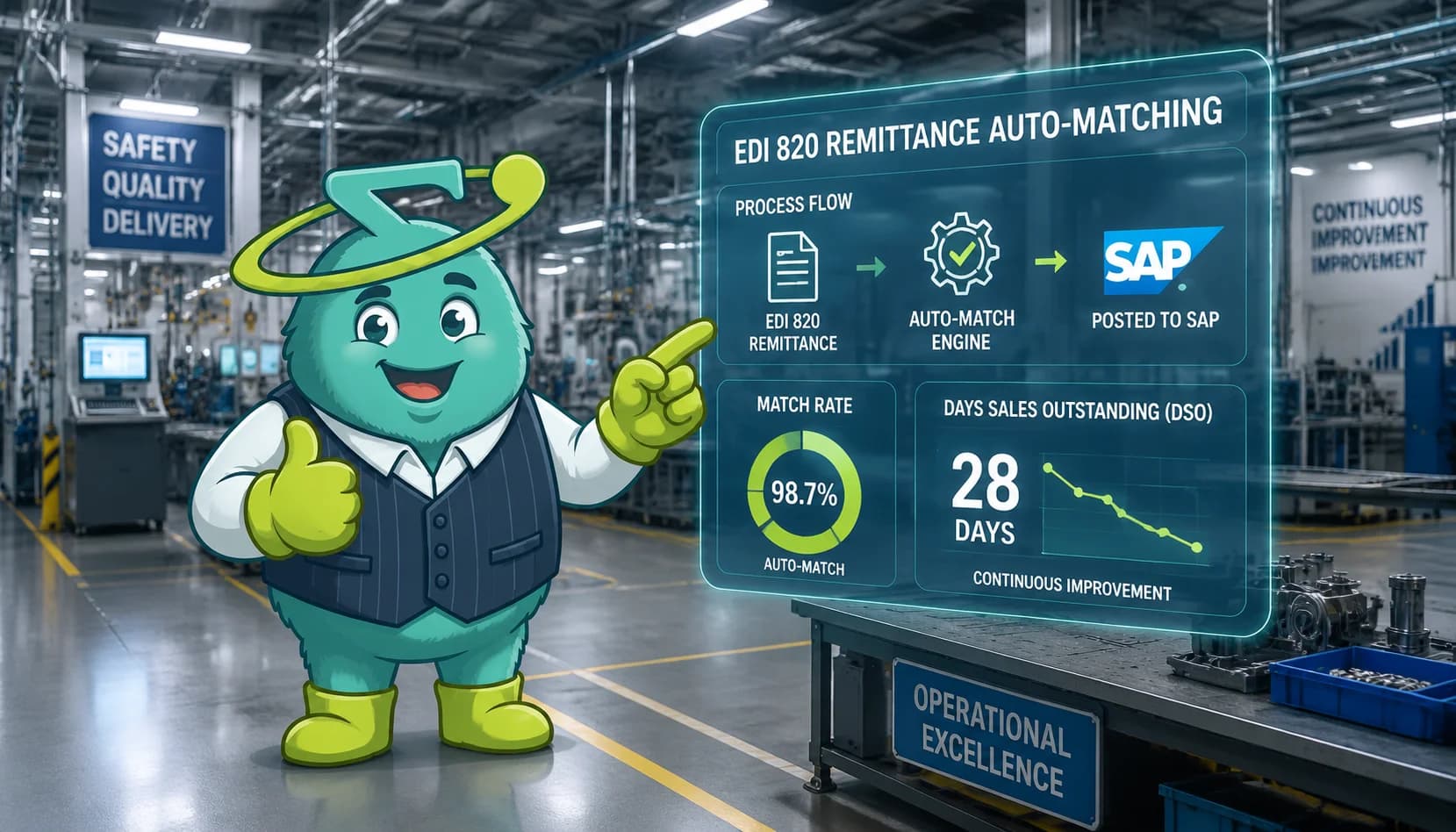
EDI 820 cash application automation parses retailer payment remittance files, matches line-item payments and deductions against the original EDI 810 invoices, and writes cash receipts plus deduction codes back to the ERP with 94 percent straight-through processing.
The EDI round trip a manufacturer lives in goes like this. You send an EDI 810 invoice to Walmart through SPS Commerce. Walmart returns an EDI 997 functional acknowledgment within hours. Sixty to ninety days later, an EDI 820 remittance lands referencing fifteen of your invoices, two short pays for shortages, one promo MCB credit, and a Net 60 cash discount. Your bank file shows the ACH deposit. Now the analyst has to tie all of that together against the right reason codes and post the cash before month-end close.
Manually, that single remittance takes four hours. Multiply by twenty retailers and a hundred remittances a month and an entire AR team is doing nothing else. Cash application automation parses the EDI 820 ST loops, identifies the RMR (remittance reference) and ADX (adjustment) segments, maps each line back to the EDI 810 invoice by invoice number plus PO plus amount tolerance, and posts the net cash. Short pays get coded by reason. Promo credits route to the trade-spend accrual. The whole flow is auditable line by line. See the [AI payment matching accuracy benchmarks](/blog/ai-payment-matching-accuracy) for how that 94 percent number is measured.
Three integration points carry the workflow. The EDI VAN (SPS Commerce, TrueCommerce, DiCentral, Orderful, or Cleo) delivers the 820 file. The AR automation platform parses, matches, and codes. The ERP receives the posted cash receipt and the deduction lines via API. Retailer portals (Walmart Retail Link, Amazon Vendor Central, Target Partners Online) feed dispute documentation back to the same workflow. The result is straight-through processing for the bulk of items, with human attention reserved for the long tail of true exceptions.
Twenty minutes versus four hours sounds like a productivity story. It is actually a working capital story. Faster cash application means faster credit-limit decisions, faster dispute creation inside the retailer dispute window, and faster month-end close. The Hackett Group O2C Benchmark 2024 ties cash application velocity directly to DSO outcomes, which is why this is the highest-leverage workflow to automate first.
Native ERP + EDI integration for manufacturers
SINGOA writes cash receipts and deduction codes back to SAP, NetSuite, Epicor, and Dynamics with no middleware and no flat files. See it on your stack.
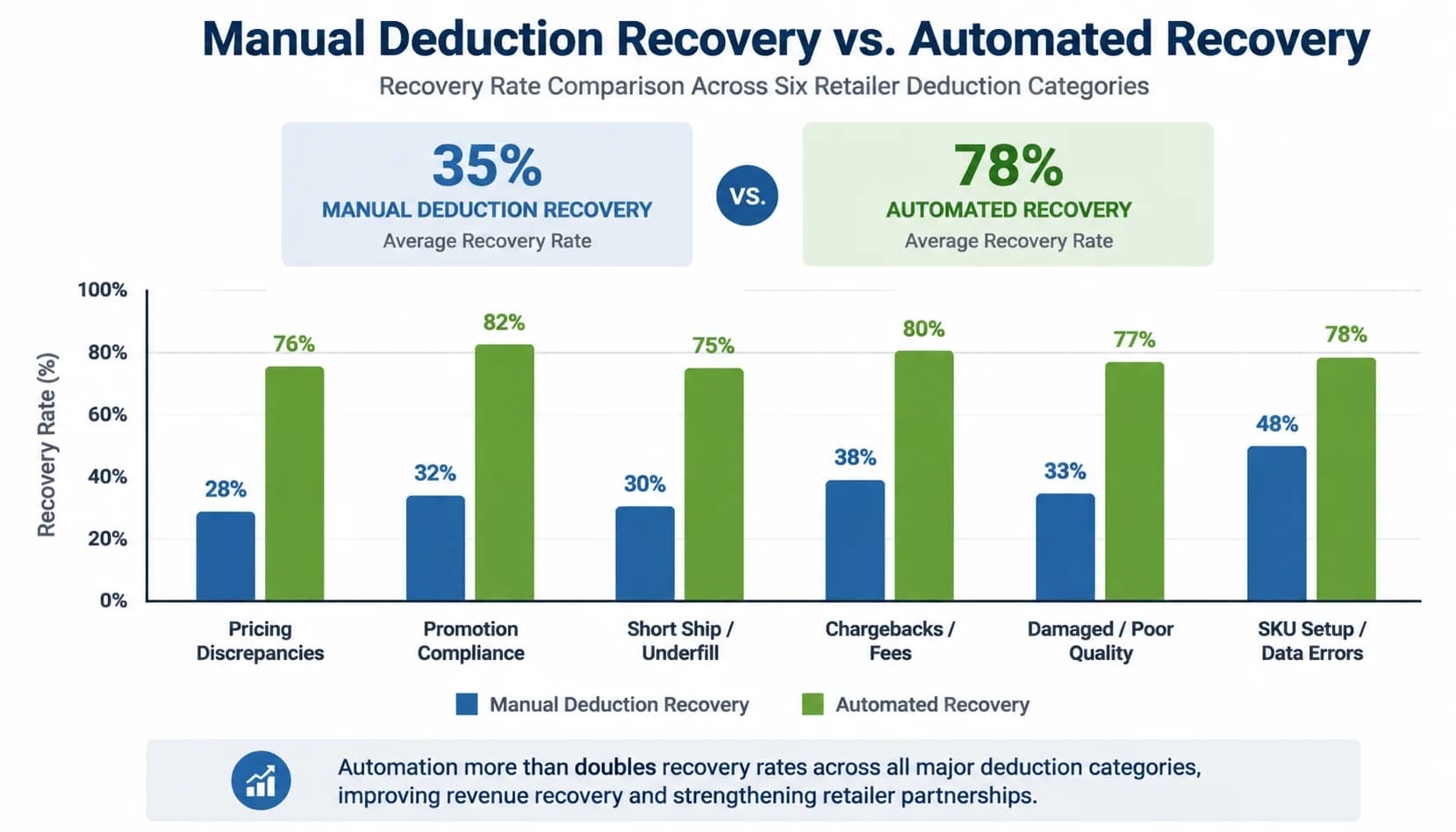
Recovering retailer deductions: from 35% manual to 78% automated
Manufacturers recover only 35 percent of retailer deductions manually, leaving 65 percent as silent margin leak. AI-powered deduction management with auto-coding, portal evidence assembly, and routed dispute workflows lifts recovery to 78 percent.
The deduction taxonomy matters because each category has a different recovery path. Shortages need proof of delivery and the EDI 856 ASN. Pricing variances need the EDI 850 PO compared against the EDI 810 invoice. OTIF (on-time in-full) penalties from Walmart and Target need the carrier scan and the appointment time. MCB (manufacturer chargeback) and promo deductions need the trade-spend authorization signed off by the broker. Compliance fines need the vendor scorecard appeal. One bucket called 'deductions' guarantees 35 percent recovery; six buckets with six workflows gets you to 78.
AI auto-coding is the unlock. An AR analyst reading 'PRC VAR INV 4471823' on a Walmart 820 today has to manually open the invoice, compare to the PO, and decide if it is a real pricing dispute or a unit-of-measure mismatch. An AI classifier trained on the retailer's historical reason-code patterns codes that line in under a second, attaches the source documents (PO, invoice, BOL, ASN), and either routes it for dispute or auto-writes it off against a pre-authorized promo. The analyst reviews exceptions, not every line.
Portal evidence assembly is where most teams lose the recovery race. Walmart's Retail Link dispute window is 90 days. Amazon Vendor Central is 60 days. Target Partners Online and Kroger vary. AR platforms that pull invoice, BOL, ASN, and POD into a single dispute package per retailer reason code, and submit through the portal, beat the window. The economics are direct: a $50M CPG manufacturer losing 2.5 percent of revenue to deductions has $1.25M at stake. Going from 35 percent to 78 percent recovery is $537,500 a year recovered. That is why [structured dispute workflows](/blog/dispute-management-ar-structured-workflows) get prioritized right after cash application.
There is also a culture shift hidden in this number. When recovery is 35 percent, deductions feel like a tax. When recovery is 78 percent, deductions become a measured operations input. Promo accruals tighten. Pricing master-data hygiene improves because every variance shows up. OTIF performance becomes visible to operations, not just to retail-customer-service. The secondary effect of automated deduction recovery is that the retailer relationship gets healthier, because disputes are evidence-based, not adversarial.
Long payment terms and supply chain visibility: what automation can and cannot fix
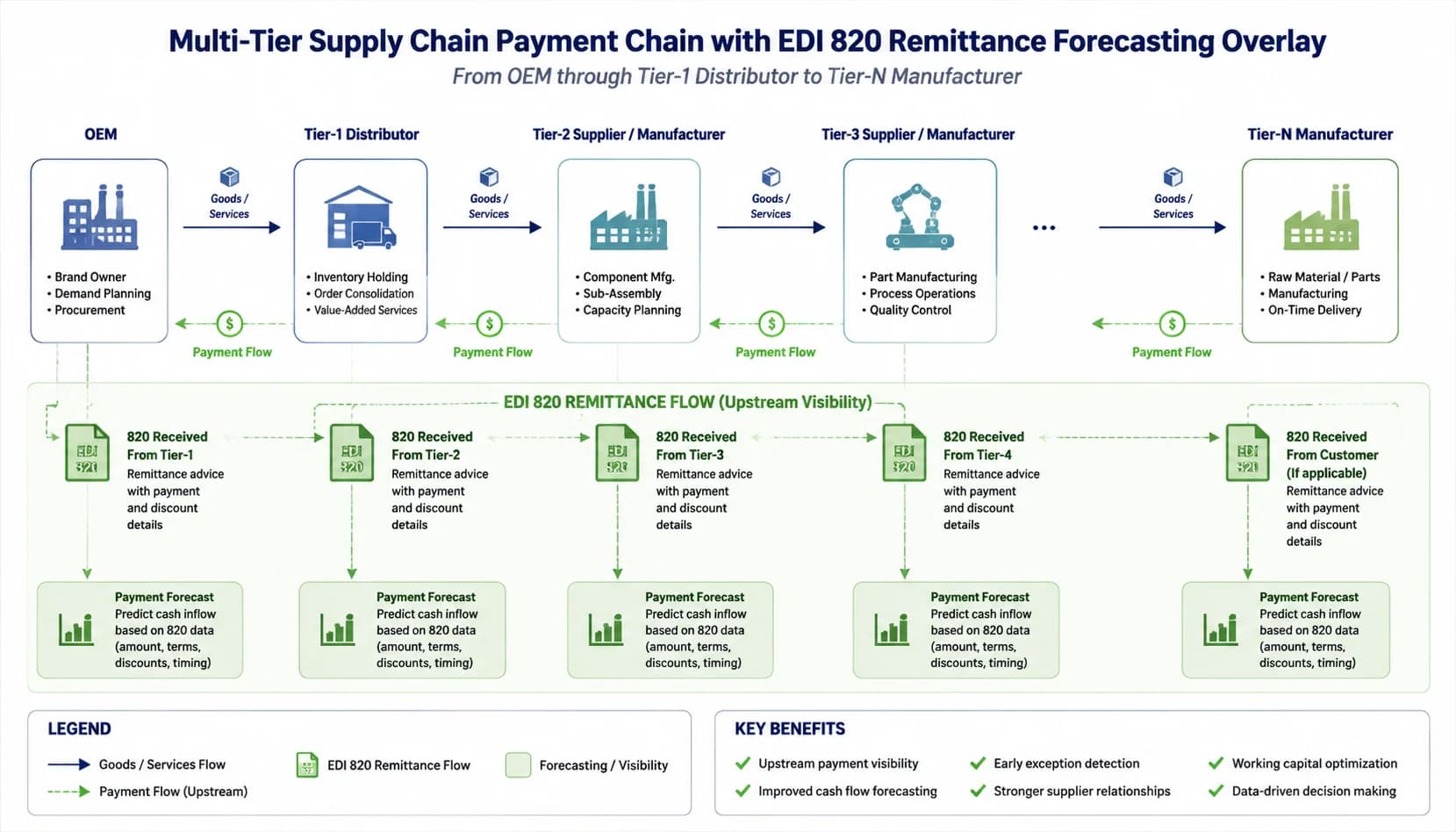
Automation cannot shorten a Net 90 retailer term. It can compress every other day of friction in the cycle: invoice-to-EDI same day, deduction resolution from 45 to 12 days, and EDI 820 remittance forecasting across the OEM, distributor, and Tier-N payment chain.
Be honest about Net 60, Net 90, and Net 120. Those terms are structural to selling into Walmart, Kroger, Amazon, Target, and the major automotive and aerospace OEMs. They reflect retailer working capital strategy, not your collections performance. Pretending an AR platform shortens them sets the project up to fail. The honest framing is that automation compresses every other component of the order-to-cash cycle, leaving the term itself intact but reclaiming days everywhere else.
What can compress: invoice cycle time (shipment-to-EDI 810 from 3 days to same day), cash application time (4 hours to 20 minutes per remittance), deduction resolution time (45 days to 12), and dispute submission lag (often days to within hours of the deduction landing). Stack those compressions and you reclaim 12 to 18 days from a 52-day DSO without touching the term. That is the math behind the 52 to 28 day outcome, and the [DSO reduction strategies](/blog/reduce-dso-proven-strategies-2026) breakdown walks through each lever.
Supply chain payment chain visibility is the underrated half of this. A Tier-2 supplier feeding a Tier-1 building for an OEM sees three layers of remittance timing it cannot directly observe. Parsing EDI 820 patterns by retailer, by OEM, and by season produces a remittance forecast accurate within a few days, per PYMNTS B2B Payments 2025 patterns. That forecast turns AR from a backward-looking reconciliation function into a forward-looking treasury input.
The working-capital impact is real even when terms stay fixed. Compress 18 days of cycle friction on a $100M manufacturer and you free roughly $4.9M of working capital, before counting deduction recovery. The CFO conversation shifts from 'why is DSO 55' to 'we hit 32 in two quarters and we know exactly which retailers are dragging the rest'. Once the forecast is accurate, supply-chain finance and dynamic discounting become viable strategies, which most manufacturers cannot meaningfully pursue today.
Manufacturing ERP and EDI integrations
AR automation for manufacturers requires native bidirectional integration with both your ERP of record and your EDI VAN. CSV imports and middleware mapping defeat the purpose; vendor-maintained API connectors are the baseline requirement.
SAP S/4HANA and ECC
FI-AR write-back via RFC and REST APIs. FB05 / F-28 incoming payment objects with deduction split codes posted to reason-code GL accounts. Vendor-maintained connector survives ERP patches and chart-of-accounts changes.
Oracle NetSuite
Bidirectional SuiteTalk integration writing Customer Payment records (not Cash Sales) linked to original invoice transactions. Deductions posted as discounts or as separate linked credit memos with full audit trail.
Epicor Kinetic
AR Receipt transaction posted via REST v2 endpoint with deduction reason codes and dispute notes synced back to the customer ledger in real time.
Microsoft Dynamics 365 Finance
Native Dynamics 365 connector for mixed-mode manufacturers handling cash application, deduction coding, and customer credit limit updates bidirectionally.
Sage 100 / 300 and Acumatica
Cloud-first ERP connectors for $25M-$50M manufacturers with full FI-AR posting and EDI VAN bridge.
SYSPRO and Infor CloudSuite / LN
Process-industry and automotive Tier-N ERP support including bill-of-material aware invoicing and multi-currency cash application.
SPS Commerce, TrueCommerce, DiCentral, Orderful, Cleo
EDI VAN connectors that ingest 810 invoices, 850 POs, 820 remittances, 856 ASNs, 812 adjustments, and 997 acknowledgments into a single cash application workflow.
Walmart Retail Link, Amazon Vendor Central, Target Partners Online
Retailer portal integrations for dispute submission with assembled evidence (PO, BOL, ASN, POD) and dispute-window timers per retailer.
Manufacturing AR compliance: retailer scorecards and revenue recognition
Manufacturing AR operates inside a compliance framework set by retailer vendor scorecards, EDI transaction standards, and revenue recognition rules. AR automation has to handle these natively or the deduction recovery numbers do not hold up under audit.
Retailer Vendor Compliance Scorecards (OTIF, ASN accuracy, label compliance)
Walmart, Target, Amazon, and Kroger publish vendor scorecards that drive unilateral chargebacks for on-time-in-full failures, ASN mismatches, and label compliance violations. AR automation surfaces compliance deductions by retailer so operations can act on the root cause, not just AR can chase the chargeback.
EDI X12 transaction set adherence (810, 820, 850, 856, 812, 997)
Retailers enforce strict EDI X12 compliance. A malformed 810 triggers a 997 rejection that delays the entire payment cycle. Cash application requires precise parsing of BPR, RMR, and ADX segments. AR automation validates outbound 810s before transmission and parses inbound 820s end to end.
ASC 606 / ASC 610 revenue recognition
Promo deductions, MCB rebates, and trade-spend accruals interact with revenue recognition under ASC 606 (contracts with customers) and ASC 610 (deductions from gross revenue). Misclassifying a non-trade deduction as a trade deduction overstates gross revenue and creates audit risk.
Retailer dispute window enforcement
Walmart Retail Link enforces a 90-day dispute window. Amazon Vendor Central enforces 60 days. Target Partners Online and Kroger vary. Missing the window forfeits the recovery entirely. AR automation tracks every deduction against its retailer-specific dispute window with escalation alerts at 30, 14, and 7 days before expiry.
ROI: what 52 to 28 day DSO actually means in working capital and headcount
Working capital math first, because it is the line the CFO models. DSO compression of 24 days on $100M of revenue equates to $100M divided by 365, multiplied by 24, which is approximately $6.58M of cash released from receivables back into operating capital. That is one-time cash, but it permanently resets the working capital baseline. Scale that to $250M revenue and the unlock approaches $16.4M. At $500M, you are clearing $32.9M in a single cycle correction.
Deduction recovery uplift is the second line. If 3 percent of gross revenue is at deduction risk and recovery moves from 35 percent to 78 percent, that 43 percentage-point lift on $3M at risk is $1.29M recovered annually on a $100M base, recurring. AR FTE reclaim is the third. Removing 30 hours per week of manual cash application and EDI 820 matching per analyst, across a typical three-person AR team, equates to roughly 1.5 FTEs of reclaimed capacity that gets redeployed to credit review, collections strategy, and trade-spend cleanup.
Payback runs under 90 days for the median manufacturer in this revenue band, which the [AR automation 90-day payback case studies](/blog/ar-automation-use-cases-90-day-payback) document with named outcomes. The mix matters: cash application velocity drives most of the DSO compression in the first 30 days, deduction recovery builds across the first two quarters, and forecasting accuracy compounds from there. The working capital unlock alone usually covers the entire annual platform spend in the first 60 days, which is why finance leaders treat this as a treasury initiative, not an IT one. Manufacturing AR in 2026 is not broken because of one big problem. It is dragging because of three structural drivers stacked on top of each other. Only two of the three are solvable directly, and the right job is to compress everything around the fixed Net 90 calendar. Pull a representative EDI 820 sample from your three largest retailers, ask each candidate vendor to run it end-to-end on your ERP sandbox, and watch what posts back. Native integration, deduction coding accuracy, and portal evidence assembly will be visible within the first hour of that test, and the right vendor is the one whose numbers survive contact with your own data. See [transparent per-invoice pricing](/pricing) to model the spend side.
24 days
Average manufacturing DSO reduction with AR automation (52 to 28 days)
SINGOA customer data and Hackett Group O2C Benchmark 2024
$6.58M
Working capital unlocked on a $100M manufacturer at 24-day DSO compression
Calculated: $100M / 365 days x 24 days
43 points
Deduction recovery uplift moving from 35% to 78%
Hackett Group O2C Benchmark 2024
4 hours to 20 minutes
Cash application time per complex EDI 820 remittance, manual vs automated
IOFM Cash Application Benchmark 2024
94%
Straight-through processing rate for automated cash posting
SINGOA platform data
Under 90 days
Typical payback period for mid-market manufacturers
SINGOA customer data
- 24-day DSO compression from 52 to 28 days releases approximately $6.6M in working capital on a $100M revenue base, with the unlock scaling linearly to $16.4M at $250M and $32.9M at $500M
- Deduction recovery moves from 35 percent to 78 percent, recovering an additional $1.29M per year on a $100M base when 3 percent of gross revenue is at deduction risk
- AR FTE reclaim equals roughly 1.5 FTEs of capacity across a typical three-person team, redeployed to credit review, collections strategy, and trade-spend cleanup
- EDI 820 cash application drops from 4 hours per complex remittance to 20 minutes, with 94 percent straight-through processing across a typical retailer mix
- Payback under 90 days for the median manufacturer in the $25M-$500M revenue band, with working capital unlock typically covering annual platform spend in the first 60 days