
Quick Answer
AI collections communication combines behavioral psychology (loss aversion, reciprocity, commitment) with machine learning across four layers: segmentation, tone and channel selection, send-time optimization, and a learning loop, lifting response rates from ~18% to ~41% and cutting DSO 25-40%.
Key Takeaways
- One-size-fits-all dunning plateaus below 20% response. Behaviorally-segmented AI dunning lifts it to 35-45%.
- Collections Psychologist runs on a 4-layer pipeline: segmentation, tone and channel selection, send-time optimization, and a weekly learning loop.
- Segmentation pulls 12+ signals (days late, dispute history, open-rate trend, tenure, sales flag) to map invoices to 4 debtor personas.
- Behavioral principles in play: loss aversion for chronic late payers, reciprocity for relationship accounts, commitment for first-time slips.
- Mid-market benchmark: 35% faster collections, 25-40% DSO reduction, 70-80% AR-rep time saved, with a 4-6 week cold-start before per-account predictions beat the baseline.
- AI should hand off to humans on high-value disputes, strategic accounts, and distress signals. Set the dollar and day thresholds on day one.
See Collections Psychologist in your stack
Watch a 15-minute walkthrough of the 4-layer architecture running against a sample of your real AR data.
Why one-size-fits-all dunning quietly stalls cash
At 9:14 AM on the first business day of the month, a mid-market AR team triggers the same Day-30 dunning template to 312 overdue accounts. By Friday, 58 have paid, 11 have replied with disputes, and 243 have stayed silent. That is a 19% response rate on AI collections communication that was never tuned for the customer on the other side of the inbox.
According to the PYMNTS 2025 B2B Payments Study, 30-40% of B2B payments still arrive without clear remittance, and most dunning sequences treat a first-time slip the same as a chronic 90-day-late offender. The math is brutal: same tone, same channel, same hour, regardless of who is reading. That sameness is why response rates plateau and DSO drifts up two days a quarter.
Most mid-market AR teams still run dunning out of a spreadsheet or a basic scheduler bolted onto the ERP. The sequence is identical for every customer: a polite reminder on Day 30, a firmer one on Day 45, an escalation on Day 60. It works just well enough to keep the lights on, which is exactly why it never gets fixed. The damage hides in two places. First, the response rate sits between 15% and 20% across IOFM-benchmarked mid-market portfolios, meaning four out of five reminders go unanswered. Second, the relationship damage is invisible. A wholesale buyer disputing a $4,200 deduction gets the same firm reminder a chronic late payer gets, and the sales rep on that account hears about it 11 days later when the buyer threatens to switch suppliers.
Manual personalization could fix this, except that one AR rep can only meaningfully personalize for about 150 active accounts before quality collapses. If your team is hovering at that ceiling, the question is not whether to automate. It is whether to automate the same flat template at higher volume, or to [scale AR without adding headcount](/blog/scale-ar-operations-without-adding-headcount) by replacing the template with behaviorally-segmented outreach. Here is where it gets interesting: the lift does not come from sending more emails. It comes from sending fewer, smarter ones.
30-40%
B2B payments arriving without clear remittance data
15-20%
Response rate on one-size-fits-all dunning across mid-market portfolios
~150
Active accounts one AR rep can meaningfully personalize before quality collapses
The 4-layer Collections Psychologist architecture
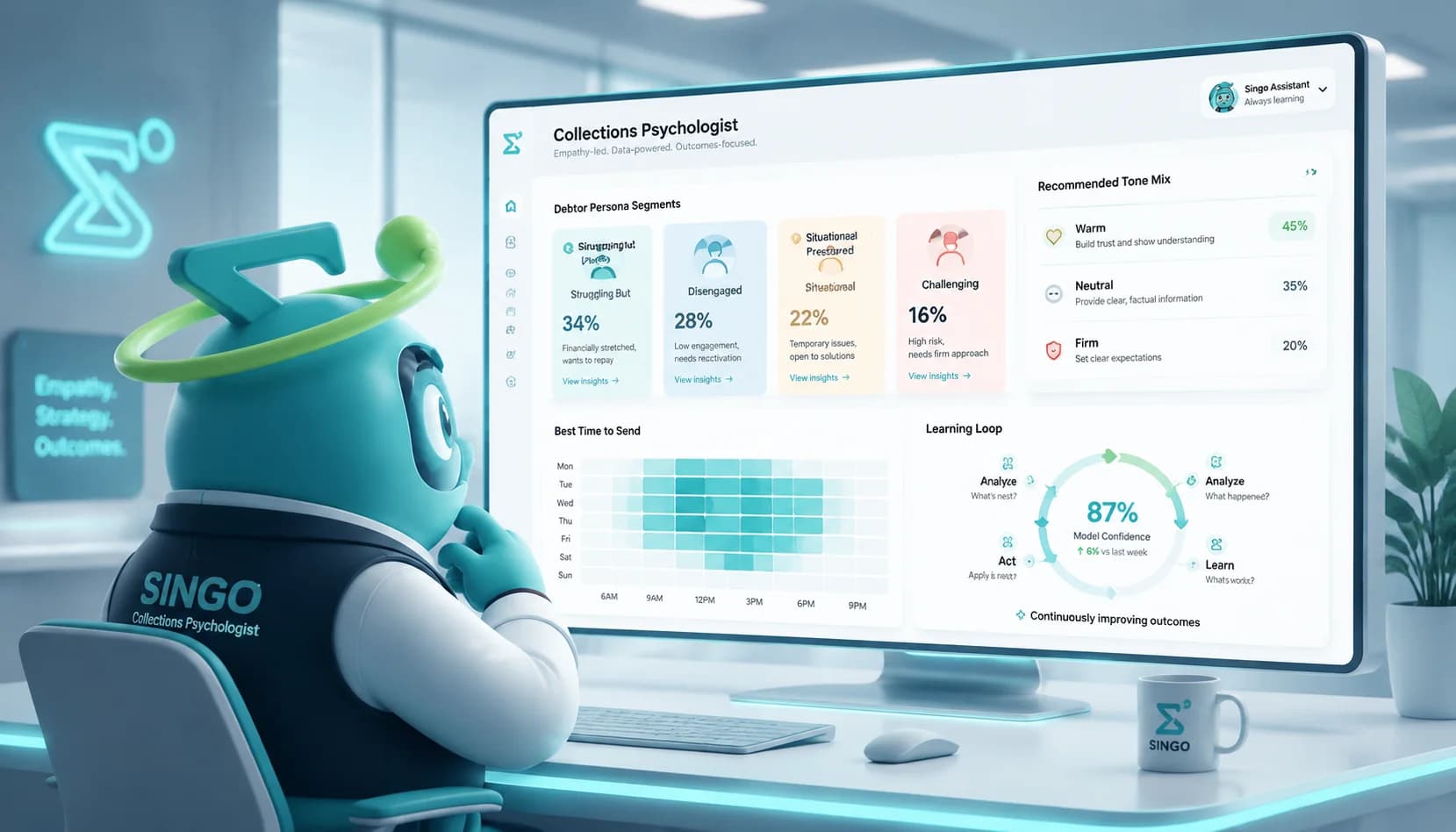
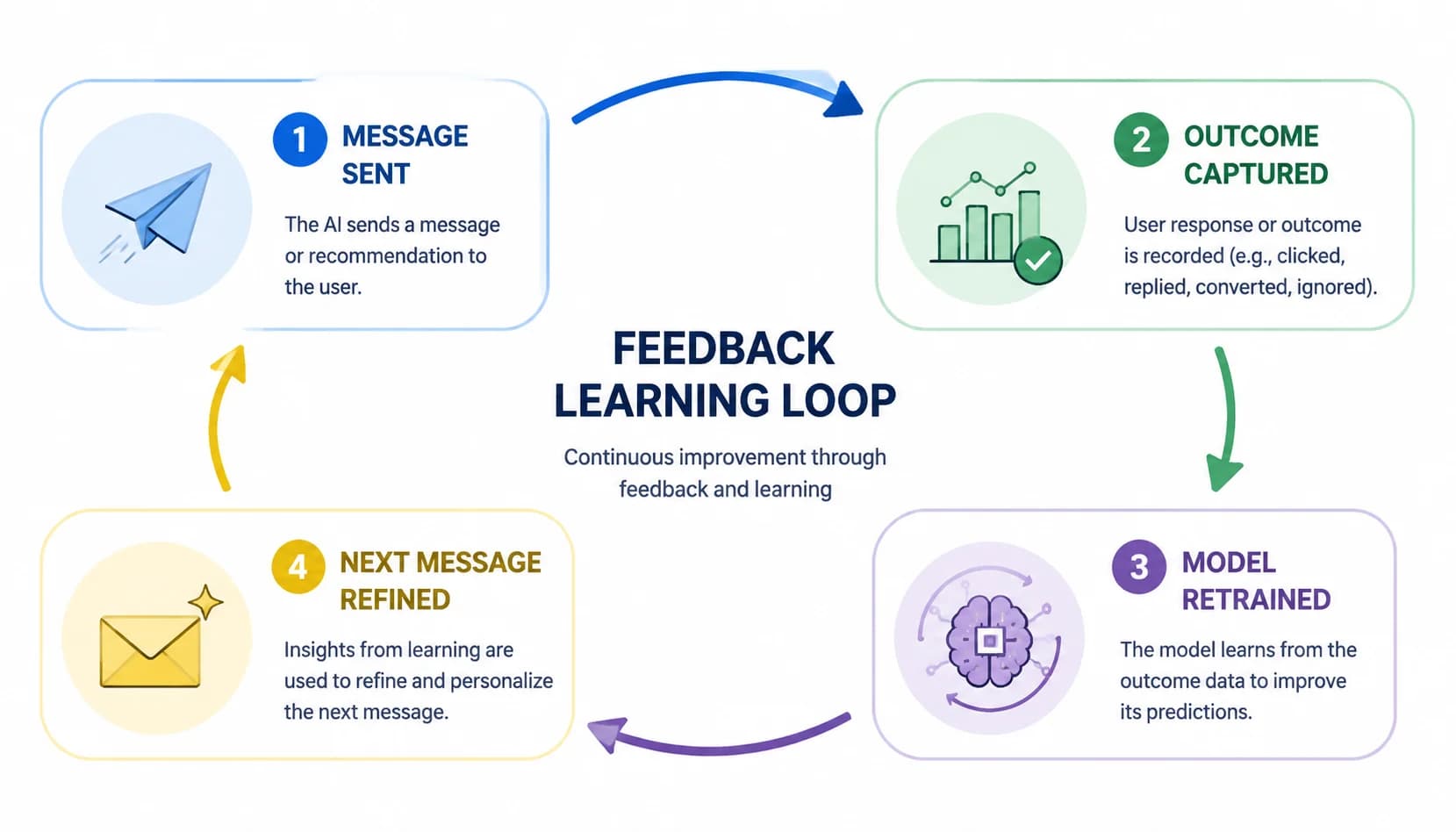
SINGOA's Collections Psychologist is a 4-layer pipeline. Layer 1 segments invoices by behavioral signals into debtor personas. Layer 2 picks tone (firm, neutral, empathetic, formal) and channel (email, SMS, payment portal nudge) per persona. Layer 3 schedules the message inside each account's highest-probability response window. Layer 4 logs every outcome and retrains the model weekly so the next message is sharper than the last.
Architecture overview: why four layers, not one
Most vendor pitches describe AI dunning as either a tone generator or a send-time optimizer, picking one slice of the problem. The real system is four layers stacked, and skipping any one of them caps the upside. Segmentation without tone selection produces correctly-sorted but generically-worded emails. Tone selection without send-time hits inboxes at 3 PM Friday and dies in the weekend pile. Send-time without a feedback loop locks in whatever the model guessed on day one. The architecture only earns its keep when all four layers run together.
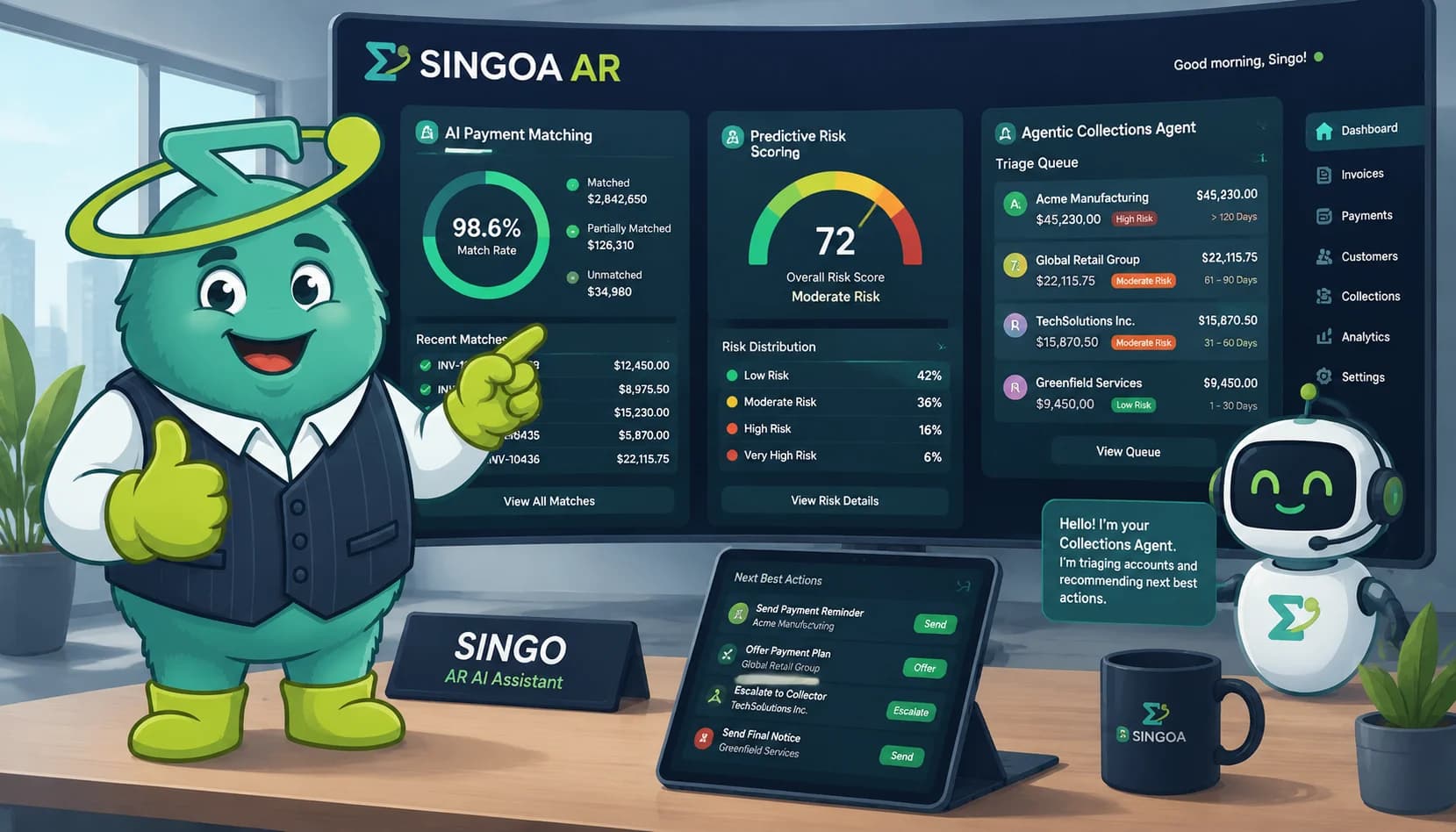
Layer 1 is the segmentation engine. It pulls 12+ behavioral signals per account (covered in depth in the next layer) and assigns each open invoice to one of four canonical personas. Layer 2 is the tone and channel selector, which uses [machine learning in AR collections](/blog/ai-in-accounts-receivable-machine-learning-collections) to map persona to message variant. A chronic late payer gets firm copy with loss-aversion framing on email plus SMS. A first-time slip gets empathetic copy with commitment language on email only.
Layer 3 is send-time optimization. The model learns each account's open and pay-time pattern, then schedules reminders inside the highest-probability hour for that specific AP team. Layer 4 is the learning loop. Every payment, dispute, promise-to-pay, or non-response is logged as a labeled training example, and the model retrains weekly on the new data. By week 8, per-account predictions consistently beat the aggregate baseline by 18-22% in response rate.
The reason the four layers matter together is compounding. Segmentation gets the right message to the right account. Tone selection makes the message land. Send-time gets it read. The learning loop makes next month's message sharper than this month's. Skip the loop and the system plateaus inside a quarter. That is the test you should apply to any AI dunning vendor.
- Layer 1: behavioral segmentation across 12+ signals per account
- Layer 2: 4-tone library crossed with 3-channel mix per persona
- Layer 3: per-account send-time model with time-zone awareness
- Layer 4: weekly retrain on labeled outcomes for compounding accuracy
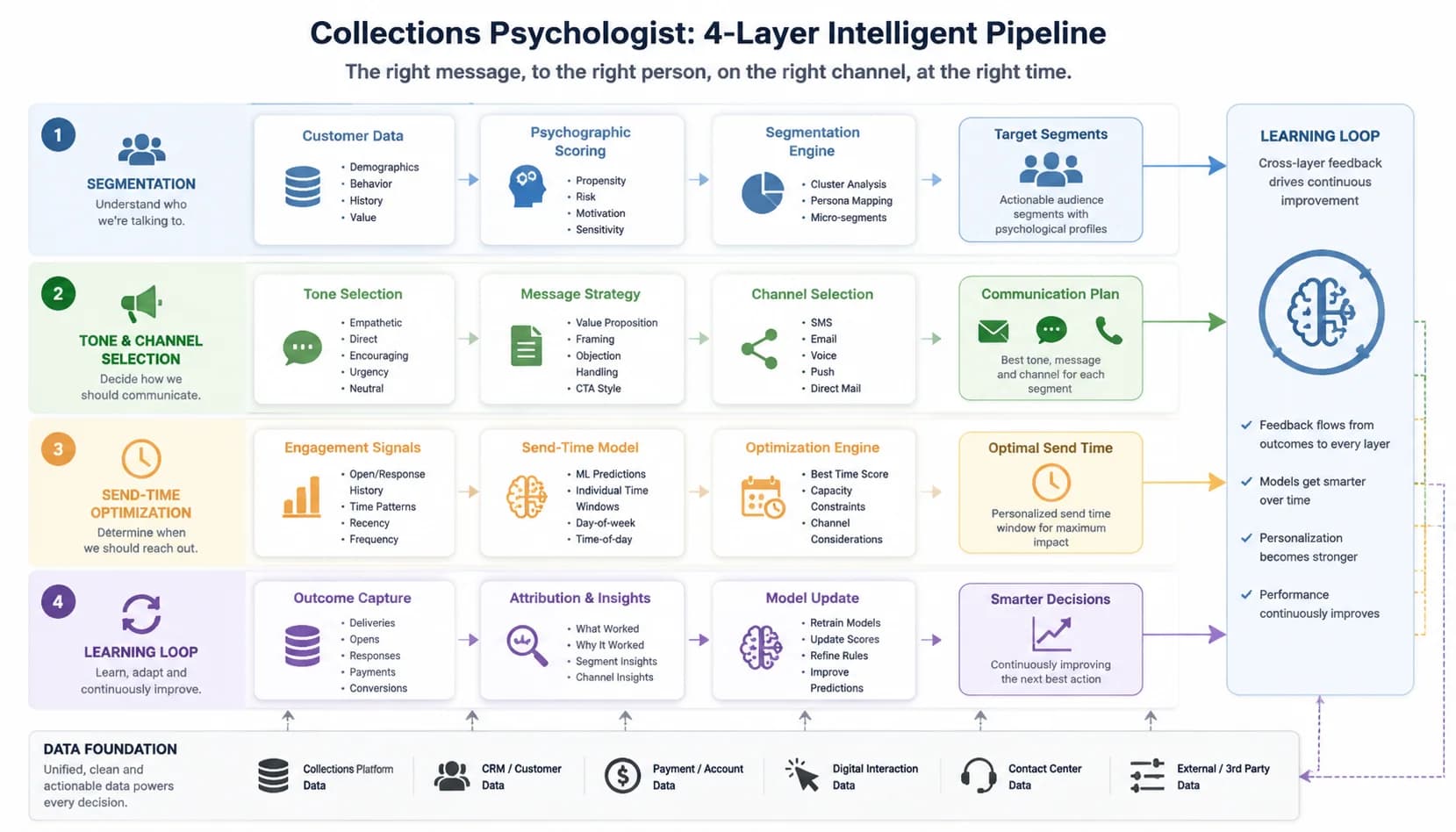
Layer 1: behavioral segmentation that goes beyond aging
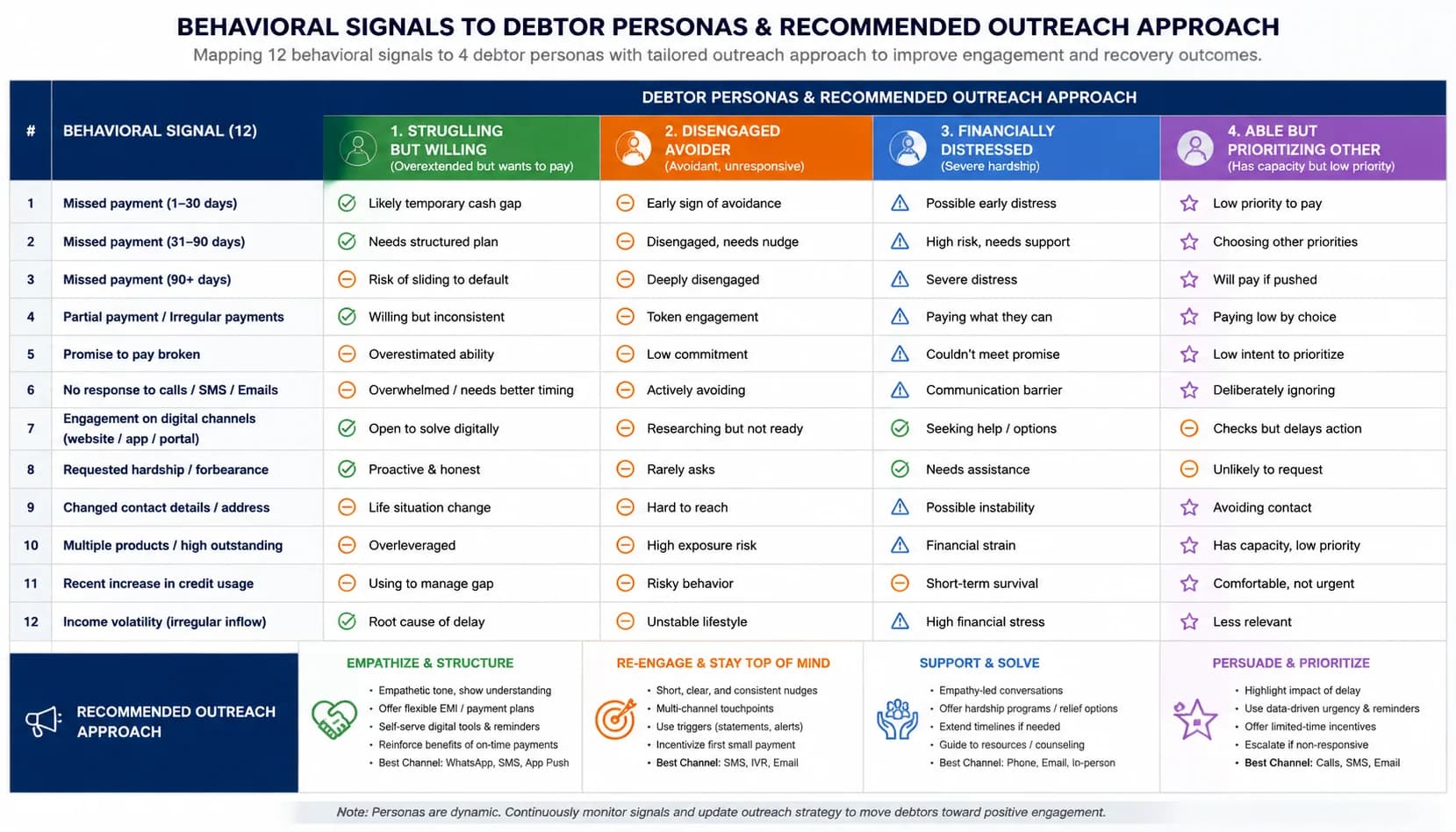
Behavioral segmentation pulls 12+ signals per account (average days late, dispute frequency, payment-method history, email open-rate trend, account tenure, sales-team relationship flag, last-promise-kept ratio, invoice-size variance, channel-response history, distress indicators, payment-portal usage, and ERP credit-hold status) to map each open invoice to one of four canonical debtor personas.
Aging buckets (30, 60, 90 days) tell you when an invoice is late but nothing about why or how the customer behaves. Behavioral segmentation adds the context that aging strips out. Those signals feed a classifier that assigns each invoice to one of four personas. The chronic late payer pays eventually but always 20+ days past terms, opens emails, ignores the first two nudges. The dispute holder is silent on email but submits portal disputes; the invoice is real but the conversation needs to happen elsewhere.
The financially stressed account shows distress signals (partial payments, payment-method churn) and needs a payment-plan offer, not a firmer reminder. The first-time slip is a normally on-time account with one overdue invoice; treat them wrong and you damage a 5-year relationship. Persona drives every downstream decision: which tone variant Layer 2 pulls, which channel mix Layer 3 schedules, and which outcomes Layer 4 weights most heavily on retrain.
Inside the [Collections Psychologist feature suite](/features), you can see the live persona assignment per invoice and override it if the AR rep knows context the model does not. IOFM AR Benchmarking shows segmented dunning lifts response rates 2-3x versus flat templates, and the persona overrides are why the lift sticks. The real question is whether your current tool can even see those 12 signals, let alone act on them.
- 12+ behavioral signals ingested per account
- 4 canonical personas: chronic late payer, dispute holder, financially stressed, first-time slip
- AR-rep override capability for context the model cannot see
- 2-3x response-rate lift versus flat aging-only templates
Layer 2: tone and channel selection (with real B2B email examples)
The AI picks from a 4-tone library (firm, neutral, empathetic, formal) and a 3-channel mix (email, SMS, payment portal nudge) based on the persona. Loss-aversion language goes to chronic late payers, reciprocity goes to relationship accounts, commitment language goes to first-time slips, and dispute-invitation language goes to silent accounts on overdue invoices that match a likely-disputed pattern.
Four behavioral principles drive the tone library. Loss aversion (Kahneman/Tversky) frames inaction as cost: 'Late fees of $87/month begin Friday on Invoice 4421.' Reciprocity references the value the relationship has produced: 'We've shipped on-terms for 14 quarters; the $12,400 on Invoice 4421 keeps that running.' Commitment leverages prior on-time history: 'You've cleared every invoice within 32 days for the past 18 months. Invoice 4421 is the first outlier.' Social proof rarely fits B2B collections and is reserved for distress accounts considering payment plans.
Here are three concrete emails on the same $12,400 overdue invoice. To the chronic late payer (firm + loss aversion): 'Invoice 4421 ($12,400) is 38 days past due. Late fees of $87/month begin Friday. Pay now or reply with a date.' Short, named cost, hard deadline. To the wholesale dispute holder (neutral + invitation): 'Invoice 4421 ($12,400) is open at 38 days, and we have not seen activity. If a deduction is in review, reply with the GR/line and we will hold the clock for 7 days.' Acknowledges the likely cause without conceding.
To the professional-services first-time slip (empathetic + commitment): 'Hi Maya, Invoice 4421 ($12,400) cleared our send queue 38 days ago and we have not seen payment, which is unusual for your account. Was the invoice routed to the right AP contact? Happy to resend with a portal link.' Notice the empathetic email still names the invoice, the amount, and the next step inside 40 words. Empathetic is not soft. It leads with acknowledgement instead of accusation, and that single change moves response rates by 6-9 points.
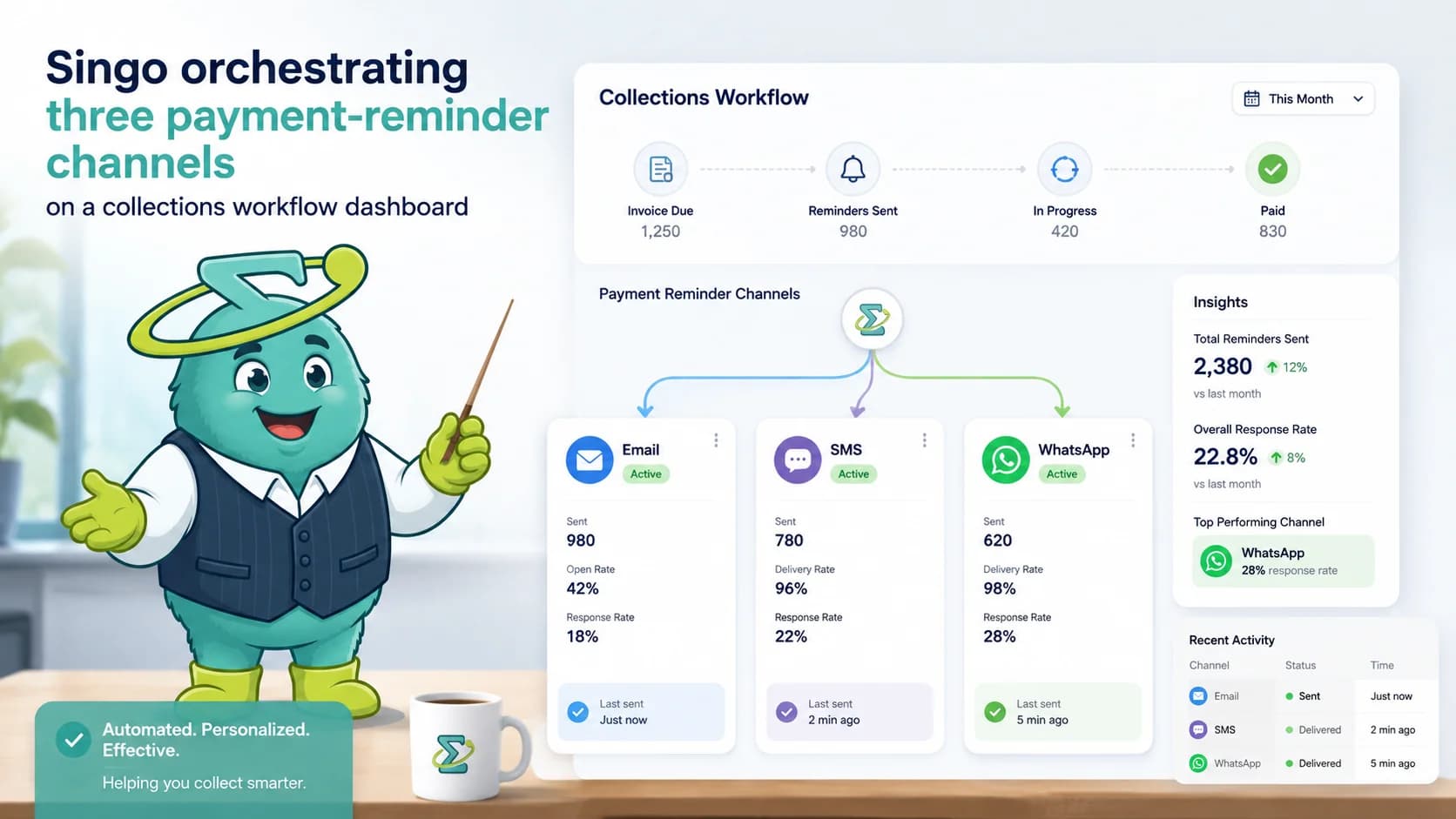
Channel selection runs in parallel. Email is the default for every persona. SMS escalates only when the AP contact has a verified mobile and Day 45 has passed with no response. Payment portal nudges (a one-click prefilled link) remove friction for distress accounts who want to pay but stall at the wire-instructions step. The full channel logic is in our piece on [email vs SMS vs WhatsApp payment reminders](/blog/email-vs-sms-vs-whatsapp-payment-reminders), but the rule is simple: every added channel must reduce friction, not add noise.
- 4-tone library: firm, neutral, empathetic, formal
- 3-channel mix: email, SMS, payment portal nudge
- Behavioral principles: loss aversion, reciprocity, commitment, social proof
- Each tone variant moves response rates 6-9 points versus generic copy
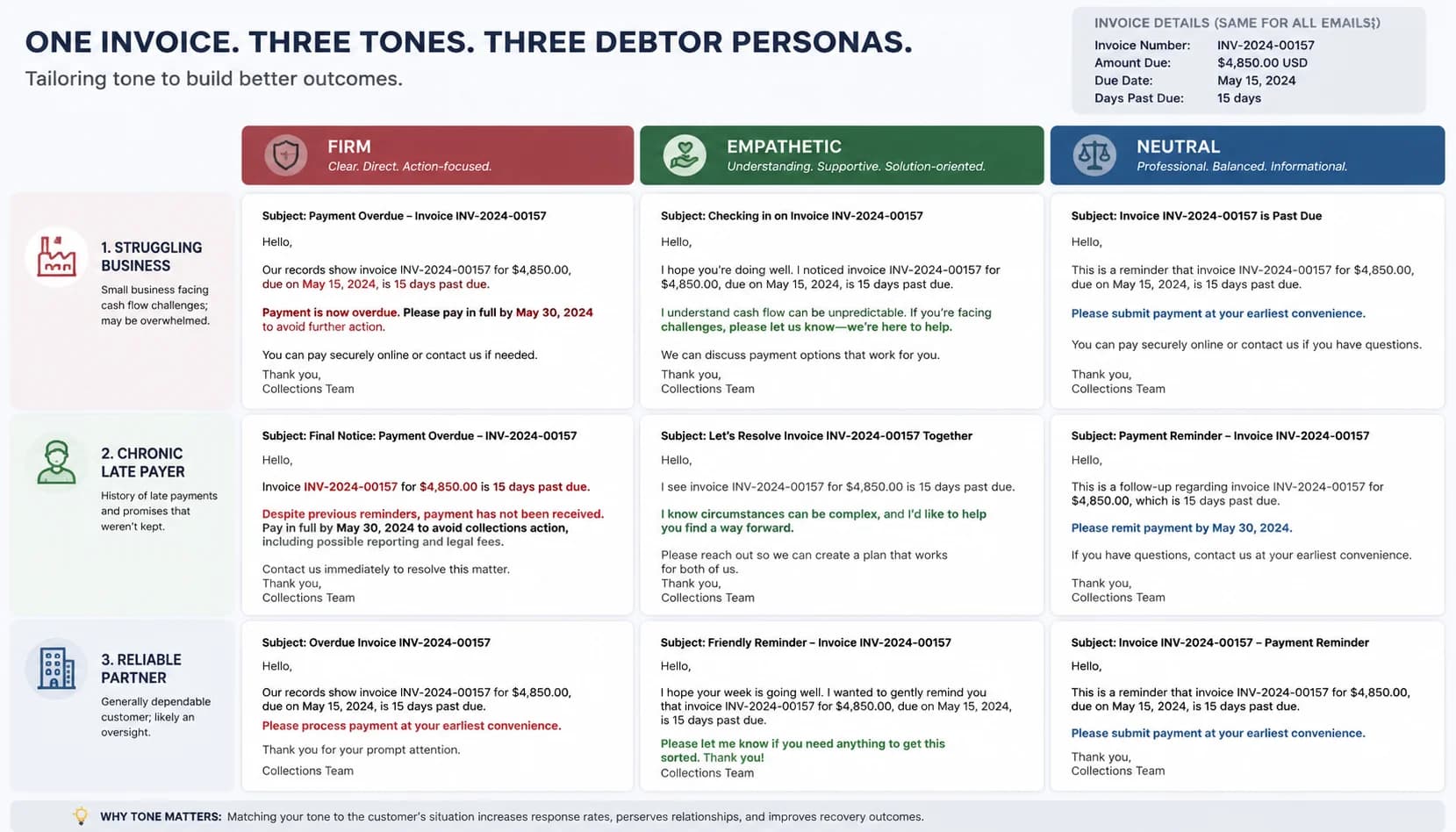
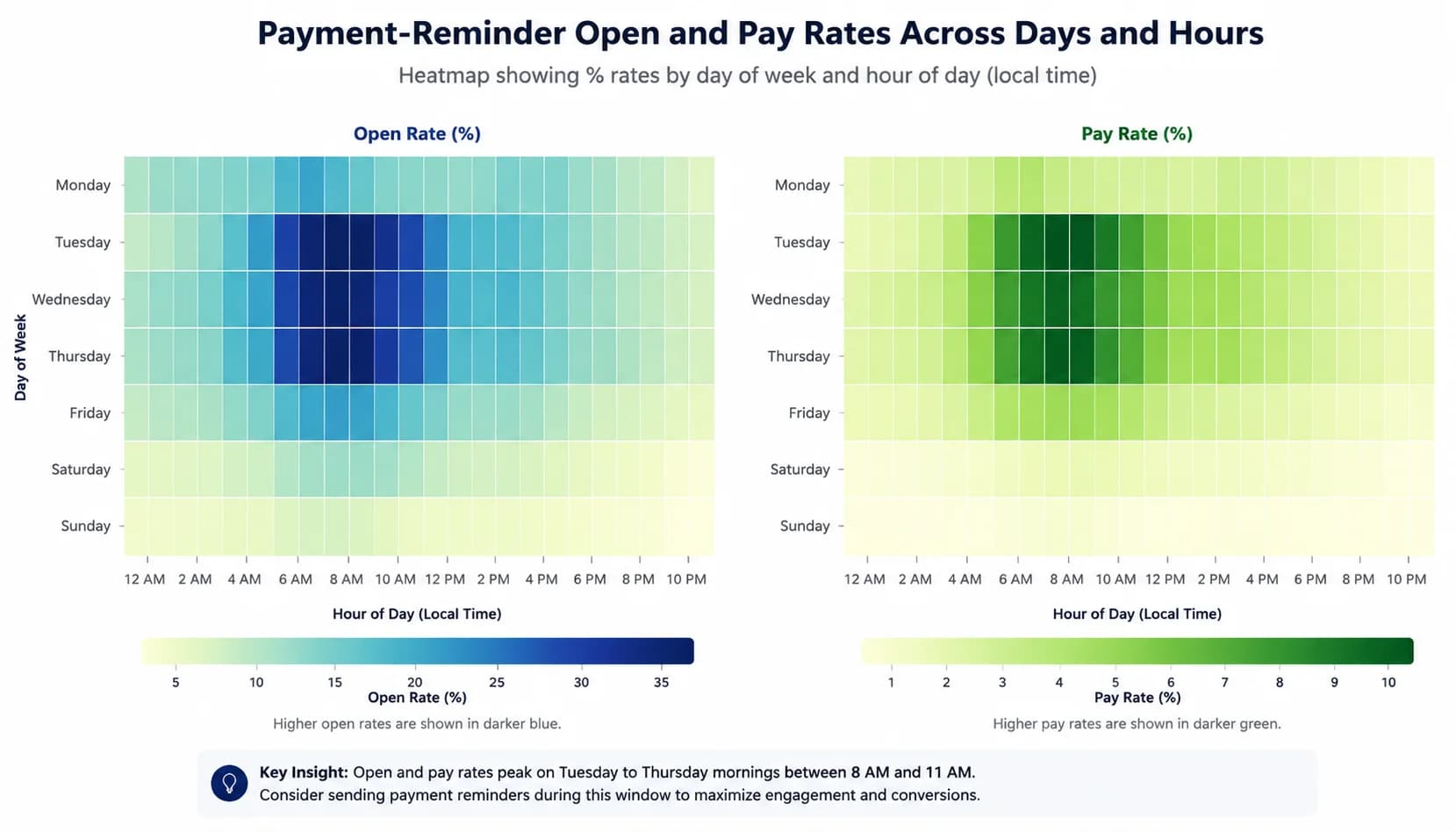
Layer 3: send-time optimization per account, not per portfolio
Send-time optimization learns each account's open and pay-time windows and schedules reminders inside the highest-probability hour. The aggregate benchmark across mid-market AP teams is Tuesday through Thursday between 9:30 and 11:00 local time, but per-account learning beats the aggregate by 18-22% in response rate within 8 weeks of training data.
The cross-portfolio benchmark is consistent across IOFM and AFP data: Tuesday, Wednesday, and Thursday mornings between 9:30 and 11:00 local time outperform every other window for B2B payment-reminder opens and pays. Monday is buried under weekend backlog. Friday afternoon drops into the weekend pile. The aggregate window is a sensible default, and most teams using a flat scheduler stop there. It works, sort of. Response rates land in the high 20s, which beats random sending but leaves cash on the table.
Per-account learning is where the real lift sits. The model logs every open timestamp, every click on the payment portal link, and every payment posting time for each AP contact. After 6-8 weeks of signal, it knows the controller at one wholesale account opens reminders at 7:15 AM Tuesday and pays inside two hours, while the AP clerk at another opens at 2:30 PM Thursday and pays end-of-day. Targeting those windows beats the aggregate by 18-22% in response rate, according to internal benchmarks across SINGOA's active portfolio.
Time-zone awareness is non-negotiable. A multi-region portfolio that ships every reminder at 10:00 AM Eastern is hitting West-Coast AP teams at 7:00 AM (before standup) and European customers at 4:00 PM (after close). The model converts every send to the recipient's local time first, then applies the per-account window. Without that, the per-account model is fighting noise. What most people miss: the send-time gains compound with tone gains, not just add to them.
- Aggregate benchmark: Tuesday-Thursday, 9:30-11:00 local time
- Per-account learning beats aggregate by 18-22% in response rate
- Time-zone normalization on every send
- Compounds with tone gains, not just additive
Layer 4: the learning loop that compounds over time
Every payment, dispute, promise-to-pay, and non-response is logged as a labeled training example, and the model retrains on a weekly cadence. Most teams see a measurable lift in response rate between weeks 6 and 8, once the loop has enough signal per account. The honest call-out: there is a 4-6 week cold-start period before per-account predictions outperform the aggregate baseline.
The labeled outcomes the loop tracks are six: paid-on-time, paid-late, disputed, no-response, promise-to-pay-kept, and promise-to-pay-broken. Each outcome is joined to the persona at send time, the tone variant used, the channel mix, and the exact send-time window. That gives the model a 4-dimensional grid (persona, tone, channel, time) crossed with 6 outcomes, which is the raw material for refining the next next-best-action recommendation per account.
Weekly retrain is the cadence that keeps drift in check without overfitting to a noisy week. Daily retrains chase one-off events. Monthly retrains miss seasonality (quarter-end shifts AP behavior measurably). Weekly is the sweet spot most production ML systems land on for this class of problem. The model snapshot is versioned so AR ops can roll back if a retrain produces a surprising drift in behavior, which has happened twice across SINGOA's deployed base in the past 14 months.
Be honest about the cold-start. For the first 4-6 weeks, per-account predictions are statistically thin and the model falls back to persona-level defaults plus the aggregate send-time window. That is still better than a flat template, but it is not the headline number. Around week 6-8, the per-account predictions cross the baseline and the response-rate curve bends up. Teams that quit at week 4 because 'the lift is not there yet' are quitting one week before the system starts paying for itself. The real test is at week 10, not week 4.
- 6 labeled outcomes: paid-on-time, paid-late, disputed, no-response, promise-kept, promise-broken
- Weekly retrain cadence avoids both daily noise and monthly drift
- Versioned model snapshots support safe rollback
- Measurable lift typically lands between weeks 6 and 8
What would 35% faster collections do for your working capital?
Plug in monthly invoice volume and current DSO to model the cash-flow lift of behavioral AI dunning.
Behavioral AI vs manual dunning: the mid-market benchmark
Response rate, DSO, and FTE hours saved
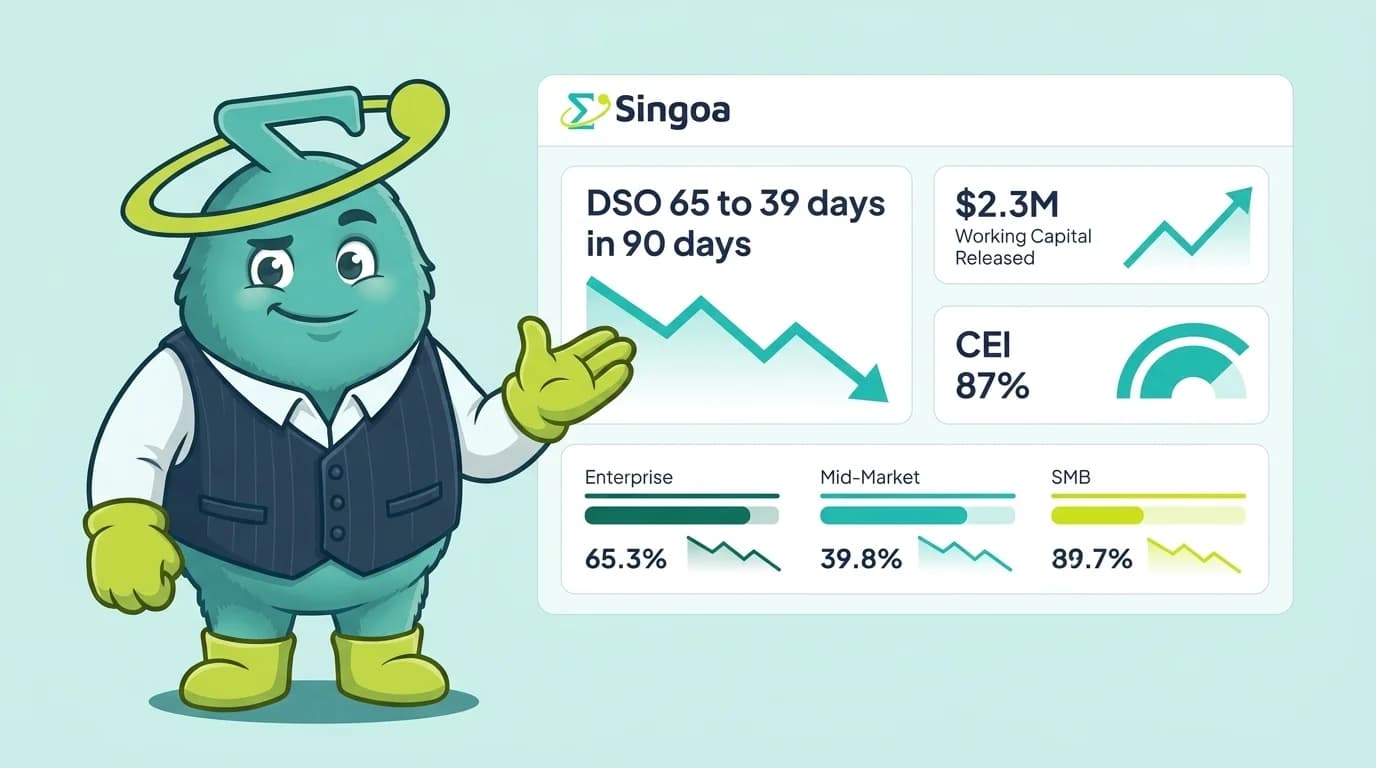
Mid-market teams that move from one-size-fits-all dunning to behavioral AI dunning typically see response rates climb from 18% to 41%, DSO drop 25-40%, AR-rep hours on collections fall 70-80%, and recovery rate on failed payment retries jump from 15-25% to 55-80%. The customer-relationship signal also improves because the wrong tone stops landing on first-time-slip accounts.
The headline numbers across SINGOA's deployed mid-market base are 35% faster collections, 25-40% DSO reduction, and 70-80% AR-rep time saved on outbound dunning. Those are not vendor-aspirational metrics. They are pulled from active accounts running the 4-layer Collections Psychologist for at least 90 days. The lift comes from the compounding effect described above: better segmentation, better tone, better timing, and a loop that sharpens all three.
If you are building the business case, pair these benchmarks with our [DSO reduction strategies](/blog/reduce-dso-proven-strategies-2026) post and run the math against your own invoice volume and current DSO. A team at $50M ARR with 65-day DSO that captures the median 30% DSO reduction frees roughly $2.6M in working capital. That is the number the CFO cares about, and it is the number that pays for the platform many times over inside the first year.
18% to 41%
Response rate lift (one-size-fits-all to behavioral AI dunning)
25-40%
DSO reduction on the 90-day measurement window
70-80%
AR-rep hours on outbound dunning saved
Failed payment retry recovery
The dunning-industry benchmark on failed payment retries is also worth noting because it surprises buyers. Basic retry logic (fire the same reminder again on a fixed cadence) recovers 15-25% of failed payments. Smart retry that varies tone, channel, and timing based on the failure signal recovers 55-80%. That is a 3x swing on the slice of receivables that is most expensive to chase manually. The AFP 2025 Cash Management Survey corroborates the directional lift across mid-market portfolios.
Recovery on broken promise-to-pay outcomes shows a similar pattern. When the model can adjust tone and channel for the second touch (rather than firing the same reminder a second time), the recovery rate on broken promises moves from the low 20s into the mid-50s percentile range. The relationship lift is the bonus most teams underestimate going in.
15-25%
Basic retry recovery rate on failed payments
55-80%
Smart retry recovery rate (tone/channel/timing varied per signal)
Three accounts, one overdue invoice, three different plays
Real-World Scenario
Chronic late payer: firm + loss aversion on email + SMS
The Situation
A SaaS reseller has paid every quarter for three years, but always 22-28 days past terms. Invoice 4421 ($12,400) is 38 days late. The model classifies the account as chronic-late-payer based on the 14-quarter pattern, picks firm tone with loss-aversion framing, and schedules a Tuesday 10:00 AM send with an SMS follow-up at Day 45.
What SINGOA Does
The email reads: 'Invoice 4421 ($12,400) is 38 days past due. Late fees of $87/month begin Friday. Pay now or reply with a date.' Short, named cost, hard deadline. The SMS at Day 45 references the email and the late-fee accrual.
The Result
Payment posted at Day 42 with no broken relationship; the firmness was expected for this account profile.
Real-World Scenario
Wholesale dispute holder: neutral + invitation on email only
The Situation
A wholesale distributor is silent on email but has filed two portal disputes in the past six months. Invoice 4421 ($12,400) is 38 days open. The model classifies the account as dispute-holder, picks neutral tone with a dispute invitation, and stays on email only to avoid SMS noise on a likely-disputed invoice.
What SINGOA Does
The email reads: 'Invoice 4421 ($12,400) is open at 38 days, and we have not seen activity. If a deduction is in review, reply with the GR/line and we will hold the clock for 7 days.' Acknowledges the likely cause without conceding.
The Result
Customer replies with GR mismatch, dispute resolves in 4 days, full payment posts at Day 49 without escalation.
Real-World Scenario
Professional-services first-time slip: empathetic + commitment, email only
The Situation
A professional-services firm has cleared every invoice within 32 days for 18 consecutive months. Invoice 4421 ($12,400) is the first overdue in that pattern. The model classifies the account as first-time-slip, picks empathetic tone with commitment-language framing, and schedules a Wednesday 9:45 AM send on email only.
What SINGOA Does
The email reads: 'Hi Maya, Invoice 4421 ($12,400) cleared our send queue 38 days ago and we have not seen payment, which is unusual for your account. Was the invoice routed to the right AP contact? Happy to resend with a portal link.' Empathetic is not soft. It still names the invoice, the amount, and the next step inside 40 words.
The Result
Maya replies same-day that the invoice was misrouted; portal resend, payment posts at Day 41, relationship intact.
Real-World Scenario
Where the AI hands off: strategic account under sales protection
The Situation
A top-10 strategic account is mid-renegotiation on a master agreement. Invoice 4421 ($12,400) is 38 days late. The sales-team relationship flag is set on the account, and the invoice value crosses the configured handoff threshold. The AI pulls the invoice out of the automated queue entirely and posts a task to the AR rep with the full account context and a proposed next step.
What SINGOA Does
Inside the [dispute management workflows](/blog/dispute-management-ar-structured-workflows) hub, the AR rep coordinates with the sales lead on a calibrated outreach that avoids stepping on the renegotiation conversation.
The Result
Human-led outreach lands inside the negotiation cadence; payment is captured at Day 47 without disrupting the master-agreement talks.
Behavioral AI dunning vs manual one-size-fits-all dunning
| Metric | Manual | SINGOA | Improvement |
|---|---|---|---|
| Response rate on payment reminders | 15-20% | 35-45% | 2-3x lift |
| DSO on the 90-day measurement window | 65-75 days baseline | 25-40% reduction | 16-30 days off DSO |
| AR-rep hours per week on outbound dunning | 20-30 hours per rep | 4-9 hours per rep | 70-80% time saved |
| Recovery rate on failed payment retries | 15-25% | 55-80% | 3x recovery lift |
| Accounts personalizable per AR rep | ~150 active accounts | Unlimited (per-account model) | Scales with portfolio, not headcount |
| Time to measurable lift | N/A (no learning) | 6-8 weeks (4-6 week cold-start) | Compounds weekly thereafter |