
Quick Answer
No single channel wins outright. SMS leads on open rate at 98%, WhatsApp leads on conversion at 2-3x email, and email anchors the audit trail. Teams that sequence all three recover 30% more past-due invoices than email-only.
Key Takeaways
- Email payment reminders average 20-28% open and 6-9% response, strong for audit trail but a weak standalone nudger.
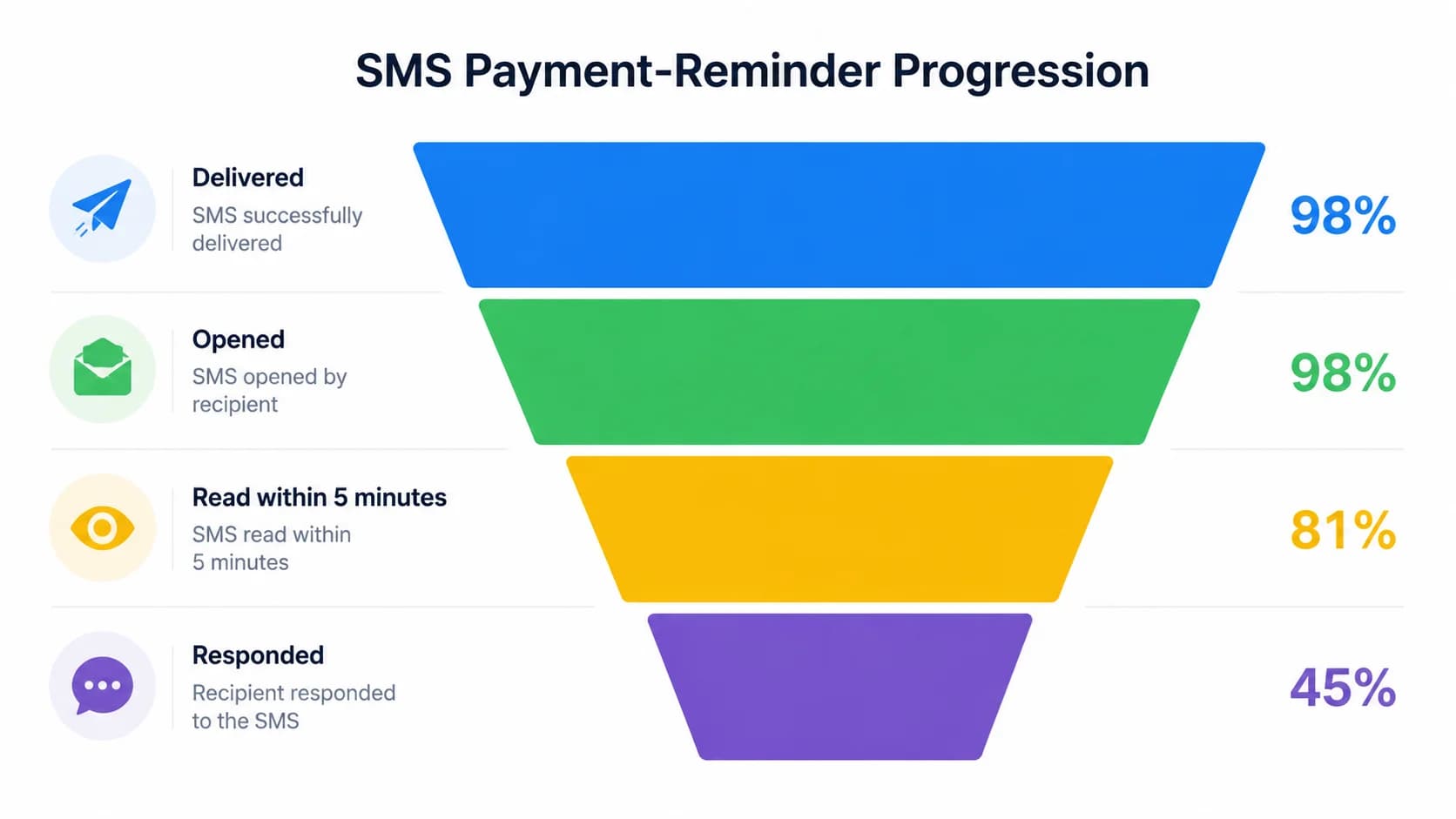
- SMS hits 98% open, 45% response, and 81% read within 5 minutes, the fastest single collection channel.
- WhatsApp drives 2-3x payment conversion versus email and 55-60% faster collection turnaround in B2B case data.
- Sequenced multi-channel cadences recover 30% more past-due invoices than email-only (Versapay 2024).
- TCPA consent for SMS and Meta-approved utility templates for WhatsApp are gating steps, record consent in the AR platform.
See your multi-channel ROI
Plug in your monthly past-due invoice volume to see what a 30% recovery lift translates to in working capital.
Why single-channel dunning is plateauing in 2026
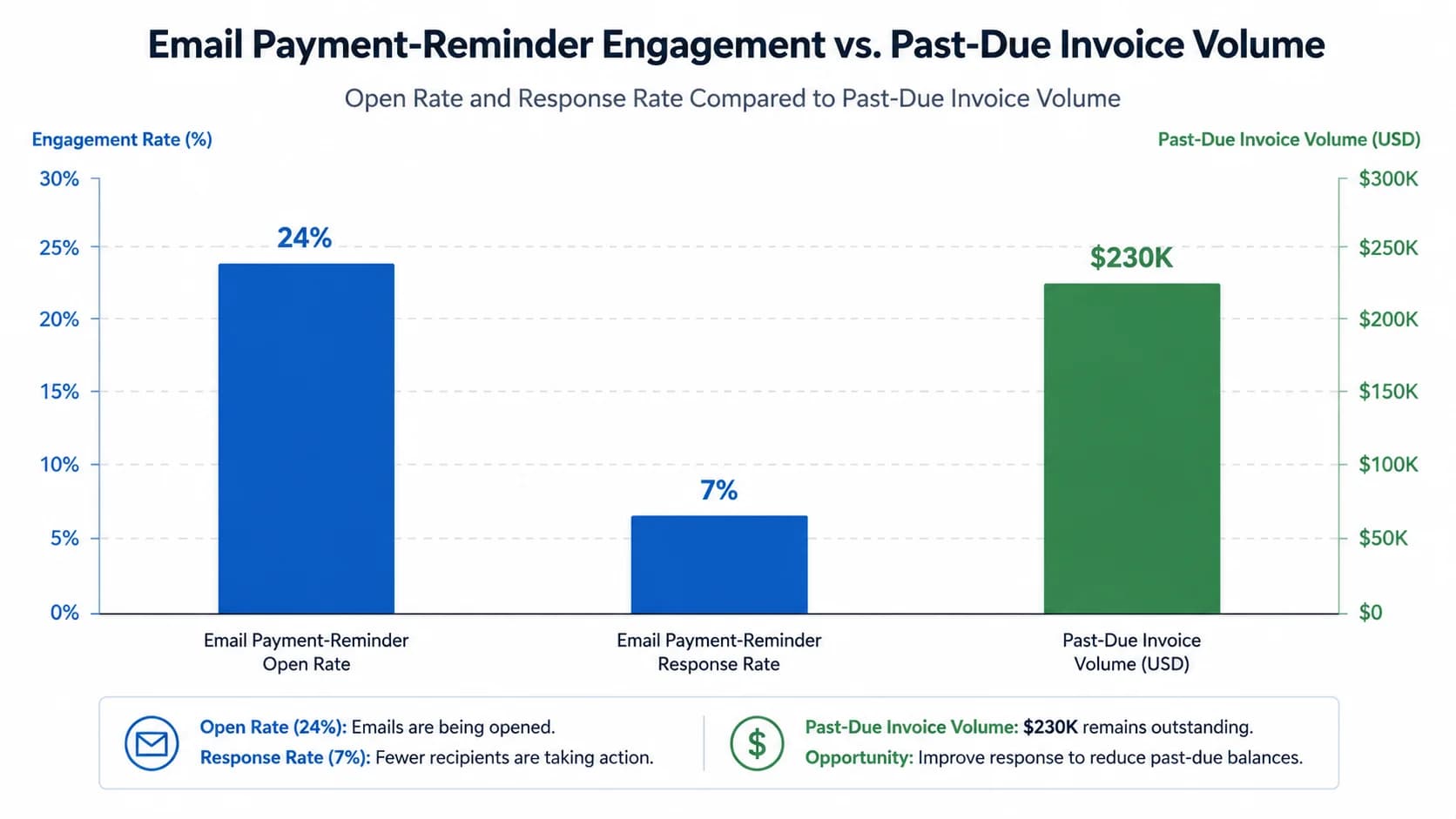
Walk any mid-market AR team through their last quarter and you will hear the same complaint. Open rates on the dunning sequence are sliding, customers keep claiming they never received the invoice, and DSO refuses to move. Mailchimp's 2024 B2B benchmark puts the average payment-reminder open rate at 20-28%, and Velocify research pegs click-through on those emails at 6-9%. That means two-thirds of your reminders never get seen by the person holding the checkbook.
The 'I never received your invoice' line is now the number-one dispute reason logged in most collections platforms. It is not always a lie. Spam filters, shared AP inboxes, and PTO auto-routes swallow legitimate reminders every week. By the time your collector calls on day 21, the customer genuinely cannot find the email, and the call becomes a forwarding exercise instead of a payment conversation.
More volume does not fix the channel. Sending three reminders instead of one to an inbox that already filters payment-reminder language just trains the spam classifier to suppress you harder. The fix is to escalate channels, not frequency. Versapay's 2024 collections benchmark found that teams running a sequenced multi-channel cadence recover 30% more past-due invoices than email-only peers, and those same teams pair the lift with classic [DSO reduction strategies](/blog/reduce-dso-proven-strategies-2026). The real question is which channel does what, and when.
Email: still the audit-trail anchor (but a weak nudger)
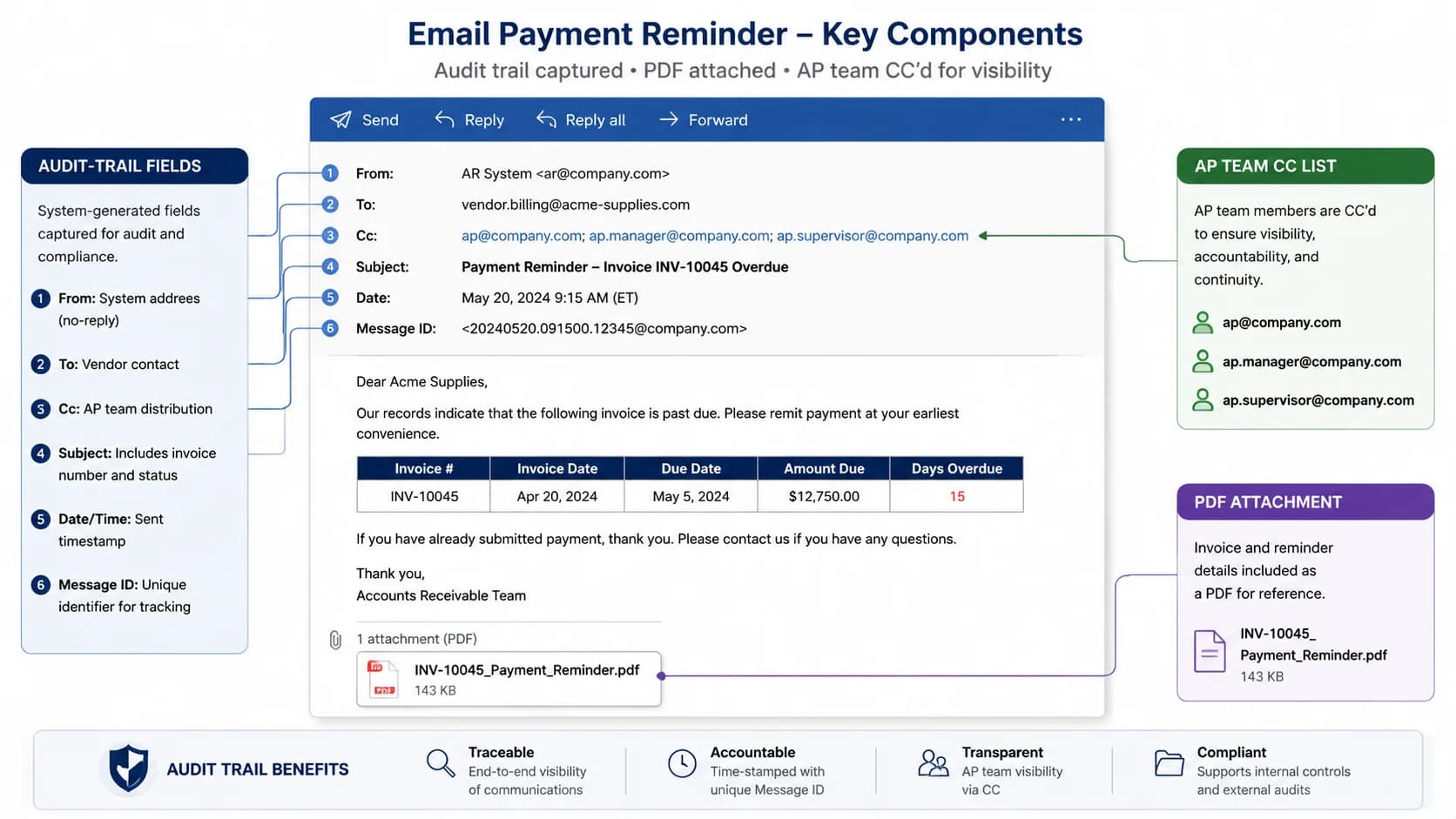
Email is the channel finance teams cannot abandon, even when its nudging power is weak. The PDF invoice, the wire instructions, the multi-recipient CC to the AP team and the buyer, the timestamped delivery record your auditor wants. None of that lives natively on SMS or WhatsApp. Mailchimp's 2024 B2B benchmark sets payment-reminder open rates at 20-28%, with response rates of 6-9%, and those numbers are stable enough to plan around.
Where email shines: initial invoice delivery, monthly statement runs, and formal escalation letters that need to live in a thread your CFO can forward to legal. The best send window is Tuesday through Thursday, between 10am and 2pm in the recipient's timezone, which is when AP staff are clearing their queue rather than triaging Monday chaos. Subject lines that lead with invoice number and amount outperform vague 'payment due' framing by a wide margin in published vendor tests.
Where email fails: spam filters trained to demote payment-reminder language, template fatigue from the same three reminders every cycle, and read latency measured in hours or days. None of that disqualifies email. It just means email cannot be the only lever you pull on a 45-day-past-due invoice. The Controller still wants every dunning step provable in writing, which is why email stays in the cadence even when SMS or WhatsApp is driving the actual payment behavior. Think of email as the system of record, not the system of motion.
Pro Tip
Always keep email as the system-of-record channel. Even when SMS or WhatsApp drives the actual payment, your dispute defense and audit trail live in the email thread, so never drop email from the cadence entirely.
Run email, SMS, and WhatsApp from one cadence
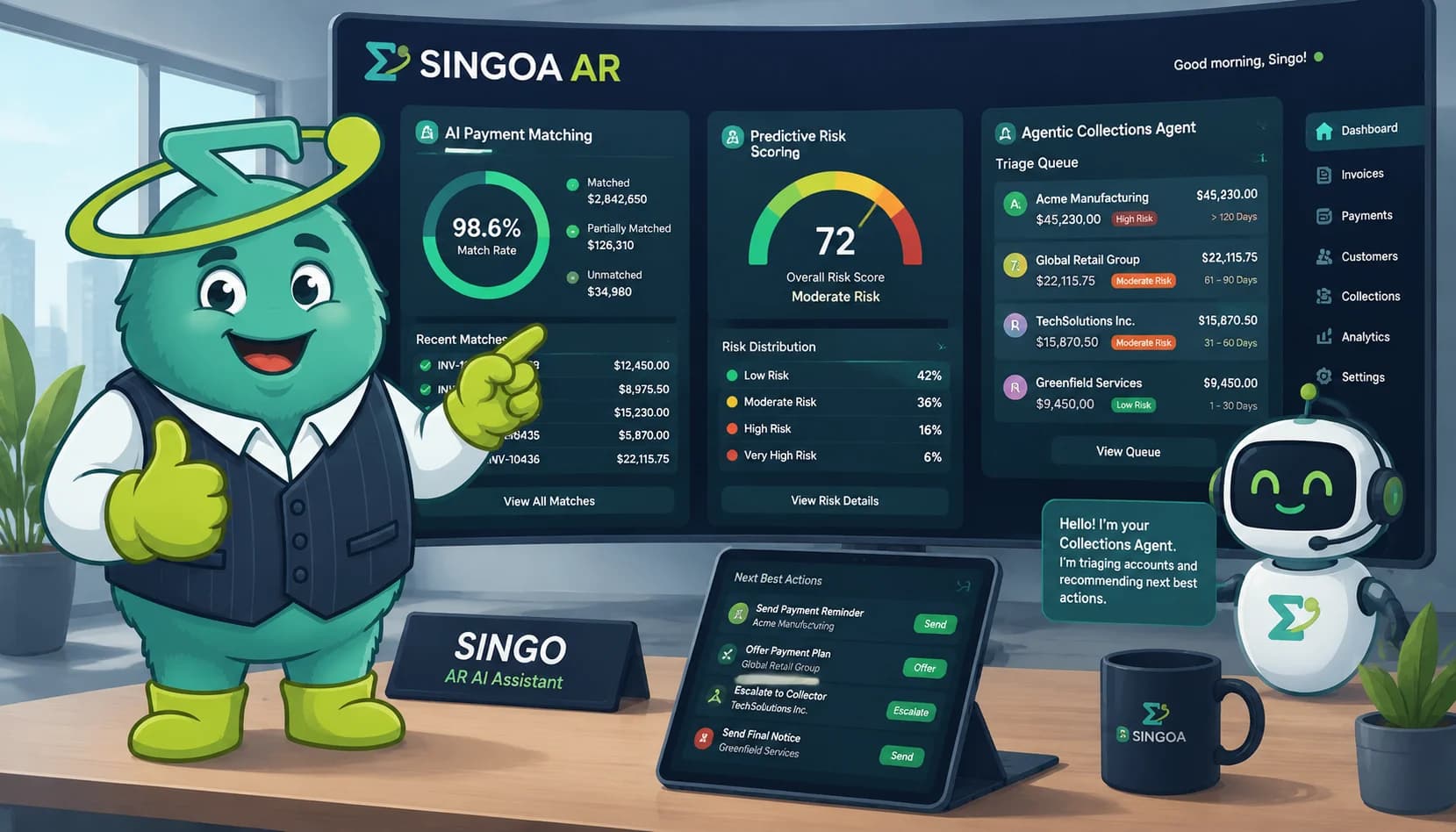
SINGOA Collections selects the right channel per debtor (by tier, geography, and response history) and closes the loop with 99.2% payment matching.
SMS: the 98% open rate that cuts collection time in half
SMS lives where the AP clerk's attention already is. Industry benchmarks cited across Resolve, Upflow, and Telnyx (2024-2025) put SMS at a 98% open rate, 45% response rate, and 81% of messages read within five minutes of delivery. Compare that to the 24% email open average and the gap stops being a debate. The 2017 Behavioural Insights Team randomized trial in Australia found that government SMS reminders increased credit-card repayments by 28% versus email, which showed no measurable effect at all.
The strengths of SMS are tactical. It is mobile-native, requires no app or login, and clears spam-filter noise because the inbox is not flooded the way email is. A 160-character nudge with the invoice number, the amount due, and a one-tap link to pay can convert a stuck receivable in under an hour. Build SMS templates with [automated payment reminders](/features) that fire on aging-bucket triggers, and your collectors stop chasing the low-friction cases manually.
The weaknesses are real and worth naming. No attachments, no PDF invoice, no thread your auditor can pull. Sender-ID trust signals vary by carrier, and short codes versus long codes affect deliverability. The bigger constraint in the US is TCPA. Prior express consent is required for B2B SMS, and consent has to be captured at customer onboarding and stored in the AR system, not in a sales rep's notebook. Record it once, store it forever. Here is where it gets interesting: SMS is fastest, but it does its best work as the second touch, not the first.
Pro Tip
Always link to a one-tap payment portal in the SMS body. Every extra step (call us, log in, find your invoice) cuts response rate roughly in half, so the link is the entire reason SMS converts faster than email.
WhatsApp: the read-in-minutes channel reshaping B2B collections
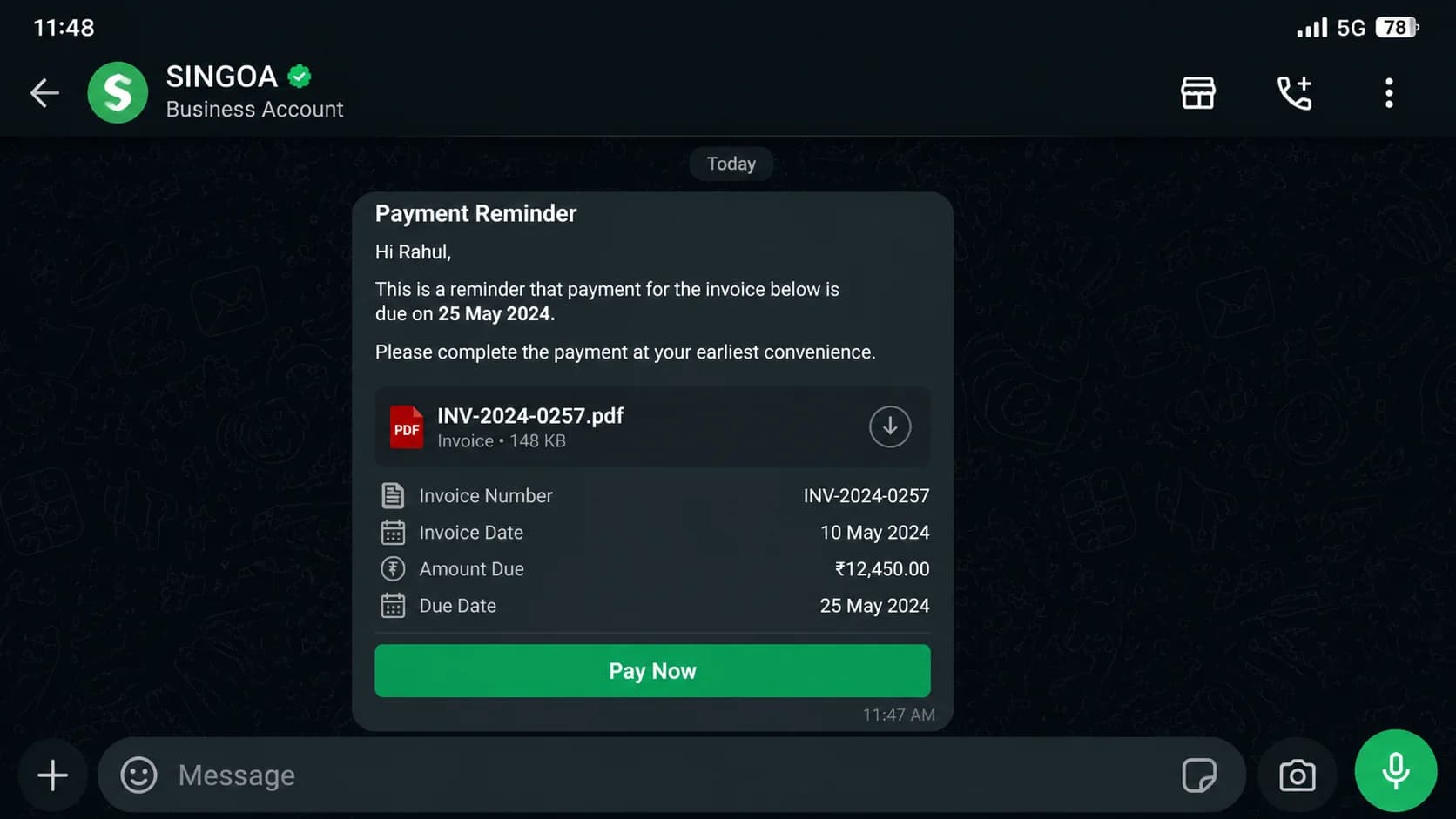
WhatsApp has quietly become the channel where past-due conversations actually happen. Infobip, Peakflo, and Pickyassist all publish case data showing 2-3x payment conversion versus email and 55-60% faster collection turnaround on past-due invoices. Messages get read within minutes because WhatsApp sits in the same notification stream as personal chats, and a buyer who ignores ten emails a day still glances at every WhatsApp badge. That attention asymmetry is the whole story.
The strengths stack up fast. Rich media means the PDF invoice rides inside the thread, no separate download. Two-way conversation lets your collector resolve a dispute, take a payment commitment, and log it in one exchange. Voice notes work for buyers who do not type. Geographic reach matters too: WhatsApp dominates B2B communication in LATAM, EMEA, India, and Southeast Asia, and is growing in North American B2B as a [WhatsApp Business integration](/integrations) becomes a standard checkbox on AR tool RFPs.
The catch is the rule set. The WhatsApp Business Platform separates utility templates (invoice due, payment receipt, statement reminder) from marketing templates, and Meta has to approve each one. Utility templates do not need a marketing opt-in and qualify for lower per-conversation pricing. The 24-hour customer service window governs how long you can keep a free-form conversation open after a customer reply. Per-message template fees mean you cannot blast WhatsApp the way you blast email, which is part of why response rates stay high. Budget for the cost, but the conversion math still works on every aging bucket past day 14.
Pro Tip
Use WhatsApp utility templates (transactional) for your first three reminders. They require no marketing opt-in, get approved by Meta faster, and qualify for the lower per-conversation pricing tier.
Head-to-head: email vs SMS vs WhatsApp at a glance
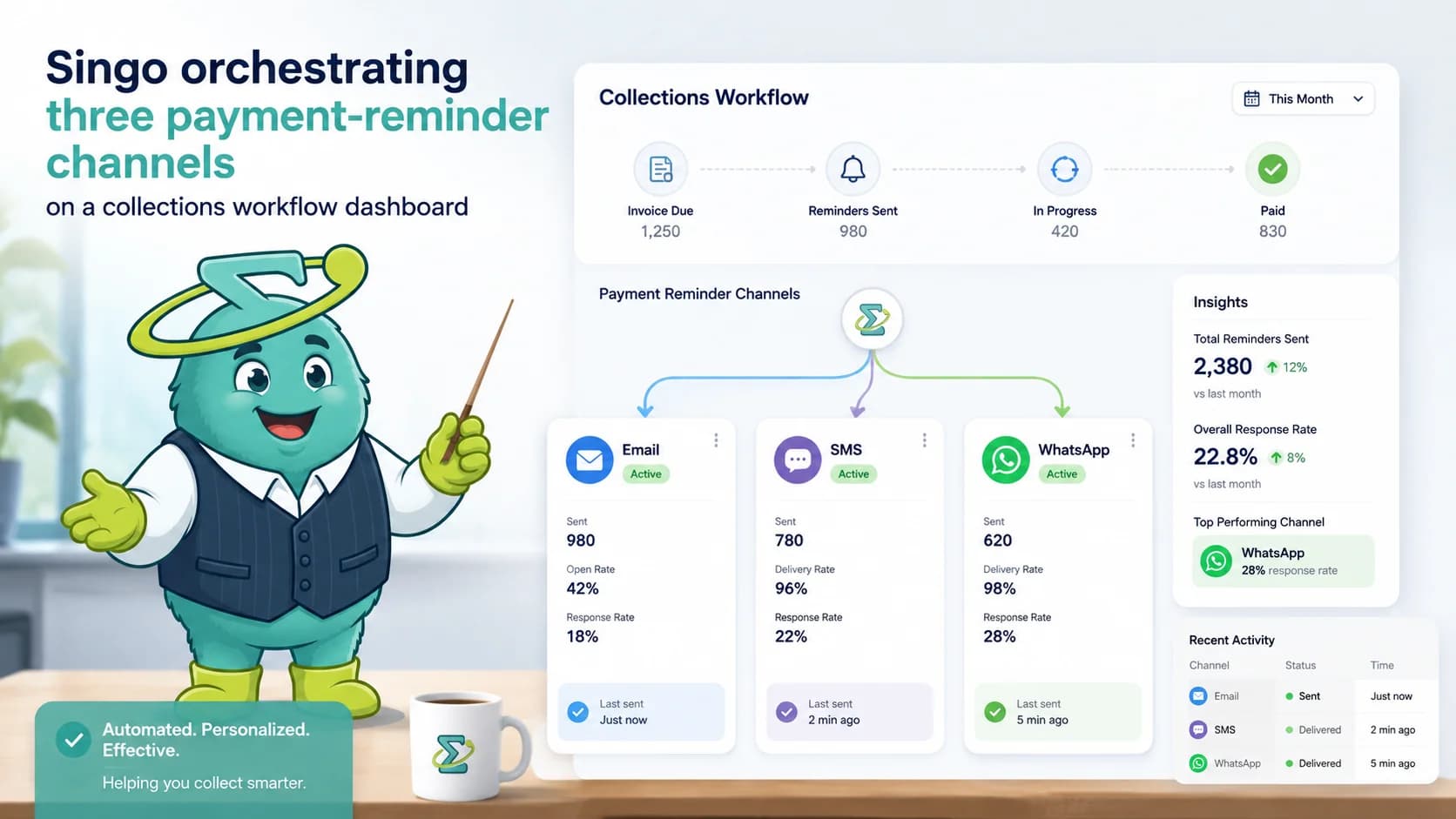
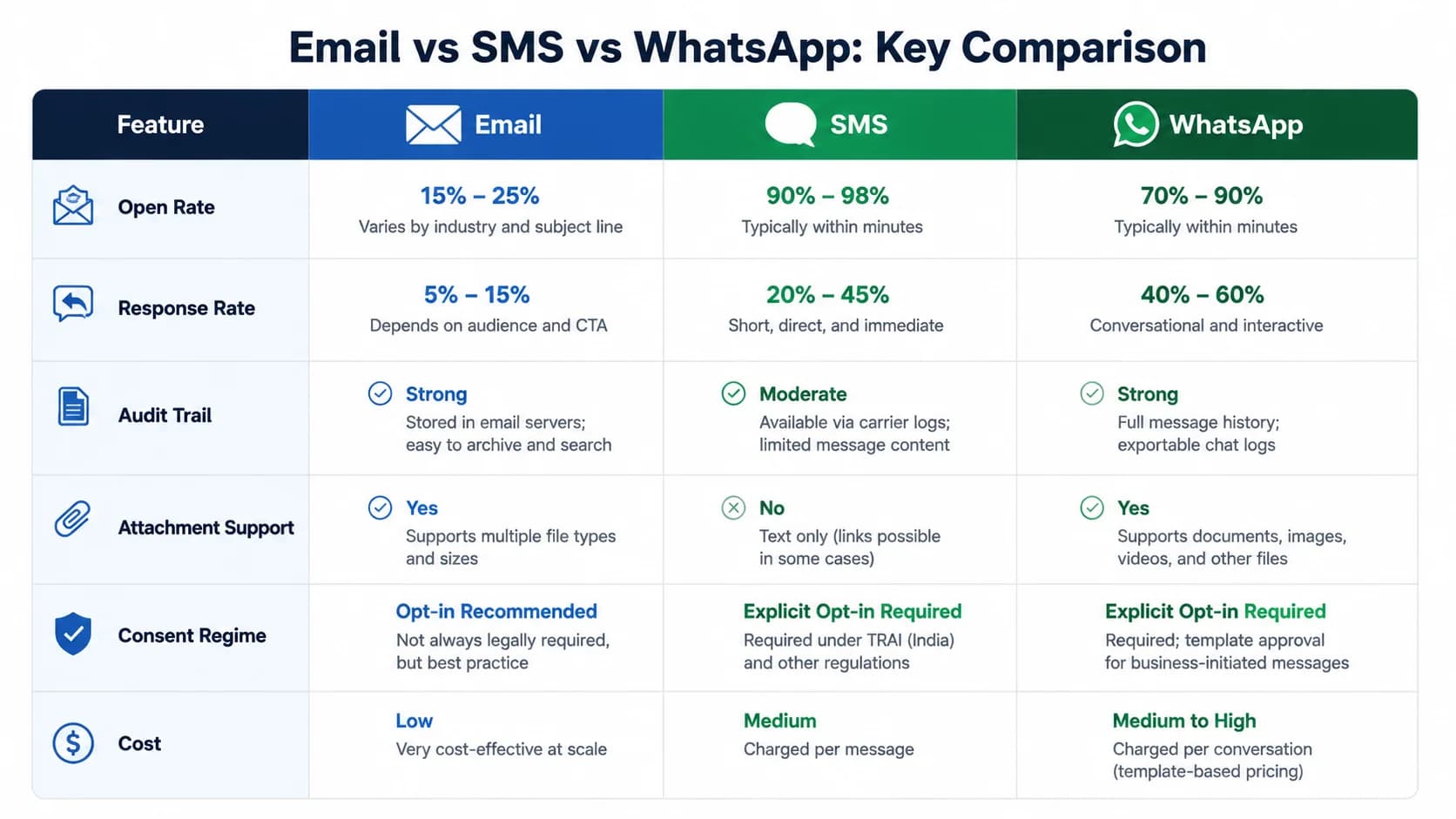
Lay the three channels side by side and the strengths separate cleanly. Email posts a 20-28% open rate and 6-9% response, with full attachment support, no consent regime beyond CAN-SPAM, and effectively zero variable cost. SMS posts a 98% open rate and 45% response, with no attachments, a TCPA prior-express-consent requirement in the US, and a per-message cost in the single-digit cents. WhatsApp Business reads within minutes and converts 2-3x email, supports rich media including PDF invoice attachments, requires Meta-approved utility templates, and bills per conversation in the low-double-digit cents.
Geography tilts the matrix further. WhatsApp is the dominant B2B channel across LATAM, EMEA, India, and Southeast Asia. SMS still carries North American B2B with the highest raw open rate. Email remains the universal audit-trail anchor in every region because it is the only channel a finance auditor will accept as primary proof of delivery. None of those statements contradict each other, and that is the point.
The verdict line from every benchmark study lands in the same place. Use all three, sequenced by aging bucket. Email is the system of record, SMS is the speed nudge, WhatsApp is the conversion conversation. Teams that pick one channel and stop are leaving 30% of recoverable past-due invoices on the table, per Versapay's 2024 collections benchmark. What most people miss is that the cadence design, not the channel choice, is where the lift actually compounds.
The multi-channel dunning cadence by aging bucket
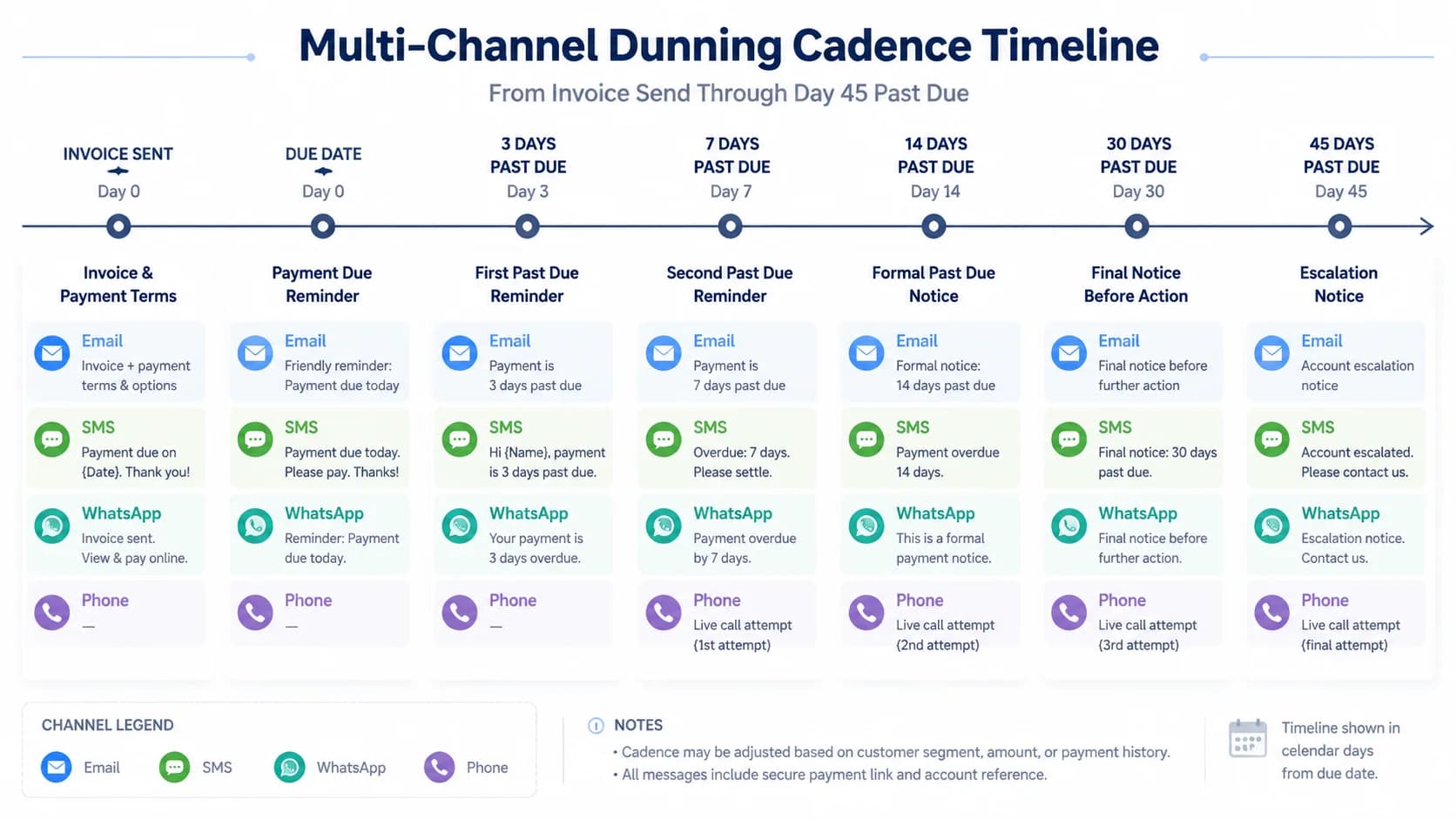
Start three days before the due date. Send the email invoice with PDF and wire instructions, and where the customer has opted in, drop a brief WhatsApp courtesy reminder with the invoice number and due date. On the due date itself, fire a single email payment-due notice. This pre-due posture catches calendar misses and reduces the day-1 past-due volume by roughly 15-20% in most published cadence audits, without burning any goodwill.
Day 7 past due is where SMS earns its slot. Send a short SMS with the invoice number, amount, and a one-tap link to the payment portal, paired with an email follow-up for the audit thread. Day 14 past due moves to a WhatsApp two-way conversation, opening with a utility template and inviting a reply. The collector takes over inside the 24-hour service window to resolve disputes, lock in commitments, or capture short-pay reasons. Email continues in parallel to keep the trail intact.
Day 30 past due is escalation, not repetition. A phone call from a named collector, paired with a WhatsApp message confirming the conversation and an email statement summarizing all open invoices on the account. Day 45 and beyond moves to senior AR review or third-party collections handoff, with full multi-channel history exported as evidence. Cadences like this are how mid-market teams [scale AR operations without adding headcount](/blog/scale-ar-operations-without-adding-headcount). Segment by customer tier so your top 20% of AR balance gets WhatsApp earlier, while smaller accounts stay on email-and-SMS through day 14.
Timezone discipline matters more than people admit. Send SMS during the recipient's working hours, never on weekends, and respect the WhatsApp 24-hour service window so you do not pay for re-engagement templates you did not need. The real question is not whether to add SMS and WhatsApp. It is whether your aging buckets are mapped to the right channel at the right hour.
Pro Tip
Never run all three channels on day 1 past due. Start with one nudge and escalate channels (not just frequency) as the invoice ages. Stacking channels too early reads as harassment and burns the customer relationship faster than the missed payment ever would.
Compliance and consent: the rules nobody else talks about
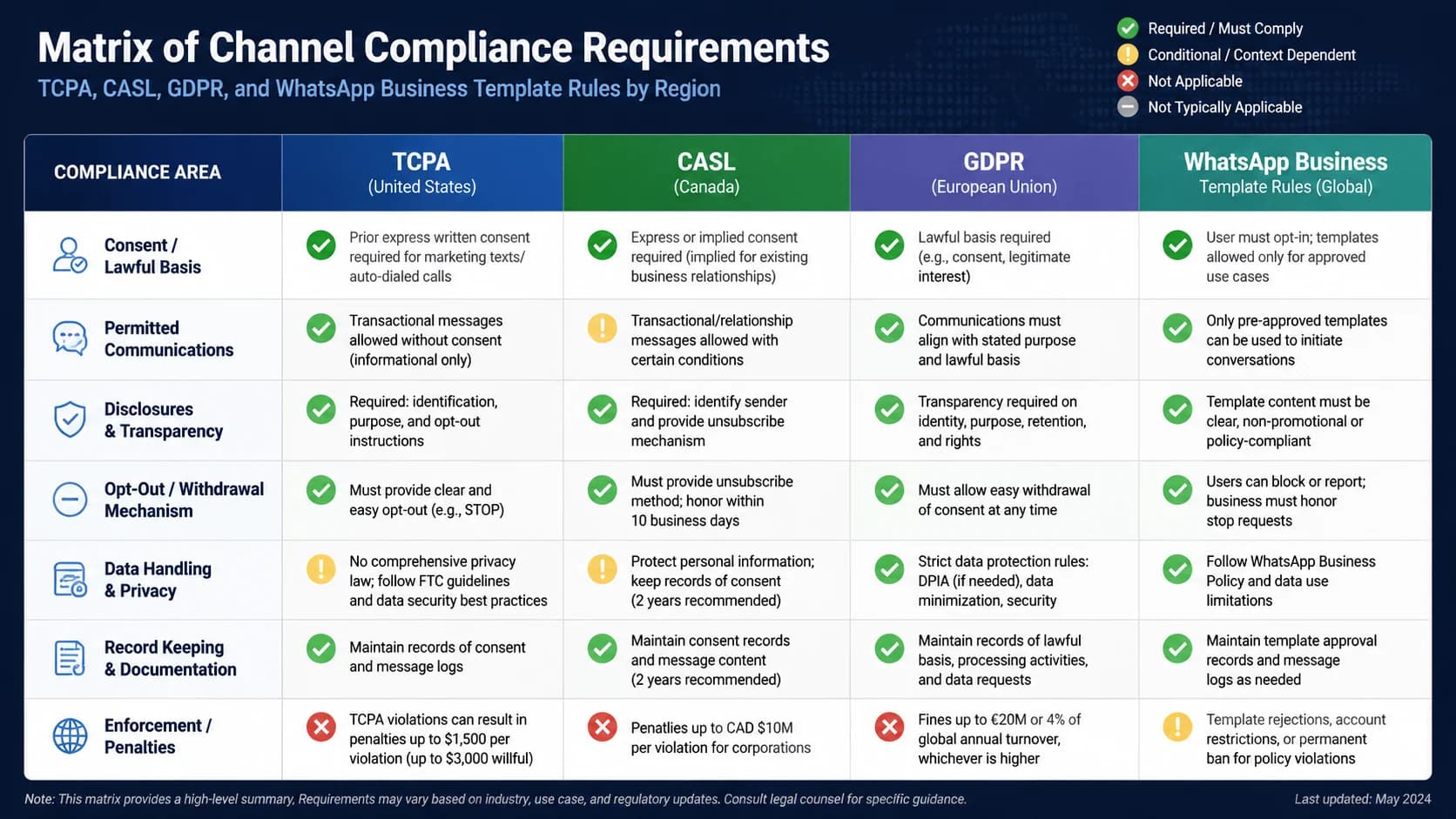
TCPA is the first rule that catches AR teams off guard. The Telephone Consumer Protection Act of 1991 requires prior express consent before you can send automated SMS to a phone number in the US, even in a B2B context with an established customer relationship. Consent has to be captured at customer onboarding, ideally as a checkbox on the credit application or master service agreement, and stored against the customer record. CASL in Canada and GDPR in the EU impose similar lawful-basis requirements, with stricter rules around withdrawal and audit.
WhatsApp Business runs its own approval layer on top of regional law. Meta categorizes message templates into utility, authentication, and marketing. Utility templates (invoice due, payment confirmation, statement reminder) are approved on a transactional basis and do not require a marketing opt-in. Marketing templates do. The 24-hour customer service window opens whenever a customer messages you first, and during that window you can send free-form replies. After it closes, you go back to approved templates only.
The operational answer is boring and works. Record consent once at onboarding, store it in the AR platform alongside the customer master, and let the cadence engine read the consent flag before firing any SMS or WhatsApp message. This guidance is operational, not legal, so loop in your counsel before changing customer agreements. The teams that get compliance right early never get to deal with the regulator question at all.
How AI-driven channel selection closes the loop
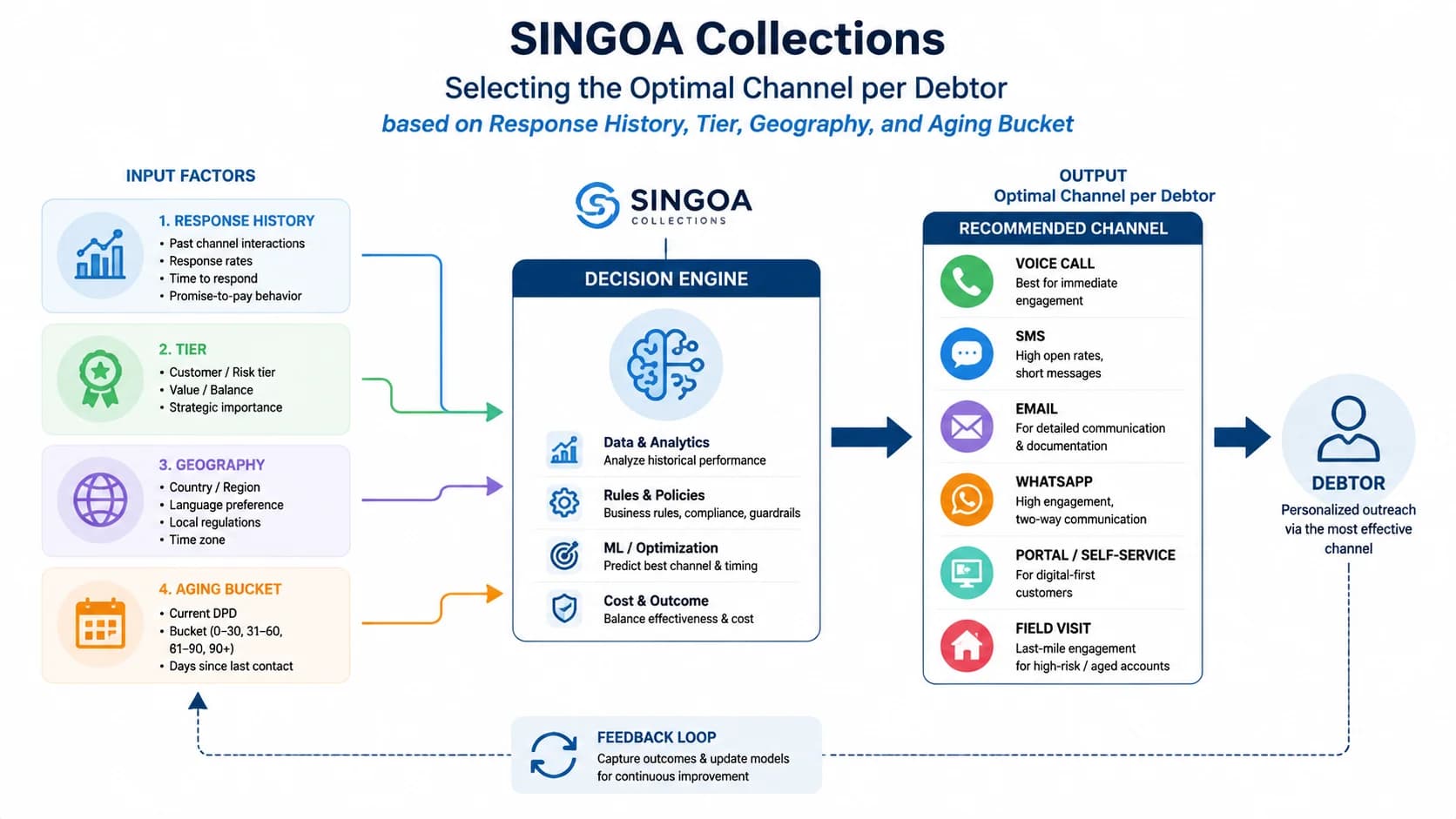
Static cadences are a starting point, not the finish line. The next layer is letting software pick the channel per debtor based on what worked last time. If a buyer paid within two hours of a WhatsApp nudge last cycle, send WhatsApp first this cycle. If another buyer ignores SMS but replies to email same-day, skip SMS entirely. Signals worth weighting include prior response by channel, customer tier, geography, and invoice age, all of which sit in your AR data already.
The tone-and-timing layer matters as much as the channel. The same payment message reads three different ways: a formal email with PDF, a sub-160-character SMS with one link, a conversational WhatsApp message that invites a reply. Mid-market AR platforms like SINGOA's Collections orchestrator handle the rewrite per channel automatically, so a single cadence step produces the right voice on the right surface without your collector copy-pasting between tabs. The technique aligns with how [AI in accounts receivable](/blog/ai-in-accounts-receivable-machine-learning-collections) is reshaping mid-market AR workflows in 2026.
Closing the loop is where the math finally compounds. Every channel points to the same Branded Payment Portal, and the payment that lands there reconciles back to the open invoice without a human touching the cash-application step. SINGOA's 99.2% payment matching means the AR clerk does not spend Friday afternoon untangling which Stripe deposit belongs to which short-paid invoice. The cadence drives the payment, and the matching engine logs it clean.
Sequence the channels, recover the working capital
The channel debate is over. Email cannot stand alone, SMS cannot replace the audit trail, and WhatsApp cannot operate without consent rules. The mid-market AR teams pulling 30% more recovery out of the same ledger are not the ones picking a favorite channel. They are the ones sequencing email, SMS, and WhatsApp by aging bucket, customer tier, and geography, then closing the loop with automated cash application.
If you take one action this quarter, audit your current cadence against the day-by-day map in section 6. Where is SMS missing at day 7? Where could a WhatsApp utility template replace a third email that nobody opens? Where is consent captured (or not) at customer onboarding? Each of those gaps is recoverable working capital sitting in your past-due aging report right now.
The teams winning this in 2026 treat channel selection as a data problem, not a preference. Prior response behavior, customer tier, time zone, and invoice age decide the next touch, and a single payment portal absorbs the reply no matter which channel sent it. That is the real shift from email-only dunning, and it is what makes the next 30 days of cash flow look different from the last 30.