
Why SaaS AR is a three-body problem: dunning, revenue recognition, and churn
Global subscription businesses lose $141 billion each year to involuntary churn, according to the [Paddle / ProfitWell State of Subscriptions 2024](https://www.paddle.com/resources/state-of-subscriptions) report. For a $10M ARR SaaS company sitting at the industry-average 4.5% involuntary churn rate, that translates to roughly $450,000 in leaked MRR every twelve months, most of it caused by expired cards and issuer declines that never had to happen. Yet many finance teams still treat this as a billing-platform problem, not an AR problem.
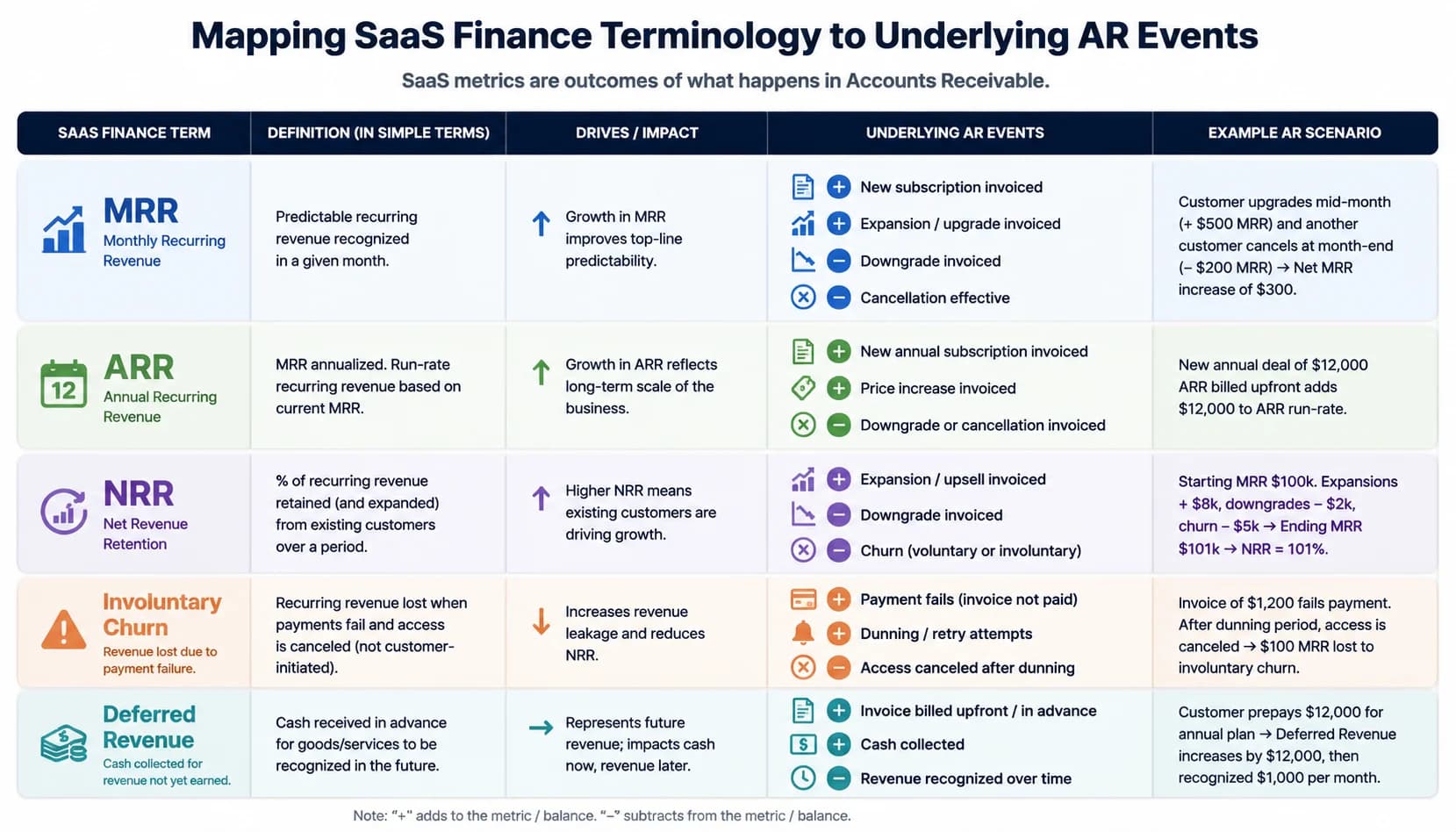
That framing is the trap. SaaS subscription billing looks like one workflow inside Stripe or Chargebee, but it is actually three interlocking workflows: dunning failed payments, recognizing revenue under ASC 606, and preventing involuntary churn before it hits the deferred revenue schedule. When VP Finance leaders at $5M to $50M ARR companies inherit these processes, they usually find a native dunning sequence recovering 30% of failures, a bookkeeper managing ASC 606 in spreadsheets, and a churn number nobody trusts.
In physics, a three-body problem is a system where three forces pull on each other and no closed-form solution exists. SaaS AR looks the same. Every failed payment simultaneously creates a dunning task, a deferred revenue adjustment, and a potential involuntary churn event. A finance team that solves one of the three in isolation, say by turning on Stripe's default retries, still leaks money through the other two. The scale matters because 20 to 40% of total SaaS churn is involuntary, not voluntary. That is not customers deciding your product no longer fits, it is a card that expired, an issuer that blocked a routine authorization, or a 3D Secure prompt that timed out. Three parties usually notice at the same time: the board asks why NRR dipped when logo retention looks fine, the auditor flags mid-period upgrades recognized on cash timing instead of ratable obligations, and Customer Success sees active users churn in Intercom without any support ticket. Each of those signals traces back to a single event, a failed charge, that a purpose-built AR layer would have caught. Modern platforms like SINGOA read the same event stream that drives your [SaaS AR automation industry hub](/industries/saas) and resolve all three symptoms from one workflow.
$141B
Annual global loss to involuntary churn across subscription businesses
Paddle / ProfitWell State of Subscriptions 2024
4.5%
SaaS average involuntary churn rate; best-in-class teams operate at 1.2%
Baremetrics / Churn Buster 2024 benchmarks
1 in 3
Card-on-file declines that are recoverable purely via smarter retry timing
Stripe Decline Data Analysis 2023
42%
Payment failures caused by expired cards, solvable via account updater APIs
Industry payment-fail analysis 2025
60%
SaaS companies lacking ASC 606-compliant revenue recognition
Zuora / IDC Subscription Economy Index 2024
42 to 18 days
SaaS DSO reduction from a manual baseline to a consolidated AR stack
SaaS Capital AR Benchmarks 2024 / SINGOA customer data
Common Pain Points
- Native billing dunning on Stripe, Chargebee, or Recurly recovers only 30-40% of failed payments, leaving 60-70% of the recoverable population uncollected and quietly walking off the MRR line
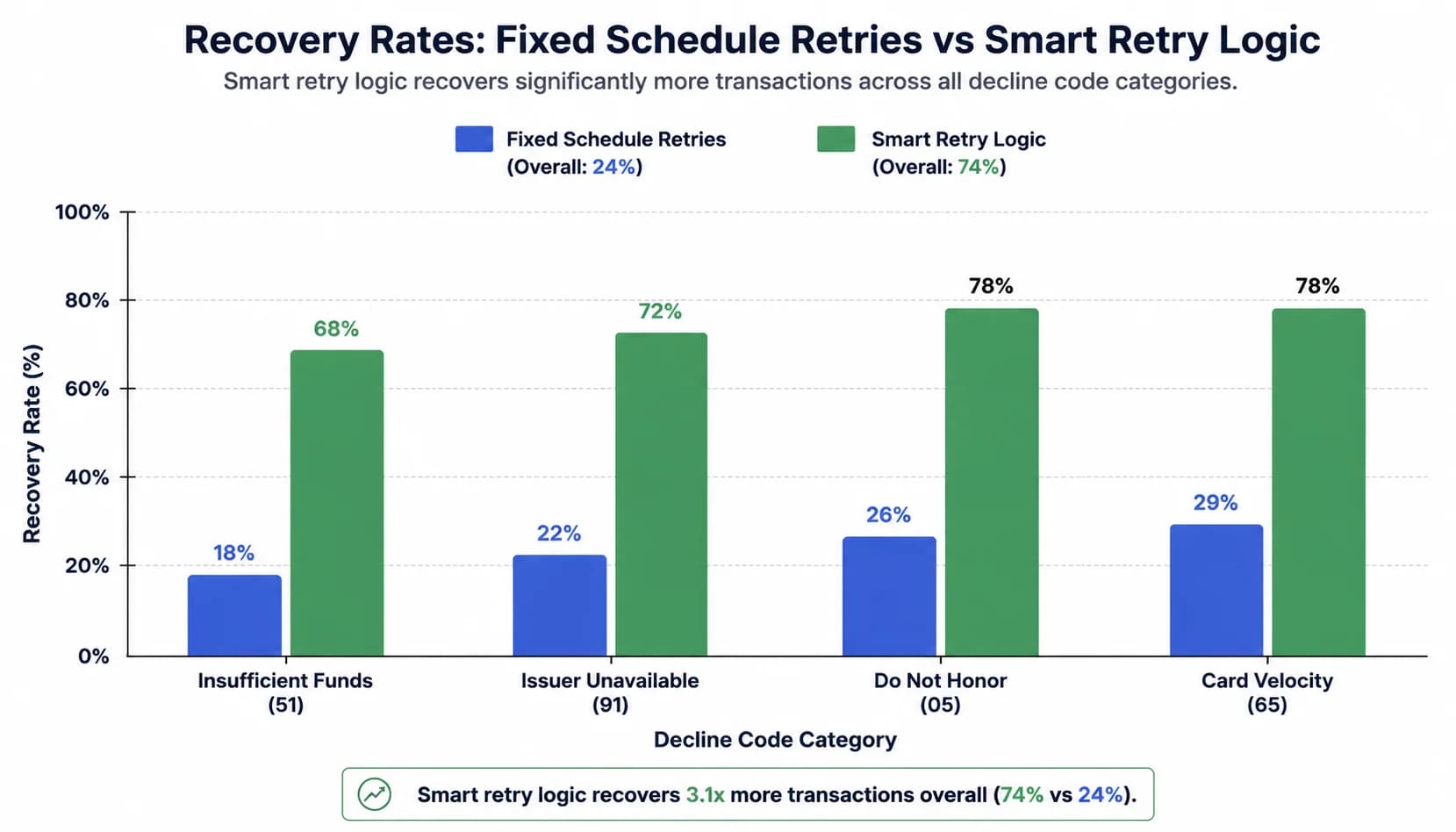
- Fixed-schedule retries succeed 24% of the time while smart retries tuned to decline code and card BIN succeed 74%, meaning most teams are leaving three quarters of recoverable revenue on the table
- Spreadsheet-based ASC 606 revenue recognition breaks the moment a customer upgrades mid-term, and auditors flag mid-period contract modifications more often than any other scenario
- Involuntary churn stuck near the 4.5% SaaS average silently drags NRR down one point per quarter even when logo retention looks healthy on the customer-success dashboard
- 37% of dunning emails are never opened, yet most finance teams still rely on a single-channel email cadence rather than routing across email, SMS, and in-app in parallel
- 42% of failed payments come from expired cards, but very few teams warn customers 14-30 days before renewal or run an account updater API to refresh the card on file silently
Industry Terminology Guide
Calculate your SaaS dunning ROI
Plug in your MRR and current involuntary churn to see recovered revenue at 78% dunning success versus your native billing platform's 35% baseline.
How a purpose-built AR layer solves each SaaS problem
Generic AR vendor language gets in the way of SaaS buying decisions. When a sales engineer says 'invoice', your billing team hears 'subscription charge'. When they say 'past-due notice', your CS lead hears 'dunning sequence with smart retries'. When they say 'write-off', your controller hears 'deferred revenue reversal against ASC 606 obligations'. SaaS AR solves dunning with smart retry logic tuned to decline code, applies the ASC 606 five-step model at the subscription-event level, prevents involuntary churn through card updater and pre-dunning outreach, and surfaces MRR recovered on a real-time dashboard split by decline code and billing platform.
The SaaS Finance Persona: What a VP Finance at $5M-$50M ARR Actually Deals With
SaaS finance leaders inherit Stripe or Chargebee native dunning that recovers only 30-40%, spreadsheet-based revenue recognition, and involuntary churn stuck near 4.5%. The Series B audit forces the reckoning.
The reader of this guide is usually a VP Finance, Head of RevOps, or first-in-seat CFO at a company between 30 and 500 employees. They know their MRR, ARR, and NRR to the dollar. They can walk a board through gross-vs-net retention without notes. What they inherited, however, is a billing stack the founders wired to Stripe in year one, a bookkeeper who built the deferred revenue schedule in Google Sheets, and a dunning sequence nobody has audited since Series A.
That inherited stack recovers 30 to 40% of failed payments on a good month. The finance leader knows this because a Baremetrics dashboard or a Metronome cohort view says so. They also know that involuntary churn is quietly running near the SaaS average of 4.5%, published by Churn Buster and Baremetrics in their 2024 benchmarks. Neither number is catastrophic on its own. Combined, they mean the company loses about one point of NRR every quarter to problems that were solvable at the payment-attempt layer, not the customer-relationship layer.
The forcing function is usually the audit. A Series B lead investor asks for ASC 606-compliant financials, or an existing auditor flags mid-period contract modifications during a routine review. Suddenly the spreadsheet cannot be reverse-engineered fast enough, and the finance team is stuck manually rebuilding revenue schedules from Stripe events. That is the moment leaders start searching for a purpose-built subscription AR platform. Before you evaluate anything, benchmark your two numbers, because you cannot report lift without a baseline. For a wider view of what to measure, see [AR KPIs every CFO should track](/blog/accounts-receivable-kpis-cfo-track). The real question is which levers move the numbers most in ninety days.
Dunning Management: What the Modern Retry Stack Looks Like in 2026
Modern SaaS dunning combines smart retry timing tuned to decline code and card BIN, multi-channel outreach across email, SMS, and in-app, plus account updater services. That stack pushes recovery from 35% to 78%.
The single biggest win in SaaS AR is replacing fixed-schedule retries with smart retries. Fixed schedules typically try again at 24 hours, 72 hours, and 7 days, regardless of why the charge failed. In SINGOA customer data, that cadence recovers about 24% of failed payments. Smart retries, which read the decline code, the card BIN, and the historical success curve for that issuer, recover 74% of the same population. The [Stripe Decline Data Analysis 2023](https://stripe.com/reports/decline-code-analysis) showed that 1 in 3 card-on-file declines are recoverable purely by changing retry timing, before any customer outreach happens.
The lever that unlocks smart retries is decline-code segmentation. Insufficient-funds declines respond well to a retry two to four days after payday for the cardholder's issuer, which is a pattern SINGOA infers from the BIN. Do-not-honor declines usually need a 3DS re-authentication, not a retry. Expired-card declines are best resolved by an account updater API from Visa or Mastercard, since 42% of payment failures stem from expired cards, according to 2025 industry payment-fail analysis. Trying to retry an expired card without an updater is wasted authorization traffic.
Customer outreach still matters, but not as much as most vendors imply. Churn Buster's 2024 Email Performance Report found that 37% of dunning emails are never opened at all. That is why leading SaaS teams route dunning outreach across email, SMS, and in-product banners in parallel, then fall back to a live CSM ping for high-ACV accounts. For a full comparison of when each channel wins, see our post on [payment reminder channels compared](/blog/email-vs-sms-vs-whatsapp-payment-reminders). Multi-channel is not a marketing preference, it is a mathematical necessity when a third of your primary channel is invisible.
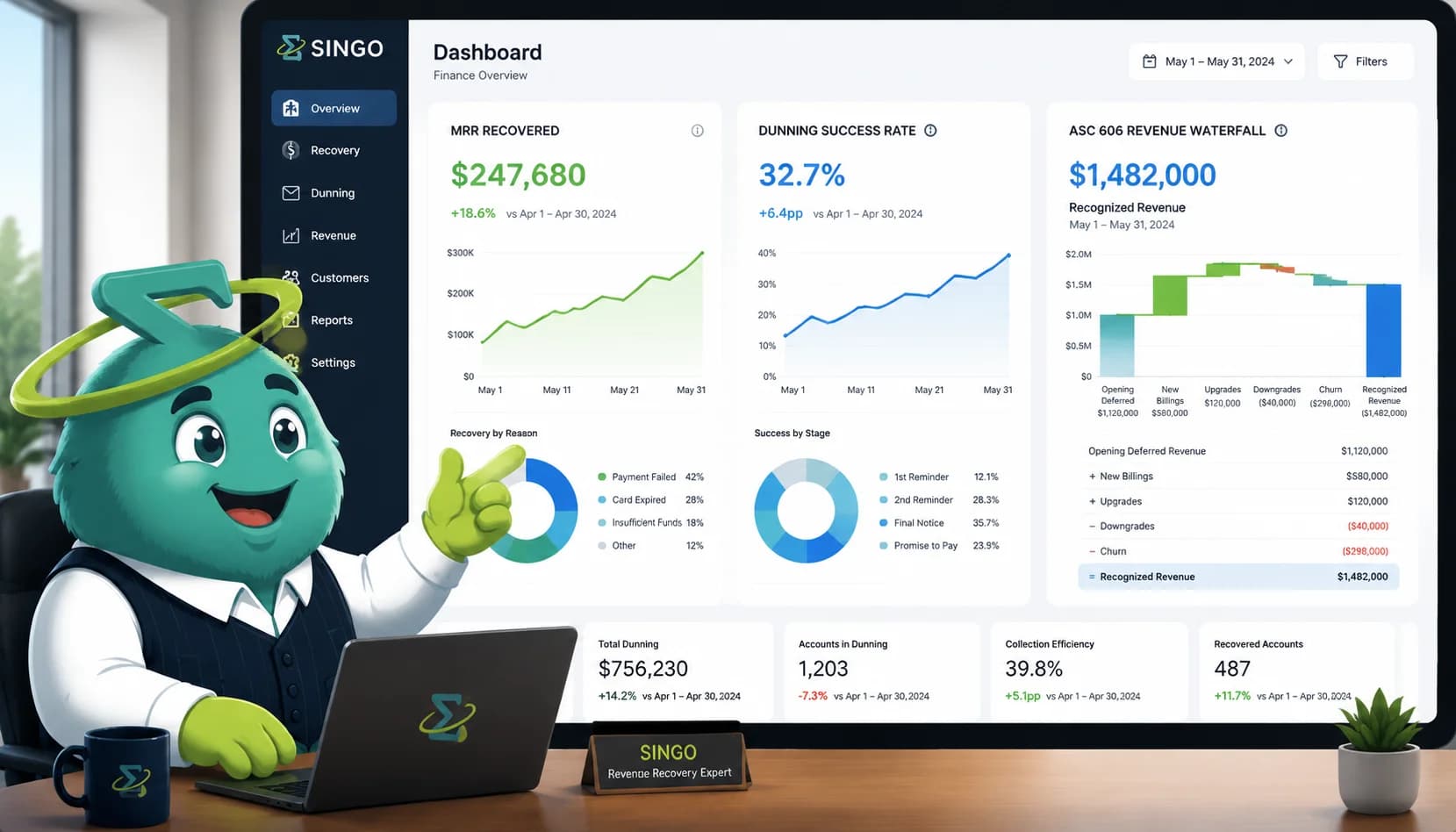
The result of stacking these levers is not incremental. A finance team that moves from Stripe-native retries to a purpose-built layer with decline-code routing, account updater, and multi-channel outreach typically sees dunning recovery climb from 35% to 78% in the first quarter. On $10M ARR at 4.5% failure rate, that swing is worth roughly $200,000 in recovered MRR per year. What most people miss: the recovered dollars are almost pure margin, because sales and marketing already paid to acquire them.
Cut involuntary churn from 4.5% to 1.2%
SaaS finance teams using SINGOA recover 78% of failed payments and stay ASC 606 audit-ready, without replacing Stripe, Chargebee, or Recurly.
ASC 606 Revenue Recognition for SaaS: The Five-Step Model Applied
ASC 606 requires SaaS companies to identify the contract, identify performance obligations, determine the transaction price, allocate price to obligations, and recognize revenue as obligations are satisfied.
Step one is the contract itself. For SaaS that usually means the signed order form or the click-through Terms of Service tied to a Stripe subscription. Step two, identifying performance obligations, is where auditors focus. A single annual SaaS contract can carry multiple obligations: the software access, an onboarding service, a bundled support tier, and any usage-based overage rights. Each obligation gets its own recognition pattern, and the [KPMG Revenue Recognition Handbook](https://kpmg.com/us/en/frv/reference-library/2024/handbook-revenue-recognition.html) explicitly calls out that bundled onboarding is a distinct obligation when the customer could purchase implementation separately.
Step three, the transaction price, is straightforward for fixed subscriptions but harder for usage-based tiers. Variable consideration must be estimated using either the expected-value or the most-likely-amount method, then constrained so that a significant reversal is not probable. Step four allocates that price across the obligations you identified in step two, typically by relative standalone selling price. Step five recognizes revenue as each obligation is satisfied. For most SaaS access rights, that is a ratable straight-line recognition across the subscription term.
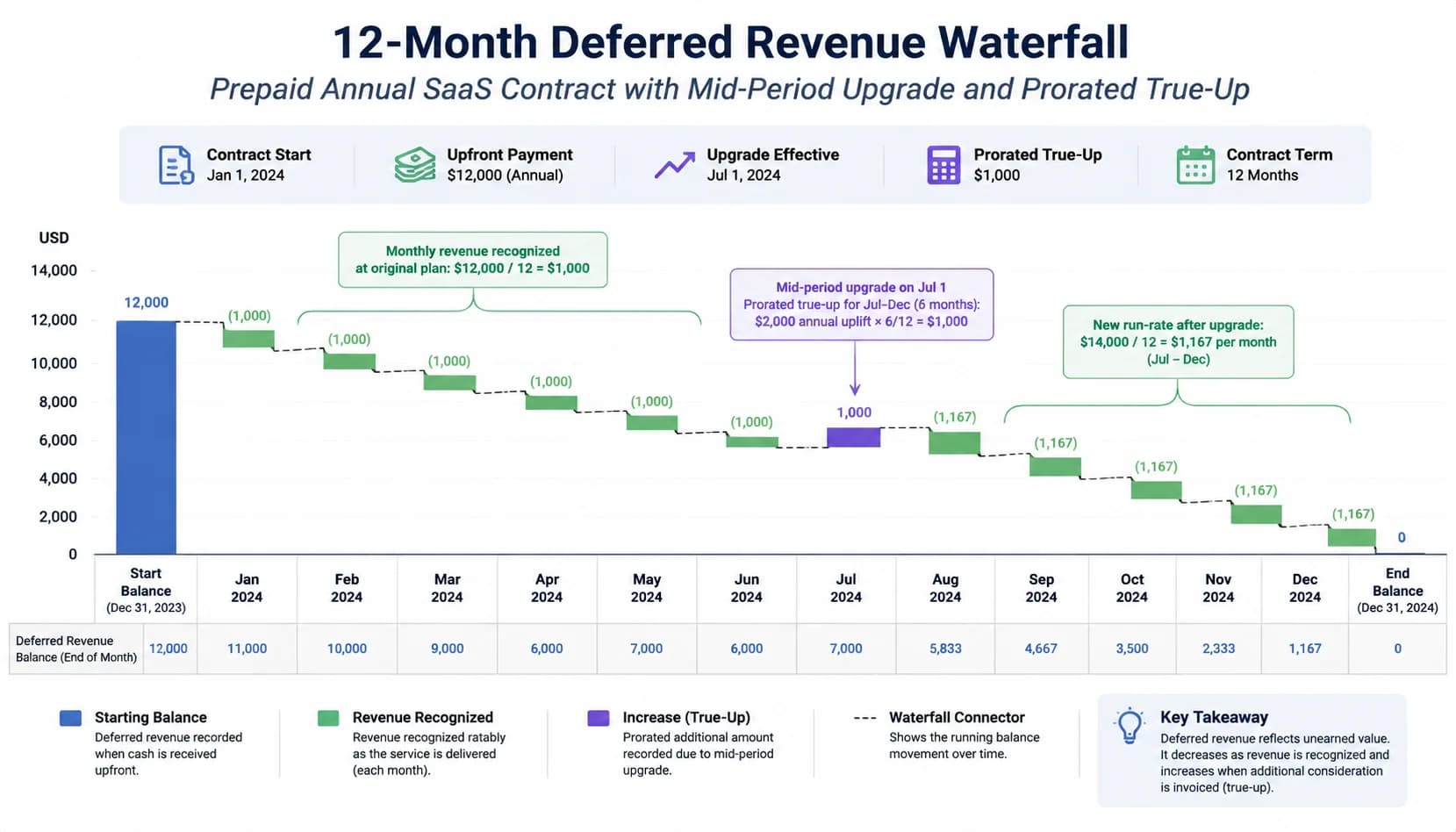
Consider a prepaid annual contract of $12,000 signed on January 1. Under ASC 606, you defer $12,000 to a liability on day one and recognize $1,000 into revenue each month across a 12-month waterfall. Simple enough, until the customer upgrades in month 4 to a $2,000 monthly plan. That is a contract modification. If the added services are distinct at their standalone price, you treat it as a separate contract. If the modification changes the scope of the remaining obligation, you re-allocate the unrecognized deferred balance across the new term. This is the scenario auditors flag most often, and it is where spreadsheets fall apart.
The stakes are not theoretical. The Zuora and IDC Subscription Economy Index 2024 estimated that 60% of SaaS companies lack fully ASC 606-compliant revenue recognition. That gap becomes a diligence issue during Series B or acquisition, when auditors demand a defensible revenue schedule, obligation-by-obligation, for every active subscription. Building that from cash-basis Stripe events by hand takes weeks. Building it from a subscription event stream that tags each event with contract, obligation, and modification metadata takes minutes. Platforms like SINGOA emit that structured trail continuously, which also feeds directly into [SOC 2, PCI, and ASC 606 audit readiness](/compliance). The upshot for finance leaders: your ability to raise a clean Series B increasingly depends on whether your revenue recognition is auditable at the event level, not the invoice level.
Involuntary Churn: The 4.5% Problem and How to Get It Below 1.5%
Involuntary churn is subscription loss caused by failed payments, not customer intent. The SaaS average is 4.5%; best-in-class teams get below 1.5% by combining retries, card updater, pre-dunning warnings, and account updater APIs.
Voluntary churn is the customer telling you goodbye. Involuntary churn is the payment method telling you goodbye without asking the customer. The distinction matters because the remediation is completely different. Voluntary churn is a product, pricing, or customer success problem. Involuntary churn is a payment engineering problem. Confusing the two leads to a common failure mode: finance blames the CS team for a churn number that was actually caused by expired cards, and CS spins up save-offers that never reach the account holder.
The [Baremetrics Involuntary Churn Benchmarks 2024](https://baremetrics.com/blog/involuntary-churn) pegged the SaaS average at 4.5% annually. Best-in-class teams operate at 1.2%. The gap between those two numbers is worth serious money. On a $10M ARR base, dropping from 4.5% to 1.2% recovers roughly $330,000 in annualized MRR. On a $50M base, the same 3.3-point delta is worth $1.65M. Neither figure requires acquiring a single new customer, it just stops leaking the ones you already won.
Four levers close the gap. First, pre-dunning: warn the customer 14 to 30 days before the card on file expires, so they update it during a calm renewal moment instead of a failed-charge fire drill. Second, account updater APIs, offered by Visa, Mastercard, and Amex, refresh 42% of expired cards silently and account for the largest single failure category. Third, smart retries, as covered in the dunning section, handle the recoverable declines that remain. Fourth, a short grace-period window keeps the customer's access live during the retry sequence, which prevents self-cancellation triggered by a login blocker.
Track involuntary churn as a leading indicator, not a lagging one. A 1-point drop in involuntary churn typically produces a 3 to 4 point NRR lift inside two quarters, because retained customers compound expansion revenue. Predictive scoring layered on top can flag at-risk accounts before the charge even fails, using signals like BIN age, prior decline history, and product usage patterns, an approach we detail in [predictive credit risk scoring](/blog/predictive-credit-risk-scoring-ml-payment-defaults). But there is a catch: none of these levers help if the finance team is not tracking a monthly involuntary churn number in the first place. Start there.
Integrations: how a purpose-built AR layer sits on top of Stripe, Chargebee, Recurly, Zuora, Maxio, and Paddle
The first question every VP Finance asks a subscription AR vendor is whether it forces a billing platform replacement. For $5M to $50M ARR teams already running Stripe, Chargebee, or Recurly, that migration is a non-starter. Sales collateral, payment tokens, contract history, and integrations to CRM all live inside the billing platform. Ripping it out to gain better dunning would trade one problem for a much larger one. The right answer is a layer that listens to the billing platform's webhook stream, not a replacement that owns the customer of record. In practice, each platform limits how far native dunning can go: Stripe Billing caps at three retry attempts and does not natively pull in issuer-level BIN success curves. Chargebee's dunning workflow is deeper, yet still routes single-channel email. Recurly adds account updater but leaves decline-code segmentation to the customer. Zuora and Maxio prioritize revenue recognition mechanics over payment recovery. Paddle, operating as a merchant of record, handles some of this transparently but limits customization. A purpose-built layer fills the gaps without replacing what each platform already does well. The [50+ billing and accounting integrations](/integrations) page shows the full supported list, and adoption is measured in days, not quarters, because platforms like SINGOA read events rather than owning the subscription.
Stripe Billing
Event-stream integration with Stripe subscriptions, invoices, and charges. SINGOA reads charge failures, decline codes, and card BIN data to run smart retry logic beyond Stripe's default three-attempt cap. No token migration required.
Chargebee
Webhook integration with Chargebee subscriptions and dunning events. SINGOA extends Chargebee's single-channel email cadence into multi-channel outreach and layers on decline-code segmentation for smarter retry timing.
Recurly
Native connector to Recurly subscription and billing events. SINGOA adds decline-code segmentation and predictive churn scoring on top of Recurly's account updater support without replacing the billing engine.
Zuora
Event-stream integration with Zuora Billing and Zuora Revenue. SINGOA layers dunning recovery and predictive churn scoring on top of Zuora's revenue recognition mechanics for teams already invested in the Zuora stack.
Maxio (SaaSOptics + Chargify)
Integration with Maxio subscription and revenue schedules. SINGOA extends the retry stack and adds multi-channel dunning while Maxio continues to own the finance-team-facing revenue schedule.
Paddle
Merchant-of-record aware integration with Paddle subscriptions. SINGOA respects Paddle's MoR responsibilities and adds churn scoring, CSM handoff signals, and CRM synchronization on top.
Braintree
Subscription and charge event integration with Braintree, useful for teams running Braintree alongside Stripe for regional payment methods. Full parity with the smart retry and account updater stack.
QuickBooks Online / Xero / NetSuite / Sage Intacct
GL writeback closes the loop. Recognized revenue, deferred revenue rollforward, and cash receipts post to QuickBooks Online, Xero, NetSuite, or Sage Intacct on the same schedule your controller uses for close, without a bookkeeper spreadsheet in the middle.
HubSpot / Salesforce
CRM synchronization for CSM handoff. Payment failures, dunning stage, and churn risk score flow to the account record in HubSpot or Salesforce so CSMs see dunning activity the moment it starts, not three days later.
ChurnZero / Gainsight / Intercom
Customer success signal exchange. Payment-health data lands in ChurnZero, Gainsight, or Intercom so success playbooks fire at the right customer at the right time, not on a stale weekly report.
Compliance: SOC 2, PCI, ASC 606, IFRS 15, and GDPR data residency for EU customers
SaaS AR platforms must satisfy SOC 2 Type II for security, delegate PCI DSS scope to tokenizing billing platforms, produce ASC 606 or IFRS 15 audit trails, and honor GDPR data residency requirements for EU customer PII. Compliance is not a differentiator, it is the price of entry, and the earlier you validate it the fewer surprises land in your next audit letter. The full matrix, along with how each obligation flows through the platform, sits on our [SINGOA compliance and audit readiness](/compliance) page.
SOC 2 Type II Attestation
SOC 2 Type II is table stakes. A SaaS AR layer sees customer PII, subscription contract data, and payment metadata, so any serious vendor carries an annual attestation covering the five trust services criteria. Ask for the current report, not a summary, and confirm the scope covers the production environment your workload will run in. If the vendor cannot deliver a bridge letter between the last attestation and today, keep looking.
PCI DSS Scope Delegated to Billing Platform
PCI DSS scope for a subscription AR layer is different from a full payment processor. Because platforms like SINGOA delegate card acceptance to the underlying tokenizing billing platform (Stripe, Chargebee, Recurly, or Paddle), the AR layer never touches raw PAN data. That reduces the PCI footprint to SAQ-A-EQ or SAQ-D-service-provider depending on the integration pattern. Verify the vendor's Attestation of Compliance and the specific SAQ they filed.
ASC 606 Audit Trail with Obligation-Level Recognition
For revenue teams, the deliverable that matters is the ASC 606 audit trail: obligation-by-obligation recognition schedules, contract-modification records with before-and-after states, and exportable deferred revenue waterfalls tied back to each subscription event. Auditors want to trace a single dollar of recognized revenue back to the underlying performance obligation and the contract event that satisfied it.
IFRS 15 Parity for International Entities
IFRS 15 parity matters if you have entities in the UK, EU, or APAC. The core five-step model is the same, but disclosure requirements and contract-modification treatment differ in specific edge cases. A well-designed AR layer emits a single event stream that can produce both ASC 606 and IFRS 15 outputs without duplicate configuration.
GDPR Data Residency for EU Customer PII
GDPR data residency matters if EU customer PII must stay in EU regions. A well-designed AR layer offers regional storage buckets and processor-of-record clarity. Ask which sub-processors the vendor uses, where each sub-processor stores data, and how customer PII is separated between US and EU regions.
ROI: quantifying dunning recovery, DSO reduction, and audit-cost avoidance at $10M and $50M ARR
Start with the recovered MRR line. At $10M ARR, cutting involuntary churn from the 4.5% SaaS average to a best-in-class 1.2% recovers about $330,000 per year. At $25M ARR that number climbs to roughly $825,000. At $50M ARR it reaches $1.65M. These are not marketing estimates, they are the arithmetic of a 3.3-point recovery applied against your ARR base. The variability comes from customer mix, price point, and how much of your churn was already voluntary versus involuntary.
The second line is DSO. The [SaaS Capital AR Benchmarks 2024](https://www.saas-capital.com/research/) place the industry median SaaS DSO at 22 days, but many mid-market subscription businesses run in the 40s once you include failed-payment aging and manual re-invoicing. SINGOA customer data shows a typical move from 42 days to 18 days after the retry stack and revenue recognition are consolidated. On a $50M ARR base, releasing 24 days of working capital translates to roughly $3.3M in cash freed up on the balance sheet, cash that can fund headcount instead of sitting stuck in Stripe's pending queue.
The third line is audit cost avoidance. Finance teams that reverse-engineer ASC 606 schedules from Stripe events typically add 80 to 120 hours of audit-prep work per quarter. A structured revenue schedule cuts that by 30 to 40%. At a fully loaded finance-team cost of $75 per hour, that saves $30,000 to $60,000 per year, and it removes the audit-prep bottleneck that delays close every quarter. For a deeper treatment of the DSO piece, see [reduce DSO: proven strategies](/blog/reduce-dso-proven-strategies-2026). Combined, the three lines produce a payback period under 90 days for most $10M-plus ARR teams. Model the ROI at your current involuntary churn rate, not the industry average, so the numbers reflect your baseline.
$330K
Recovered annualized MRR from cutting involuntary churn from 4.5% to 1.2% at $10M ARR
SINGOA customer data / Baremetrics 2024 baseline
$1.65M
Recovered annualized MRR at $50M ARR with the same 3.3-point involuntary churn delta
SINGOA customer data
35% to 78%
Dunning recovery rate lift from Stripe or Chargebee native to purpose-built layer
SINGOA SaaS customer benchmarking 2026
42 to 18 days
SaaS DSO reduction after consolidating retry stack and revenue recognition
SaaS Capital AR Benchmarks 2024 / SINGOA customer data
$3.3M
Working capital released at $50M ARR from 24-day DSO improvement
Working-capital arithmetic on $50M ARR base
30-40%
Audit preparation hours saved per quarter with structured ASC 606 revenue schedule
SINGOA finance-team benchmarking 2026
- Recover $330K-$1.65M in annualized MRR across the $10M-$50M ARR range by cutting involuntary churn from 4.5% to 1.2%, without acquiring a single new customer
- Free $3.3M in working capital at $50M ARR by pulling SaaS DSO from 42 to 18 days, releasing cash that can fund headcount instead of sitting in Stripe's pending queue
- Save $30K-$60K per year in audit prep by producing a defensible ASC 606 revenue schedule at the event level, and cut the finance-team bottleneck that delays quarterly close
- Push dunning recovery from a 35% native-billing baseline to 78% via smart retries, account updater, and multi-channel outreach in parallel, without replacing Stripe, Chargebee, or Recurly
- Achieve payback in under 90 days for most $10M-plus ARR teams, with the recovered dollars showing up on the same P&L that funded the platform inside the same fiscal year