
The upstream accounting problem: why JIB, COPAS, and AFE are inseparable
Joint venture billing errors drain $12 billion from the upstream industry every year, and the average mid-size operator loses $2.4 million of that to disputed JIB statements, missed AFE supplementals, and COPAS audit findings (Enverus and COPAS Research Institute, 2024). If you have ever spent the last week of the month rebuilding a working interest schedule in Excel because a farmout closed on the 18th, you already know where the leakage starts.
Oil and gas accounting is not really three separate problems. Joint interest billing, COPAS compliance, and AFE tracking sit on top of the same JOA. The working interest percentage that drives a JIB statement is the same percentage that an AFE locks at approval, and the cost categories that flow into the JIB are the same ones a COPAS auditor will sample 24 months later. When one of these systems lives in WolfePak, another in Avocet, and the reconciliation lives in a shared spreadsheet, the seams are where the dollars escape.
This guide walks through all three pillars in the order an upstream JV accountant actually touches them: how a JIB statement is built from the JOA outward, what COPAS 2005 and 2020 procedures require operators to prove, how AFE variance tracking catches overruns before they become audit findings, and how integrated [Oil & Gas AR automation](/industries/oil-gas) closes the gap. We will quantify the ROI mid-size operators see in the first 90 days and call out where automation still falls short. Source: [COPAS guidance on joint interest billing](https://copas.org/joint-interest-billing-and-how-it-relates-to-oil-and-gas-accounting/).
$12B
Lost industry-wide annually to JV billing errors and JIB disputes
Enverus / COPAS Research Institute, 2024
18%
Average JIB dispute rate (industry baseline)
COPAS Operator Survey, 2023
90 days
Average JIB dispute resolution time on manual workflows
Enverus AR Benchmarking Report, 2024
12%
Average AFE variance over budget across drilling and completion AFEs
SPE Production & Operations Journal
$2.4M
Average annual revenue leakage per mid-size operator
SINGOA O&G Customer Analysis, 2025
Common Pain Points
- Working interest schedules mutate mid-cycle from farmouts, partial assignments, and non-consent elections, and most spreadsheet workflows handle these as manual adjustments in the next cycle, driving the 18% industry-baseline dispute rate
- JOAs typically require JIB statement issuance within 15 to 30 days of production-month close, and operators with manual workflows routinely miss the window during quarter-end, granting partners audit rights
- A typical mid-size operator has six or more different COPAS exhibits live across its portfolio because each JOA inherits whatever procedure was in force when signed (1974, 1984, 2005, 2020), and misapplied exhibits trigger 24-month restatements
- Field engineers issue change orders weekly during drilling campaigns, but JV accounting only sees actual costs at month-end through the production accounting feed, so 14% variances surface after the supplemental window closes
- Revenue distribution waterfalls (royalty, ORRI, NPI, working interest) with multi-state severance tax across Texas, Oklahoma, North Dakota, Wyoming, Colorado, New Mexico, Louisiana, and West Virginia are unmanageable at 200-well scale in spreadsheets
- JIB lives in WolfePak, AFE in Avocet, COPAS validation in a quarterly spreadsheet, so the three systems drift and the seams are where dollars escape
Industry Terminology Guide
See your JIB dispute reduction ROI
Enter your monthly JIB statement volume and current dispute rate to see what an 18% to 3% automation shift translates to in recovered working capital.
How JIB, COPAS, and AFE automation closes the upstream accounting gap
Each solution targets one of the three pillars of upstream accounting. Together they form a closed-loop workflow that replaces the 1 to 3 weeks per month JV accountants spend reconciling spreadsheets against JOAs with continuous validation tied to an immutable audit trail.
Joint interest billing (JIB) explained: from JOA to partner statement
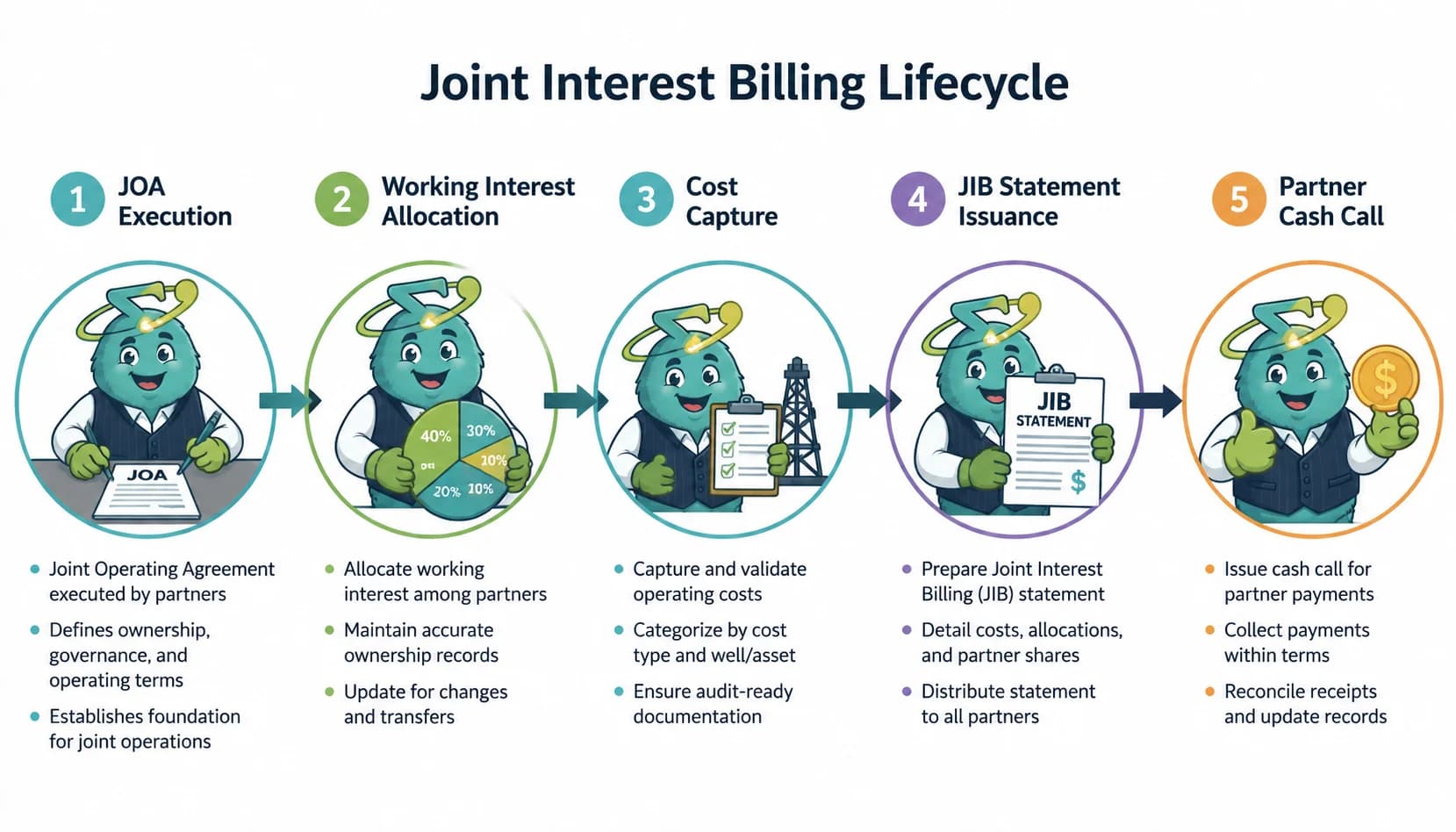
Joint interest billing is the monthly process by which an operator allocates well-level costs and revenues across all working interest owners per the JOA, then issues a JIB statement to each non-operating partner showing their share of expenses, net revenue, and cash call due.
Work an example. A three-partner well operates under a JOA with working interests of 0.4375, 0.3750, and 0.1875. The operator captures $640,000 of intangible drilling cost, $185,000 of tangible equipment, and $42,000 of monthly LOE. After applying the COPAS overhead exhibit and the 4.6% severance tax for Texas, the JIB engine assigns each partner their pro-rata share of expense, nets it against their pro-rata revenue at the wellhead price, and produces a single statement showing the cash call due. Multiply that across 400 statements monthly and the operational stakes become visible.
Where it breaks is working interest mutation. Farmouts, partial assignments, and non-consent elections all shift the percentages mid-cycle. If a partner farms out half their position on the 18th, the JIB engine has to split the month into a pre-cutoff and post-cutoff allocation, apply the right exhibit to each, and notify both partners. Most spreadsheet workflows handle this as a manual adjustment in the next cycle, which is exactly the failure mode that produces the industry-baseline 18% dispute rate and 90-day average resolution time. SINGOA customer data and [proven DSO reduction strategies](/blog/reduce-dso-proven-strategies-2026) show the same WI-mutation gap drives most upstream DSO.
Timing is the second failure mode. JOAs typically require statement issuance within 15 to 30 days of the production month close, and partners gain audit rights if statements arrive late. Baker Tilly's accounts-payable and JIB analysis flags this as the most under-reported source of dispute escalation, because operators with manual workflows routinely miss the window during quarter-end. The cure is continuous validation against the JOA rather than month-end batch reconciliation, which is the architectural premise of every modern JIB platform.
Source: [Baker Tilly analysis of JIB and AP in oil & gas](https://www.bakertilly.com/insights/accounts-payable-and-joint-interest-billing-in-oil-and-gas). Pro tip: when a non-op elects to go non-consent on a single well within a multi-well unit, your JIB engine must net the penalty interest reversion against future net revenue, not just the cost share. Most spreadsheet workflows miss this and trigger automatic audits within 12 months.
COPAS compliance: 2005 vs 2020 procedures and what auditors actually check
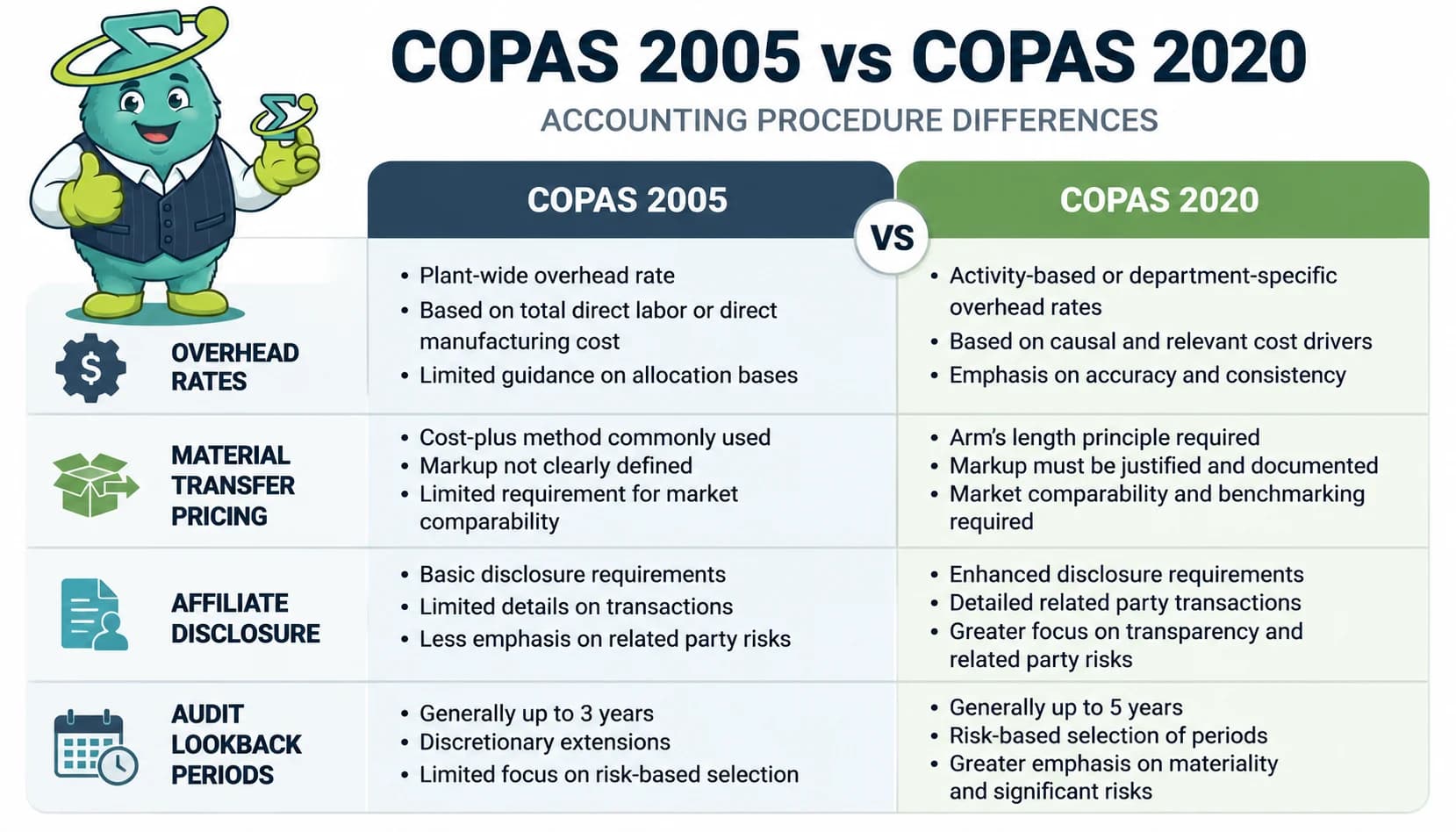
COPAS accounting procedures are the industry-standard exhibits attached to a JOA that govern how operators charge costs to the joint account, covering overhead rates, material transfer pricing under Section 2.5, affiliate disclosure, and audit lookback windows of typically 24 months under the 2005 procedure and 24 to 36 months under 2020.
Most JV accountants treat COPAS as a vocabulary problem. It is really a version-control problem. A typical mid-size operator has six or more different COPAS exhibits live across its portfolio at any moment, because each JOA inherits whatever procedure was in force when it was signed. Wells drilled in 1989 reference the 1984 procedure. Wells from 2008 reference 2005. Wells from 2022 reference 2020. Every one of those exhibits has different overhead rate adjustment factors, different material transfer rules, and different audit rights. Cost allocations only validate if you map them to the right exhibit by well, every cycle.
The 2005 to 2020 jump matters most. COPAS 2020 tightened overhead rate adjustment language so producing-well rates index to a published Producer Price Index series rather than the freer hand the 2005 procedure allowed. Section 2.5 material transfer pricing under 2020 also requires a documented condition assessment for used equipment moved between joint accounts, where 2005 accepted the operator's good-faith determination. Affiliate disclosure rules tightened in parallel; any cost charged through an operator-affiliated service company now needs explicit JOA-clause disclosure on the JIB statement. Your [audit and compliance controls](/compliance) need to apply per-exhibit rules, not a single global ruleset.
What does a COPAS audit actually inspect? Auditors sample 24 months of JIB statements (sometimes 36 under 2020), trace each cost back to the source invoice, recompute the overhead exhibit, validate material transfer pricing on equipment movement, and flag any affiliate charge without proper disclosure. The most common finding is not fraud. It is a wrong overhead percentage applied because the operator's spreadsheet did not differentiate between drilling, producing, and combined-rate wells under the right COPAS schedule.
A single misapplied overhead exhibit, repeated 200 times monthly, generates a 24-month restatement that wipes the year's working capital gains. Modern automation handles this by attaching the COPAS exhibit metadata to each well at JOA load and refusing to issue a statement that fails the exhibit's validation rules. That sounds basic. It is the single highest-leverage control upstream finance teams can put in place. Pro tip: if your JOA pre-dates 2005 and references the COPAS 1974 procedure, do NOT assume overhead rates scale uniformly. The 1974 schedule lacks the producing-overhead adjustment factor that 2005 introduced, and applying a modern factor overcharges non-ops by 8-12% and surfaces as a restatement on the next audit.
Cut JIB disputes 83% without rip-and-replace
Mid-size upstream operators using SINGOA cut JIB disputes from 18% to 3% while keeping their existing WolfePak, Avocet, or Quorum stack. See how in 15 minutes.
AFE tracking: capital control from initial approval through supplemental authorization
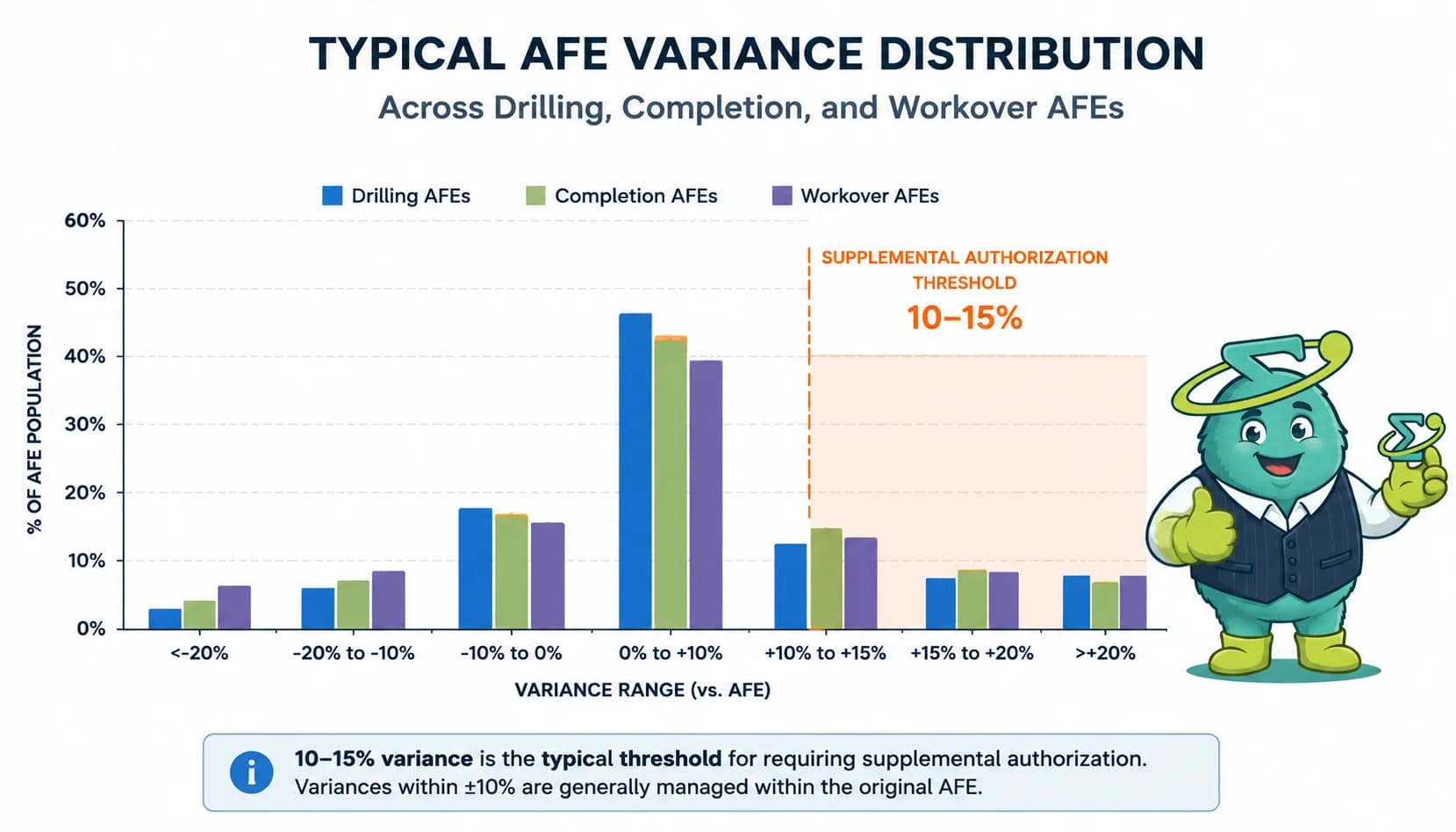
An authorization for expenditure (AFE) is a capital approval document that locks partner consent to a budgeted well cost (typically drilling, completion, or workover). A supplemental AFE is required whenever projected costs exceed the original AFE by the JOA-defined variance threshold, usually 10 to 15 percent or an absolute dollar limit, whichever is lower.
The AFE lifecycle has five stages: estimate, partner approval, field execution, variance tracking, and final reconciliation. Stage three is where capital control breaks. Field engineers issue change orders weekly during a drilling campaign, but the JV accounting team only sees actual costs at month-end through the production accounting feed. By the time a 14% variance shows up in the cost ledger, the well is already two zones into a deeper completion than the partners approved. That sequence is how silent overruns become COPAS audit findings 18 months later.
The numbers back it up. SPE Production and Operations Journal data puts the average AFE variance at 12% over budget across drilling and completion AFEs. On a $30 million deepwater AFE, 12% is $3.6 million of unbudgeted spend. If that crosses the JOA threshold without a supplemental, every non-operating partner has grounds to refuse payment or demand a restatement. A well-designed AFE tracker pulls daily cost data from the field, compares it to the approved AFE, projects forward to total dry-hole cost, and triggers the supplemental workflow before the variance crystallizes. For deeper context on automating that signal flow, see the [complete guide to AR automation](/blog/complete-guide-ar-automation).
Supplemental AFE workflow is the under-built piece. A supplemental needs the same partner approval as the original, but with the time pressure of an active operation. Manual workflows email PDFs, chase signatures, and miss the JOA's response window, at which point silent consent provisions kick in and non-ops gain audit ammunition. Automated workflows issue the supplemental, time-stamp partner responses against the JOA's response window, and produce an immutable record of who approved what and when.
Source: [Enverus AFE definition](https://www.enverus.com/glossary/authorization-for-expenditure-afe/). What most JV accountants miss: the working capital impact of a missed supplemental is not the variance dollar amount. It is the 60 to 90 days the operator carries the full partner share on its own balance sheet before the dispute resolves. Pro tip: set your supplemental AFE trigger to the LOWER of (a) the JOA-stated percentage variance or (b) an absolute dollar threshold, usually $250K. Otherwise a 9% variance on a $30M deepwater AFE goes unsupplemental and surfaces as a $2.7M audit exception 18 months later.
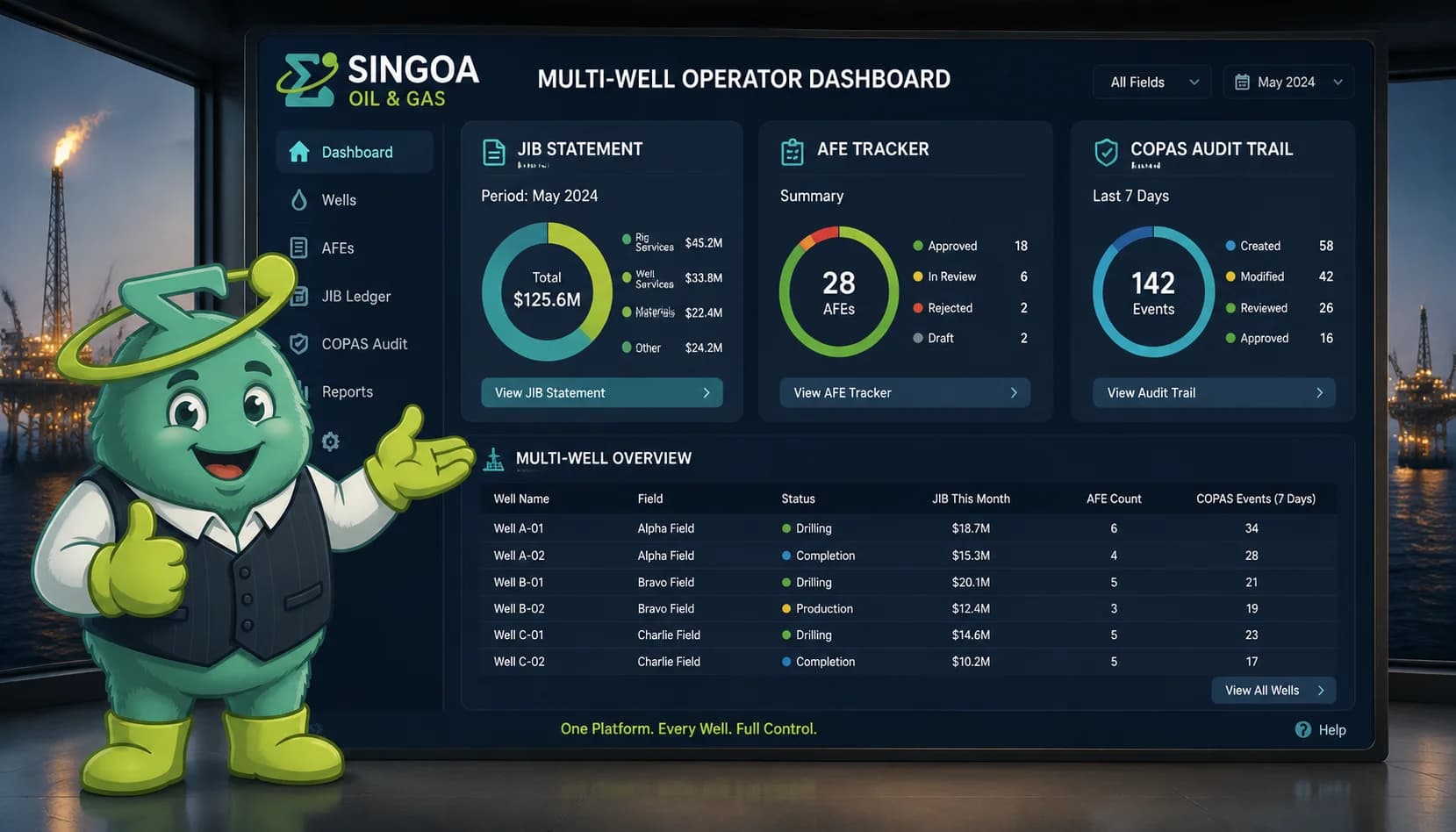
How automation closes the gap: SINGOA's integrated JIB + AFE + COPAS workflow
Modern AR automation platforms integrate JIB statement generation, AFE variance tracking, COPAS-compliant cost allocation, and revenue distribution waterfalls into a single workflow that cuts dispute rates from 18% to 3% and DSO from 65 days to 25.
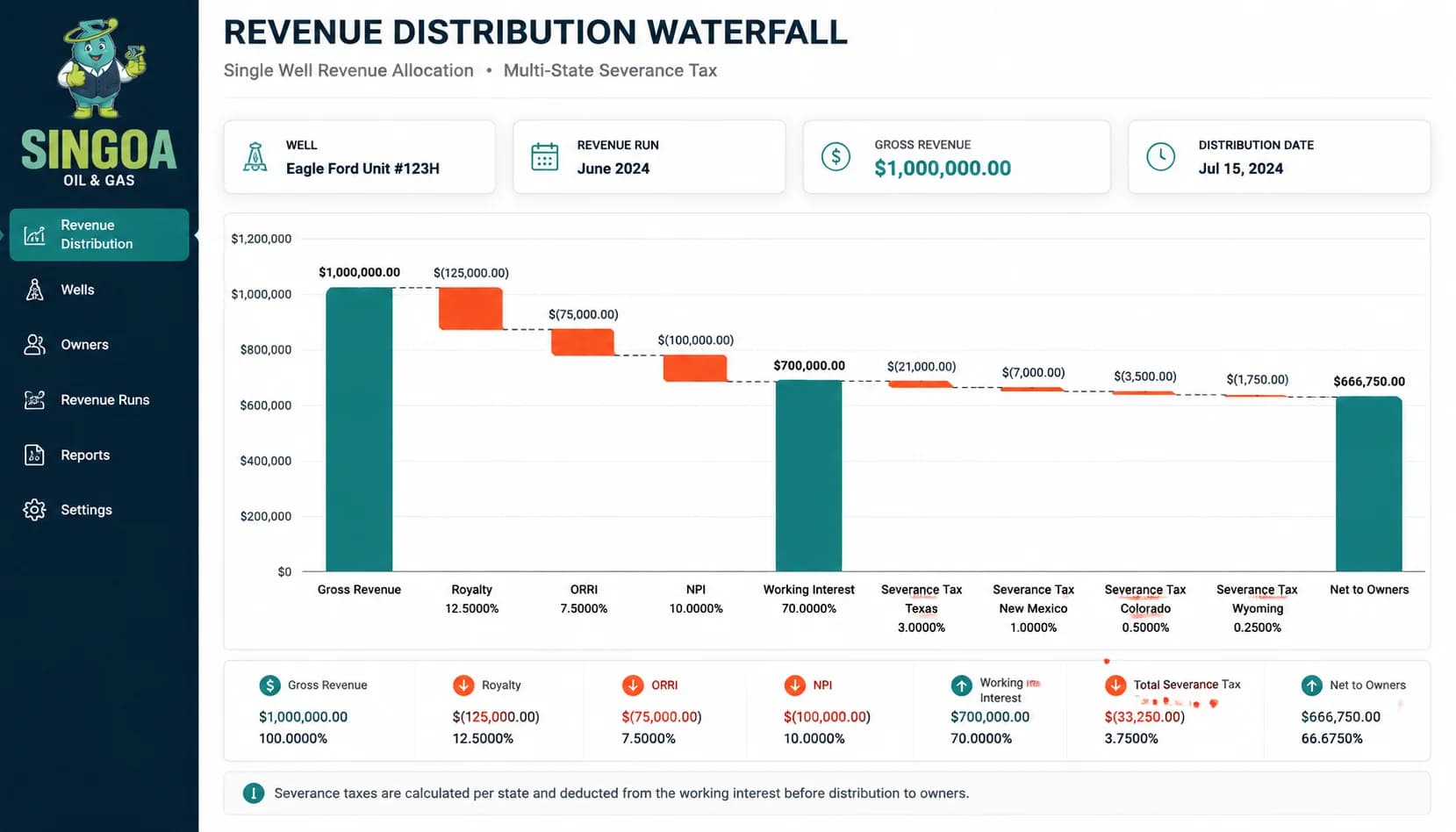
Four solution areas anchor the integrated workflow. First, automated JIB statement generation that pulls cost data from production accounting, applies the right COPAS exhibit per well, and produces partner statements inside the JOA's issuance window. Second, AFE tracking with daily variance alerts that fire before the supplemental threshold trips. Third, a revenue distribution waterfall that handles the royalty, ORRI, NPI, and working interest cascade with multi-state severance tax automation across Texas, Oklahoma, North Dakota, Wyoming, Colorado, New Mexico, Louisiana, and West Virginia. Fourth, an immutable hash-chain audit trail that maps every dollar back to its source JOA clause and COPAS exhibit.
The benchmarks are concrete. Platforms like SINGOA report 99.2% working interest allocation accuracy across the customer base, an 83% reduction in JIB disputes (18% baseline down to 3%), and dispute resolution time compressed to 25 days against the 90-day industry average. Those numbers come from SINGOA's customer dataset and reflect actual mid-size operator production, not vendor projection. The full set of [AR automation platform features](/features) covers payment matching, smart collections, and dispute management on top of the JIB-specific workflow.
The revenue waterfall is where most automation projects under-deliver. A correct waterfall computes royalty owner distributions first against gross production revenue, applies severance tax at the state-specific rate, layers ORRI and NPI burdens on the net, and only then allocates working interest shares against the residual. Each step has its own JOA-clause and division-order references. Doing this in a spreadsheet is feasible for a 10-well operator. At 200 wells across four states, it stops being feasible the first month a severance tax rate changes.
Honest limit: automation does not replace the JV accountant on non-standard JOA elections. Subsea cluster JOAs with bespoke cost-sharing tiers, unitization agreements with shifting tract-participation factors, and JOAs that pre-date 1989 with hand-amended overhead exhibits all still require manual review of the underlying clause. What automation does is reduce the standard-case workload by 80 to 90 percent so JV accountants have time to do that manual review properly, which is the actual ROI lever.
Integrations that matter: WolfePak, Avocet, Quorum, P2, and Oildex/Enverus
Production accounting systems like WolfePak, Avocet, Quorum, and P2 already hold the well-level cost and volume data. The gap is the JV billing, partner communication, and COPAS compliance overlay. Modern AR platforms integrate via bi-directional APIs to Oildex/Enverus and the operator's existing GL to avoid the rip-and-replace migration risk. SINGOA's [ERP and production system integrations](/integrations) cover bi-directional sync with all five platforms.
WolfePak
SMB upstream standard for operators in the $20M to $100M revenue band. Solid production accounting and AP modules, but the JIB module ships thin partner-facing UX and limited COPAS exhibit version control. SINGOA layers JIB statement generation, partner-facing dispute portal, and COPAS exhibit validation on top via bi-directional API.
Avocet (Schlumberger)
Dominates the mid-market with strong production accounting and reservoir-side analytics. Partner statement formatting and dispute workflow lag platforms built for AR from day one. SINGOA provides the JIB and partner-communication overlay while preserving Avocet as the system of record for volumes and costs.
Quorum
Anchors the large-cap segment with heavy customization that buys flexibility at the cost of slow change cycles when a COPAS procedure updates. SINGOA's bi-directional API keeps JIB and AFE workflows current without waiting for the next Quorum release.
P2 Energy Solutions
Large-cap upstream operations and land management platform. SINGOA syncs working interest schedules and AFE approvals bi-directionally so farmouts captured in P2 propagate to the JIB engine the same business day.
Oildex / Enverus
Industry network layer for partner statement delivery, AFE distribution, and payment remittance. SINGOA integrates with the Enverus network natively rather than emailing PDFs, so statements clear partner mailrooms inside the JOA issuance window.
COPAS, JOA, SEC, and state severance tax: the compliance matrix
Upstream operators sit at the intersection of four overlapping compliance frameworks. Each one has audit teeth and each one is enforceable against the JIB statement, not the production system.
COPAS Accounting Procedures (1962, 1974, 1984, 2005, 2020)
Cost allocations, overhead rate schedules, material transfer pricing under Section 2.5, and affiliate disclosure are validated per the COPAS procedure attached to each JOA. Most operators run six or more exhibits across their portfolio.
Joint Operating Agreement (JOA)
Working interest schedules, AFE approval thresholds, partner notification requirements, and audit rights and lookback periods all flow from the JOA. JIB statements that misalign with the JOA grant partners audit rights immediately.
SEC Regulation S-X
Revenue distribution records must support SEC Regulation S-X reporting for public operators and proved reserve disclosure for both public and PE-backed operators.
State severance tax (TX, OK, ND, WY, CO, NM, LA, WV, and others)
Multi-state severance tax rates apply to gross production revenue before partner distribution. Rates change mid-year; manual workflows miss the change and overdistribute.
ROI: what mid-size operators measure in the first 90 days
Mid-size upstream operators automating JIB, AFE, and COPAS workflows typically see JIB dispute rates fall from 18% to 3%, DSO compress from 65 days to 25, AFE variance surface 30+ days earlier, and 1 to 3 weeks of monthly JV accounting time return to higher-leverage analyst work. Collectively this recovers $2.4 million or more in annual revenue leakage per mid-size operator.
The headline metrics are four. JIB dispute rate drops 83% (18% baseline down to 3% on SINGOA customer data). DSO compresses 40 days (65-day industry average down to 25 days on the SINGOA upstream benchmark). Working interest allocation accuracy hits 99.2% across the customer base. Annual revenue leakage recovered averages $2.4 million per mid-size operator (SINGOA O&G Customer Analysis, 2025). The leakage figure is the one CFOs press hardest on, because it converts directly to working capital available for the next acquisition rather than tied up in disputed JIB statements.
Measure the right things in the first 90 days. Track dispute count weekly (not monthly) so the 18-to-3 trajectory is visible. Track JIB statement issuance latency against the JOA window so you catch slippage before partners do. Track AFE variance alert lead time, which should move from negative (variance discovered after the fact) to positive (variance flagged before supplemental threshold). For per-statement economics, see [per-JIB-statement pricing](/pricing). The real question is not whether automation pays back. It is how fast it does, and at mid-size operator scale that answer is typically 4 to 7 months.
83%
Reduction in JIB disputes (18% baseline to 3% with automation)
SINGOA O&G customer data
40 days
DSO compression for upstream operators (65-day baseline to 25 days)
SINGOA upstream benchmark
99.2%
Working interest allocation accuracy across the SINGOA customer base
SINGOA platform data
$2.4M
Average annual revenue leakage recovered per mid-size operator
SINGOA O&G Customer Analysis, 2025
25 days
Dispute resolution time with automation vs 90-day industry average
SINGOA customer data
4-7 months
Typical payback period at mid-size operator scale
SINGOA O&G Customer Analysis, 2025
- JIB dispute count drops weekly on a measurable 18-to-3 trajectory inside the first 90 days
- JIB statement issuance lands inside the JOA window every cycle, removing the audit-rights exposure
- AFE variance alert lead time moves from negative (after the fact) to positive (before supplemental threshold)
- COPAS audit readiness shifts from a 6-week scramble to a 2-day exhibit pull
- JV accountant retention improves because manual reconciliation week stops eating the talented staffer's first year
- CFO board-deck confidence improves: the JV billing line stops needing a footnote every quarter
- Working capital available for the next acquisition rather than tied up in disputed JIB statements