
Why Construction Has the Worst Payment Problem in Business
Construction AR complexity is unlike any other industry. A single commercial project involves four compounding demands. AIA-format billing runs against a schedule of values. Retainage is withheld at 5-10% until substantial completion. Conditional and unconditional lien waivers are exchanged at each payment milestone. Funds flow through a multi-tier payment chain from owner to general contractor to subcontractor to supplier. Each transfer introduces additional delay and potential dispute. According to the Mobilization Funding 2025 Report, 82% of contractors now face payment waits exceeding 30 days, up from 49% just two years ago. The acceleration is structural and worsening as project complexity and subcontractor tiers deepen.
The financial impact is staggering. Construction companies average 83-day DSO industry-wide per PYMNTS B2B Payments data. That compares to 42 days for professional services and 35 days for SaaS companies. A mid-market general contractor with $30M in annual revenue carrying 83-day DSO has $6.8M permanently locked in receivables, $2.5M more than a manufacturer of equivalent size. According to CFMA, 43% of subcontractors report not having enough working capital to cover unexpected expenses or project delays. A 2025 Built survey of 1,200 contractors found firms inflate bids by an average of 8% to protect against slow payments. Slow payment then makes construction more expensive for everyone in the payment chain.
Construction AR automation does not solve a collections problem. It solves a billing complexity problem. When pay applications are prepared accurately in AIA format, submitted through the right GC portal, and tracked systematically with lien waiver documentation attached, general contractors pay faster because they encounter fewer reasons to delay approval. Construction firms achieving 55-day DSO do so by eliminating friction from the billing process itself, not by becoming more aggressive in collections. According to a 2025 Levelset survey of 2,400 contractors, spreadsheet-based billing creates an average of 4.2 errors per pay application. Each error triggers a rejection cycle that adds 2-4 weeks to the payment timeline.
83 days
Average construction industry DSO, highest of any sector
PYMNTS B2B Payments Report, 2025
$340K
Annual working capital loss from AR inefficiency for a $20M contractor
CFMA industry benchmarking, 2025
82%
Contractors facing payment waits exceeding 30 days, up from 49% in 2023
Mobilization Funding 2025 Report
52%
Subcontractors reporting retainage held past contractual release dates
Levelset / ASCA Survey, 2023
4.2 per app
Average pay application errors from spreadsheet-based billing
Levelset Contractor Survey, 2025
Common Pain Points
- AIA G702/G703 form preparation requires 2-5 hours per application, and formatting errors cause rejections that delay payment by 2-4 weeks, AGC data shows 34% of pay apps are returned for errors or missing documentation
- Retainage tracking across 20-50 active projects is unmanageable in spreadsheets, retainage outstanding beyond 6 months post-substantial-completion frequently goes unresolved and becomes a write-off
- Lien waiver exchange remains paper-based at most firms, lost waivers are the single most common reason GCs cite for payment delays, and missed filing deadlines forfeit lien rights entirely
- Schedule-of-values progress tracking requires manual reconciliation between project management software and billing systems, data entry errors cause disputes that add 18 days on average per FMI Research
- Multi-tier payment chains create visibility gaps, subcontractors often cannot determine when the GC has been paid by the owner, making follow-up timing guesswork
- Change order billing is routinely delayed or omitted entirely, according to CFMA, unbilled change orders represent 2-5% of annual revenue for contractors with manual AR processes
Industry Terminology Guide
Calculate Your Construction AR Savings
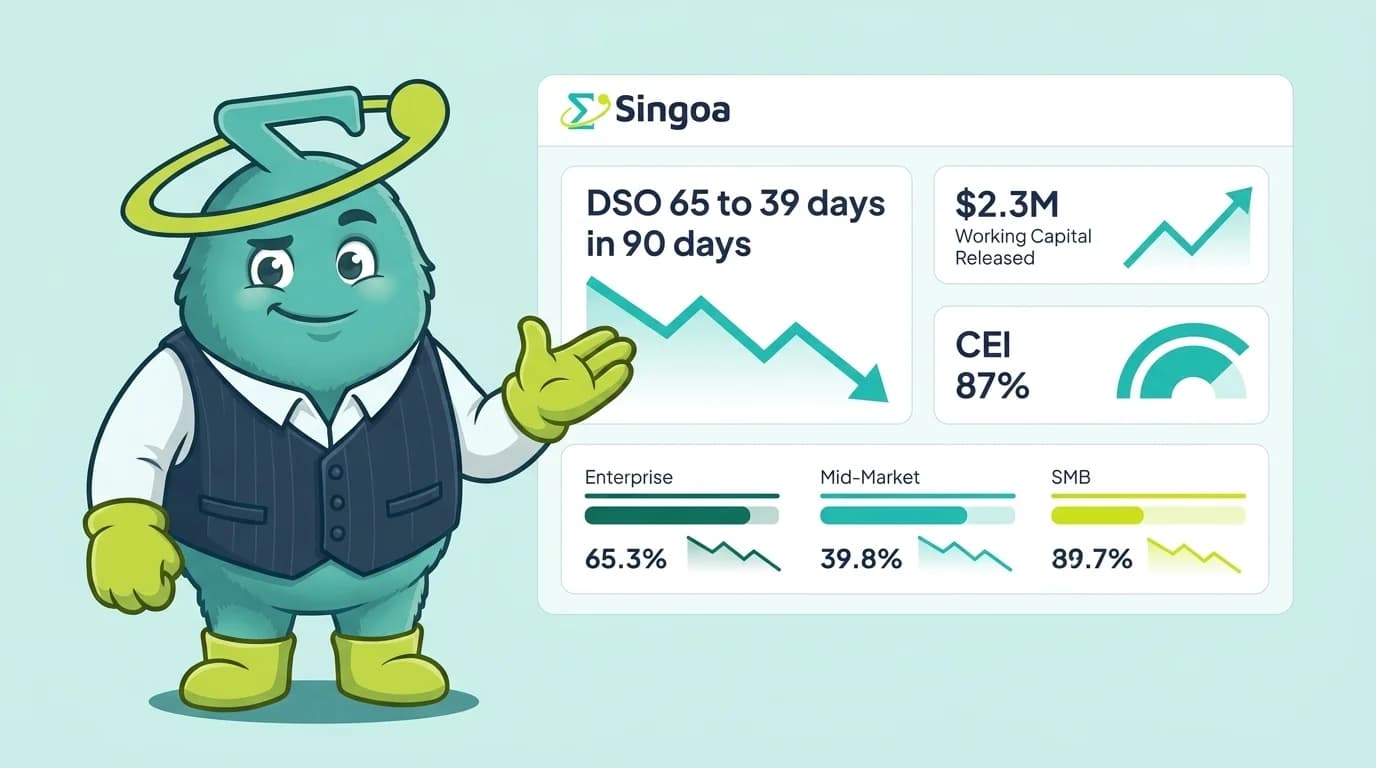
Model the working capital released when DSO drops from 83 days to 55 days. For a $30M GC, that is $2.3M freed plus $750K-$1M in recovered retainage.
Four AR Automation Solutions That Cut Construction DSO by 28 Days
Each solution targets one of the four structural root causes behind construction's 83-day DSO. Together, they form a closed-loop billing system that eliminates manual handoffs between project management, billing, collections, and compliance.
Automated AIA G702/G703 Pay Application Billing
Generate accurate AIA-format pay applications from project data in minutes, not hours, eliminating the preparation bottleneck that delays every billing cycle.
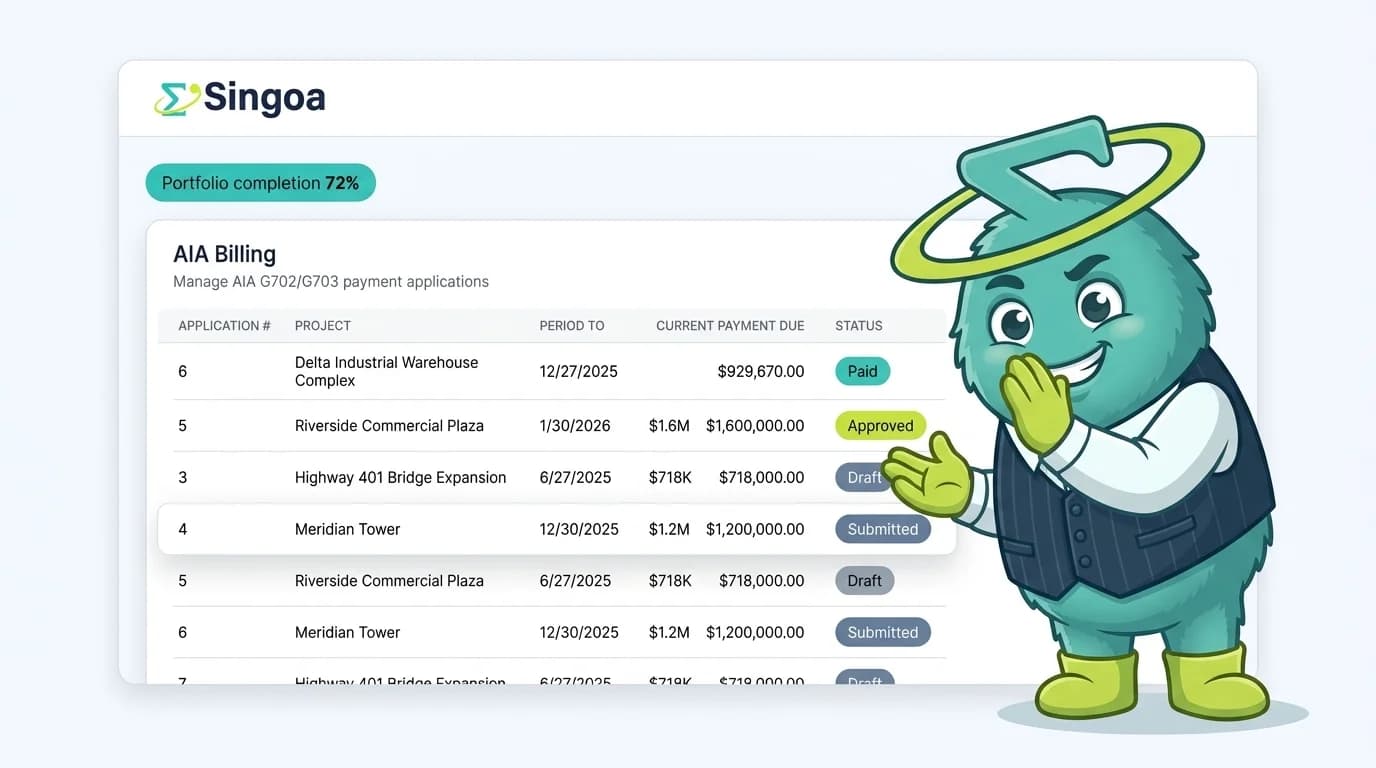
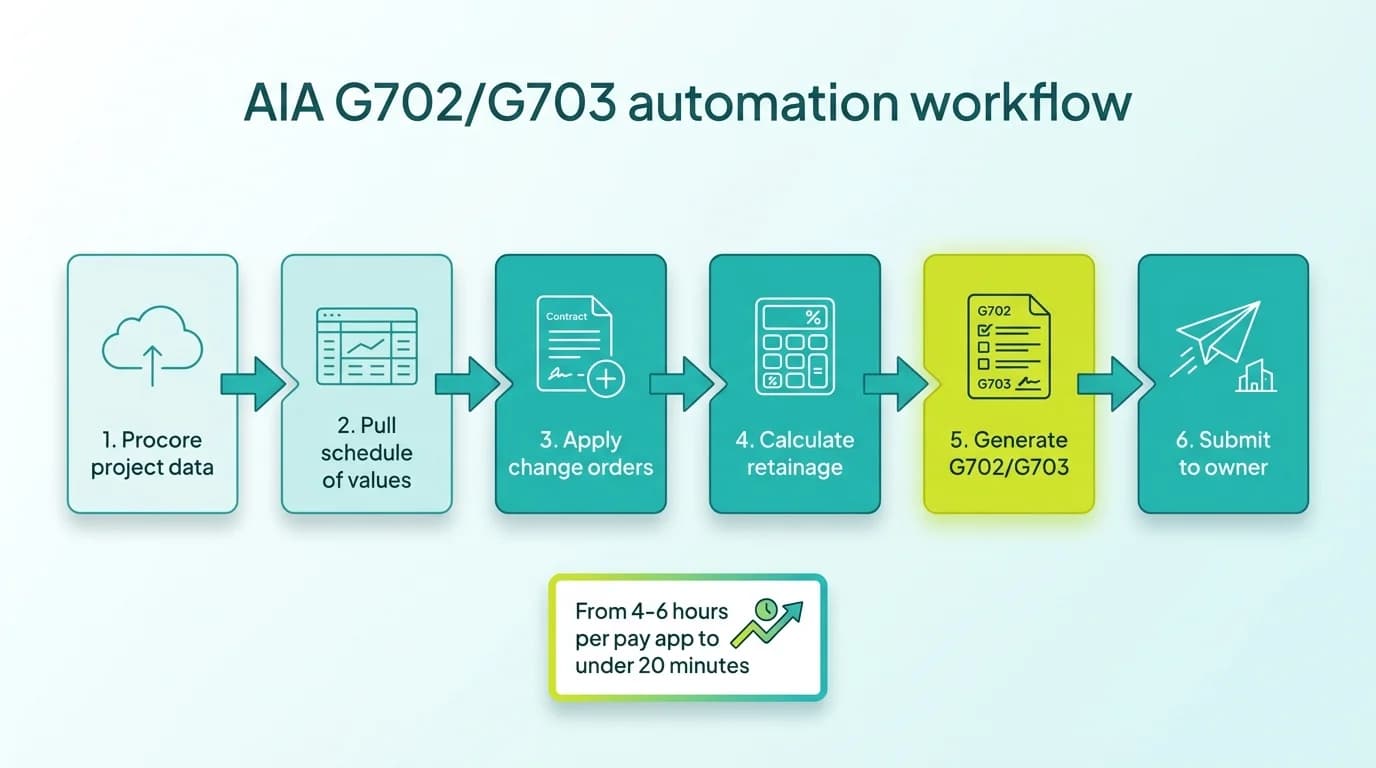
AIA pay applications are the most billing-intensive document format in any industry. A properly prepared G702 requires calculation of contract value to date, retainage amounts by SOV line item, net amount due, and certification of work completion percentage against each schedule-of-values line. For a commercial general contractor managing 30 active projects, preparing monthly pay applications manually consumes 60-150 staff hours per billing cycle. According to the AGC, 34% of these manually prepared applications are returned by the GC for errors or missing documentation, adding 2-4 weeks to the payment timeline for each rejection.
Automated AIA billing integrates directly with your project management system, Procore, Buildertrend, Sage 300 CRE, or Viewpoint Vista, to pull current completion percentages, stored materials data, and approved change orders in real time. The system generates G702 cover sheets and G703 continuation sheets automatically, calculates all amounts to AIA specifications, and submits pay applications through GC portals including Oracle Textura, Procore Pay, and GCPay without manual data re-entry. A 2025 Levelset survey found that spreadsheet-based billing produces an average of 4.2 errors per pay application. Automated generation eliminates these errors at the source.
The downstream impact is measurable. Rejection rates from formatting errors drop from 15-20% (manual) to under 2% (automated) because the system applies AIA formatting rules consistently on every submission. According to Archdesk's 2026 analysis, GC approval times improve 40-60% when pay applications arrive correctly formatted and complete on first submission. For a $25M contractor submitting 30 monthly pay apps, eliminating one rejection cycle per month accelerates cash collection by $200,000-$400,000 in any given 90-day period.
The biggest savings from pay application automation are not in staff hours. They are in the elimination of float. Every day a pay application sits in revision adds another day of DSO. A contractor with $30M revenue and 83-day DSO carries $6.8M in outstanding receivables. Reduce that cycle by even 10 days through error-free submissions and you free $822,000 in working capital. That is money that was always yours but trapped in the approval pipeline.
Retainage Tracking and Automated Release Management
Track every dollar of retainage across all projects with automated release requests triggered at contractual milestones, recovering funds that manual processes leave outstanding for months or years.
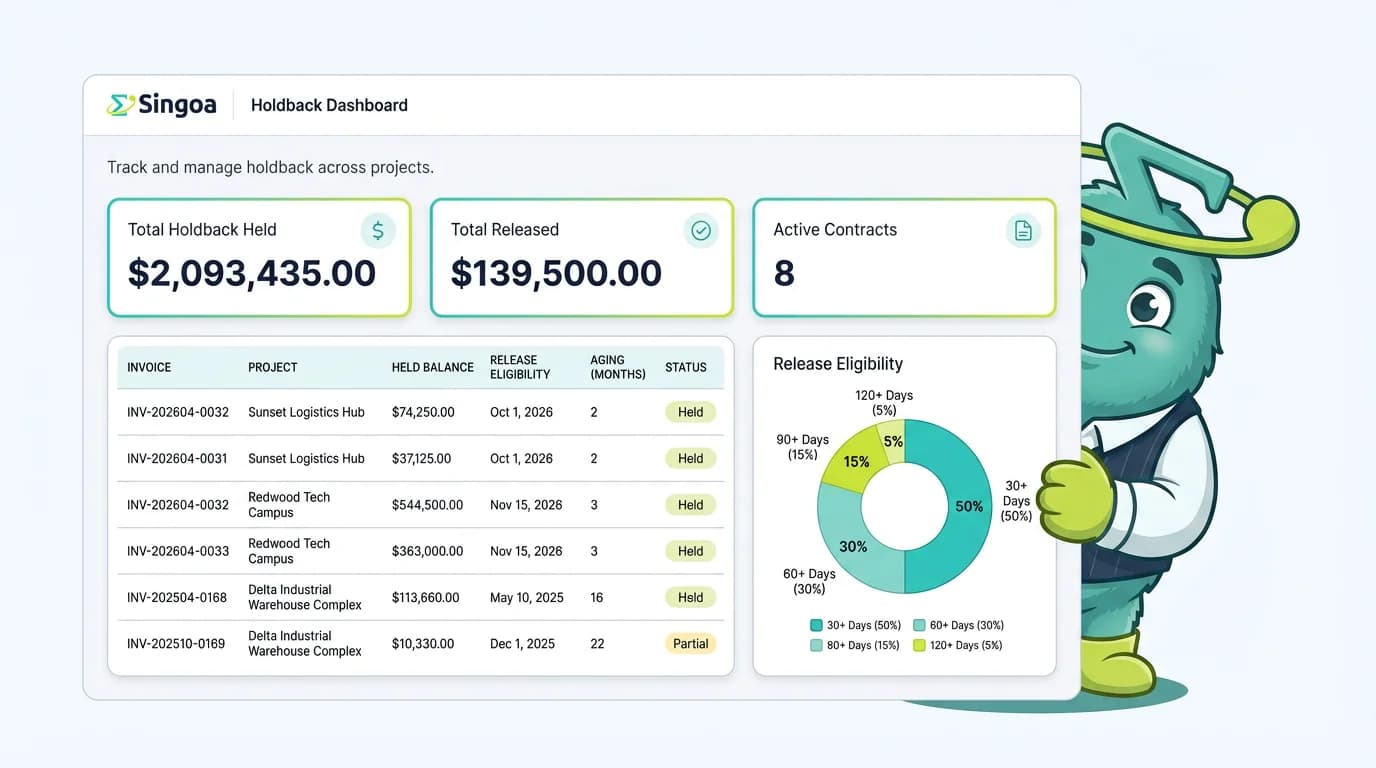
Retainage creates a shadow receivables portfolio that most construction firms manage poorly. A mid-market general contractor with 40 active projects may have $800,000 to $2M in outstanding retainage at any given time, spread across dozens of contracts with different completion percentages and release conditions. According to a Levelset/ASCA survey, 52% of subcontractors report retainage held past contractual release dates. In manual tracking environments, retainage outstanding beyond 6 months post-substantial-completion frequently goes unresolved and becomes a de facto write-off that nobody notices until year-end reconciliation.
Automated retainage management maintains a dedicated retainage ledger for every contract, tracking withheld amounts by pay application, release conditions by contract type, substantial completion, final completion, or punch list clearance, and aging from the project completion date forward. The system generates automatic release requests when completion conditions are certified and sends escalating follow-up reminders for retainage not released within contracted timelines. Retainage reform is accelerating across the country: California's SB 61 caps private project retention at 5% starting January 2026, Iowa reduced public project retainage from 5% to 3% in July 2025, and New York enacted its 5% retainage cap in 2023. Automated tracking adapts to these changing state requirements automatically.
The financial case is compelling. Construction firms using automated retainage management recover 15-20% more retainage within 12 months of project completion compared to spreadsheet-based tracking. For a contractor averaging $5M in annual retainage outstanding, that represents $750,000 to $1M in additional annual cash collection. That recovered capital funds equipment purchases, bond premiums, and project mobilization costs that would otherwise require credit line draws at current interest rates of 7-9%.
Watch AIA G702/G703 Billing Run Live
15-minute walkthrough of automated pay app generation from Procore data, retainage release workflows, and 50-state lien deadline tracking.
Electronic Lien Waiver and Mechanics Lien Deadline Management
Generate, deliver, track, and archive conditional and unconditional lien waivers electronically while monitoring filing deadlines across all 50 states, eliminating paper exchange delays and legal exposure.
Lien waivers are a legal prerequisite for payment release on virtually every commercial construction contract. General contractors require conditional lien waivers before releasing payment and unconditional waivers upon payment receipt. For a subcontractor managing 30 active projects, generating and exchanging paper waivers consumes 10-20 hours of administrative time monthly. But the real cost is not the labor, it is the delay. Lost or misfiled waivers are the single most frequently cited reason GCs give for holding payment. According to CFMA 2025 data, proper lien waiver management reduces payment disputes by 52% on commercial projects. The same survey found that 67% of commercial GCs now use digital lien waiver platforms, up from 38% in 2023.
Electronic lien waiver management generates the appropriate waiver type, conditional or unconditional, progress or final, automatically based on pay application and payment status. Waivers are delivered to GCs via email or direct portal submission with delivery confirmation and read tracking. The system maintains a searchable archive indexed by project, contract, pay application number, and date, eliminating the common scenario where a GC requests a previously-submitted waiver that was misfiled or lost in a shared drive. States requiring notarized waivers are handled through integrated electronic notarization services, reducing the 3-5 day delay for physical notarization to same-day processing.
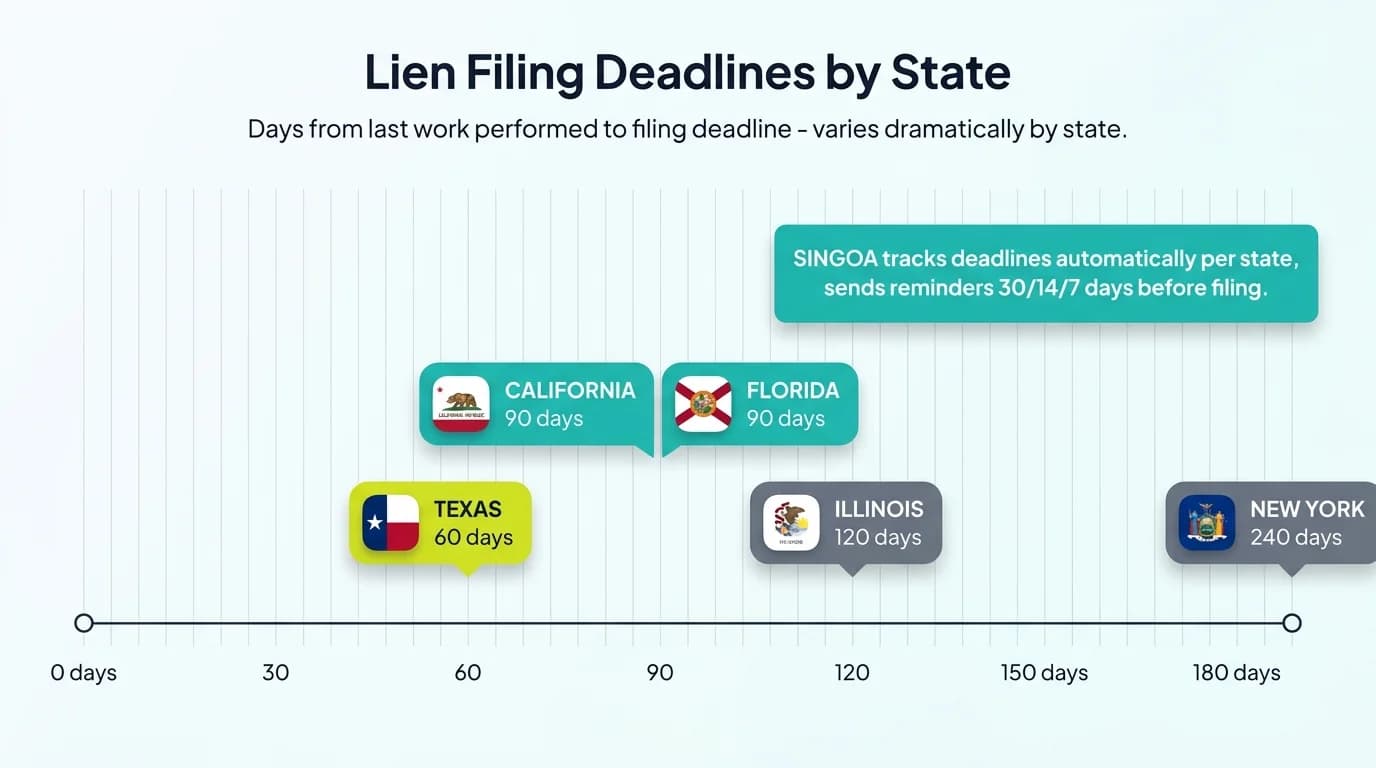
The stakes get higher than delayed payments. Mechanics lien deadlines vary by state, project type, and contractor tier. Missing a filing deadline means forfeiting your legal right to payment entirely. Texas requires original contractors to file lien affidavits by the 15th day of the fourth month after work completion. California preliminary notice deadlines differ for public versus private projects. Construction AR automation platforms like [SINGOA](/industries/construction) maintain a continuously updated lien law database covering all 50 states and auto-populate deadlines for every project at creation. Automated reminders at 30, 14, and 7 days before each deadline ensure that no filing window closes without action. That protection is worth far more than the cost of any AR platform.
Change Order Reconciliation: Capturing the Revenue You Already Earned
Ensure every approved change order is billed before each pay application submission, capturing the 2-5% of annual revenue that manual AR processes routinely miss.
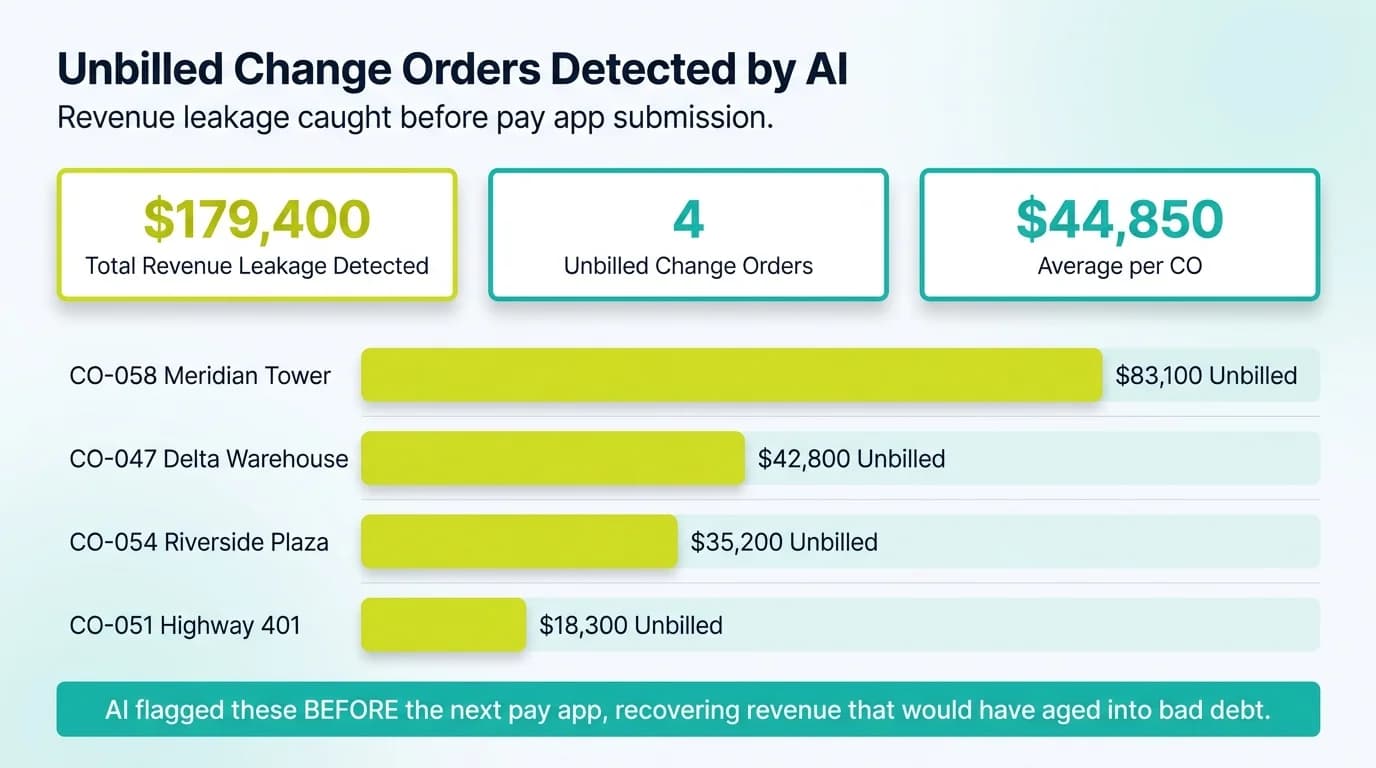
Change orders are the most profitable work in construction, priced at a premium and often completed faster than base contract scope. They are also the most likely revenue to go unbilled in manual AR systems. A project manager approves a change order verbally, the paperwork gets delayed, and the work gets absorbed into base contract billing without a separate line item. According to CFMA, unbilled change orders represent 2-5% of annual revenue for mid-market contractors with manual AR processes. For a $25M revenue contractor, that is $500,000 to $1.25M in earned revenue that never generates a pay application. According to ENR, 35% of contractors experience delayed payments or disputes specifically due to poorly managed change order documentation.
Automated change order reconciliation integrates with project management systems to capture all approved change orders and flag any that have not been submitted in the current billing cycle. Before each pay application submission, the reconciliation engine compares approved COs against your current SOV. Any approved CO not included in the current billing appears on a pre-submission variance report showing potential revenue leakage. This closed-loop tracking ensures that every approved change order generates a billing entry and every billing entry receives payment follow-up. Construction firms operating on margins of 5% or less cannot afford to leave 2-5% of revenue uncaptured, that is the difference between profitable growth and operating at break-even.
Beyond billing completeness, automated change order tracking provides real-time pipeline visibility: how many COs are in negotiation, how many are approved awaiting billing, and how many are billed awaiting payment. This pipeline view gives CFOs accurate cash flow forecasting that includes change order revenue, not just base contract billing. According to MGI Research, automating and centralizing billing processes recovers up to 80% of revenue that would otherwise leak through manual process gaps. For construction specifically, change order reconciliation is where the largest dollar recovery occurs because the work is already complete and the approval already exists, the only missing step is the billing entry.
Construction ERP and Project Management Integrations
AR automation for construction requires native bidirectional integration with both your accounting ERP and project management platform. CSV imports and manual data transfers defeat the purpose, real-time sync is the baseline requirement.
Procore
Bidirectional sync of project completion data, SOV line items, change orders, and contract values. Direct pay application submission through Procore Pay with status tracking and GC notification.
Sage 300 CRE
Real-time sync with Sage Construction for contract billing, job cost data, retainage ledger balances, and payment posting. AIA pay applications generated from Sage project data automatically.
Viewpoint Vista
AIA billing data pulled directly from Viewpoint job cost modules with automatic schedule-of-values synchronization and change order reconciliation.

Oracle Textura
Direct submission of pay applications and lien waivers to Oracle Textura Payment Management, the most widely used GC payment portal for commercial construction.

Foundation Software
Construction-specific ERP integration with job cost, project management, and payroll data sync for accurate billing calculations and certified payroll attachment.

Buildertrend
Project completion data, daily logs, and change order sync for residential and light commercial contractors using Buildertrend as their primary project management platform.
Construction AR Compliance: Laws and Regulations That Affect Your Billing
Construction billing operates within a specific legal and contractual framework that varies by state, project type, and contractor tier. AR automation must handle these compliance requirements natively, not as an afterthought bolted onto a generic platform.
State Prompt Pay Laws
Most states have Prompt Pay statutes requiring payment within 7-30 days of pay application approval. Timelines vary: California mandates 30 days for private projects, while federal Miller Act projects require 7 days. AR automation tracks GC payment timelines against state-specific prompt pay requirements and calculates statutory interest penalties for late payments automatically.
Mechanics Lien Rights Preservation
Preserving lien rights requires preliminary notice filing and strict lien deadline compliance by state and contractor tier. Texas requires original contractors to file by the 15th day of the fourth month after completion. California deadlines differ for public versus private projects. Missing a single deadline forfeits your legal right to payment. AR automation tracks every deadline by project and jurisdiction with automated escalation alerts.
Retainage Reform Compliance
Retainage regulations are changing rapidly. California SB 61 caps private project retention at 5% starting January 2026. Iowa reduced public project retainage from 5% to 3% in July 2025. New York enacted a 5% cap in 2023. Illinois has enacted three retainage reform laws in six years. AR automation must track contract-specific retainage rates against evolving state maximums and flag non-compliant withholding.
Certified Payroll and Prevailing Wage
Public works projects require Davis-Bacon Act compliance with certified payroll submission alongside pay applications. State-specific forms (California DIR, New York) add additional requirements. AR automation attaches certified payroll documentation to pay applications automatically and validates completeness before submission.
ROI of AR Automation for Construction Companies
Construction firms implementing AR automation consistently achieve three categories of financial improvement: reduced collection time through error-free billing, recovered unbilled revenue through change order reconciliation, and accelerated retainage recovery through automated release management. Based on platform data across mid-market construction clients, the combination typically delivers 400-600% ROI in year one for contractors with $10M or more in annual revenue and 20 or more active projects.
The most significant ROI driver is often the one CFOs least expect: change order billing completeness. A $25M revenue contractor with 3% unbilled change orders is leaving $750,000 per year in earned revenue uncaptured. Automated change order reconciliation identifies and captures this revenue at zero additional labor cost, it is pure margin improvement with no offsetting expense. Combined with the working capital freed by reducing DSO from 83 to 55 days, the total financial impact exceeds what most construction firms expect from any single technology investment.
Consider the math for a $30M general contractor: reducing DSO by 28 days frees $2.3M in working capital. Capturing 3% in previously unbilled change orders adds $900,000 in annual revenue. Recovering retainage 40% faster releases an additional $400,000-$600,000 annually. Against a per-pay-application cost of $1-3 and no setup fees, the payback period is measured in weeks rather than months. That ROI calculation does not even include the 70-80% reduction in AR staff time spent on manual [pay application preparation](/features), which frees your billing team to focus on dispute resolution and GC relationship management rather than data entry. AR automation platforms built for construction, like [SINGOA's construction-specific solution](/industries/construction), deliver these returns because they understand the unique billing workflows that generic AR tools simply cannot handle.
28 days
Average DSO reduction for construction companies using AR automation (83 to 55 days)
Industry platform benchmarking data, 2025
2-5%
Additional revenue captured annually from automated change order billing completeness
Construction Financial Management Association, 2025
70%
Reduction in AIA pay application preparation time with automated generation
AR automation implementation data, 2025
$750K-$1M
Retainage recovery improvement in first 12 months for a $25M contractor
Mid-market contractor case data, 2025
91%
Pay application rejection rate reduction from manual to automated billing
Archdesk 2026 AIA Billing Analysis
- 28-day DSO reduction from 83 to 55 days frees $2.3M in working capital for a $30M revenue contractor, capital that was always earned but trapped in the approval pipeline
- AIA billing preparation time drops from 120 to 36 staff hours per monthly billing cycle, saving 84 hours that your team redirects to dispute resolution and GC relationship management
- Change order billing completeness adds 2-5% incremental revenue, the highest-margin revenue in construction because the work is already complete and the approval already exists
- Retainage recovery timeline compresses from 6-18 months post-completion to 3-6 months through automated release requests and escalation at contractual milestones
- Lien waiver automation eliminates the number-one GC-cited reason for payment delays, reducing payment disputes by 52% according to CFMA 2025 data and accelerating approval cycles by 40-60%