
Why higher-ed AR is broken (and what modern looks like)
It is 7:45 PM on the last business day of January, and somewhere in a bursar's office, three people are still verifying that 8,400 students received their 1098-T forms. The SIS exported the QTRE figures at noon, the cashiering vendor's portal locked at 5, and the spreadsheet reconciling Pell disbursements to Box 5 is on its fourth revision. This is not an outlier. Across U.S. higher education, the IRS reports student delivery deadlines of January 31 every year, and most institutions still treat the run-up as a controlled fire drill.
Federal Student Aid pegs outstanding student debt at $92 billion as of 2024, and NACUBO benchmarks show manual student collection rates parked at 45%, a write-off rate near 28%, and aid reconciliation that eats 4.2 hours per student each term. Those numbers come from real bursars surveyed across regional universities and community colleges, not from a vendor brochure. The cause is structural: tuition billing lives in three places at once.
Walk into any mid-sized regional university bursar's office and you will find the same architecture. The SIS holds enrollment, charges, and financial aid awards. A separate cashiering vendor accepts payment but pushes settlement back on a nightly batch. A third spreadsheet tracks collections follow-up, holds, and exceptions. Each system claims to be the source of truth, and none of them agrees with the others by Friday afternoon. The bursar spends Monday morning reconciling the gaps before any new work can start. Get the [education industry AR overview](/industries/education) and you can see how the stack fits together.
$92B
Outstanding U.S. student debt
Federal Student Aid, 2024
45%
Manual student collection rate baseline
NACUBO Student Accounts Benchmarking
82%
Automated student collection rate (best-in-class)
NACUBO + SINGOA education benchmarks
4.2 hrs
Aid reconciliation time per student (manual)
Ellucian benchmark
38 days
Education industry DSO baseline
SINGOA education reference data
Common Pain Points
- Three-system sprawl across SIS (Banner, Workday Student, PeopleSoft), cashiering tools (TouchNet, Nelnet, Flywire, Transact), and manual collections spreadsheets that disagree by Friday afternoon
- Manual student collection rates stuck at 45% with write-off rates near 28%, leaving a 6,000-student institution carrying seven-figure annual revenue leakage
- Aid reconciliation consuming 4.2 hours per student each term, equivalent to a full FTE for a 6,000-student institution
- 1098-T season treated as an annual fire drill, with QTRE pulled from one system, Box 5 reconciled in spreadsheets, and student delivery scrambling toward the January 31 deadline
- Three holds (transcript, registration, diploma) tracked in spreadsheets that the registrar cannot see in real time at the student services counter
- FERPA authorized-user access handed off via shared student usernames, which fails the federal consent standard before the first parent payment posts
Industry Terminology Guide
See your bursar-office automation ROI
Plug in your enrollment, tuition revenue, and current collection rate to see what 82% automation translates to in recovered receivables.
The three pillars of modern tuition billing
The bursar evaluating vendors should organize the conversation around three pillars: SIS integration depth, FERPA-compliant authorized-user workflows, and 1098-T automation. Each pillar maps to a specific operational risk, and each has a concrete vendor-evaluation rubric.
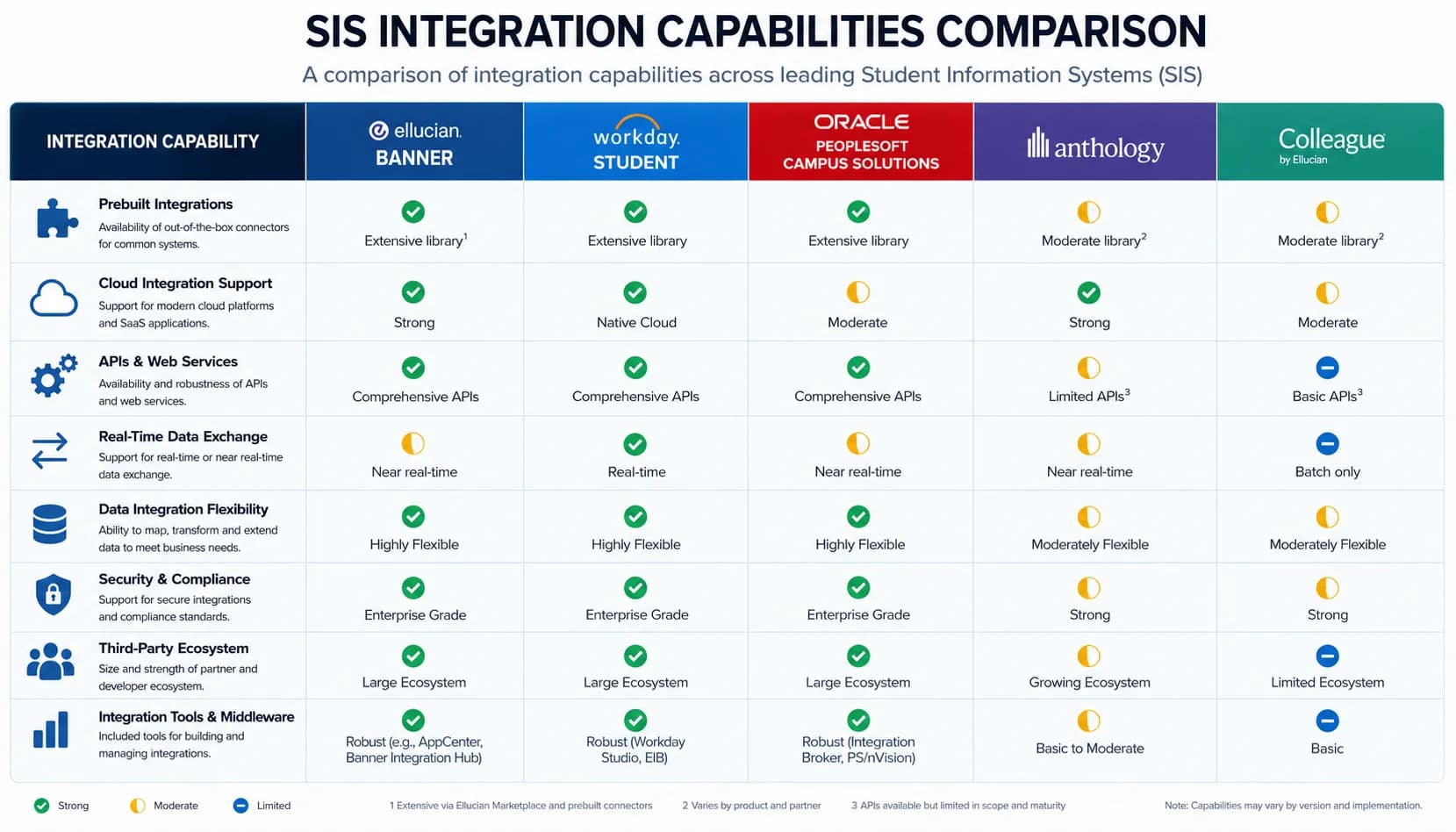
Pillar 1: SIS integration - Banner, Workday Student, PeopleSoft, Anthology
Modern tuition billing platforms integrate with the SIS via real-time REST APIs to sync demographics, registration, charges, aid, holds, and refunds bidirectionally, eliminating the nightly CSV exports that cause aid reconciliation delays.
The first question to ask any tuition billing vendor is which API they use, not which SIS they support. Ellucian Banner exposes student data through Ethos, a REST-based platform that supports near real-time reads and writes. Workday Student offers a Student API distinct from the HCM API used for employee data. PeopleSoft Campus Solutions ships with Integration Broker, which supports both REST and SOAP. Anthology offers a REST API for its Student Information System product. If a vendor pitches 'CSV import nightly' as the integration story, the project will look like the spreadsheet swamp it claims to replace.
Six data objects must move in both directions. Student demographics flow from the SIS to the billing layer. Term and course registration arrive on enrollment events. Charges post from the SIS or from the billing system depending on the institution's design. Financial aid awards flow in as credits. Holds (registration, transcript, diploma) need to write back to the SIS so the registrar sees them at the student services counter. Refunds flow back to the SIS to close the loop on R2T4. A vendor that handles five of six is not enough. Find the gap and it becomes manual work.
Integration depth comes in five levels: read-only batch, read-only API, bidirectional batch, bidirectional API, and bidirectional API with hold writeback plus event-driven webhooks. Only the top two levels support the operational tempo a modern bursar's office needs. Platforms with [50+ integrations including Banner and Workday Student](/integrations) can typically reach level four or five out of the box. The real question is whether the vendor will commit to those depths in the SOW, or whether they will quietly downgrade during implementation.
Pillar 2: FERPA-compliant authorized-user and parent-pay workflows
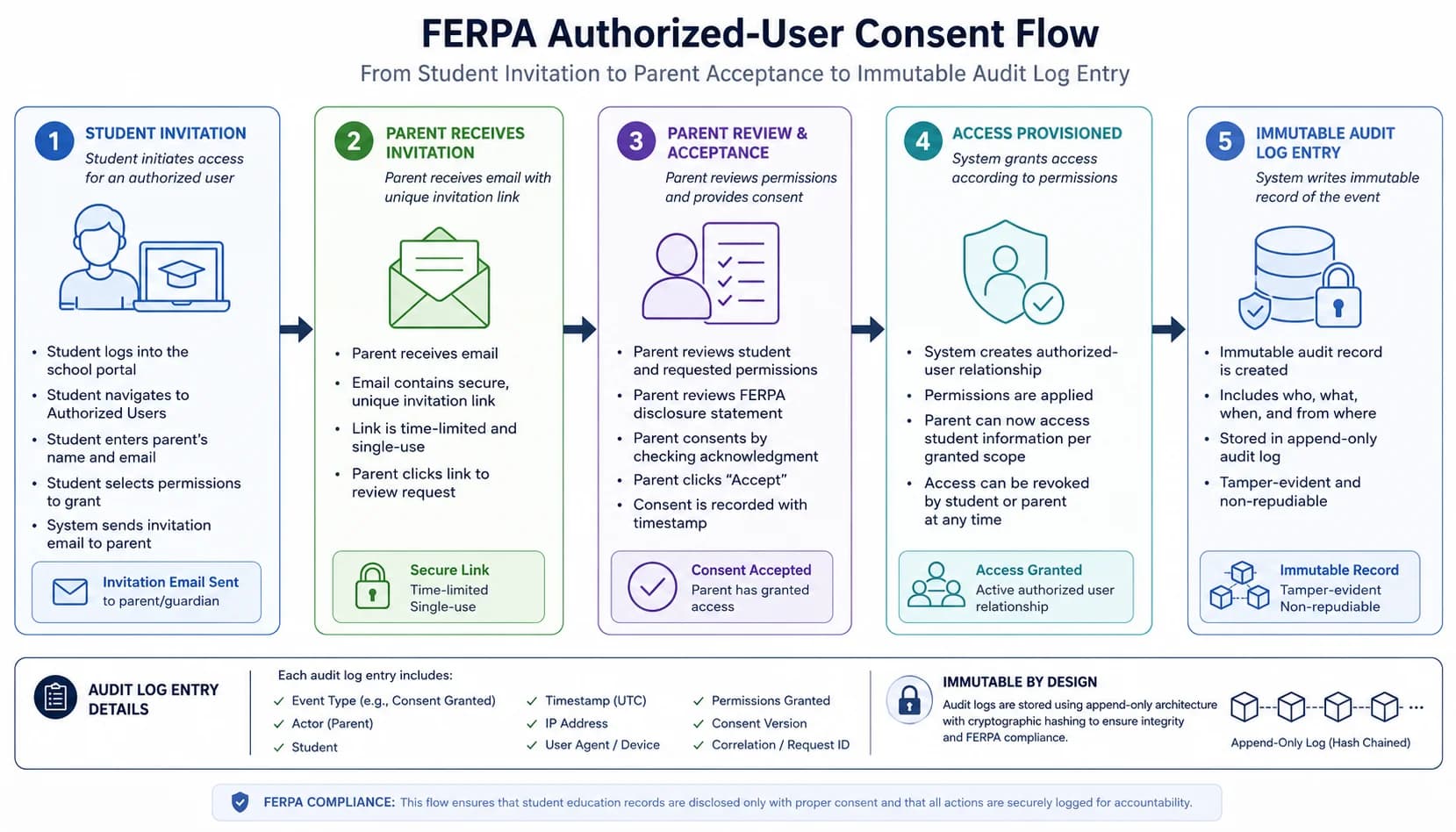
FERPA-compliant student billing requires explicit student consent before any parent or third party can view tuition account details, an immutable audit log of every access event, and the ability to revoke authorization at any time.
The Family Educational Rights and Privacy Act treats every dollar of student-level financial data as protected. The U.S. Department of Education's [SINGOA's compliance posture (FERPA, GLBA, SOC 2)](/compliance) guidance is explicit: a parent does not have automatic access just because they pay the bill. The student must consent. That consent must be specific (which records can be viewed), time-bounded (typically expires end-of-term or end-of-academic-year), and revocable on demand. A platform that issues a shared username and password to mom and dad is failing the standard before the first payment posts.
The correct workflow starts inside the student portal. The student initiates an invitation, selects which data the authorized user can see (charges only, charges plus financial aid, charges plus aid plus academic holds), and sets an expiration date. The system emails the authorized user a unique invitation. They accept, create their own credentials, and gain scoped access. Every page view, every download, and every payment touch lands in an immutable audit log keyed to the authorized user, not the student. Auditors look for this log first.
GLBA Safeguards Rule overlaps with FERPA on the financial-data side. The 2023 amendments require institutions to inventory the systems holding student financial data, encrypt customer information at rest and in transit, and run annual penetration tests. A FERPA-compliant authorized-user flow without GLBA-grade controls underneath is a half-built compliance story. Bursars should ask vendors for their SOC 2 Type II report, their GLBA self-assessment, and the FERPA training materials they ship for student-services staff.
Built for the bursar's office
SINGOA connects Banner, Workday Student, and PeopleSoft, automates 1098-T filing, and ships with FERPA-compliant authorized-user workflows out of the box.
Pillar 3: 1098-T automation - QTRE, deadlines, and the 10-form e-file threshold
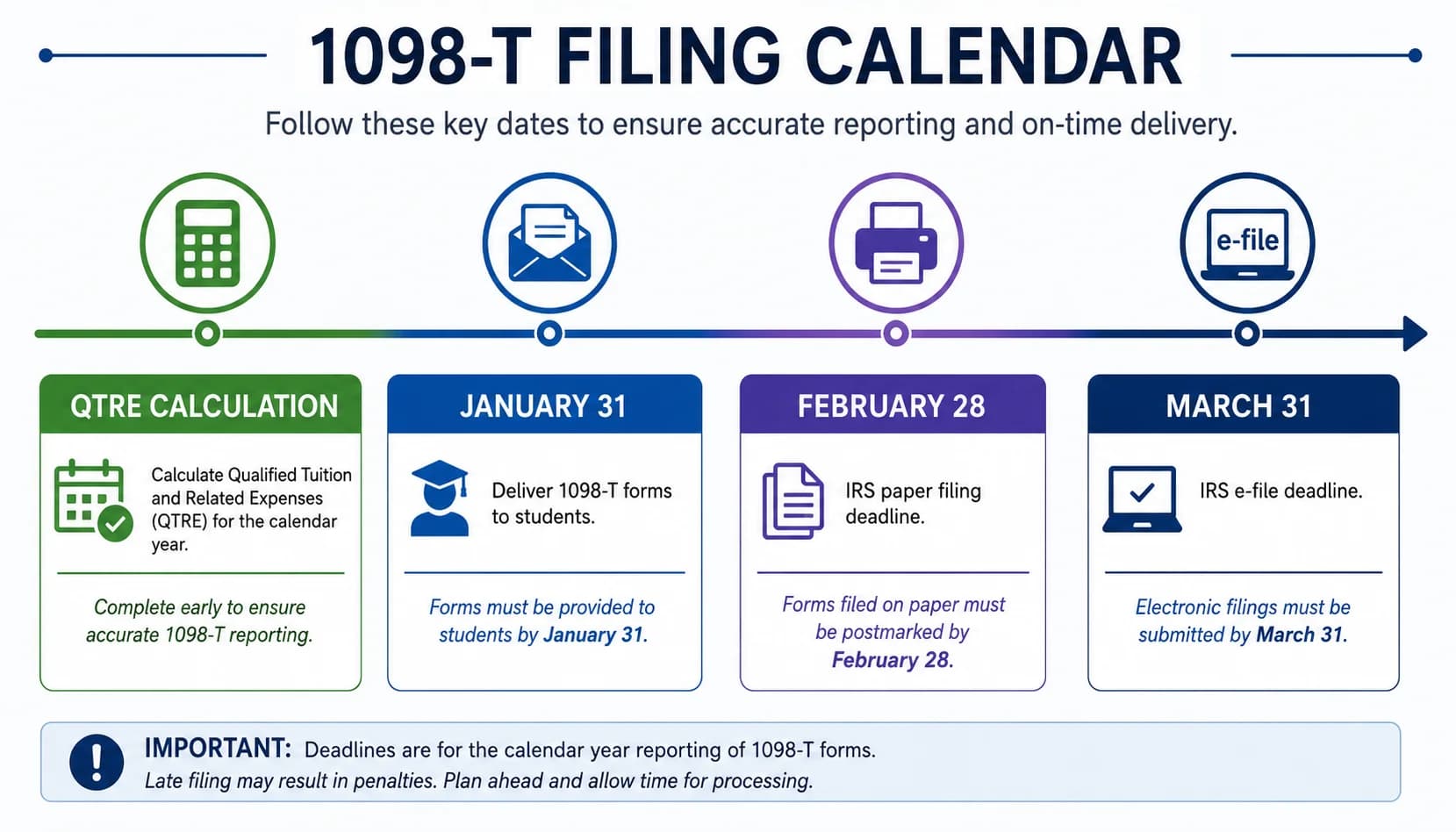
Automated 1098-T filing pulls QTRE from the SIS, calculates Box 1 and Box 5, delivers student copies by January 31, and e-files with the IRS by March 31. The 10-return e-file threshold applies to nearly every accredited institution.
The IRS draws a hard line between QTRE and everything else. Tuition counts. Required fees for enrollment count. Lab fees and required course materials count when they are mandatory for attendance. Room and board do not. Health insurance does not. Optional services do not. Box 1 reports payments received during the calendar year, Box 4 captures adjustments to prior-year amounts, Box 5 reports scholarships and grants administered by the institution, and Box 6 catches scholarship adjustments. A 1098-T that miscategorizes a $2,400 mandatory lab fee can cost a family their American Opportunity Credit.
The calendar is unforgiving. Student delivery is January 31. Paper filing with the IRS is February 28. Electronic filing is March 31. Thomson Reuters Tax has tracked the e-file threshold steadily downward, and at 10 returns under current regulations, virtually every accredited institution must file electronically. That requires a Transmitter Control Code from the IRS, which can take 45 days to issue if you have not already applied. Bursars who discover the TCC requirement in mid-January end up scrambling for an outside filer.
Automation closes the gap. The platform pulls QTRE from the SIS, applies the IRS rules to separate tuition from room and board, calculates Box 1 against payments received, and generates the student-delivered PDF with TIN masking. It also produces the IRS submission file in the required format. Students can opt into electronic delivery, which the IRS allows under specific consent rules. The system retains the audit trail for the seven-year period the IRS expects. Get this right once and the next tax season looks like a routine run, not a fire drill.
Industry overview: bursar terminology and the higher-ed AR stack
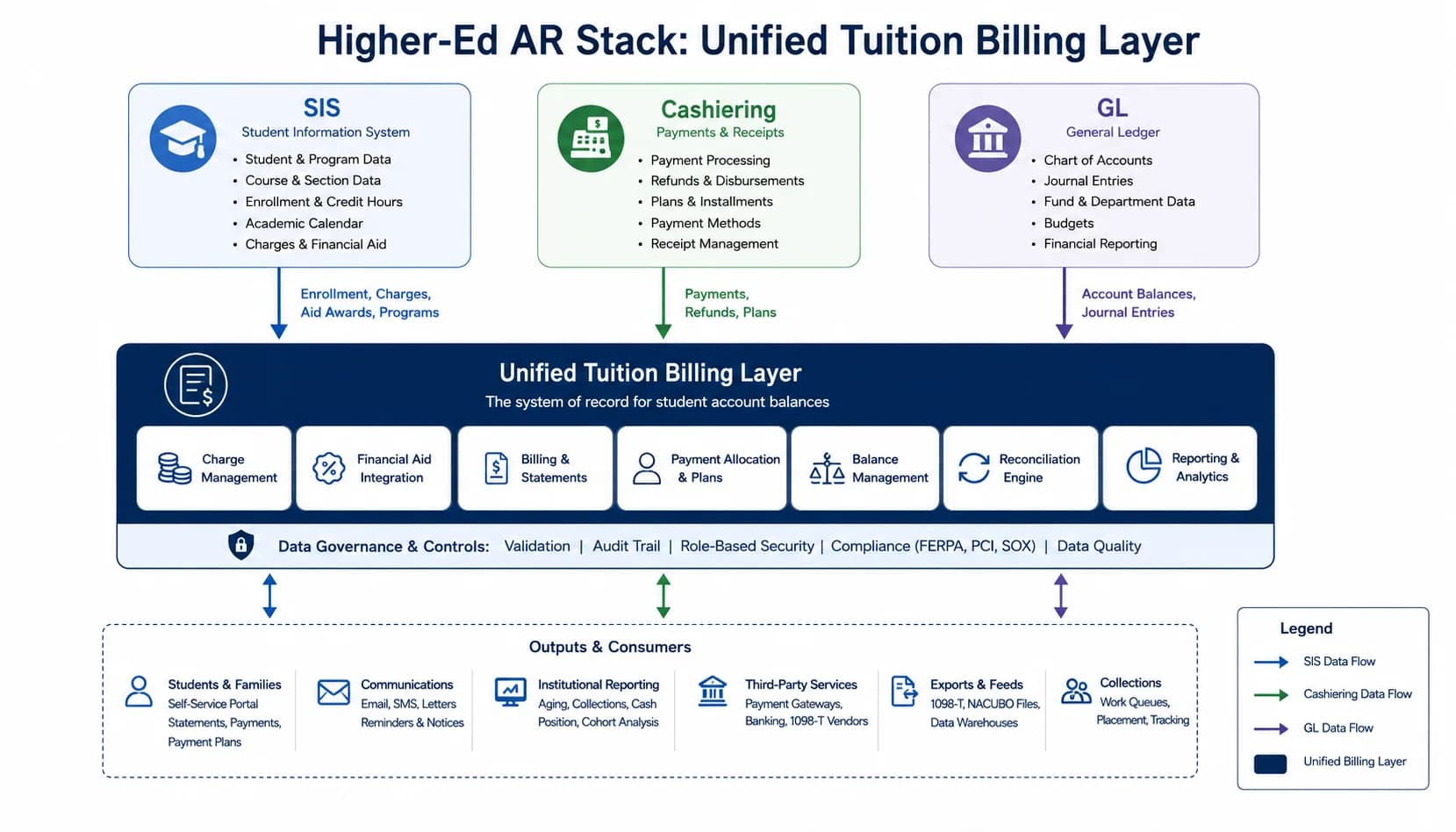
The higher-ed AR stack centers on the SIS as system of record, a cashiering layer, and a general ledger. Native bursar terminology (QTRE, R2T4, SAP holds, COA) maps directly to standard AR concepts.
Before evaluating vendors, the terminology has to be precise. A tuition statement is the equivalent of an invoice but governed by FERPA. QTRE (qualified tuition and related expenses) is what goes in 1098-T Box 1, and it excludes room, board, and insurance. R2T4 (Return to Title IV) is the federal calculation that fires when a student withdraws before completing 60% of a term. SAP (Satisfactory Academic Progress) drives the hold that blocks further federal aid disbursement. COA (Cost of Attendance) anchors every aid award.
Three holds drive collections in higher ed. A transcript hold prevents the student from sending official transcripts to a transfer school or employer. A registration hold blocks the next term's course enrollment. A diploma hold delays the credential at graduation. Bursars rank these by leverage: registration holds collect during late summer and early winter, transcript holds collect from alumni applying to graduate school, and diploma holds collect at commencement. EAB Student Financial Services research consistently shows registration holds as the single highest-yield collection lever.
Map the vocabulary to AR concepts and the pieces line up. A tuition statement is an invoice. A QTRE line is a billable item. A financial aid award is a credit memo. A payment plan is an installment schedule. The SIS vendors that own this layer are concentrated: Ellucian (Banner and Colleague) covers roughly half of U.S. institutions, Workday Student is growing in mid-market private colleges, and PeopleSoft Campus Solutions remains entrenched in larger public universities. Anthology serves a broad community-college base.
Tuition billing vendor scorecard: a 12-line RFP checklist
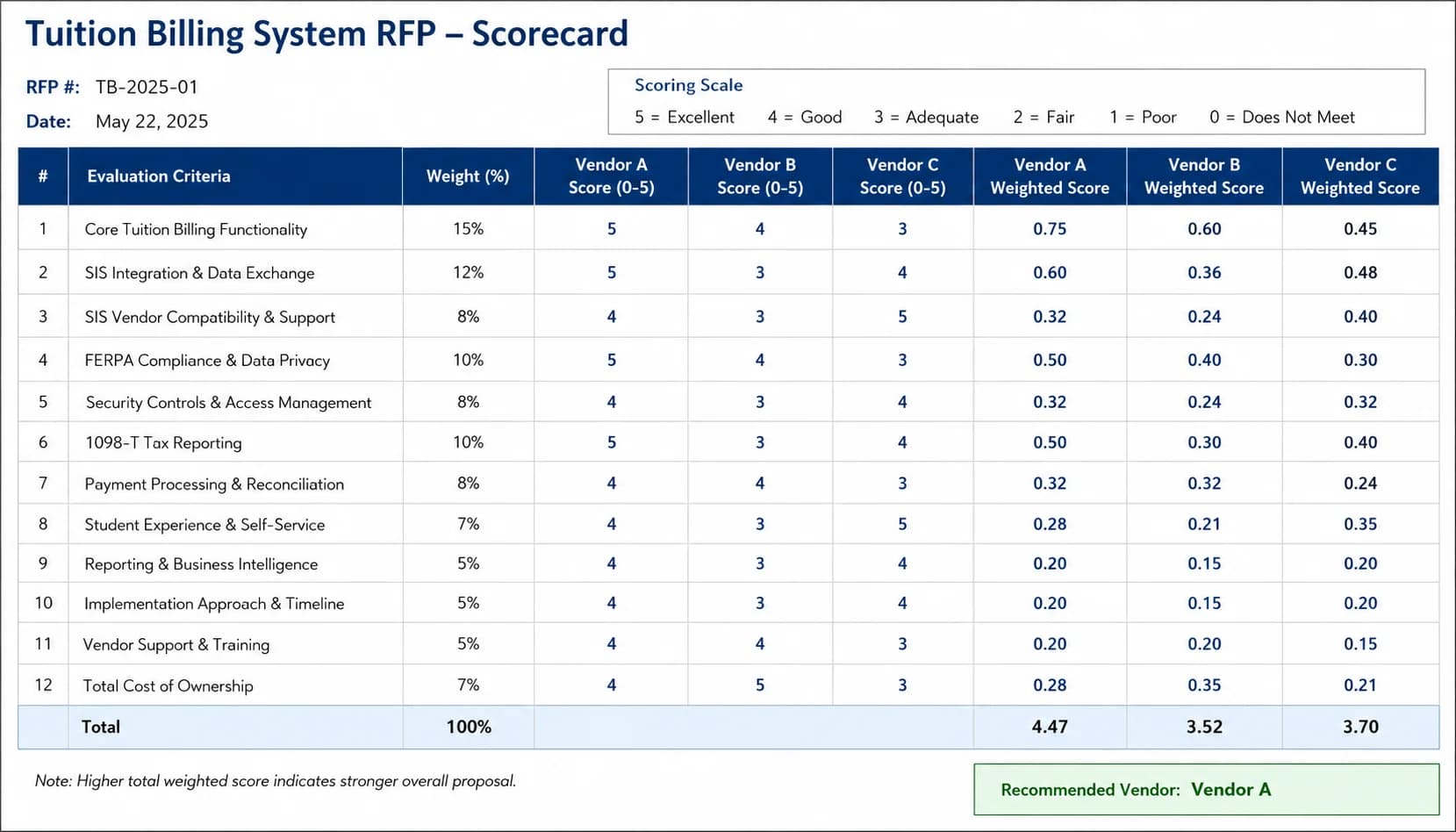
A tuition billing RFP scorecard should rate vendors on 12 criteria mapped to the three pillars plus operational layers. Score every vendor against the same rubric before any demo.
The 12-line scorecard maps directly to the three pillars plus the operational layers around them. Pillar 1 covers SIS integration depth (real-time API versus batch CSV), R2T4 automation, and IPEDS-ready reporting. Pillar 2 covers FERPA authorized-user workflows, GLBA controls, and immutable audit logging. Pillar 3 covers 1098-T e-file support including TCC handling. Operational lines cover payment plan flexibility, parent and student portal UX, AI payment matching for student ACH and card payments, multi-campus support for consortium or system institutions, and a realistic implementation timeline. Solutions like SINGOA's payment matching and authorized-user portal score against these lines line-by-line.
Three red flags should disqualify a vendor before the demo. First, an SIS integration described as 'nightly CSV import' or 'we can map any export.' That is the spreadsheet swamp with a portal on top. Second, parent access via a shared student username and password labelled as 'FERPA-friendly.' It is not. Third, 1098-T delivery described as 'we mail forms January 31' with no mention of QTRE rules, electronic delivery consent, or e-file submission. Mail-only 1098-T flunks the IRS 10-return e-file requirement and forces every student into a paper experience they do not want.
Implementation timelines run 8 to 14 weeks for a clean Banner or Workday Student environment with one SIS instance, one cashiering tool, and one general ledger. Multi-campus consortia, custom GL chart-of-accounts mappings, and legacy data migrations push the timeline toward 16 to 20 weeks. Ask for references at institutions of similar size and SIS, and verify those references actually finished on time. See [SINGOA pricing](/pricing) for higher-ed package details before you write the SOW.
SIS, cashiering, and GL integrations
Higher-ed AR sits between the SIS as system of record, a cashiering layer that accepts payment, and a general ledger that books revenue. Mature tuition billing platforms ship native connectors for the entire stack.
Ellucian Banner
Real-time bidirectional Ethos REST integration for Banner 9; ODS-based connector for Banner 8 environments.
Ellucian Colleague
Native Colleague API integration covering demographics, charges, aid, holds, and refunds.
Workday Student
Workday Student API integration distinct from the HCM API, with event-driven webhooks for enrollment and withdrawal.
Oracle PeopleSoft Campus Solutions
PeopleSoft Integration Broker connector supporting both REST and SOAP for Campus Solutions 9.2 environments.
Anthology Student
REST API integration for the Anthology Student Information System, common at community colleges.
TouchNet, Nelnet, Flywire, Transact, CashNet
Cashiering and payment processor integrations covering domestic card and ACH, plus international student payment rails.
Workday Financials, PeopleSoft FSCM, Sage Intacct, QuickBooks
General ledger connectors that book tuition revenue, aid disbursement, and refunds to the correct chart-of-accounts segments.
Blackbaud and PowerSchool Higher Ed
Connectors for smaller private colleges and K-12-to-higher-ed institutions running Blackbaud or PowerSchool Higher Ed.
Compliance: FERPA, GLBA, Title IV, and IRS 1098-T
Higher-ed tuition billing platforms must satisfy four overlapping regulatory frameworks. Each maps to a specific control surface inside the product.
FERPA: authorized-user consent and audit logging
Student-initiated consent, scope limits, expiration dates, revocation on demand, and an immutable audit log of every access event keyed to the authorized user.
GLBA Safeguards Rule: financial data protection
Inventory of systems holding student financial data, encryption at rest and in transit, annual penetration tests, and incident response procedures under the 2023 amendments.
Title IV: R2T4, SAP holds, and federal aid reconciliation
Return to Title IV calculations within the 45-day federal window, SAP hold enforcement before further disbursement, and the federal aid waterfall (unsubsidized loans first, then subsidized, then Pell).
IRS 1098-T: QTRE, deadlines, and the 10-return e-file threshold
QTRE calculation excluding room and board, Box 1 against payments received, January 31 student delivery, March 31 IRS e-filing, and the 10-return mandatory e-file threshold under current regulations.
ROI: what bursars actually measure (and what good looks like)
Boards and CFOs do not respond to feature lists. They respond to a scorecard. The five metrics that move the needle in higher-ed AR are student collection rate, payment plan enrollment, write-off rate, aid reconciliation time per student, and DSO. NACUBO benchmarks and SINGOA's education reference data show manual baselines clustered at 45% collection, 20% payment-plan enrollment, 28% write-off, and 4.2 hours of reconciliation per student. Automated peers reach 82% collection, 68% payment-plan adoption, 6% write-off, and 18 minutes per student. Plug those into a 6,000-student model and the recovered receivables run into seven figures.
Payment-plan adoption is the single highest-leverage lever. Students who enroll in an installment plan default at a fraction of the rate of students who face a single end-of-term bill. The shift from 20% to 68% enrollment is not a marketing claim. It comes from making enrollment a default step at registration, with auto-debit and a fee structure students see before they commit. Pair that with a parent-pay portal and you move family contributions earlier in the term, reducing the registration-hold drama that consumes September. See the [DSO reduction strategies](/blog/reduce-dso-proven-strategies-2026) cross-reference for tactics that map directly to the bursar's office.
Translate the metrics into a board narrative. A 6,000-student regional university running at 45% manual collection on $80 million in annual tuition is leaving roughly $44 million on the table over a four-year cohort. Moving to 82% recovers $30 million of that. Pair the number with the staff redirect (the FTE freed from manual reconciliation gets to focus on financial counseling) and the story sells itself. Here is the part most bursars miss: the same scorecard becomes the audit-prep document because every metric ties to a controlled data source.
Title IV R2T4 is the highest-stakes calculation in the bursar's office because the federal government audits it. When a student withdraws before completing 60% of a term, the institution must determine the percentage of aid earned, return the unearned portion to the federal aid programs in a strict waterfall (unsubsidized loans first, then subsidized, then Pell), and close the file within 45 days. Federal Student Aid program reviews routinely cite institutions for R2T4 errors driven by stale Cost of Attendance tables, missed last-date-of-attendance entries, and arithmetic done in spreadsheets that nobody version-controls.
Automation rebuilds the calculation from the SIS, the financial aid award, and the attendance record. The system pulls the official last date of attendance, applies the institutional refund policy, calculates the percentage of the term completed, runs the waterfall, and posts the return to each federal program. The audit trail captures every input and every formula run, time-stamped and signed. Bursars who [scale AR without adding headcount](/blog/scale-ar-operations-without-adding-headcount) consistently cite R2T4 automation as the single highest-yield change they made. International students introduce edge cases the spreadsheets rarely handle well. F-1 and J-1 visa holders carry I-20 or DS-2019 documents that must be updated when financial holds appear. Health insurance is often mandatory and must roll into QTRE differently than for domestic students. Sponsored billing for embassy or government payers requires third-party invoicing outside the student portal.
45% to 82%
Student collection rate (manual baseline to automated peer)
NACUBO + SINGOA education benchmarks
20% to 68%
Payment plan enrollment (manual to automated)
SINGOA education reference data
28% to 6%
Student account write-off rate (manual to automated)
NACUBO Student Accounts Benchmarking
4.2 hrs to 18 min
Aid reconciliation time per student (manual to automated)
Ellucian benchmark
38 days
Education industry DSO baseline
SINGOA education reference data
$30M
Recovered receivables, 6,000-student regional university, four-year cohort
SINGOA model on $80M annual tuition base
- Move student collection rate from 45% manual to 82% automated, recovering seven-figure receivables at mid-sized institutions
- Shift payment plan enrollment from 20% to 68% by making installment plans the default step at registration with auto-debit
- Cut write-off rate from 28% to 6% through earlier intervention, parent-pay portal access, and SIS-synced hold enforcement
- Reduce aid reconciliation time from 4.2 hours per student to 18 minutes via SIS-integrated R2T4 calculation and waterfall posting
- Close R2T4 within the 45-day federal Title IV window with a complete audit trail of every input and formula run
- Turn 1098-T season from a fire drill into a routine processing run with automated QTRE extraction and IRS-format e-file submission
- Replace shared parent usernames with FERPA-compliant authorized-user workflows, eliminating consent-violation risk at every payment touch