
Why Freight and Logistics AR Is Broken: 52-Day DSO and 40% Accessorial Recovery
A $40M asset-based carrier out of Dallas closed the books last quarter with 52-day DSO, $180,000 in unrecovered detention charges, and 4.2% of every dollar going straight to a recourse factor. Their billing manager clocked 22 hours a week just chasing brokers. None of those numbers are outliers. The Transportation Intermediaries Association pegs average freight DSO at 52 days in its 2024 Freight Payment Benchmark, and DAT reports carriers recover only 40% of documented accessorials.
Freight AR is not slow because carriers are careless. It is slow because the invoice cycle sits on top of documents that never talk to each other. The BOL comes back from the shipper, the POD from the receiver, the rate confirmation from the broker, and each one lives in a different inbox or scanning queue. Read that number alongside the [AR KPIs every CFO should track](/blog/accounts-receivable-kpis-cfo-track) and the working capital cost becomes obvious fast.
Accessorial leakage is the second wound. DAT's 2024 Accessorial Benchmark pegs baseline recovery at 40% of earned charges, and the American Trucking Associations estimates the industry-wide loss at $7.2 billion a year. Detention runs the driver over 3 hours, the ELD records the dwell, but nothing turns that dwell into a claim. Lumper receipts get lost. Layover charges get argued away over the phone. TONU fees vanish because the broker cancellation email never made it onto the invoice as a separate line.
Then the disputes hit. The NPTC 2023 Freight Invoice Accuracy Study measured a 14% dispute rate across carrier invoices, meaning roughly one in seven bills gets kicked back before payment. Each kickback resets the aging clock, drops the load into a manual queue, and burns another 20 to 40 minutes of billing staff time. SINGOA's transportation customer analysis puts total manual AR time at 22 hours a week for a mid-market carrier. A carrier waiting 52 days to collect, losing 60% of accessorials, and disputing 14% of loads has no choice but to factor. Universal recourse factoring at 3-5% then eats the retained margin on every load, whether or not that broker actually pays slow.
52 days
Average freight carrier DSO across asset-based carriers, brokers, and LTL
TIA 2024 Freight Payment Benchmark
$7.2B
Annual industry-wide accessorial revenue loss for carriers
American Trucking Associations / DAT Market Analysis 2024
40%
Baseline accessorial recovery from documented charges
DAT 2024 Accessorial Benchmark Report
14%
Freight invoice dispute rate at manual carriers
NPTC 2023 Freight Invoice Accuracy Study
22 hrs
Weekly manual AR staff time at mid-market carriers
SINGOA Transportation Customer Analysis 2025
Common Pain Points
- BOL, POD, and rate confirmation live in separate inboxes and scanning queues, forcing manual data re-entry that produces the 61% baseline auto-match rate and drives 3-5 day invoice-to-submit cycles
- ELD dwell data never converts into a documented detention claim because there is no wired path from the ELD event to the accessorial invoice line, leaving detention charges on the table on most delayed loads
- TONU fees, lumper receipts, layover charges, and driver assist events vanish between the broker email, the driver macro, and the billing spreadsheet, dragging accessorial recovery to the 40% DAT baseline
- Fuel surcharge is billed against a stale FSC matrix while the DOE weekly diesel index moves every Monday, producing double-digit dispute rates and slow AP portal approvals
- Broker payment chain visibility ends at the AP inbox, so a day 21 collections call frequently hits an AR clerk whose own aging clock has not started, wasting cadence effort
- Universal recourse factoring at 3-5% eats retained margin on every load regardless of broker pay speed, defaulting the carrier into a working-capital tool priced against fleet-wide revenue
Industry Terminology Guide
See what freight billing automation is worth to your fleet
Plug in load volume and average invoice size to see DSO, accessorial, and factoring savings for your fleet.
Four AR Automation Solutions That Cut Freight DSO from 52 to 18 Days
Each solution rebuilds one leg of the freight AR pipeline: invoice generation, accessorial recovery, broker collections, and factoring routing. Together they collapse invoice-to-submit from 3-5 days to under 4 hours and lift accessorial recovery from 40% to 85%.
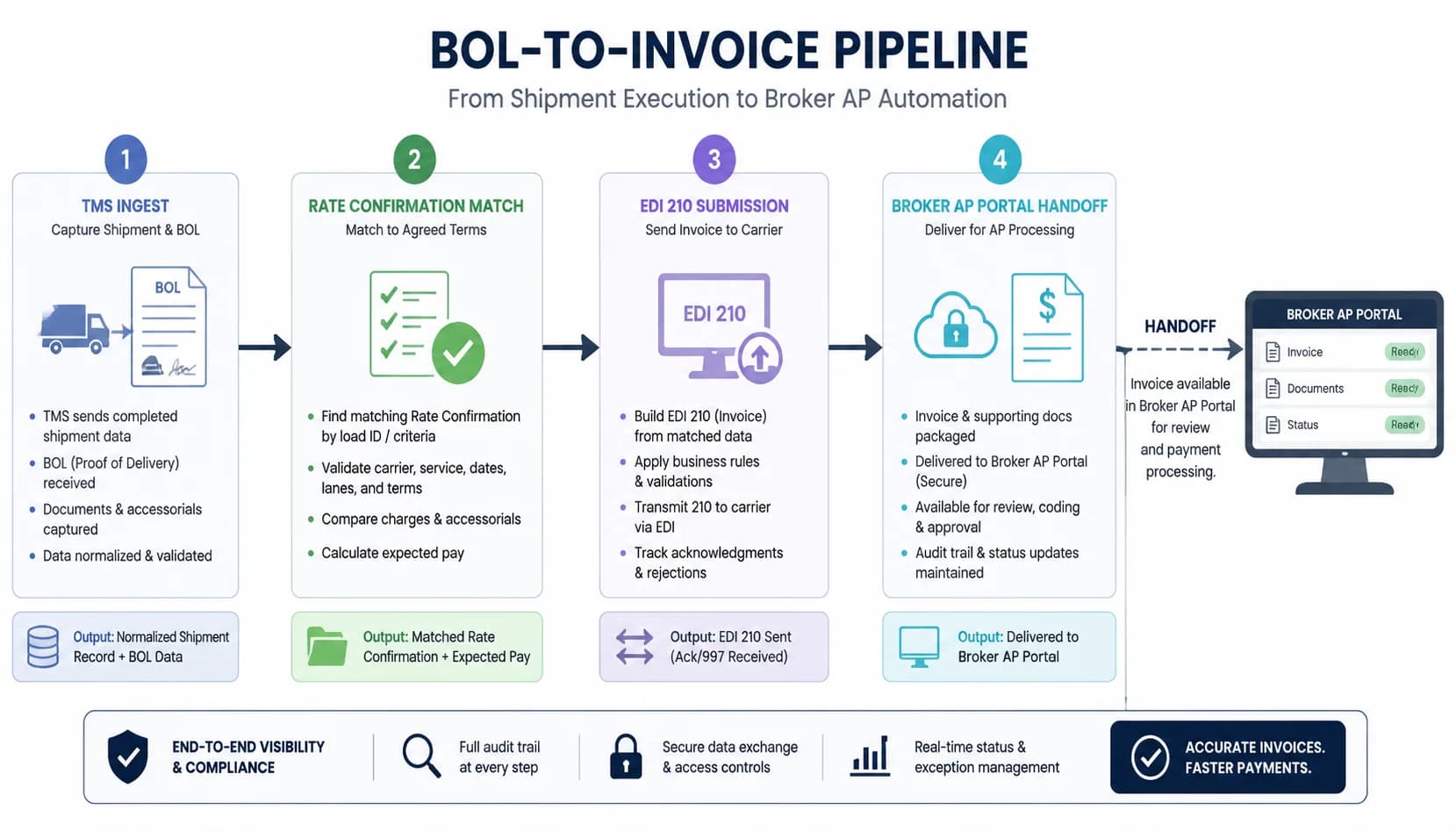
Automated BOL-to-Invoice Generation from TMS Data
Ingest BOL, POD, and rate confirmation from the TMS, auto-match load ID plus PO at 94%, and generate a compliant EDI 210 to the broker AP portal in under four hours.
The mechanic starts at the TMS. The platform reads BOL header data, POD signature and timestamp, and rate confirmation terms straight out of TMW, McLeod, or Trimble. There is no re-keying and no PDF-to-spreadsheet step. Load ID pairs to the rate confirmation, the carrier agreement supplies the FSC matrix and accessorial rates, and the invoice draft appears with every line item populated. AI-powered tools such as SINGOA's [AI payment matching](/features) push the auto-match rate from a manual baseline of 61% to 94% on live carrier data.
Match confidence matters because brokers reject on any mismatch. The tighter the matching logic, the fewer kickbacks. A good freight billing system matches on load ID plus PO plus pickup date, not load ID alone. When a broker sends a multi-load rate confirmation, load ID by itself is ambiguous, and the AP portal will bounce the EDI 210 as duplicate or unmatched. The platform should also flag rate confirmation revisions, because a $75 detention rate that changed to $60 mid-week silently reduces payable value.
Invoice generation runs on the carrier agreement, not on driver memory. Fuel surcharge pulls from the current DOE weekly diesel index, accessorial lines populate from documented events (ELD dwell, lumper receipt, TONU email), and the EDI 210 outbound goes to the broker AP portal in the format that broker actually accepts. NPTC's accuracy study shows first-pass acceptance climbs above 96% once the platform enforces broker-specific format rules.
The speed shift is where the working capital moves. Manual invoice-to-submit at 3-5 days becomes under 4 hours because the platform triggers on POD receipt rather than on a weekly billing cycle. That single change advances the aging clock by 4 to 6 days on every load. Multiplied across a 200-load week, invoice-to-submit compression alone can pull a full week out of the DSO number before any collections work happens.
Detention, Accessorial, and Fuel Surcharge Recovery
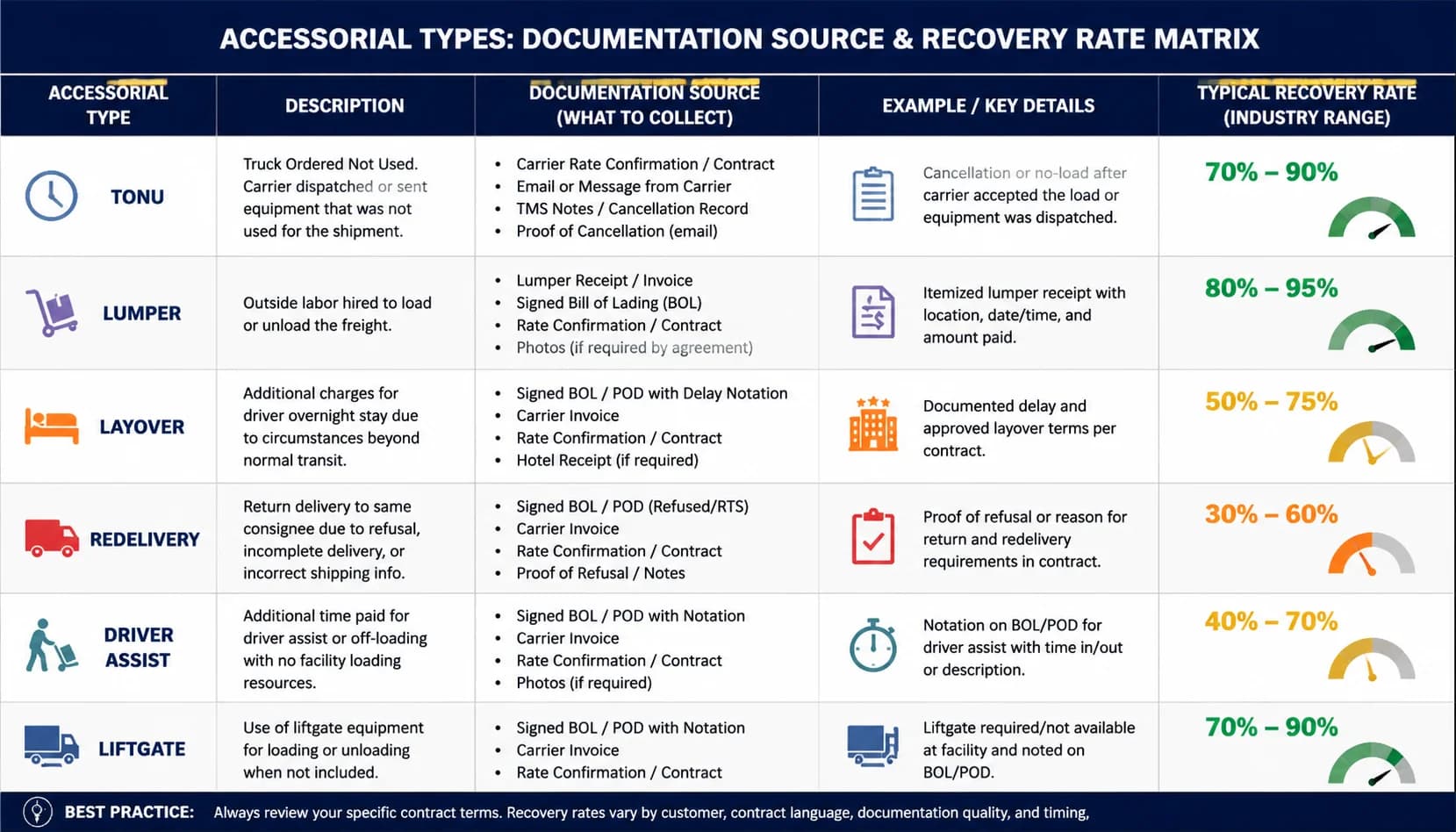
Convert ELD dwell into detention claims, wire every accessorial type to a documented event, and sync the DOE weekly diesel index into the FSC matrix to lift recovery from 40% to 85%.
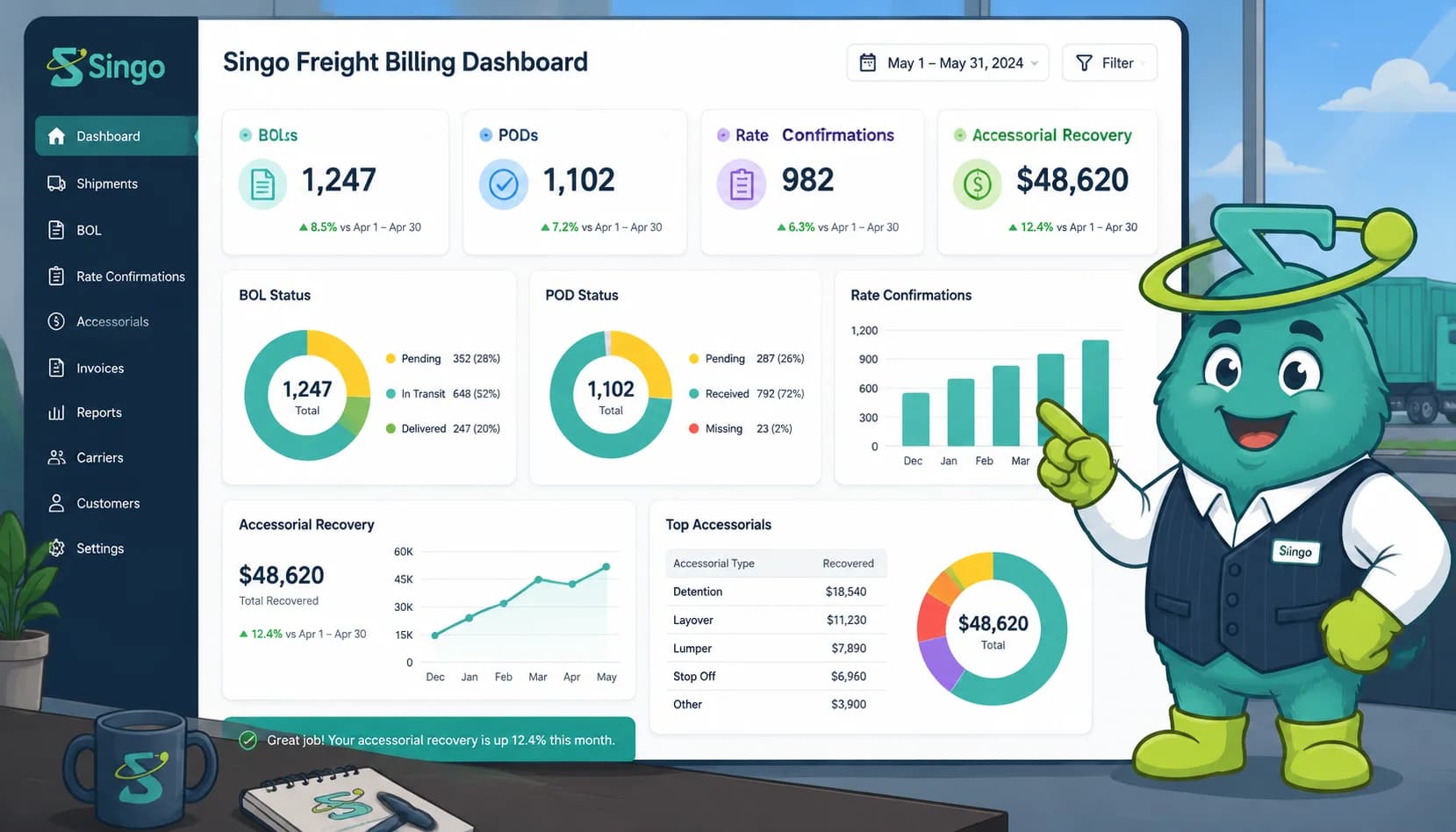
Detention is where the biggest dollars leak, and the fix is documentation discipline the platform enforces. ELD dwell data pinpoints arrival at the shipper, departure from the receiver, and every dwell minute in between. Once dwell crosses the contract free time (usually 2 hours), the platform opens a detention claim, pulls the driver name, tractor and trailer numbers, and gate timestamps, and attaches everything to the invoice as a documented accessorial. FreightWaves' 2025 brokerage analysis puts accessorials at 18-27% of LTL invoice value, so the recovery lift moves real money.
Accessorial types each need their own recipe. TONU triggers on the broker cancellation email plus the driver's dispatched-to-cancelled window. Lumper needs the receipt scan, the driver reimbursement record, and the broker's pre-approval. Layover requires the 10-hour reset documentation. Redelivery, driver assist, liftgate, residential delivery, and dray each map to their own trigger event. Platforms built for freight, such as [SINGOA for transportation carriers](/industries/transportation), ship with the full accessorial checklist wired to documented events so nothing gets left on the invoice.
Fuel surcharge is the second silent leak. The DOE weekly diesel index publishes every Monday, and most carrier agreements tie FSC to that index with a base fuel price and cents-per-gallon step table. Manual billing runs a stale FSC all week, then eats the difference. Automated FSC pulls the current index every Monday, applies the correct broker-specific FSC matrix, and computes the line to the penny. Dispute rate on fuel surcharge drops below 3% because the number the broker AP portal receives matches the number their audit engine expects.
Documentation retention closes the loop. Every accessorial line ties back to the ELD event, the receipt scan, the broker email, or the rate confirmation clause that justifies it. When the broker AP portal kicks a line back, the platform surfaces the packet in one click instead of sending the billing manager on a 30-minute dig through email and shared drives. The number you care about is dispute cycle time, and this is where it collapses from days to minutes.
Stop chasing brokers by hand
SINGOA runs your broker cadence, polls TriumphPay, and lifts accessorial recovery from 40% to 85% without adding headcount.
Broker Collections and the Payment Chain Problem
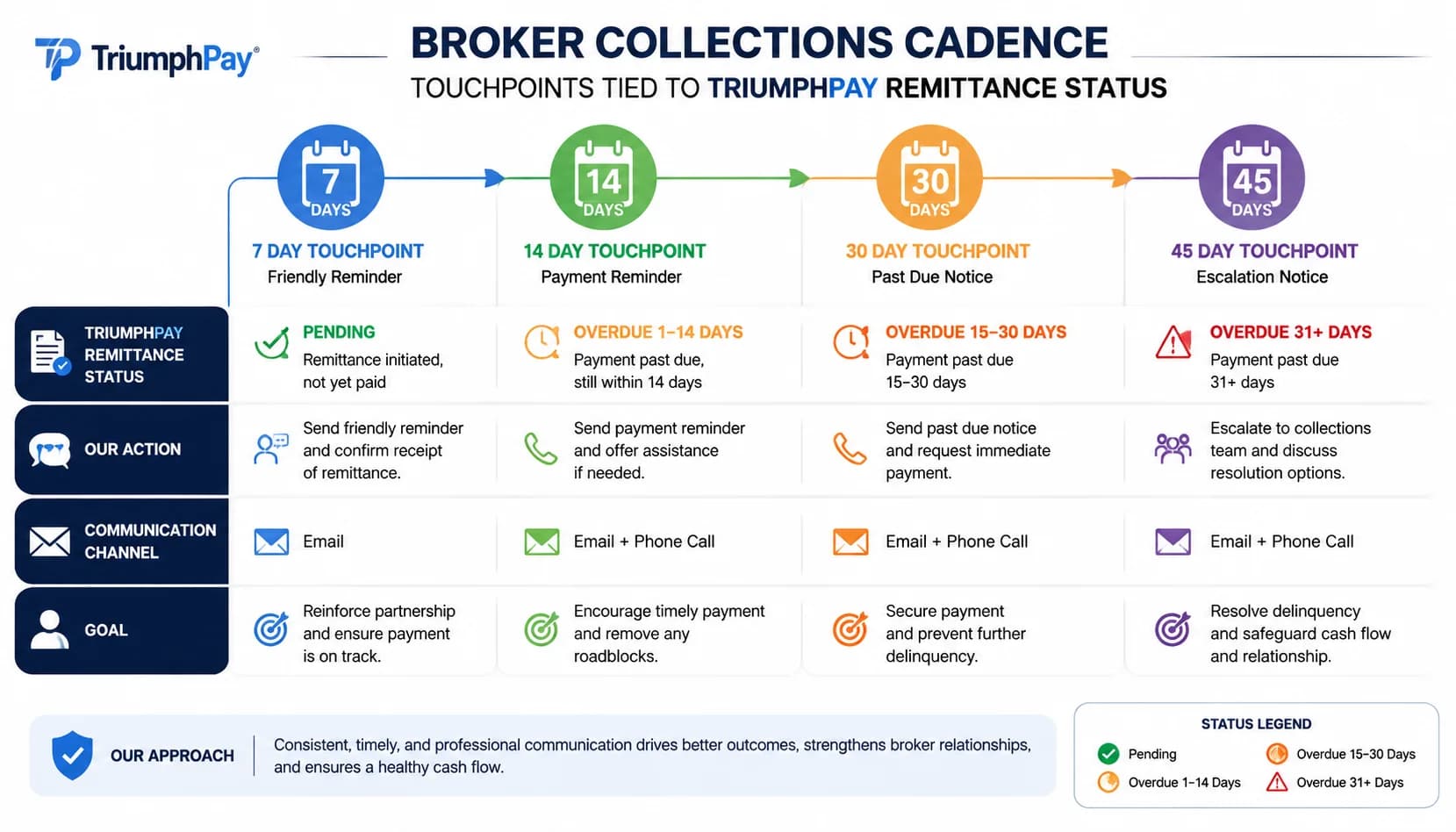
Run a 7/14/30/45-day broker cadence backed by TriumphPay status polling and broker payment history scoring to close the visibility gap manual collections cannot see.
The uncomfortable truth of freight collections is that the broker is not the final payer. Shipper terms drive broker cash flow, and broker cash flow drives carrier cash flow. A carrier who calls a broker AR clerk on day 21 is often talking to somebody whose own AR clock has not started. That is why generic collections cadences fail in freight, and why a broker-tuned 7/14/30/45-day sequence, informed by broker-specific pay history, works better than any hand-run process.
The cadence itself is workmanlike. Day 7 is a polite status ping, usually an email confirming receipt and remittance date. Day 14 escalates to a documented request with the EDI 210 attached and the AP portal link resent. Day 30 goes to broker AR management. Day 45 triggers a decision node: escalate, factor the invoice retroactively (if the factoring agreement allows), or route to collections. The [DSO reduction strategies for 2026](/blog/reduce-dso-proven-strategies-2026) guide walks the same cadence logic across other industries.
TriumphPay changes what the cadence knows. When the platform polls TriumphPay for remittance status, the day 7 email is no longer a guess. It says: your invoice is queued, scheduled for the 22nd, or in dispute for a specific reason. Remittance parsing then reconciles the incoming ACH to the load ID automatically, so the aging report reflects actual cash and not the platform's assumption. Manual collections can never match that data because they cannot see inside the broker's payment queue.
Broker payment history scoring is the last piece. Every load a carrier hauls for a broker feeds a rolling scorecard: average days to pay, dispute rate, accessorial acceptance rate, TriumphPay adoption. Slow brokers get an accelerated cadence and a factoring flag. Fast brokers get a lighter touch and stay off the factor. The billing manager stops guessing which broker to call first and starts working the queue the scorecard already ranked.
Selective Factoring: When to Factor vs Collect Direct
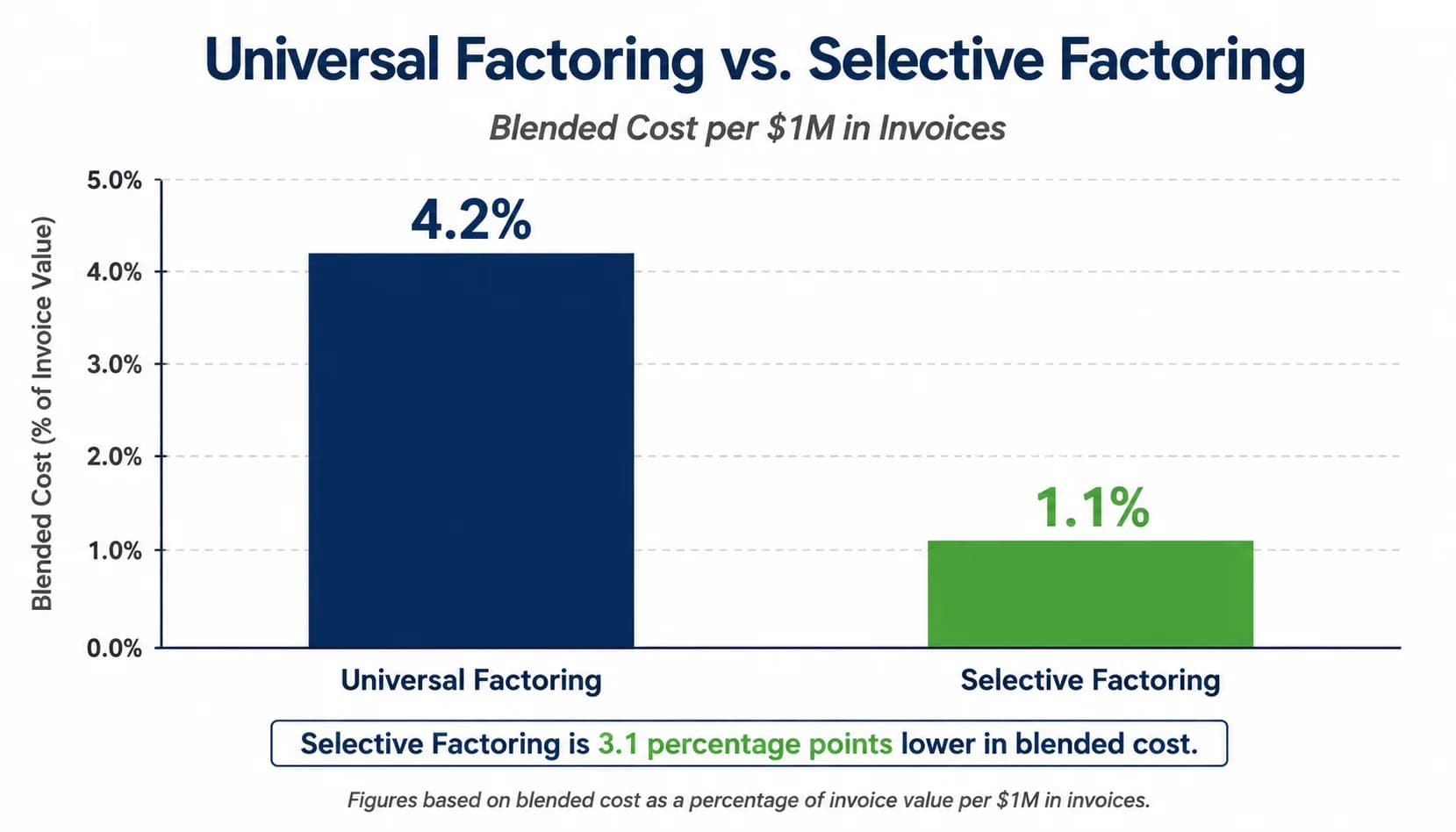
Route only slow-paying or high-risk broker loads to the factor, cutting blended factoring cost from 4.2% to 1.1% while preserving margin on 70-80% of loads that pay direct within 30 days.
ATBS 2023 Carrier Factoring Survey found roughly one in three carriers factor invoices at 3-5%. Most of those carriers factor universally, meaning every load flows through the factor regardless of the broker's actual pay speed. The blended cost lands near 4.2% of gross revenue. On a $20M fleet, that is $840,000 a year, most of it spent buying speed on loads that would have paid within 25 days without any help.
Selective factoring flips the default. The platform runs every load through a broker risk score, and only loads above a defined threshold (slow pay history, dispute pattern, unknown broker) route to the factor. Fast-paying brokers stay on direct collect. That drops blended cost from 4.2% to 1.1% on carriers running the model well. On the same $20M fleet, that is $620,000 back in retained margin, priced against SINGOA's [$1-3 per invoice pricing](/pricing) rather than a percentage of revenue.
The non-recourse versus recourse call is a separate decision. Non-recourse buys credit protection but costs 50-150 basis points more. Recourse is cheaper but leaves the carrier holding bad debt if the broker never pays. Selective factoring under recourse works well because the platform only routes loads with strong pay signals; the credit risk stays low without paying non-recourse premium on every load.
Factor integrations matter here too. RTS Financial, OTR Capital, and Thunder Funding each expose different handshake flows for invoice submission, verification calls, and advance reconciliation. A freight billing platform that speaks all three lets the carrier switch factors without rebuilding the workflow, and lets the CFO benchmark advance rates and reserve holdbacks against actual load performance. Here is where most carriers discover they were overpaying by 200-300 basis points.
TMS, Load Board, Factoring, and Accounting Integrations
Freight billing software must integrate with five categories: the TMS (TMW, McLeod, Trimble), load boards (DAT, Truckstop), the broker payment network (TriumphPay), factoring partners (RTS, OTR, Thunder), and the general ledger (QuickBooks Enterprise, Sage Intacct). Miss any category and the automation reverts to manual re-entry within the first week. Modern platforms surface all of this through [50+ AR integrations](/integrations) rather than one-off custom builds.

TMW Systems (Trimble Transportation)
Bidirectional sync of BOL headers, POD status, rate confirmations, driver dispatch, and ELD dwell data. Invoice status flows back into TMW for dispatchers and the CFO.

McLeod Software
Native sync of load master data, rate confirmations, and accessorial rate schedules for asset-based carriers running LoadMaster or PowerBroker.
Trimble TMS
Real-time BOL and POD ingest, rate confirmation matching, and EDI 210 outbound for carriers on Trimble's core TMS stack.

DAT Freight & Analytics
Load board metadata plus DAT credit rating, days-to-pay history, and dispute pattern feed the broker risk score before the first invoice cuts.

Truckstop
Broker credit and load metadata feed the risk score and cadence engine for carriers sourcing loads through Truckstop.

TriumphPay
Bidirectional status polling and remittance parsing on the carrier side, plus invoice submission and quick-pay decisions on the broker side. Automated cadence runs off actual TriumphPay status, not assumptions.

RTS Financial
Selective factoring routing with automated invoice submission, verification call handling, and advance reconciliation.

OTR Capital
Non-recourse and recourse factoring handshake with reserve holdback tracking and advance rate benchmarking.

Thunder Funding
Factoring integration for carriers using Thunder Funding, with load-level routing driven by broker risk score.

QuickBooks Enterprise
AR entries, cash applications, and accessorial adjustments post cleanly into QuickBooks Enterprise for $5M-$50M carriers, powering the aging report the CFO reads each morning.

Sage Intacct
Multi-entity GL sync for larger carriers and brokerages running Sage Intacct, with accessorial adjustments and cash application at the load level.
Freight Compliance: FMCSA, BOL Audit Trail, and EDI Standards
Freight billing operates inside FMCSA documentation rules, carrier-agreement FSC matrices, and the EDI 210/214/820 standards brokers and shippers actually run on. Compliance must be native to the platform, not bolted on as an afterthought.
FMCSA BOL and POD Documentation Retention
FMCSA requires carriers to retain BOL and POD documentation for the full regulatory window. Modern freight billing platforms archive every BOL and POD automatically at ingest, indexed by load ID, tractor, driver, and date, and surface the packet in one click when a broker AP audit or shipper claim opens.
EDI 210, 214, and 820 Standards
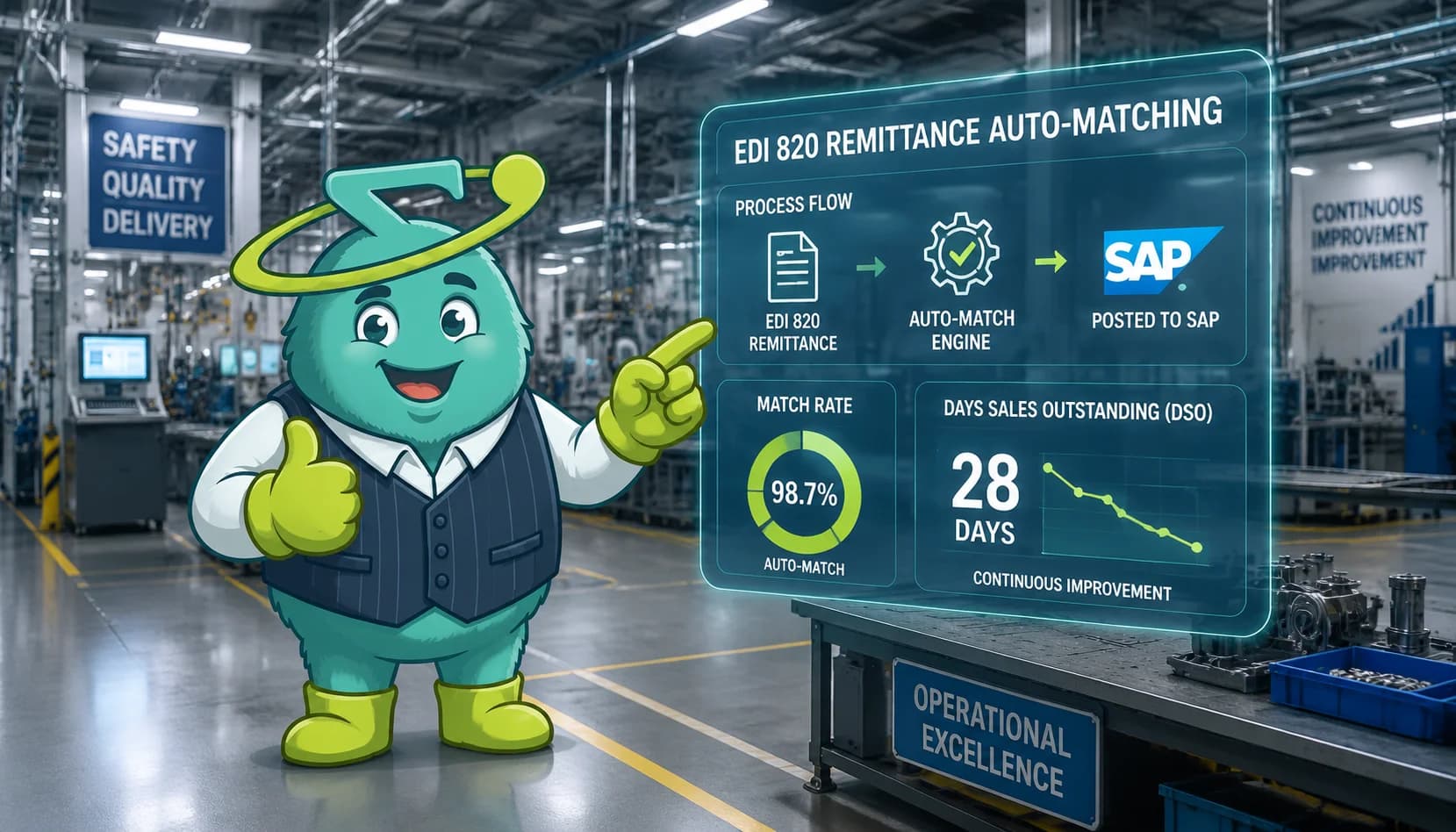
EDI 210 (freight invoice), EDI 214 (shipment status), and EDI 820 (payment remittance) are the standards broker AP portals and shipper systems actually consume. The platform must speak all three fluently on outbound submission, inbound status, and remittance parsing.
Carrier Agreement FSC Matrix Enforcement
Every carrier-broker agreement carries its own FSC matrix, accessorial rate schedule, and dispute window. Billing accuracy depends on enforcing the correct matrix against the current DOE weekly diesel index, not a spreadsheet copied last quarter.
Accessorial Documentation Chain
Detention, TONU, lumper, layover, driver assist, liftgate, residential, and dray charges each require documented events (ELD dwell, receipt scan, broker email) that survive AP portal audit. Automation preserves the documentation chain from event to invoice line to remittance.
ROI of Freight Billing Automation for Carriers and Brokers
Compliance is table stakes but the details matter. FMCSA requires BOL and POD retention for the full documentation window, and modern freight billing platforms handle it automatically. EDI 210 (freight invoice), EDI 214 (shipment status), and EDI 820 (payment remittance) are the standards brokers and shippers actually run on, and the platform must speak all three fluently. Carrier agreements sit on top of that, defining the FSC matrix, accessorial rate schedules, and dispute windows the platform enforces on every invoice.
The staff-time reduction is where operators feel the change. CSCMP's 2025 Supply Chain Management Report cites 60-75% invoice processing time cuts across supply chain automation programs. SINGOA's transportation customer data lands at the top end of that range: 22 hours per week of manual AR work drops to 4 hours. The billing manager stops re-keying and starts working exceptions, disputes, and broker relationships, which is the actual leverage in the role. See the [complete guide to AR automation](/blog/complete-guide-ar-automation) for the broader framework.
The ROI model is where most carriers underprice the change. Modeling only DSO working-capital gains misses the bigger dollar number. A $30M carrier moving from 52 days to 18 days DSO frees roughly $2.8M in working capital, a real one-time gain. But the same carrier lifting accessorial recovery from 40% to 85% on 22% of invoice value captures ongoing incremental revenue near $1.9M per year. That is recurring margin, not a one-time cash release, and it changes the payback math entirely. Selective factoring adds a third leg. Cutting blended factoring cost from 4.2% to 1.1% on $30M of revenue returns $930,000 annually. Add DSO release, accessorial lift, and factoring savings and payback under 90 days becomes the base case, not the optimistic case, for carriers above $5M.
34 days
Freight DSO reduction from 52 to 18 days for carriers on full stack
SINGOA Transportation Customer Analysis 2025
45 pts
Accessorial recovery lift from 40% baseline to 85% documented capture
DAT 2024 Accessorial Benchmark + SINGOA customer data
79%
Freight invoice dispute rate reduction from 14% manual to 3% automated
NPTC 2023 + SINGOA customer data
310 bps
Blended factoring cost drop from universal (4.2%) to selective (1.1%)
ATBS 2023 Carrier Factoring Survey + SINGOA customer data
82%
Billing staff time reduction from 22 to 4 hours per week
SINGOA Transportation Customer Analysis 2025
under 90 days
Typical payback period for carriers above $5M revenue
SINGOA implementation data 2025
- 34-day DSO reduction frees roughly $2.8M in one-time working capital for a $30M carrier, capital that was always earned but trapped in the broker payment queue
- Accessorial recovery lift from 40% to 85% on 22% of invoice value captures near $1.9M per year in recurring margin for a $30M fleet, the largest single ROI driver in the model
- Selective factoring at 1.1% blended cost versus 4.2% universal returns roughly $930,000 annually on $30M of revenue, priced against $1-3 per invoice rather than a percentage of gross
- Invoice-to-submit collapses from 3-5 days to under 4 hours, advancing the aging clock 4-6 days on every load before any collections work happens
- Billing staff time drops from 22 to 4 hours per week, freeing the manager to work exceptions and broker relationships rather than re-keying BOL data
- Payback under 90 days becomes the base case (not the optimistic case) for carriers above $5M when the ROI model includes accessorial lift alongside DSO and factoring savings