
Our Verdict
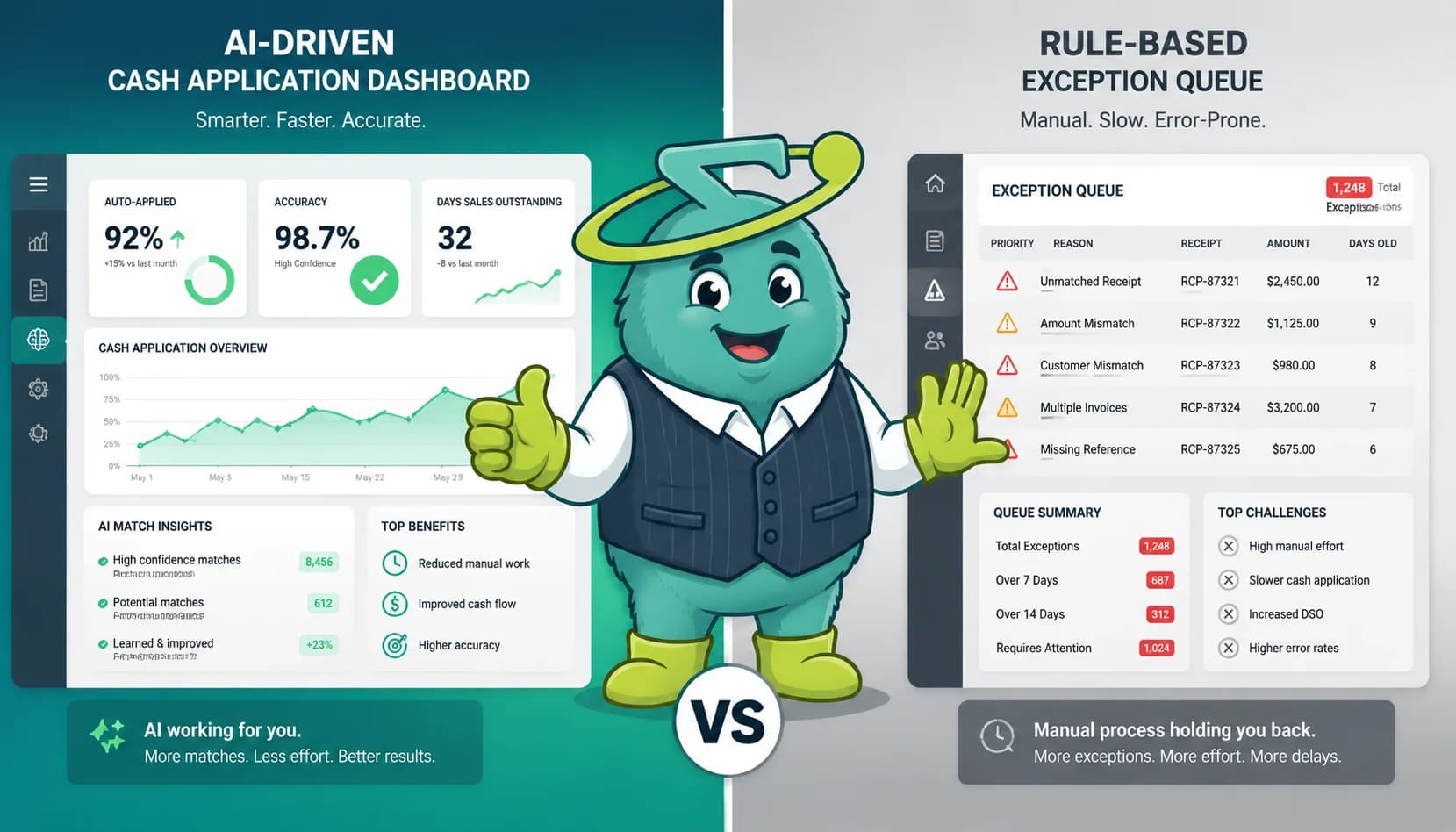
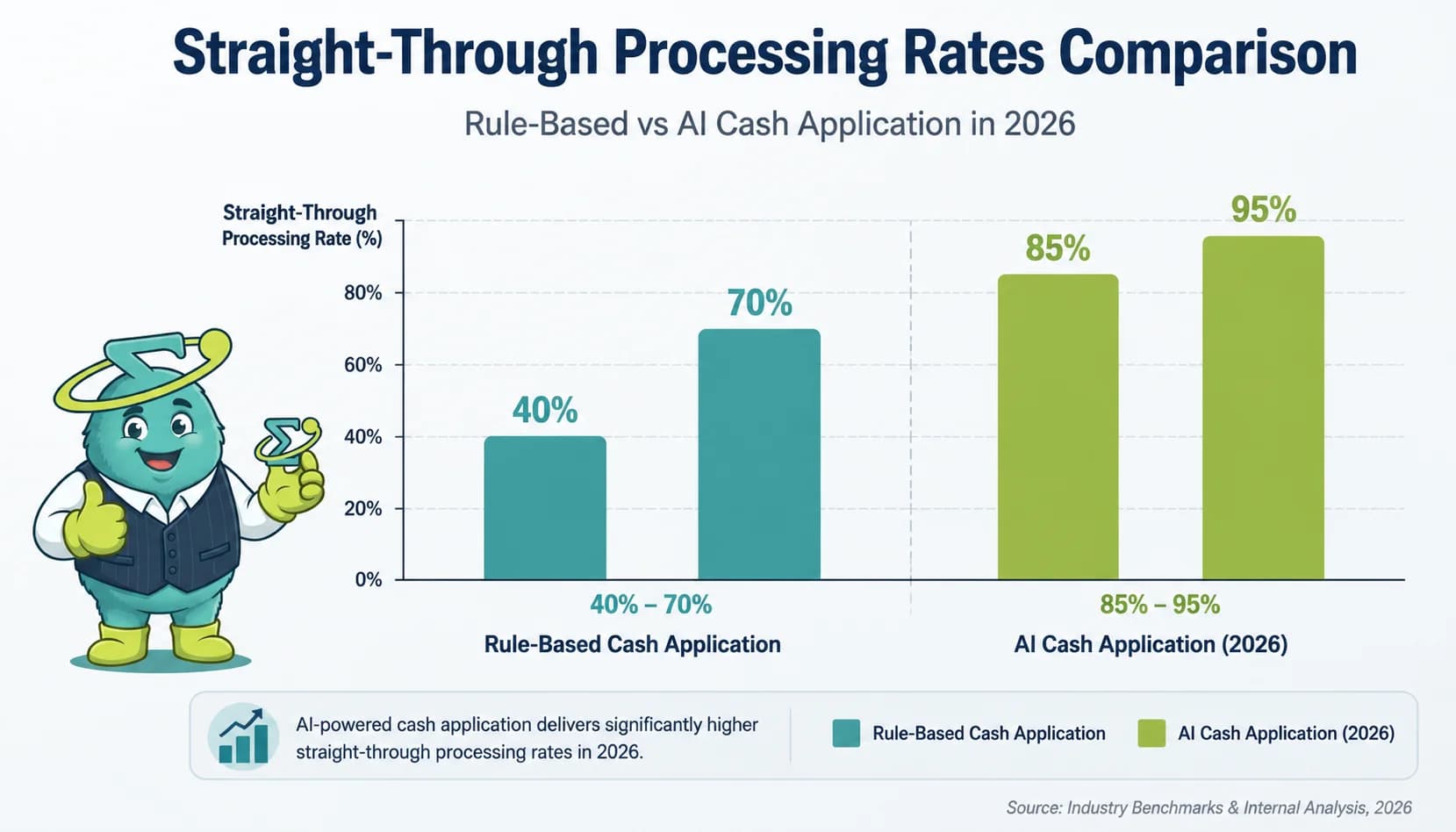
AI-native AR automation hits 85-95% straight-through processing versus 40-70% for rule-based systems. AI wins for most mid-market teams; rules still win for sub-100 invoice/month operations and audit-mandated deterministic workflows. Modern platforms ship hybrid: ML for prediction, rules for compliance guardrails.
Key Takeaways
- AI cash application hits 85-95% straight-through processing versus 40-70% for rule-based systems, per 2026 Emagia and HighRadius benchmarks.
- Rule-based AR TCO runs 2-3x its license price once rule-maintenance labor is counted; AI shifts that cost to the vendor.
- Rules still win in three scenarios: under 100 invoices per month, audit-mandated deterministic workflows, and single-payer fixed-format remittance.
- Hybrid is the real 2026 answer: ML for prediction and pattern matching, rules for compliance guardrails and human-in-loop escalation.
- Use a 5-question decision framework covering invoice volume, remittance diversity, compliance regime, adaptability need, and 3-year TCO tolerance.
At-a-Glance Comparison
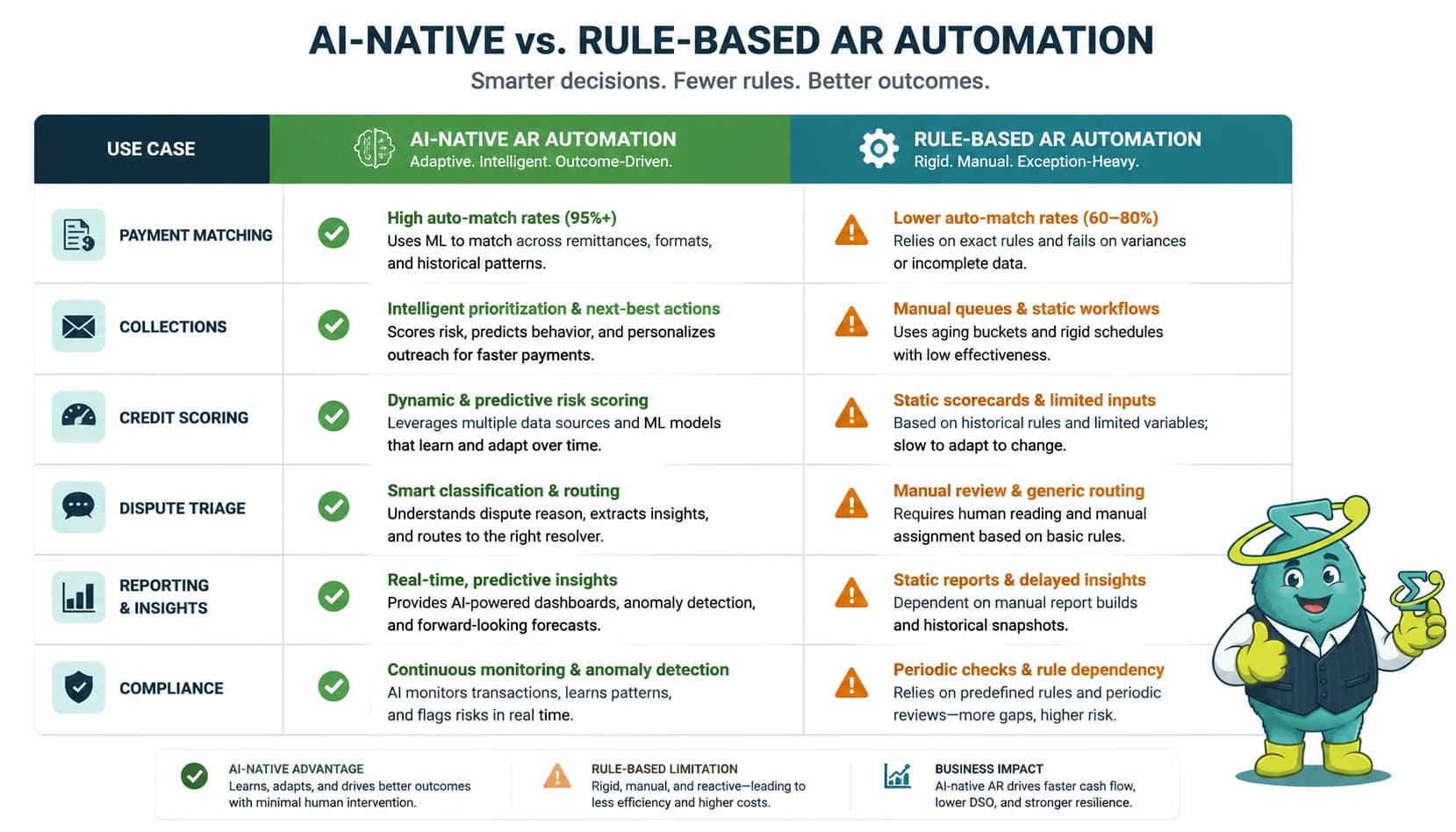
| Dimension | AI-native approach | Rule-based approach |
|---|---|---|
| Straight-through processing rate (2026) | 85-95% on typical mid-market mix | 40-70% on typical mid-market mix |
| Unstructured remittance handling | Reads PDFs, email bodies, EDI, portal downloads; holds above 80% | Requires structured formats; routinely drops below 30% |
| Adapting to a new payer format | Model incorporates the pattern within days | 1-3 week IT ticket per new format |
| Exception queue share of AR hours | Under 10% of AR team hours | 30-50% of AR team hours |
| Decision logic | Probabilistic pattern learning | Deterministic if-then branches |
| Auditability | Requires guardrails; models drift on retrain | Deterministic; auditor-friendly by design |
| 3-year total cost of ownership | 30-45% below rule-based baseline | 2-3x license price once maintenance FTE is counted |
| Best fit | 500+ invoices/month with diverse remittance | Under 100 invoices/month, SOX-heavy, single-payer |
The AI-native approach: probabilistic pattern learning
AI-based AR automation flips the rule-writing model. Instead of writing rules, you show a machine learning model 500,000 historical remittances and let it learn which patterns predict which invoice match. When a new remittance arrives, the model outputs a probability score across candidate invoices and picks the top match, or escalates the low-confidence cases to a human. New payer formats do not require an IT ticket; the model adapts as new data flows in.
Adaptability is the AI side's biggest structural advantage. When a new customer starts sending remittance advice in a novel format, an AI system incorporates the new pattern within days as historical examples accumulate. That is why [AI payment matching accuracy benchmarks](/blog/ai-payment-matching-accuracy) keep drifting upward while rule-based systems drift the other way as your customer base grows.
The exception rate flows from that. AI-native shops report exception queues under 10% of hours, freeing analysts to work disputes and short-pays instead of re-keying remittance line items. The dollar impact on DSO shows up within the first 90 days for most teams after cutover, per the 2026 HighRadius benchmark.
The rule-based approach: deterministic if-then logic
A rule-based AR system is a decision tree your IT team writes and maintains. If the remittance advice contains invoice number 4409, match it to invoice 4409. If the payment amount matches the invoice total within $2, close the invoice. If the payer name in the ACH memo starts with 'ACME', apply the payment to customer 187. Every branch is explicit, deterministic, and auditable, and every branch has to be written by a human who anticipated that specific pattern.
The important distinction is not automation versus manual. Both approaches automate work. The distinction is deterministic if-then logic versus probabilistic pattern learning. That single difference cascades into every meaningful gap in this comparison: exception rate, maintenance cost, adaptability to new customers, and how quickly the system degrades when your business grows. If you want a fuller taxonomy of the AR automation stack before diving deeper, [the complete guide to AR automation](/blog/complete-guide-ar-automation) covers the landscape end to end.
So what? If your remittance mix is stable, small, and clean, deterministic rules give you audit-perfect behavior. If your remittance mix is diverse and growing, deterministic rules become a maintenance treadmill that your AR team runs on every Monday morning. Which of those describes your team is the real question this comparison answers.
Feature-by-feature: where each approach wins and loses
Straight-through processing on 2026 benchmarks
SINGOA
- 85-95% STP on typical mid-market remittance mix per 2026 Emagia and HighRadius reports
- Holds above 80% on unstructured PDFs, email bodies, and portal downloads
- Adapts to new payer formats within days as historical examples accumulate
- Exception queues typically consume under 10% of AR team hours
Competitor
- 40-70% STP on the same input mix, depending on remittance cleanliness
- Drops below 30% on unstructured remittance because rules require exact string equality
- New payer patterns generate exceptions until IT writes a new rule (1-3 weeks)
- Exception queues routinely consume 30-50% of AR team hours
Verdict: The 85-95% figure is a peak, not a floor, and only vendors who tune their model on your remittance mix hit the top of the range on day one. Ask any vendor claiming 95% STP whether that is on their reference customer's clean data or on your actual remittance mix. The delta between the two is exactly where rule-based systems quietly break, and it is where honest AI vendors will show you a pilot number rather than a marquee number.
Cash application and payment matching
SINGOA
- ML models score matches across probability distributions, not exact string equality
- Handles partial invoice numbers, payer aliases, ACH memo fragments, and PDF remittance
- Escalates low-confidence cases to a human queue instead of blocking the whole batch
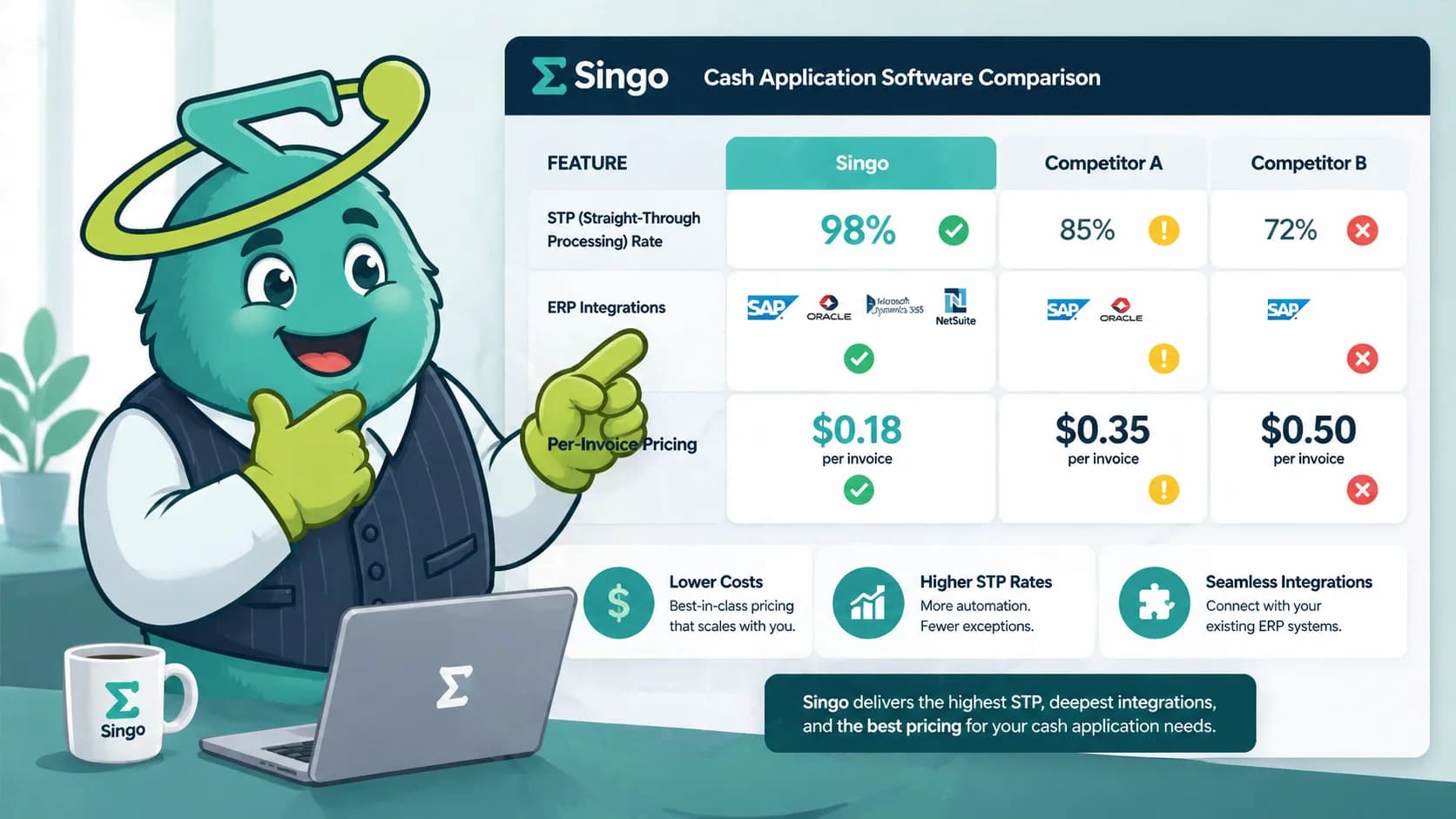
- Lands in the 90% STP range on remittance mixes that break rule engines at 55%
Competitor
- Matches on exact string equality; any variance forces the payment into an exception queue
- Cannot generalize across payer aliases or novel remittance formats without new rules
- Short-pays and lump-sum ACH deposits require manual unpicking every Monday morning
- Falls hardest on email PDFs, faxed check stubs, and portal downloads
Verdict: This is where AI beats rules by the widest margin. Platforms like SINGOA's [AI-native payment matching](/features) land in the 90% STP range on remittance mixes where rule engines cap at 55%. If your team spends Monday mornings unpicking short-pays and lump-sum ACH deposits, this is where you feel the difference first.
Collections dunning
SINGOA
- Personalizes tone, channel, and timing by each payer's historical behavior
- Routes call-responsive customers to phone queues, email-responsive customers to email
- Escalates persistent non-responders at day 45 instead of day 90
- Cuts past-due days by 22% in the first two quarters per 2026 HighRadius benchmarks
Competitor
- Blasts the same email cadence at every past-due account regardless of behavior
- Standard 30/60/90-day templates with no personalization by payer preference
- Cannot detect when a customer stops opening emails and needs a different channel
- Escalation timing is fixed by rule, not by observed non-response signals
Verdict: The gap here is nearly as wide as cash application. Teams that switched to behavior-personalized dunning cut past-due days by 22% in the first two quarters, per the 2026 HighRadius AR Benchmark Report. For single-payer setups with no behavioral diversity to learn from, rules are fine. Everywhere else, AI wins.
Credit and risk scoring
SINGOA
- Predicts payment probability from hundreds of features and adjusts limits weekly
- Detects payment trend deterioration 30 days ahead of missed payment
- Catches yesterday's safe payer becoming tomorrow's slow payer when the economy shifts
- Automates risk-based dunning routing and credit limit re-evaluation
Competitor
- Scores off a fixed rubric: revenue, years in business, industry code, prior behavior
- Every customer clearing the threshold gets the same limit regardless of trajectory
- Cannot detect early warning signals in payment cadence or behavior drift
- Requires manual annual re-scoring and rubric tuning to adapt to macro conditions
Verdict: Credit and risk scoring diverges the same way cash application does. AI predicts; rules score off a fixed rubric. That difference matters most when the economy shifts and yesterday's safe payer becomes tomorrow's slow payer. For stable portfolios in stable industries, rule-based scoring rubrics are workable. For everything else, AI-native scoring pays back within one economic cycle.
Dispute triage and reporting
SINGOA
- Classifies disputes by intent, catching questions phrased indirectly and sentiment shifts
- Detects escalation risk before a customer formalizes a dispute claim
- Routes free-text email disputes to the correct owner (logistics, sales, billing)
- Reporting parity: same DSO drilldowns, aging reports, and dashboards as rule-based
Competitor
- Classifies disputes by exact keyword match (damaged, price, quality)
- Misses disputes phrased as questions or embedded in longer customer emails
- Cannot detect sentiment shifts that predict escalation
- Reporting parity: same DSO drilldowns, aging reports, and dashboards as AI
Verdict: Dispute triage is a quieter win for AI but a real one. Reporting parity is honest, though. Both approaches produce clean dashboards, DSO drilldowns, and aging reports; do not let a vendor differentiate here. If a rules vs AI conversation comes down to reporting UX, someone is selling the wrong thing.
Compliance controls and the hybrid pattern
SINGOA
- Handles ambiguous, high-volume, pattern-heavy work: invoice matching, dunning tone, credit adjustment
- Escalates to human review on low-confidence decisions instead of forcing a decision
- Requires guardrails to prevent probabilistic drift from touching audited decision paths
- Modern platforms wrap ML predictions in deterministic rules for auditable outcomes
Competitor
- Wins outright on deterministic audit paths auditors can reproduce from source data
- Enforces write-off thresholds, tax jurisdictions, and audit-required decision paths
- Zero probabilistic drift; every branch is explicit and version-controlled
- Correct architecture for the guardrail layer around ambiguous ML predictions
Verdict: Compliance is the one area where rules genuinely win. Audit teams like deterministic decisions they can reproduce from source data; AI models drift on retrain, which auditors flag. That is why the honest 2026 architecture pattern is hybrid: ML for the ambiguous, high-volume, pattern-heavy work, and rules for the guardrails around write-offs, tax jurisdictions, and audit-required decision paths. Ask your shortlist which parts are ML and which parts are rules; if a vendor cannot answer cleanly, they do not know their own product.
See what AI-native STP is worth to your team
Plug in your monthly invoice volume and current STP rate to see the 3-year TCO delta versus rule-based tooling.
Total cost of ownership: the maintenance cost nobody mentions
The license quote a rule-based vendor sends you is roughly 30% to 40% of the real cost. The other 60% to 70% is rule maintenance. Every new customer type, remittance format, or ERP field change generates a rule ticket. At a $150M mid-market shop, that work usually consumes 0.5 to 1.0 FTE in AR ops plus recurring IT consultant hours. Nobody puts that line on the sales quote, but the invoice from IT arrives every quarter.
AI-native platforms shift the maintenance cost onto the vendor. The vendor retrains the model on aggregated customer data, ships new pattern coverage automatically, and absorbs the infrastructure spend. Your per-seat license is higher on paper, but the FTE and consultant lines disappear from your side of the ledger. Billtrust's 2026 cash application TCO analysis put the shift at roughly 30% to 45% savings on a three-year horizon for teams processing more than 500 invoices per month.
Here is a concrete example. A $200M distributor processing 4,200 invoices per month priced two options: an incumbent rule-based platform at $34K/year in license plus 0.7 FTE ($68K fully loaded) for rule maintenance, versus an AI-native platform at $62K/year in license plus 0.1 FTE ($10K) for exception review. Year-one totals: $102K rules versus $72K AI. Over three years with a 6% escalator on the rule-maintenance FTE, the delta widens to about $115K in favor of AI. You can run your own numbers against [SINGOA per-invoice pricing](/pricing) with your invoice volume.
| Tier | SINGOA | Competitor |
|---|---|---|
| Annual license (list) | $62,000 | $34,000 |
| Rule-maintenance FTE (fully loaded) | 0.1 FTE ($10,000) | 0.7 FTE ($68,000) |
| Year-1 total (4,200 invoices/mo) | $72,000 | $102,000 |
| 3-year total (6% FTE escalator) | $226,000 | $341,000 |
| 3-year TCO savings shift | 30-45% below rule baseline | Baseline |
| Break-even invoice volume | About 300 invoices/month | N/A |
TCO Analysis
Two caveats keep this from being universal. First, below 100 invoices per month, the FTE math flips: you were never spending an FTE on rules anyway, so a rule engine plus a spreadsheet queue beats the AI license. Second, if your incumbent rule engine is fully depreciated and stable, the maintenance line is smaller than the model predicts today. What most people miss is that stability is temporary. The maintenance curve rises the moment your customer mix changes, and mid-market customer mixes always change eventually.
Choose AI-native (or hybrid) AR automation if you are:
- Processing 500 or more invoices per month across a diverse mix of payer types and industries
- Handling multi-format remittance including email PDFs, EDI 820, portal downloads, check stubs, and ACH memo strings
- Adding three or more new payer formats every six months as your customer mix grows or churns
- Willing to layer ML for prediction on top of rules for compliance guardrails and human-in-loop escalation
- Answering the 5-question framework with under 3 remittance formats and quarterly customer-mix change: lean AI
- Comfortable running a pilot on your real remittance mix rather than accepting a demo on the vendor's clean data
- Targeting a 3-year TCO 30% to 45% below your current rule-engine baseline once maintenance FTE is counted
- Bringing an honest disqualifier question to every vendor demo: which parts are ML, and which parts are rules?
Choose rule-based AR automation if you are:
- Processing under 100 invoices per month, where AI has too little data to learn from
- Operating in a deterministic compliance workflow: SOX-driven tax calculations, US government contracting write-off approvals, healthcare payer adjudication, or regulated financial reporting
- Running a single-payer or single-format setup (tier-two automotive to one OEM in EDI 820, franchised distributor on one portal, specialty manufacturer billing a single national account)
- Required by your auditor to reproduce every AR decision from source data with zero probabilistic drift
- In a regulated industry where AI model drift on retrain would be flagged as a control weakness
- Better served by spending your budget on rule engine tuning, an ERP add-on, or an offshore exception team than on an AI seat you will not use
- Layering AI on top of rules for ambiguous exceptions rather than putting AI underneath in the audited decision path
Wondering if AI is the right fit for your AR mix?
A SINGOA specialist will walk your invoice volume, remittance formats, and compliance regime through the hybrid decision matrix. No pitch, just honest guidance.