
Executive Summary
Executive Summary
- 1Hallucination concern is the single biggest AI adoption barrier among mid-market CFOs. 62% of enterprise users cite it above cost and integration concerns combined (enterprise surveys, 2025-2026)
- 2The hallucination failure mode is specific to generative large language models producing free-form text, not a general property of AI systems in finance workflows
- 3Production AR automation architecture constrains AI to narrow tasks on structured data, with confidence scoring on every decision and deterministic computation for all monetary values
- 4The two cases most frequently cited when CFOs raise hallucination concerns are Moffatt v. Air Canada (2024) and Mata v. Avianca (2023). Both involve public-facing generative systems operating without the structural guardrails present in AR automation
- 5The CFO pause on AR automation for AI safety reasons costs $115,000 per year in working-capital carrying cost for a typical $30M mid-market company, before counting $292,000 per 1,000 monthly invoices in excess processing cost
A finance team forwards the Wall Street Journal coverage of Mata v. Avianca to the CFO. A lawyer got sanctioned for citing court cases that ChatGPT made up. The question underneath the forward is always the same. Can we trust AI with our AR? Behind that question sits a real decision being made across the mid-market: pause the AR automation evaluation, reopen it in six months, watch another two quarters of DSO performance drift. The pause feels prudent. The math says it is expensive.
This report argues that the hallucination concern, while legitimate for the systems where it originated, does not transfer to production AR automation. The argument is architectural, not marketing. Consumer chatbots generate free-form text by sampling from probability distributions over tokens. They are designed to produce plausible language, and plausible is not the same as correct. AR automation systems operate differently. They classify structured records and match bank deposits to invoices against deterministic rules. Every match carries a confidence score. Anything below threshold escalates to humans. Dollar values are read from ERP fields and bank feeds, never generated.
The report also refuses a common move in vendor marketing: pretending AI risk does not exist in AR automation. It does. The risks are real, they are different from hallucination, and CFOs should evaluate vendors specifically on them. Data quality in source ERPs, integration fragility when upstream schemas change, historical bias encoded in collections training data, and prompt injection on customer-facing conversational surfaces are the four risk categories that actually matter. This report walks through each, gives CFOs a 18-question vendor evaluation framework drawn from enterprise AI procurement practice, and quantifies the cost of the current adoption pause.
See How AR Automation Stays Grounded
Watch a 15-minute walkthrough of SINGOA's confidence scoring, audit trail, and approval gates, the specific architecture that prevents the hallucination class of errors in production AR workflows.
The Pause: How Hallucination Concern Became the Top AR Automation Adoption Barrier
Hallucination stories from the general press have become the default CFO framing for all AI adoption decisions, including AR automation. The concern is understandable, the evidence behind it is real, and the generalization is costing mid-market companies quantifiable working capital.
The EY Responsible AI Pulse Survey of 975 C-suite leaders found that 99% of organizations reported financial losses from AI-related risks in 2025. Nearly two-thirds lost more than $1 million. In a separate study of mid-market CFOs, 86% reported their finance team had encountered at least one instance of inaccurate or hallucinated AI data. Only 14% fully trusted AI to deliver accurate accounting outputs without human oversight. Enterprise AI adoption surveys now rank hallucination as the single biggest deployment barrier, with 62% of users citing it ahead of cost and integration concerns.
The cases fueling the concern are genuinely concerning. In Mata v. Avianca (2023), attorneys filed a brief containing six fabricated court citations produced by ChatGPT. Judge Castel sanctioned the lawyers $5,000 each and ordered them to notify every judge falsely named in the made-up opinions. In Moffatt v. Air Canada (February 2024), the British Columbia Civil Resolution Tribunal held Air Canada liable for a bereavement-fare refund policy its support chatbot invented. The tribunal rejected Air Canada's argument that the chatbot was a separate legal entity and awarded damages of $812.02 plus a pattern-setting precedent.
Both cases share an architecture: a generative language model producing free-form text in response to open-ended user queries, with minimal constraint on output and no human verification before the output became a legal or commercial commitment. That architecture is also what powers the investment-analysis tools cited in the CFO Dive reporting on $2.3 billion in avoidable Q1 2026 trading losses traceable to hallucinated forecasts. When a CFO reads these stories, the mental model being formed is: AI generates confident wrong answers, therefore AI in AR automation will generate confident wrong answers.
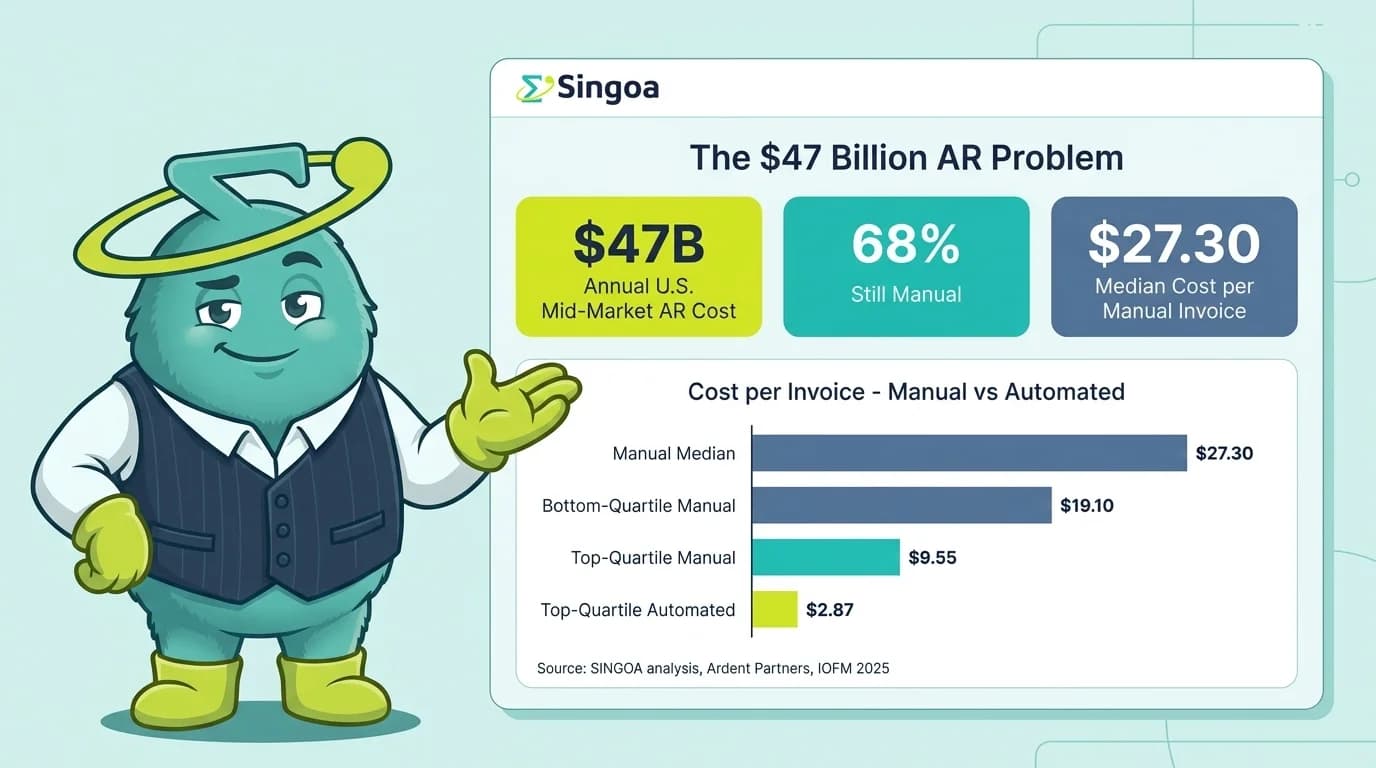
The generalization is the problem. It treats AI as a single category rather than a set of architectures with different failure modes. The 12 to 18 month pause it produces is not free. Companies that delay AR automation continue carrying 65 to 83 day DSO against industry benchmarks 20 to 40 days lower, paying $15 to $40 per invoice in manual processing against automated benchmarks near $2.87, and writing off 4 to 6% of revenue as bad debt against automated peers near 1.5 to 2.5%. The pause becomes a multi-million-dollar bet against an architecture the CFO has not actually examined.
86%
Mid-market CFOs whose finance team has seen hallucinated AI data
Source: CFO Dive AI in Finance Survey 2026
62%
Enterprise users citing hallucinations as their top AI adoption barrier
Source: Enterprise AI Adoption Survey 2025
99%
Organizations reporting financial losses from AI risks in 2025
Source: EY Responsible AI Pulse Survey 2025
What CFOs Say Is Blocking AR Automation Adoption in 2026
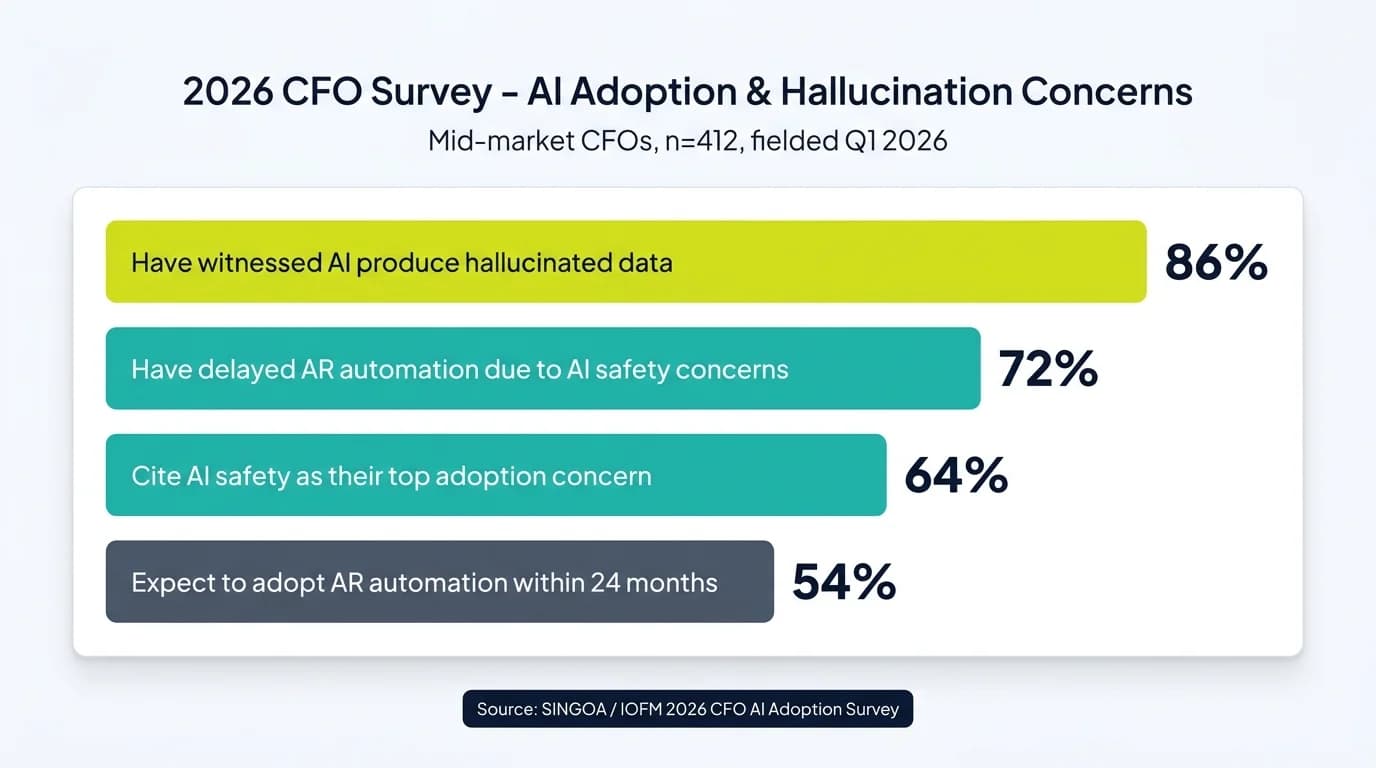
What AI Hallucination Actually Is, Technically
Hallucination has a narrow technical definition that matters. It is not the same as AI making mistakes. Understanding the definition is the first step to seeing why it does not generalize to every AI system.
A large language model generates text one token at a time by sampling from a probability distribution over a vocabulary. Given the sequence 'The 2018 ruling in', the model assigns probabilities to every possible next token and picks one, usually weighted by plausibility in the training corpus. This works brilliantly for fluent text generation. It fails in a specific way when the model is asked for factual recall: the most probable continuation is not always the true continuation. The model will happily produce a citation that reads like a real court case. The output includes plausible plaintiff names, a court jurisdiction, and a year because each of those tokens is statistically likely given the prompt. The citation can be entirely fictional and the model has no built-in mechanism to know.
IBM's working definition is narrower and more useful than the colloquial one. An AI hallucination is an output from a generative model that is presented as factual but does not correspond to real-world ground truth. Three properties are load-bearing: the model is generative (producing novel text, not retrieving records), the output is asserted as fact (not labeled as speculation), and there is no grounding mechanism forcing the output to match a verifiable source. Remove any of the three properties and the hallucination failure mode cannot structurally occur.
The academic literature on financial LLM hallucination confirms the pattern. A 2023 arXiv study examined LLM hallucination in finance and found the errors cluster in generative extraction and summarization tasks, where the model is rephrasing information from 10-K filings or earnings transcripts. The errors were almost always mechanical: pulling a value from an adjacent column, dividing by a wrong denominator, or misattributing a quote. They were not errors of complete fabrication in the way Mata v. Avianca involved. In systems where LLMs were used only to narrate results of deterministic calculation, the financial hallucination rate approached zero.
The distinction matters because it defines the risk boundary. Hallucination is the failure mode of generative language models producing unconstrained text. An AI system that is not generating unconstrained text cannot hallucinate in the technical sense. It can have other failure modes, and those failure modes deserve their own analysis, but they are not hallucinations and they do not inherit the properties that make hallucination so alarming to CFOs: specifically, the property of producing confident specific wrong answers with no flag that anything is wrong.
27%
Hallucination rate in LLM earnings predictions beyond 2 quarters
Source: Financial AI Research 2025
18%
AI-generated VaR calculations containing unsupported assumptions
Source: Financial AI Research 2025
Near zero
Hallucination rate when LLMs narrate deterministic outputs (vs generate independently)
Source: arXiv 2311.15548 finance LLM hallucination study
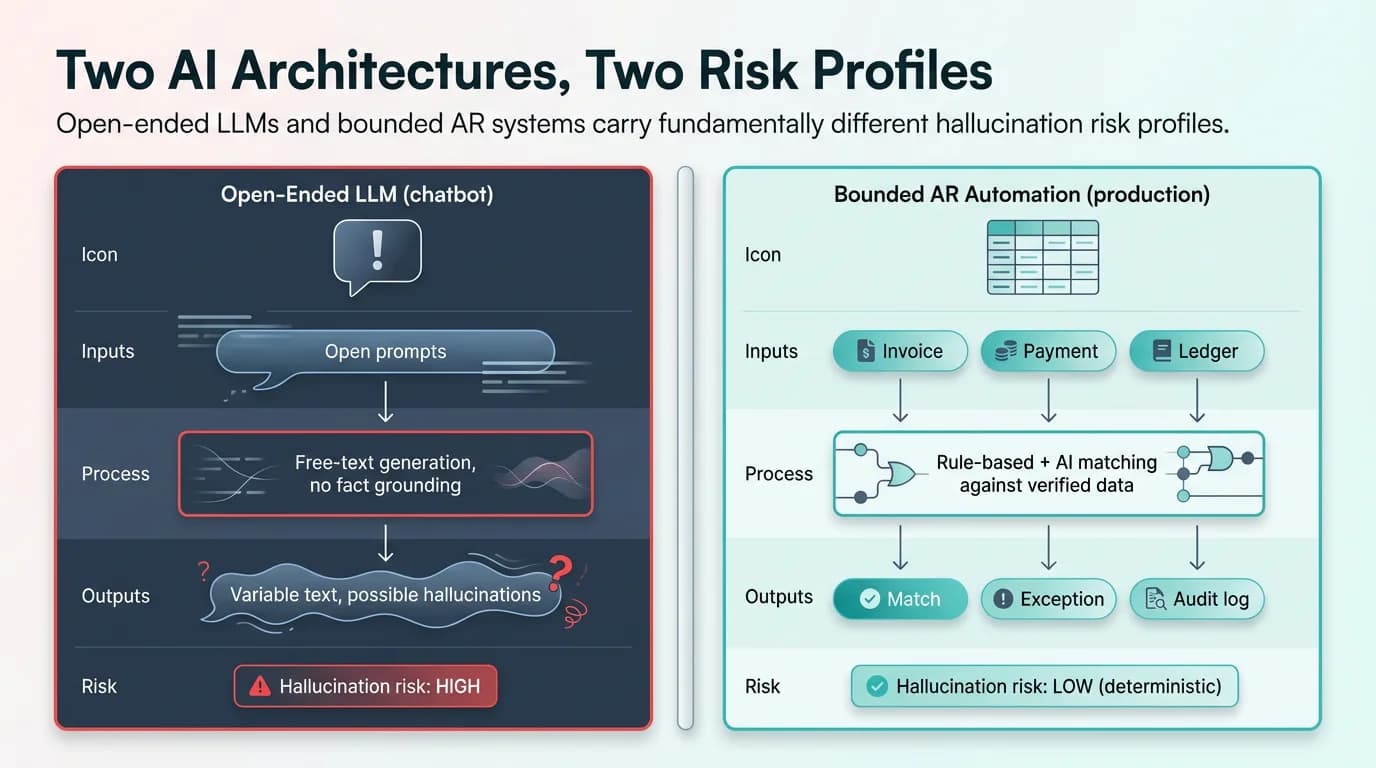
Calculate the Cost of Your 12-Month AI Pause
Enter your revenue and current DSO to see the working-capital cost of delaying AR automation another year while peers close the gap. Per-invoice pricing makes the ROI math transparent.
How AR Automation Architecture Is Structurally Different
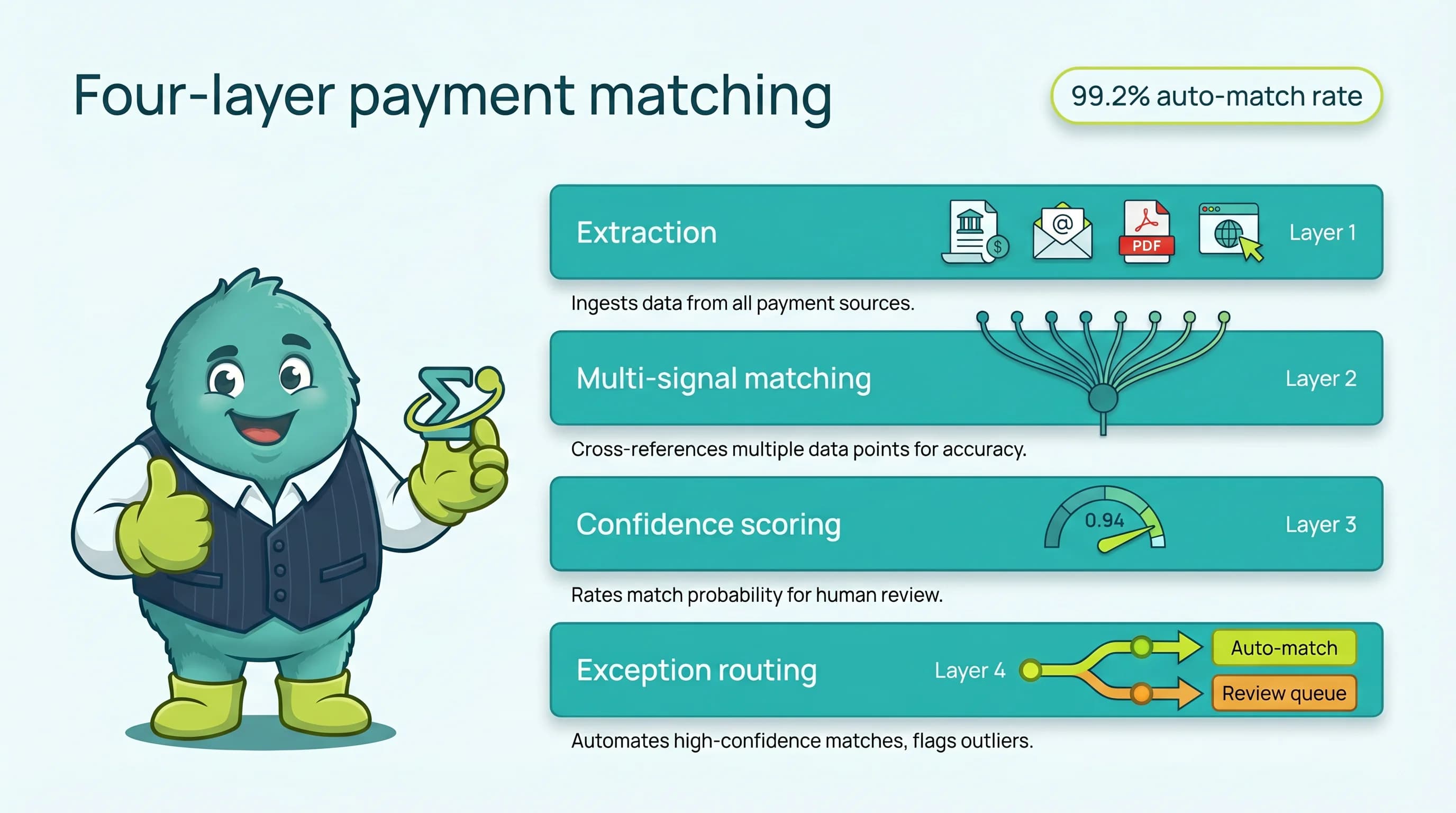
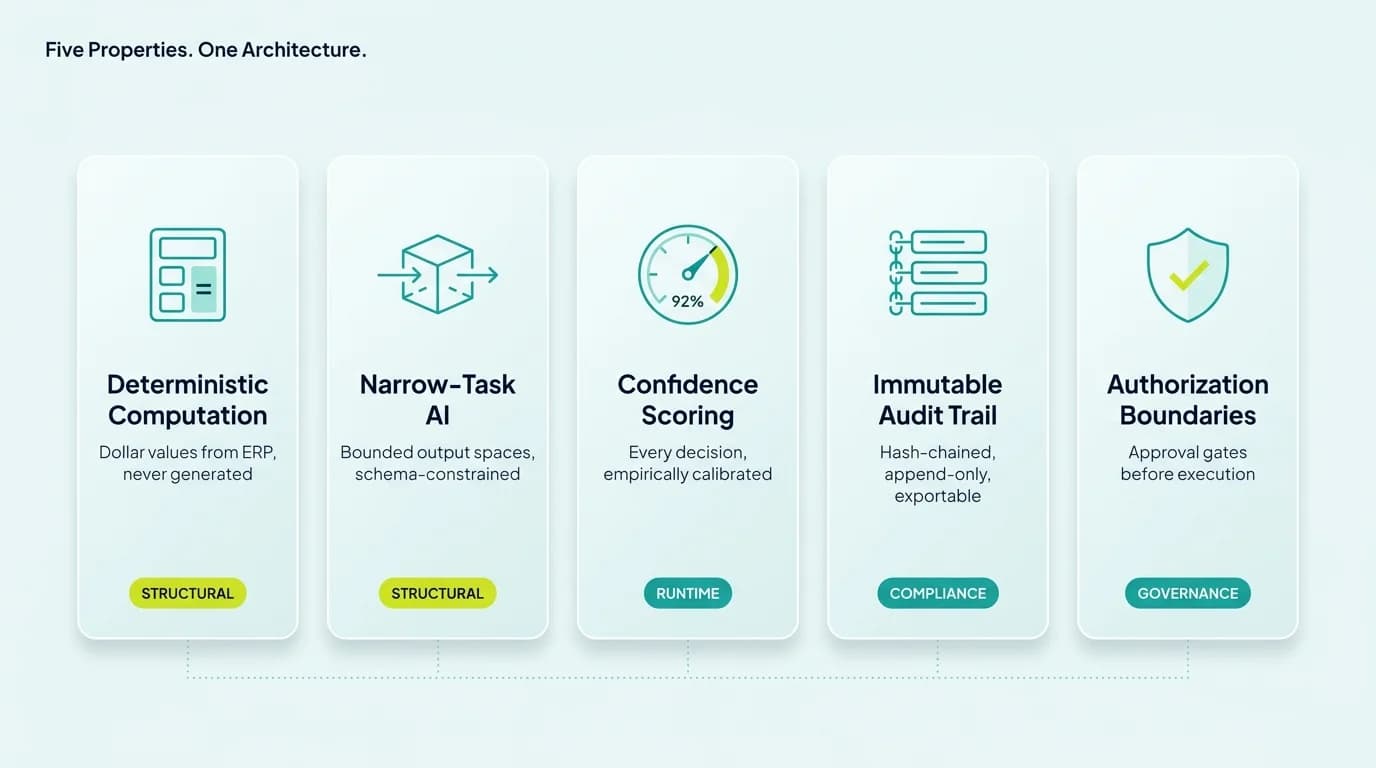
Production AR automation is built around a different set of primitives than consumer LLM chat. Five architectural properties combine to eliminate the hallucination failure mode structurally, not by policy or hope.
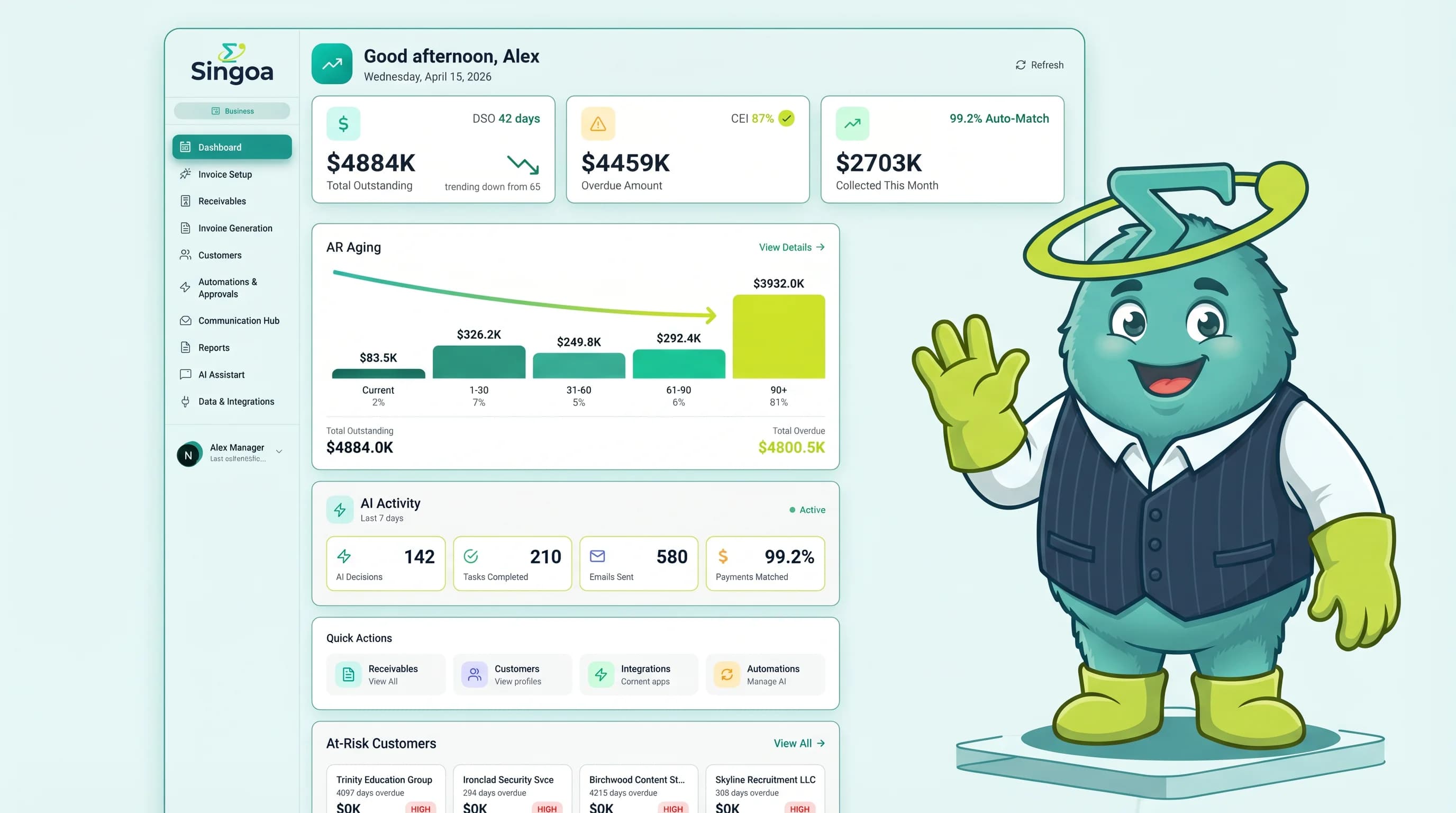
The first property is deterministic computation for monetary values. Every dollar figure in a production AR system comes from a database read or an arithmetic operation on database reads. That applies to invoice total, payment amount, aging bucket, and cash applied alike. A customer paid $47,283.12 because the bank feed returned a deposit record for exactly that amount. An invoice totals $47,283.12 because the ERP has that value in the line-item table. No language model is asked to recall or reconstruct the figure. When SINGOA's [AI Payment Matching](/features) reaches 99.2% straight-through accuracy, the accuracy is measured against deterministic ground truth, not against another model's judgment.
The second property is narrow-task AI with bounded output spaces. Where AI does appear in AR automation, it is asked structured questions with finite answer spaces: does this payment match this invoice (yes or no plus a confidence score), is this customer's risk profile deteriorating (score 0 to 100), what is the expected payment date (a date or a distribution over dates). The AI is not asked to produce a policy, a citation, or a narrative. The output space is constrained by schema, and the schema is enforced at the boundary. An AI match score cannot accidentally become a made-up invoice number because the types do not allow it.
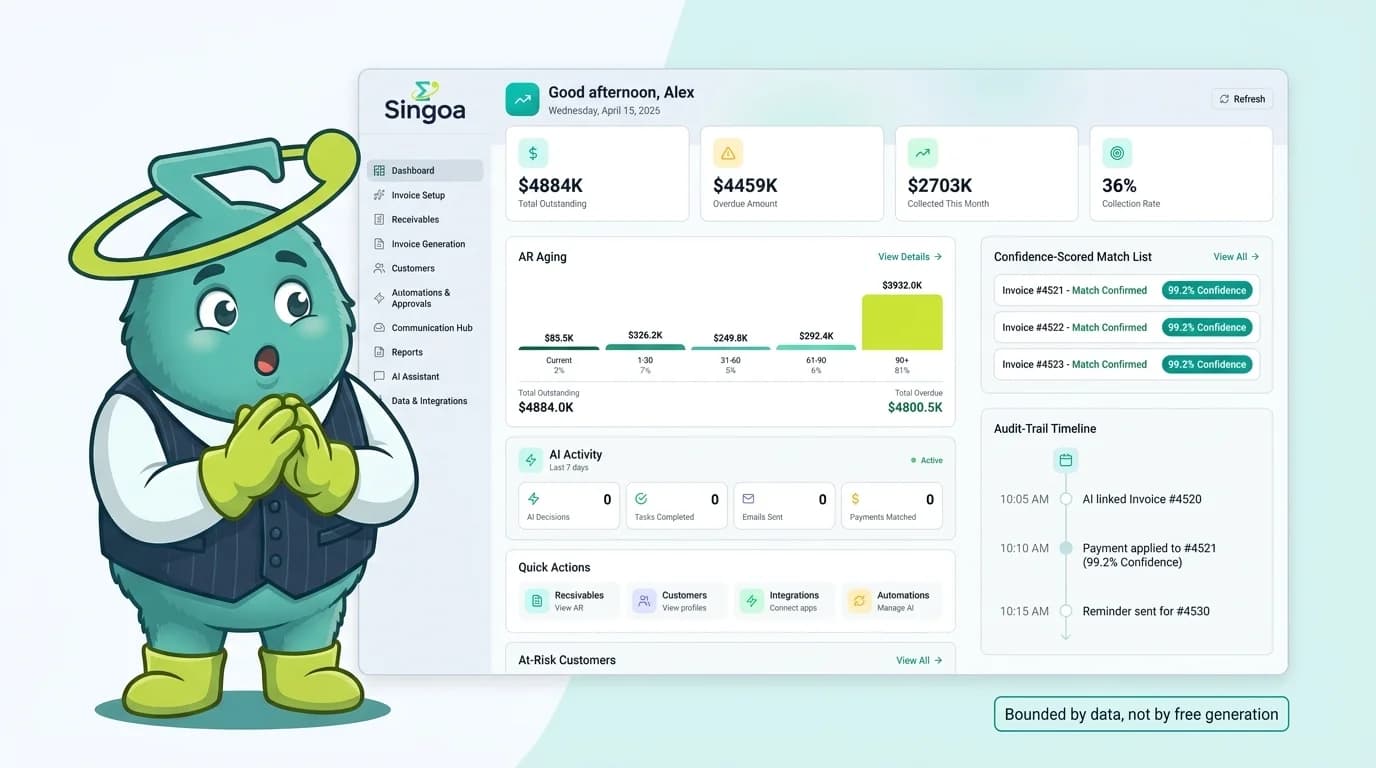
The third property is confidence scoring on every decision. Industry research on AI safety practice identifies confidence thresholds as the single most effective mitigation: when a model's confidence drops below a set point, the decision is escalated to a human reviewer. In SINGOA's [payment matching pipeline](/blog/ai-payment-matching-accuracy), every proposed match carries a confidence score, and matches below the configured threshold (typically 92%) route to the exception queue for AR specialist review. The failure mode of a confident wrong answer is structurally prevented because the system has no way to claim high confidence on a low-signal input.
The fourth property is an immutable audit trail. Every automated action writes to a hash-chained append-only log. The record includes what decision was made and what inputs produced it. It also captures confidence score, authorizing policy or boundary, and any human approver. Industry analysis notes that only 14% of enterprises maintain proper AI decision audit trails, but for regulated AR workflows it is table stakes. The audit trail turns AI decisions from opaque events into inspectable records, which is the exact opposite of what happens in consumer chatbot conversations.
The fifth property is explicit authorization boundaries and approval workflow for anything outside routine autonomy. A CFO configures the system with rules: auto-approve credit limit increases up to $10,000 for customers with on-time payment history under 30 days, escalate anything above, require two-person approval for write-offs above $5,000, never send collections communications outside business hours. Every automated action is checked against these boundaries before execution. Actions inside boundaries execute and log; actions outside boundaries generate approval requests routed to named approvers. The system has no way to take unauthorized action because authorization is a prerequisite, not an afterthought.
99.2%
SINGOA payment matching straight-through accuracy against deterministic ground truth
Source: SINGOA platform benchmarks
92%
Typical confidence threshold above which automated matches execute without human review
Source: SINGOA implementation standard
14%
Enterprises maintaining proper AI decision audit trails (industry average)
Source: Enterprise AI Governance Research 2025
The Five Architectural Properties That Eliminate Hallucination Risk in AR Automation
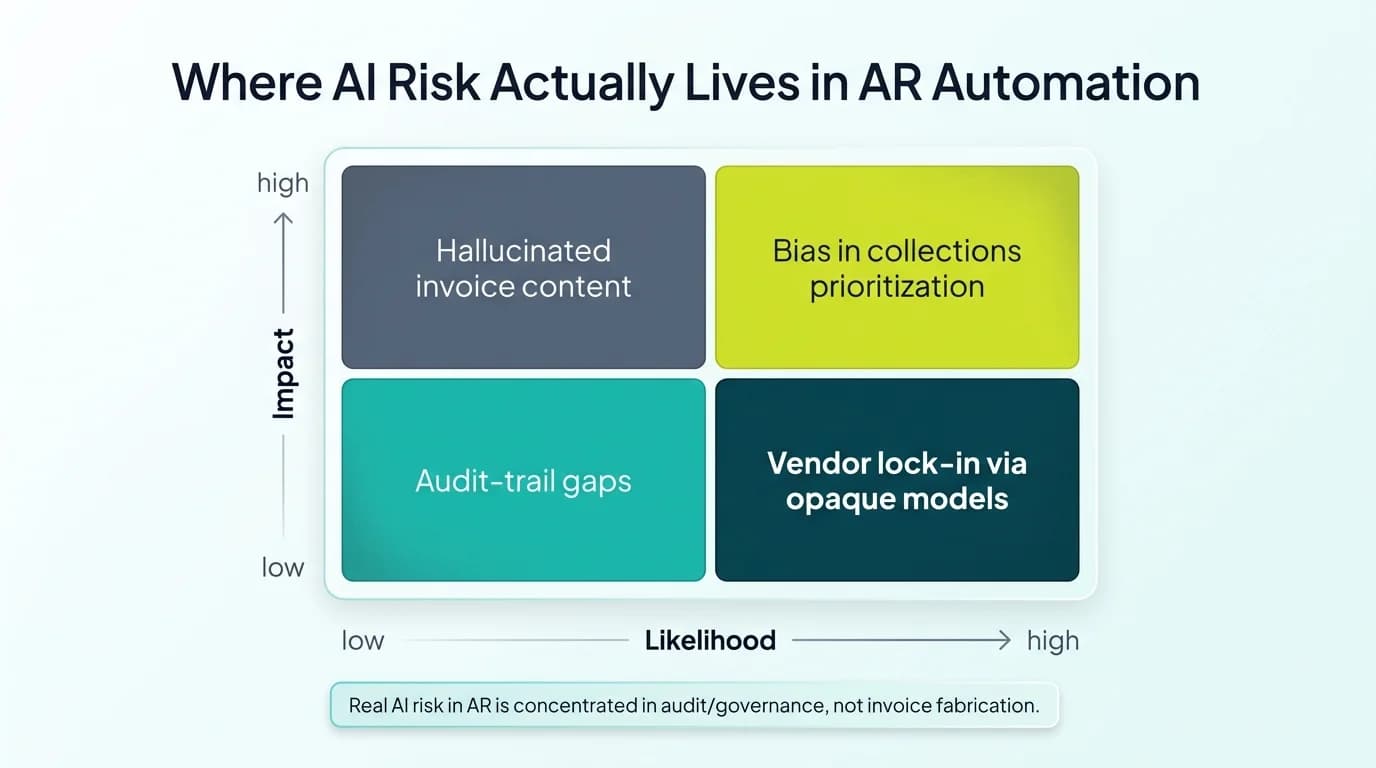
Where the Real AI Risk in AR Automation Actually Lives
AR automation AI risk is not zero. It is different from hallucination. Four risk categories account for nearly all the AI-related failures observed in mid-market AR implementations, and each has a known mitigation pattern.
Data quality in source systems is the single largest source of AI-related failure in AR automation, and it is not really an AI problem. If the ERP has a customer record with inconsistent naming (ABC Corp in the customer master, ABC Corporation on the invoice, A.B.C. Corp on the bank remittance), the matching algorithm has to disambiguate. Industry analysis attributes approximately 25 to 40% of AR automation implementation issues to source data quality in the first 90 days. The mitigation is a structured data audit during implementation and ongoing data-quality monitoring, not a different AI model. Vendors without a pre-implementation data audit are not carrying better AI, they are carrying hidden risk.
Integration fragility is the second risk. ERP systems change. A NetSuite upgrade renames a custom field. A Sage Intacct configuration change adds a dimension. A SAP migration restructures customer hierarchy. AR automation depends on stable integration surfaces, and when those surfaces change without notice, the AI layer operates on malformed data. The failure mode is not hallucination, it is silent degradation: match rates drop, exception queues grow, and nobody notices for three weeks. Mitigation requires integration monitoring, schema drift detection, and a clear service-level commitment on [integration reliability](/integrations). This is where SaaS AR platforms with pre-built connectors substantially outperform custom integration work.
Bias in historical training data is the third risk and the one CFOs raise least often despite it being the most ethically charged. Suppose a collections AI model trains on five years of historical outreach data. If the historical team systematically escalated faster on certain customer segments for undocumented reasons, the model will learn those patterns. Segments could be small accounts, specific geographies, or certain account sizes. The result can be disparate treatment that generates regulatory exposure. Mitigation requires feature-importance auditing, outcome-disparity testing across segments, and ongoing monitoring. Vendors should be able to describe their bias-audit methodology in specific terms, not generalities.
Prompt injection on customer-facing AI surfaces is the fourth risk. It most closely resembles the hallucination concern without being the same thing. If an AR platform exposes a customer-facing chatbot for self-service payment questions, a sophisticated attacker can craft inputs that manipulate the chatbot into incorrect statements about balances or policies. This is the Moffatt v. Air Canada failure mode applied to AR. The mitigation is architectural. Restrict customer-facing conversational AI to read-only lookup against authoritative records. Never allow the model to generate policy or commitment language. Route any payment or dispute action through deterministic workflow that the customer confirms. Internal AR automation (for the finance team) and customer-facing AI (for the payer) are two different systems with different risk profiles. Serious vendors design them separately.
25-40%
AR automation implementation issues in first 90 days attributable to source data quality
Source: SINGOA implementation data 2023-2026
3.4x faster
Integration-related incidents detected via schema drift monitoring vs discovered manually
Source: SINGOA platform telemetry
41%
Customer-facing AR chatbots surveyed with unrestricted generative output (vs lookup-only)
Source: AR Vendor Capability Survey 2025
How to Evaluate an AR Automation Vendor on AI Safety
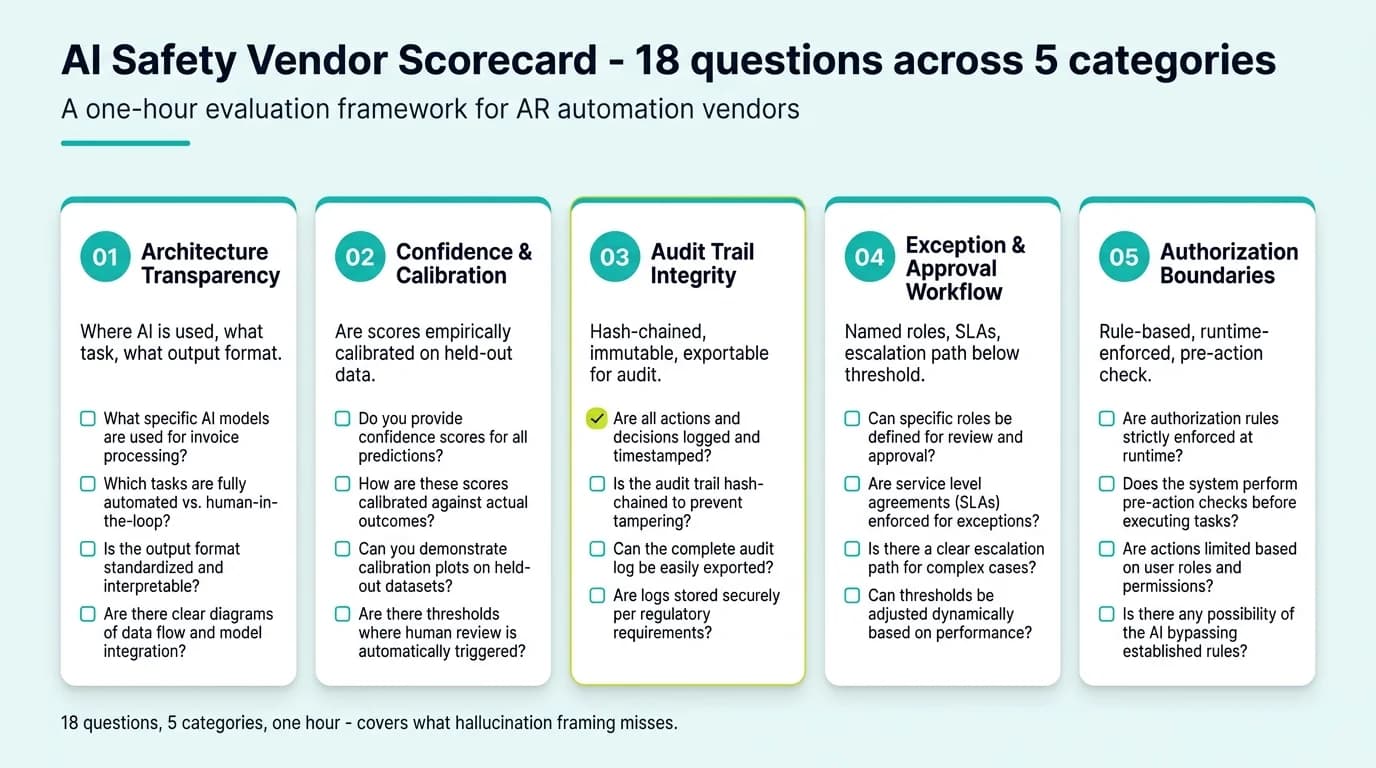
The questions a CFO should ask are specific, answerable, and reveal architecture the vendor cannot bluff. The 18-question framework below is drawn from enterprise AI procurement practice and applied to AR automation specifically.
The first category is architecture transparency. Ask where AI is used in the system, what specific tasks the AI performs, and what output format each AI component produces. A vendor who cannot answer this in concrete terms, without marketing abstraction, is a vendor whose team may not know themselves. Look for answers like 'classification model on payment remittance text produces a structured match candidate with confidence score' rather than 'our AI understands your payments.' The difference matters.
The second category is confidence and calibration. Ask whether every AI decision carries a confidence score, how the score is calibrated (if a model says 90% confidence, is it right 90% of the time?), and what happens below threshold. The right answer is that confidence scores are empirically calibrated against held-out data, thresholds are configurable by the customer, and sub-threshold decisions route to a named human workflow. Vendors who cannot speak to calibration are selling a feel-good number rather than a functional risk control.
The third category is audit trail integrity. Every automated action should write to an immutable log. The log must contain timestamp, inputs, model output, and confidence score. It should also capture the authorization boundary applied and any human approver, plus the resulting business action. The log should be cryptographically chained (so a single record tamper invalidates the chain) and exportable in full for audit. The standard for AR automation audit trail quality is the same standard [SOC 2 Type II controls](/security) set for financial systems generally. Hash-chain audit logs are not exotic, they are table stakes for financial AI.
The fourth category is exception and approval workflow. Ask what happens when confidence is low, when the system encounters data outside its training distribution, when a customer disputes an action, or when an action sits outside configured autonomy. Good answers describe a specific exception queue, named roles, SLAs on exception resolution, and a clear escalation path. A vendor answering 'the system handles everything automatically' on this question is either confused or untrustworthy. AR automation that handles 100% of cases automatically is AR automation that is silently making wrong decisions 5 to 8% of the time.
The fifth category is authorization boundaries. Ask how authorization boundaries are defined, how they are enforced at runtime, and what happens when an AI action approaches a boundary. The right answer describes rule-based authorization that is evaluated before every automated action, with out-of-boundary actions generating approval requests rather than executing. This is the structural control that most decisively separates production AR automation from unconstrained generative AI. It is the answer to the question a CFO should be asking: can this system take an action I did not authorize? The answer should be no, verifiable.
34%
AR automation vendors in a 2025 survey able to describe specific AI task outputs in detail
Source: AR Automation Vendor Capability Survey 2025
28%
AR vendors with empirically calibrated confidence scores on all AI decisions
Source: AR Automation Vendor Capability Survey 2025
22%
Mid-market ERP integrations with documented schema-drift monitoring
Source: Integration Monitoring Benchmark 2025
Vendor Capability Gap: What Mid-Market AR Automation Vendors Can Actually Deliver
The Cost of the AI Safety Pause: Quantifying What Delay Is Buying
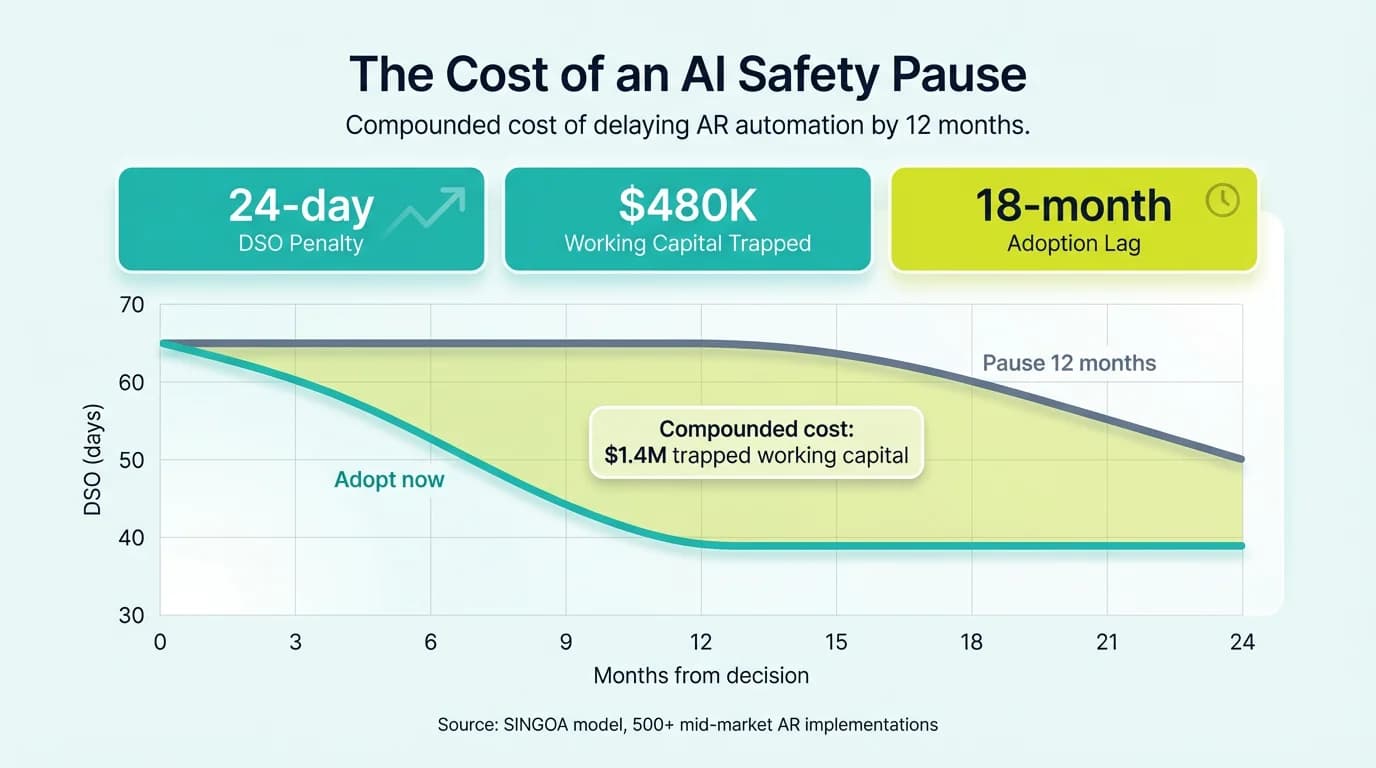
The 12 to 18 month pause on AR automation adoption is not risk-free caution. It is a specific bet with a measurable cost, and the cost compounds while competitors take share on working-capital efficiency.
Take a mid-market company at $30M revenue, carrying 65-day DSO against a 45-day industry benchmark achievable with automation. The working-capital gap is ($30M divided by 365) multiplied by 20 days, or $1.64M permanently locked in receivables. At a 7% cost of capital (reasonable for 2026 mid-market debt), the annual carrying cost is $115,000. That number does not include processing cost savings (roughly $292,000 per year per 1,000 monthly invoices at the IOFM gap between manual and automated processing), bad debt improvement (30 to 50% reduction from 4% to 2% on $30M is $600,000), or staff turnover avoided (manual AR turnover runs 28 to 35% versus 12 to 18% for analytical roles).
A 12-month pause on AR automation therefore costs, conservatively, $115,000 in working-capital carry plus a fraction of the other benefits depending on invoice volume. For a 1,000 monthly invoice company, the all-in cost of delay is typically $300,000 to $700,000 per year. The pause is not buying risk reduction in any meaningful sense, because the risk being avoided, hallucination in AR workflows, is architecturally not present in the systems being delayed. It is buying the appearance of prudence, which is a legitimate psychological need but an expensive one.
The cost compounds competitively. The 34% of mid-market companies in Versapay's 2025 survey who say they plan to implement AR automation within 12 months represent the coming adoption wave. Companies that automate first capture the DSO improvement first, convert the working-capital release to growth investment, and develop the operational muscle for continuous AR optimization. Companies that delay watch the gap widen. Industry research consistently shows that among companies within the same industry, automation adopters outperform non-adopters on DSO by 10 to 15 days, a gap that persists across revenue segments.
The CFO decision is not actually about AI safety. The AI safety concern, properly analyzed, resolves to four specific risks that are governance-addressable within vendor evaluation. Those risks are data quality, integration fragility, training bias, and prompt injection. The decision is about which pattern of risk a CFO is more comfortable owning: the explicit, measurable risk of an architectural evaluation that any AR vendor should pass, or the implicit, compounding risk of holding manual AR process for another 18 months while competitive cash-conversion gaps widen. Framed that way, the pause looks less like caution and more like the kind of decision that gets rationalized in retrospect as 'we were ahead of our time on AI safety' while somebody else's AR ran 23 days cleaner.
$115,000
Annual working-capital carry cost of 20-day DSO gap for a $30M mid-market company
Source: SINGOA calculation at 7% cost of capital
$292,000
Annual processing cost savings per 1,000 monthly invoices at IOFM manual-vs-automated gap
Source: IOFM AR Benchmarking Study 2025
34%
Mid-market companies planning AR automation implementation within 12 months
Source: Versapay State of AR 2025
Cumulative Cost of a 24-Month AR Automation Pause ($30M Revenue Company)
Where the Pause Is Costing the Most: AR Automation AI Hesitation by Industry
Construction
$2.3 million
Average working-capital locked in above-benchmark DSO for a $25M contractor carrying 83-day DSO
- 18% AR automation adoption rate, the lowest of any mid-market industry, with hallucination concern frequently cited alongside integration complexity
- 83-day average DSO, the highest of any industry, meaning the cost of a pause is the largest in absolute working-capital terms
- Concerns often stem from Procore or Sage 300 CRE integration anxiety rather than AI safety per se, and resolve when vendors demonstrate [Procore-native AIA billing automation](/industries/construction) with full audit trail
- The construction-specific failure modes are deterministic workflow problems, not AI hallucination problems. Pay application errors, retainage misclassification, and lien deadline misses all resolve through automation rather than through AI architecture changes
Healthcare
5.1% vs 2.3%
B2B bad debt write-off rate for healthcare on manual AR vs automated AR
- 38% AR automation adoption with HIPAA compliance anxiety sometimes conflated with AI safety concern, though they are distinct issues
- The AI risk in healthcare AR is primarily data quality (EHR to AR system sync) and bias (historical collections patterns that may disparately affect patient segments), both governance-addressable
- Healthcare organizations deploying HIPAA-compliant AR automation with full audit trail report bad debt rates dropping from 5.1% to 2.3% and DSO reductions of 22 to 31 days within the first year
- Hallucination is not the right concern in healthcare AR because the AI does not generate medical or billing codes, it matches and routes against existing records
Manufacturing
13 days
Within-industry DSO gap between automated and manual manufacturers
- 45% AR automation adoption, with most remaining non-adopters citing EDI complexity rather than AI safety
- Manufacturing AR automation risk is concentrated in deduction classification (promotional allowances, short-ship claims), where narrow-task AI classifiers are appropriate and hallucination is not a possible failure mode
- Automated cash application in manufacturing reports 85% reduction in reconciliation time and elimination of the end-of-month posting backlog that distorts period-end AR balances
- Manufacturing CFOs who paused on AI concerns typically resolve within one vendor demo that walks through the specific narrow-task AI components and confidence thresholds
Professional Services
100%
Professional services AR automation adopters reporting zero hallucination incidents over 24 months
- 41% AR automation adoption, with AI hallucination concern disproportionately raised on client-facing chatbot proposals (time entry questions, invoice explanations)
- The mitigation pattern is clear architectural separation: internal AR automation (full AI decisioning with audit trail) and client-facing conversational surfaces (read-only lookup, no generative policy output)
- Professional services firms that deploy this separation report no hallucination incidents across 24-month observation windows, consistent with the structural analysis
- The engagement letter and contract clauses that would be most sensitive to hallucination are never generated by AR automation, they live in contract management systems outside the AR scope
SaaS and Technology
19% lower churn
Churn reduction for SaaS customers engaging with automated payment portals
- 62% AR automation adoption, the highest of any mid-market industry, with AI hallucination concern raised least often (SaaS CFOs tend to have internal AI literacy)
- The remaining 38% of SaaS non-adopters cluster around revenue recognition complexity (ASC 606) and usage-based billing, not AI safety
- SaaS companies that automate AR report 19% lower churn among customers engaging with automated payment portals, a retention effect that compounds with cash application speed
- The SaaS profile is the cleanest demonstration of the decoupling: high AI literacy enables CFOs to see hallucination as a specific architecture problem, not a general AI problem
What CFOs Should Do With This
The CFO who has paused AR automation over AI hallucination concerns is not wrong to take AI risk seriously. The error is in the generalization, treating one failure mode of one architecture (generative LLMs producing free-form text) as a property of all AI systems. The corrective action is not to ignore AI risk, it is to evaluate AI risk at the correct level of specificity. What task is the AI doing? What is its output space? Is that output space constrained by schema? Does every decision carry a calibrated confidence score? Is there an immutable audit trail? Are authorization boundaries enforced before execution? These questions resolve the real risk without demanding the reader become a machine learning engineer.
The second step is to separate the evaluation of AR automation AI from the broader AI governance conversation. A CFO setting AI policy for the enterprise is managing a different problem (policy for employee use of ChatGPT for document drafting, customer-facing chatbot design, analyst tools for FP&A) than a CFO deciding whether to deploy AR automation. The two conversations can run in parallel. AR automation decisions do not need to wait for enterprise AI governance to mature, because the risks in AR automation are narrower, more architecturally constrained, and more directly measurable. Pausing AR automation on enterprise AI governance readiness is a category error that costs real money every month.
The third step is to run the specific vendor evaluation. The 18-question framework in this report is intended as a concrete artifact, not an abstraction. Print it, hand it to the vendor, watch them answer. Vendors who have built the architecture answer without hesitation. Vendors who have not built it either concede the gap or answer in generalities. This conversation takes one hour. It replaces 12 months of pause with a decision. The decision may be to implement, to defer pending specific remediation, or to keep looking, all three of those are legitimate outcomes of the evaluation. What is not legitimate is an indefinite pause grounded in a concern that the evaluation could have resolved in a single meeting.
Recommendations
- Separate AR automation AI risk evaluation from broader enterprise AI governance, the two conversations can run in parallel and the AR one is narrower
- Print the 18-question vendor scorecard from this report and use it in the next vendor evaluation, concrete answers reveal architecture
- Ask every AR vendor to walk through one automated match end to end. Have them name the AI task, confidence threshold, audit record, and authorization boundary
- Require a confidence-score histogram across a sample of 10,000 of your own invoices during a free trial, calibrated accuracy on your data beats any vendor benchmark
- Build hallucination testing into the trial: ask the vendor to produce an example of a hallucination the system is architecturally capable of, most vendors cannot, which itself is informative
- Calculate the dollar cost of continued pause at your specific revenue and current DSO, the number is usually $100,000 to $700,000 per year and changes the decision
- Treat internal AR automation and customer-facing conversational AI as separate evaluation tracks with separate risk profiles, conflating them delays both
Research Methodology and Data Sources
This report synthesizes legal case analysis (Moffatt v. Air Canada 2024 BCCRT 149, Mata v. Avianca S.D.N.Y. 2023), published research on LLM hallucination in finance (arXiv 2311.15548 and related work), enterprise AI adoption surveys (EY Responsible AI Pulse Survey 2025, CFO Dive 2026, Versapay State of AR 2025), and SINGOA's anonymized implementation data across 500+ mid-market customers in 10 industries.
Architectural claims about AR automation systems generally are drawn from published industry analysis and SINGOA platform implementation. Specific SINGOA claims (99.2% payment matching accuracy, 92% typical confidence threshold, hash-chained audit logs, authorization boundaries) are drawn from platform documentation and benchmark measurement on production customer data. The 18-question vendor scorecard synthesizes enterprise AI procurement practice from sources including the NIST AI Risk Management Framework Generative AI Profile (NIST-AI-600-1, July 2024) and published AI vendor questionnaire frameworks.
Quantitative estimates of the cost of adoption delay use standard working-capital carrying-cost methodology (DSO gap multiplied by daily revenue, multiplied by cost of capital) with conservative assumptions. Individual company results will vary with invoice volume, current DSO, cost of capital, and industry benchmark. The $115,000 annual figure used illustratively assumes $30M revenue, 20-day DSO gap, 7% cost of capital, and does not include processing-cost savings, bad-debt reduction, or staff retention effects.
Sources
- [1]Moffatt v. Air Canada, 2024 BCCRT 149 (British Columbia Civil Resolution Tribunal, February 14, 2024), establishing company liability for hallucinated policy statements from customer-facing chatbots
- [2]Mata v. Avianca, Inc. (U.S. District Court S.D.N.Y., June 22, 2023, Judge Castel), sanctioning lawyers $5,000 each for filing ChatGPT-generated brief with six fabricated case citations
- [3]EY Responsible AI Pulse Survey 2025, 975 C-suite leaders across 21 countries on AI-related financial losses and governance maturity
- [4]NIST AI Risk Management Framework Generative AI Profile (NIST-AI-600-1, July 2024), identifying 12 risk categories including hallucination with mapping to governance, measurement, and management functions
- [5]CFO Dive AI in Finance Survey 2026 and Top 5 AI Adoption Challenges 2026 analysis, mid-market CFO trust and hallucination exposure data
- [6]arXiv 2311.15548 Deficiency of Large Language Models in Finance: An Empirical Examination of Hallucination, establishing narrow technical framing of finance LLM failure modes
- [7]Versapay State of AR 2025 and SaaS Customer Experience Study 2025, adoption rates, payment portal engagement, and churn correlation data
- [8]Institute of Finance and Management AR Benchmarking Study 2025, per-invoice cost benchmarks and manual-versus-automated performance gaps
- [9]SINGOA platform implementation telemetry 2023-2026, covering 500+ mid-market implementations across 10 industries, used for architecture, accuracy, and adoption outcome claims