
Our Verdict
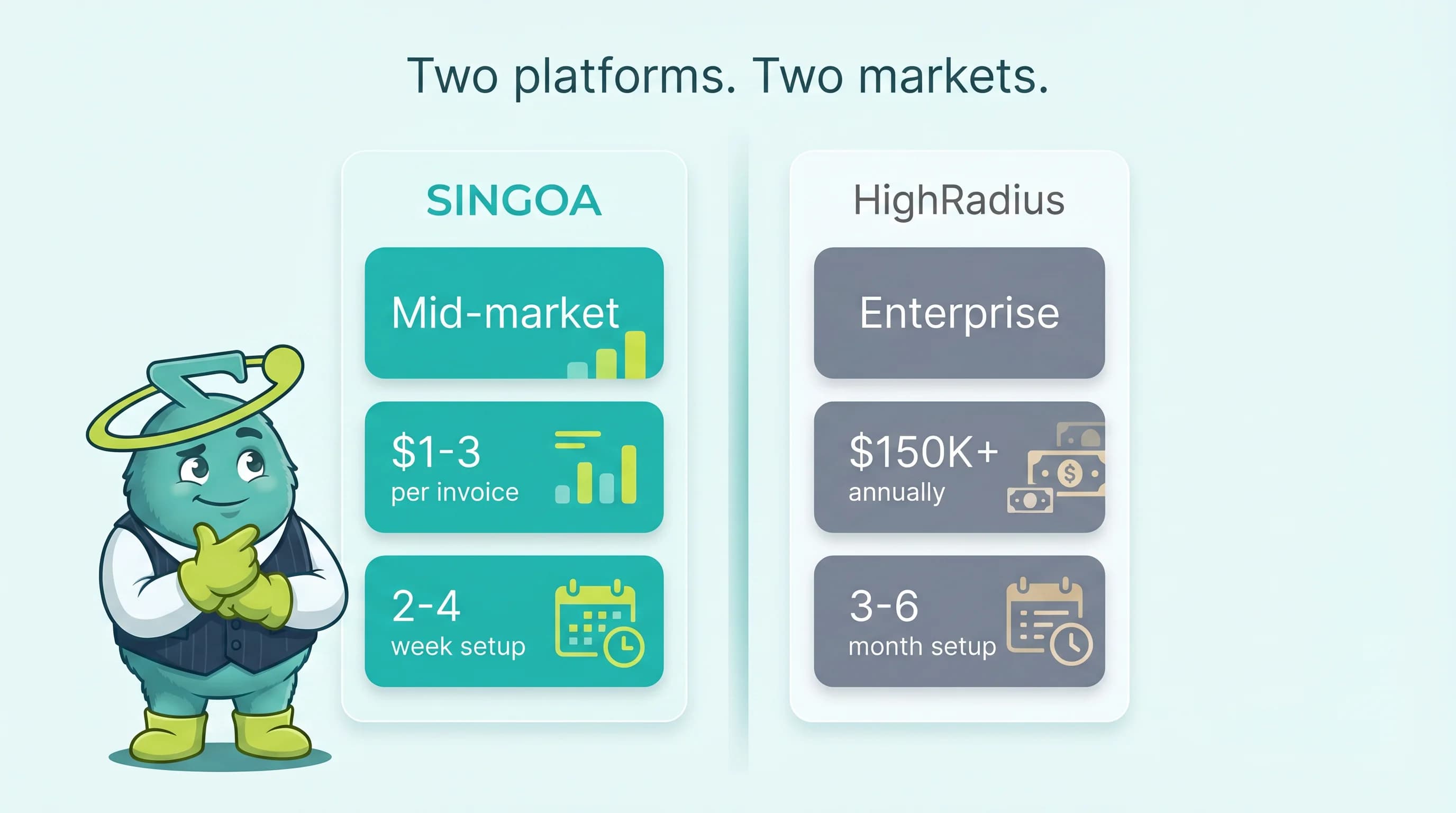
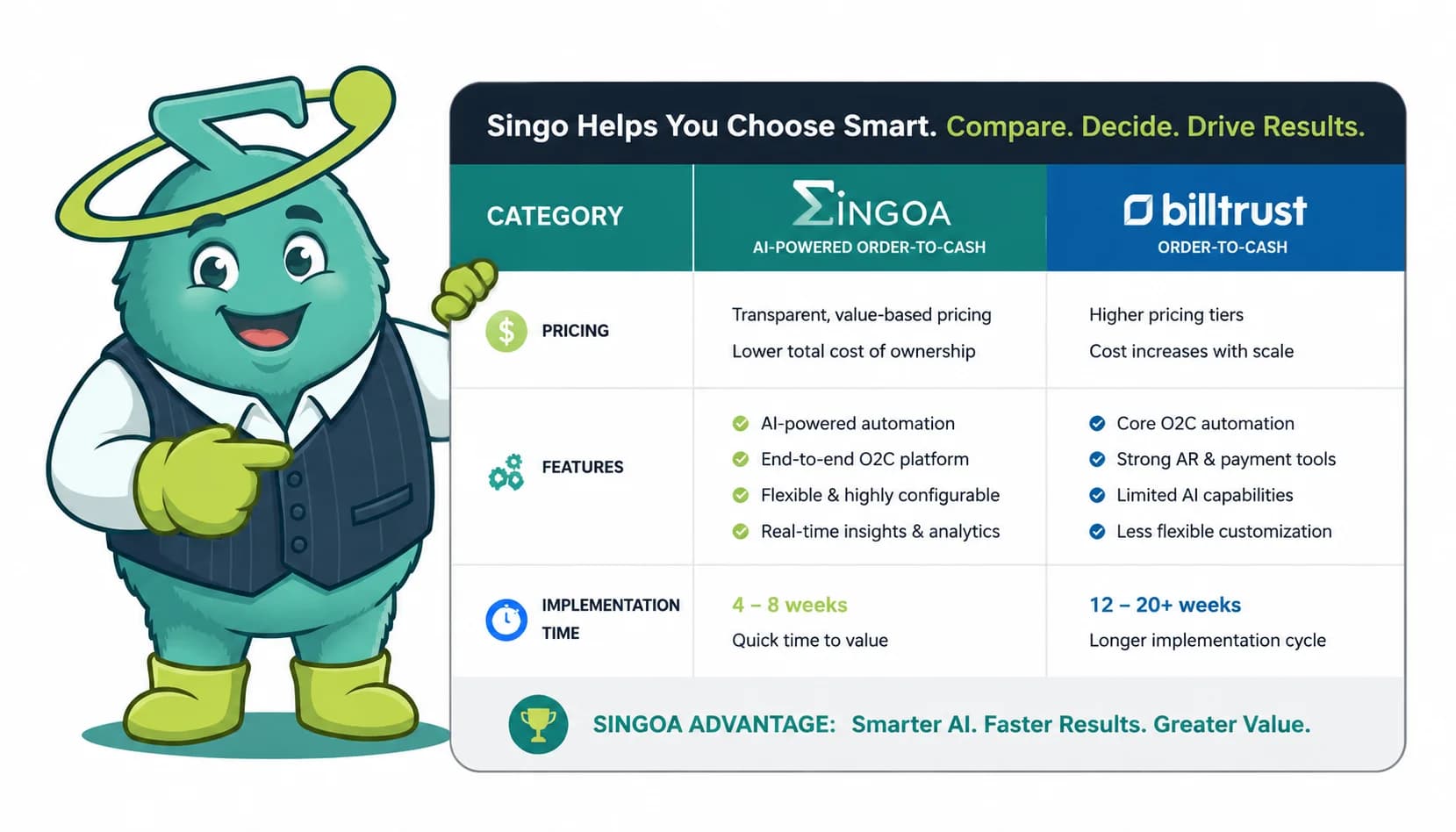
SINGOA and Billtrust both automate accounts receivable. SINGOA fits $10M-$300M mid-market teams at $1-3 per invoice with 2-4 week deployment. Billtrust fits Fortune 1000 enterprises with per-seat pricing, Business Payments Network fees, and 3-6 month implementations.
Key Takeaways
- SINGOA runs roughly 60% lower 3-year TCO at 1,000 invoices per month: $24K-$36K per year all-in versus Billtrust at $75K-$120K subscription plus $50K-$150K services.
- SINGOA deploys in 2-4 weeks self-serve. Billtrust averages 3-6 months with a required systems-integrator engagement, an $80K-$220K working-capital gap for mid-market.
- Billtrust genuinely wins on Business Payments Network reach, print-and-mail scale, and enterprise credit portfolios: real moats above roughly $500M in revenue.
- SINGOA leads on AI cash application at 95%+ auto-match, autonomous collections, and modern billing integrations like Stripe, Sequence, Orb, and Metronome.
- Rule of thumb: under $300M on QuickBooks, NetSuite, Sage, or Xero, pick SINGOA. Over $500M on SAP or Oracle with check volume, Billtrust wins.
At-a-Glance Comparison
| Feature | SINGOA | Billtrust |
|---|---|---|
| Target Market | Mid-market ($10M-$300M) | Enterprise ($500M+) |
| Pricing Model | Transparent per-invoice ($1-$3) | Per-seat subscription + BPN transaction fees |
| Annual Cost (1,000 inv/mo) | $24K-$36K all-in | $75K-$120K + $50K-$150K services |
| Implementation Time | 2-4 weeks (self-serve) | 12-24 weeks (SI engagement required) |
| Cash Application | AI on unstructured remittance (95%+ auto-match) | Rules-based extraction engine |
| Collections | Autonomous, risk-scored, agent-approved | Workflow-based, analyst-driven |
| Payments Network | Standard ACH, card, check-view portal | Business Payments Network (BPN) reach |
| Modern Billing (Stripe, Orb, Metronome) | Native connectors | Custom work typically required |
| ERP Coverage | QuickBooks, NetSuite, Sage Intacct, Xero | Oracle, SAP (deep IDoc / Cloud APIs) |
| Reporting | Real-time with drill-down | Batch nightly (real-time on premium) |
| Support Model | In-app chat + shared Slack | Tiered CSM engagement |
| 3-Year TCO Delta | ~60% lower | ~$170K-$400K higher |
See your AR automation ROI
Plug in your invoice volume to see what a SINGOA deployment saves versus a Billtrust package at 1,000 invoices per month.
SINGOA: Purpose-Built for Mid-Market AR
Your Billtrust quote landed at $95K in year-one subscription plus $110K in professional services, with a 4-month go-live. Your board wants DSO down 20% this quarter, not by Q3 2027. That gap between what enterprise AR suites cost and what mid-market finance teams actually need to hit their working-capital targets is why the SINGOA vs Billtrust question dominates procurement Slack threads at $10M to $300M companies right now.
SINGOA was built in 2024 as an AI-native cash application and collections platform explicitly for $10M-$300M finance teams. The team looked at $10M-$300M finance orgs running QuickBooks or NetSuite and asked what would happen if AI cash application and autonomous collections shipped as one connected platform alongside a payment portal. The answer was self-serve onboarding, [per-invoice pricing](/pricing), and go-live measured in weeks. The tradeoff is deliberate. SINGOA does not chase Fortune 100 credit-portfolio depth or a print-and-mail national footprint. It optimizes for the finance team that has to ship a working AR stack before the CFO's next board meeting.
SINGOA sells to controllers who want cash application, collections, and payments in one platform without a systems integrator. Native connectors cover QuickBooks, NetSuite, Sage Intacct, and Xero. Modern billing stacks like Stripe, Sequence, Orb, and Metronome connect out of the box for usage-based invoicing. The pattern from our [SINGOA vs HighRadius comparison](/blog/singoa-vs-highradius-2026) rhymes here. Below $300M, the cost curve, deployment speed, and workflow model compound in favor of a mid-market-native platform.
This post is the honest comparison. We put SINGOA and Billtrust side-by-side on pricing and three-year TCO at 1,000 invoices per month. We also weigh feature depth across cash application and collections, implementation timelines, and the tech-stack fit that decides which platform gets you promoted. Where Billtrust genuinely wins, we say so. Where SINGOA is the better call, the reasoning is specific and the numbers are transparent. Bring your Billtrust quote to this page and score it line by line.
Billtrust: Enterprise AR Suite With BPN Reach
Billtrust was founded in 2001 as a print-and-mail invoicing bureau. It went public in 2020 and matured into the enterprise AR platform behind the Business Payments Network. Billtrust sells to Fortune 1000 buyers who need check volume and buyer network reach. That network is a genuine asset when you have Home Depot and Costco on your customer list.
Billtrust's origin story explains its shape. It started as a print bureau for Fortune 1000 invoicing, added electronic delivery, and grew the Business Payments Network into a two-sided marketplace where thousands of buyers and suppliers exchange remittance and payment data. But everything about Billtrust is priced for that scale, including the sales cycle, the professional-services SOW, and the CSM tier assignment. Below $500M in revenue you rarely benefit from the moat while still paying the mortgage.
The mid-market gap is the reason this comparison matters. Billtrust's down-market packages rarely land below $80K ARR because their cost to serve is fixed. A CSM plus a solutions engineer plus a sandbox environment are not free, and the platform's economics need volume to justify that overhead. Meanwhile the AR problems inside a $50M distributor look nothing like the AR problems inside a $2B chemicals company. Our [mid-market AR overview](/industries/general) breaks the pattern down further. Reading the market fit correctly saves a quarter of wasted procurement cycles.
The mistake most teams make is optimizing for feature checklists instead of asking whether the platform's business model was designed for a company at their revenue and complexity level. That question is where the real answer starts, and the feature-by-feature detail below gives you the ammunition to answer it. If your company is over $500M in revenue and already runs on Oracle or SAP with a print-heavy customer base, Billtrust's Business Payments Network is a genuine moat. The BPN buyer connections are worth their price at that scale.
Feature-by-Feature Comparison: Where Each Platform Wins
Cash Application and Remittance AI
SINGOA
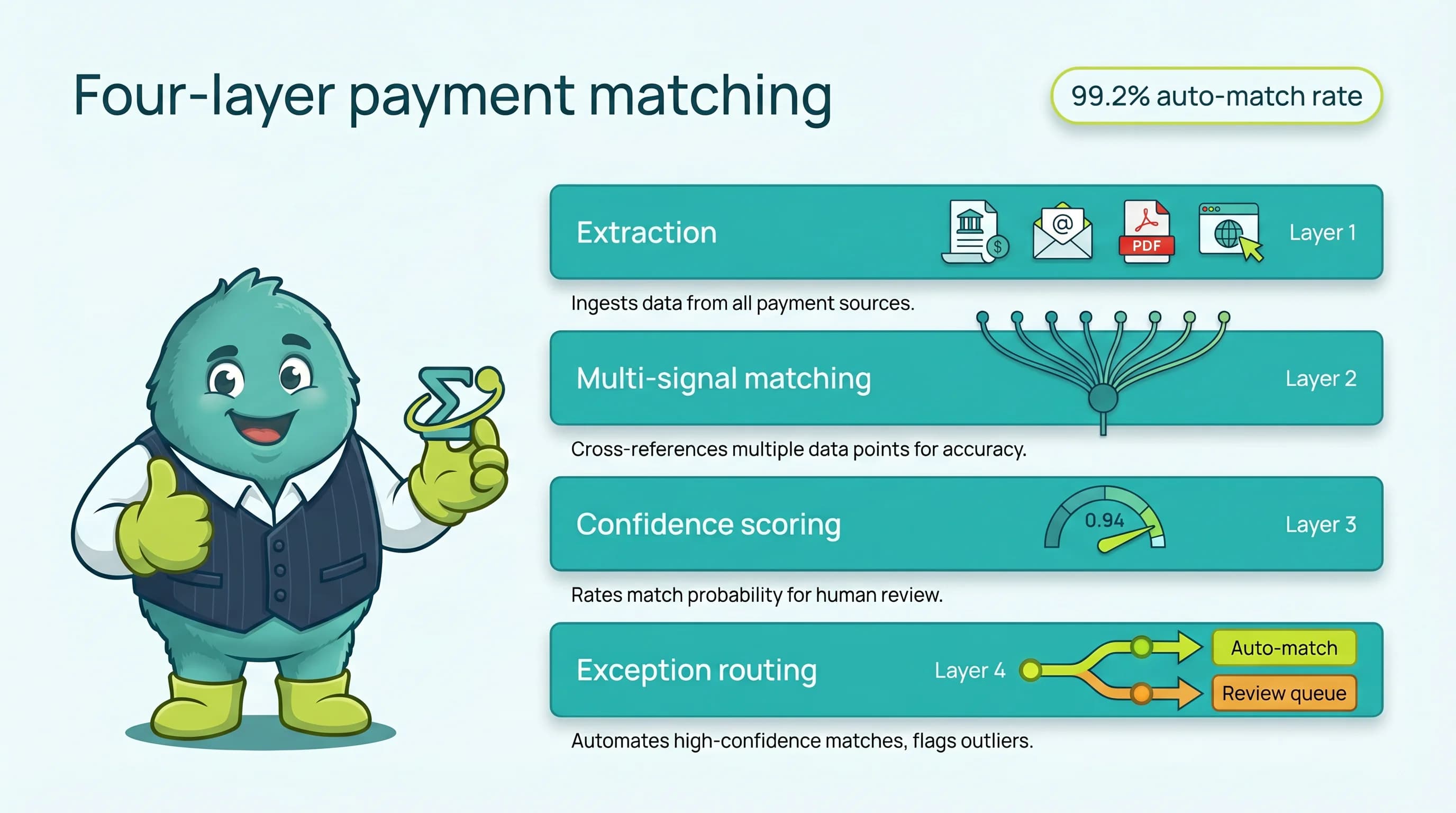
- AI reads unstructured remittance advice like PDFs, emails, and Excel attachments using models tuned for AR context
- 95%+ auto-match rate on typical mid-market invoice books
- Handles new customer remittance formats without a rules-engine rewrite
- Real-time confidence scoring with exception routing for low-confidence matches
Competitor
- Rules-based extraction engine tuned for predictable, standardized remittance formats
- Shines when all customers send remittance in a consistent template
- Requires human coding when a customer switches format or onboards new
- Multi-lockbox processing across global bank formats for enterprise volume
Verdict: SINGOA wins on cash application for mid-market. When one customer switches format or a new one comes onboard, the Billtrust workflow queues those payments for a human to code. That is where the hours accumulate. SINGOA's AI absorbs new formats without engineering work. According to the IOFM Cash Application Benchmark, 2024, unstructured remittance handling is where most mid-market teams lose the largest chunk of manual hours.

Collections Automation
SINGOA
- Autonomous collections engine drafts, sequences, and sends dunning grounded in customer risk score
- AI selects tone, timing, and channel based on aging and past payment behavior
- Human approves in batch or lets the platform ship without gatekeeping
- Scales to one analyst covering 800 customers and 4,000 open invoices without burnout
Competitor
- Workflow-based collections engine with deep enterprise configurability
- AR analyst writes copy and chooses send time within a rules framework
- Approval chains and case management for complex enterprise governance
- Collector effectiveness analytics with team performance dashboards
Verdict: SINGOA wins on collections for mid-market teams. Billtrust's workflow-based approach is fine when you have a five-person collections team. It becomes a bottleneck when one analyst is covering 800 customers and 4,000 open invoices without breathing room. SINGOA's autonomous engine unlocks capacity without adding headcount.
Payment Portal and Payments Network
SINGOA
- Branded customer portal for credit-card, ACH, and check-view payments
- Invoices, credit memos, and account statements surfaced in one view
- Standard payment processing via Stripe, Braintree, and major ACH rails
- Suits mid-market receivable mixes with low check volume
Competitor
- Branded customer portal with equivalent baseline coverage
- Business Payments Network (BPN) two-sided marketplace connecting thousands of buyers
- Print-and-mail scale for customer bases that still pay by check
- Genuine moat for Fortune 1000 suppliers with heavy buyer-network exposure
Verdict: Billtrust wins on payments network reach. Payment portals themselves are the most comparable feature in the comparison, both platforms cover the essentials. The gap opens at the BPN. If 40%+ of your receivables arrive by check and your customer base overlaps BPN buyers, Billtrust genuinely accelerates cash. Below that check-mix threshold, the network is a line item you pay for without measurable benefit.
ERP Integrations and Modern Billing Stack
SINGOA
- Native connectors for QuickBooks, NetSuite, Sage Intacct, and Xero out of the box
- Modern billing stack integrations: Stripe, Sequence, Orb, and Metronome for usage-based invoicing
- Bidirectional data sync tested against real mid-market ERP configurations
- The full [SINGOA feature overview](/features) lays out every connector
Competitor
- Strongest on Oracle and SAP with mature IDoc and Cloud APIs
- Broad enterprise ERP coverage for heavily customized environments
- Stripe integration exists but frequently requires custom work
- EDI and global banking rails for enterprise scale
Verdict: SINGOA wins on modern billing and mid-market ERPs. Billtrust wins on SAP and Oracle depth. On usage-based SaaS with Stripe or Orb, SINGOA sends remittance intelligence straight into AR without a custom SOW. Choose the platform whose native list already covers your stack, that is the honest tie-breaker.
Credit Management
SINGOA
- Credit limits, application intake, and exposure alerts appropriate to $10M-$300M books
- AI risk scoring based on payment history and behavioral pattern deterioration
- Automated customer segmentation for risk-based dunning and credit limit adjustments
- Does not attempt Fortune 500 credit portfolio simulation
Competitor
- Multi-entity credit exposure, application scoring, and portfolio monitoring
- Depth appropriate for a $2B distributor's credit portfolio
- Credit insurance integration and structured analyst workbench
- Global credit risk assessment across multiple jurisdictions
Verdict: Billtrust wins on credit management. Its credit module handles multi-entity credit exposure, application scoring, and portfolio monitoring at the depth a $2B distributor needs. For $10M-$300M books, SINGOA's credit surface is comprehensive and sufficient. This is the category where the enterprise platform earns its premium at the right revenue band.
Reporting and Analytics
SINGOA
- Real-time dashboards with drill-down to invoice and remittance level
- No waiting for a nightly batch job to see aging or DSO shifts
- Self-service report builder for finance teams without analyst support
- Export to Excel and PDF plus open REST API
Competitor
- Batch nightly reporting standard for the enterprise data model
- Real-time available on premium tiers
- Configurable KPI dashboards with peer-group benchmark comparisons
- Native integration with enterprise BI platforms including Tableau and Power BI
Verdict: SINGOA wins on real-time visibility for mid-market. Billtrust's batch model reflects its enterprise data lineage. For a controller who needs to answer a board question before the standup ends, waiting for a nightly job is the wrong friction. For a treasury team consolidating across ten entities, batch is acceptable and enterprise BI depth matters more.
Support Model
SINGOA
- In-app chat plus a shared Slack channel for every mid-market account
- Fast asynchronous answers before the AR standup ends
- Named Customer Success Manager assigned from day one
- Live onboarding included with no tiered pricing gate
Competitor
- Tiered CSM engagement where response times scale with contract size
- Quarterly business reviews as part of enterprise support tiers
- Structured escalation paths for regulated enterprise environments
- Dedicated implementation manager during multi-month go-live
Verdict: SINGOA fits the AR analyst who wants an answer before the standup meeting ends. Billtrust fits the enterprise governance model with QBRs and formal SLAs. Both models work, they just fit different operating rhythms.
Deductions and Disputes
SINGOA
- Reads short-pay reasons from remittance advice automatically
- Drafts a dispute case with invoice and reason code already attached
- Links deductions to invoice, promotion, and reason without analyst hunting
- Saves roughly six hours weekly for a $50M distributor with 12-15 deductions per week
Competitor
- Dispute workflow surfaces the deduction cleanly for enterprise scale
- Root cause analytics with structured workflow routing
- Strong on retail CPG chargeback and promotional deduction management
- Leaves the linking work to the analyst on typical mid-market SKUs
Verdict: SINGOA wins deductions for standard mid-market patterns because the AI pre-links reasons to invoices. On a $50M distributor with 12 to 15 deductions a week, that saves roughly six hours weekly, or about 300 hours a year. Billtrust wins for large retail-CPG chargeback programs where the enterprise dispute workflow depth compensates for the manual linking overhead.
See SINGOA next to your Billtrust quote
Bring your Billtrust quote to a 15-minute walkthrough. We will map every line item to a SINGOA equivalent and hand you the delta.
Pricing and 3-Year TCO at 1,000 Invoices per Month
SINGOA prices on a straight per-invoice model. The list rate is $1 to $3 per invoice depending on volume tier and product mix. That covers cash application and collections. It also covers the payment portal, remittance parsing, and integrations. There is no implementation fee, no seat license, no module unlock. A team processing 1,000 invoices per month lands between $12K and $36K annually, and typically around $24K when averaged. The transparent model matters because it makes the TCO conversation short. Read [SINGOA per-invoice pricing](/pricing) for the current schedule.
Billtrust prices on a per-seat subscription with module add-ons plus transaction fees on the Business Payments Network. A typical mid-market SOW lists an AR platform base and per-seat licenses for AR analysts. Add-on modules cover cash application, credit, collections, and disputes. Professional services run $50K to $150K depending on ERP complexity. Business Payments Network transaction fees stack on top of the subscription and vary by payment mix. A published SelectHub estimate puts the all-in mid-market Billtrust package between $125K and $270K in year one before discounting.
The 3-year TCO math is what closes the loop. SINGOA at 1,000 invoices per month runs $24K-$36K yearly, or $72K-$108K over three years, with no other line items. A midpoint Billtrust deal at the same volume runs $95K subscription plus $95K one-time professional services in year one, or roughly $190K. Add $95K in year two and year three subscription, plus modest annual price increases, plus $8K-$15K per year in BPN transaction fees. The three-year Billtrust total lands between $275K and $510K. The delta is between $170K and $400K.
Hidden costs are where the story often lands sideways. Ask Billtrust for a change-order rate on the SOW because customization requests during implementation are billed at $200 to $275 an hour. Ask for the sandbox environment cost because non-production tenants carry their own line item. Ask for the per-piece print-and-mail rate if you plan to keep any check volume in-house. And ask about renewal escalators because 5-7% annual price increases are standard in enterprise AR contracts. Every hidden cost you surface pre-signature is a working-capital dollar you keep.
A $200K three-year delta is not just a P&L line. It funds two AR analyst salaries. It pays for a treasury system upgrade. It funds a 60-day extension on customer credit terms during a demand cycle. That is why the pricing lens matters more than the feature lens for teams under $300M.
| Tier | SINGOA | Competitor |
|---|---|---|
| 1,000 invoices/month, Year 1 Subscription | $24K-$36K | $75K-$120K |
| One-Time Implementation / Professional Services | $0, included | $50K-$150K |
| Business Payments Network Transaction Fees | Not applicable | $8K-$15K/year |
| Year 1 All-In | $24K-$36K | $125K-$270K |
| 3-Year TCO | $72K-$108K | $275K-$510K |
| 3-Year Delta (favor of SINGOA) | Baseline | $170K-$400K higher |
TCO Analysis
At 1,000 invoices per month over three years, SINGOA totals $72K-$108K and Billtrust totals $275K-$510K, a roughly 60-70% delta in favor of SINGOA. That difference funds two AR analyst salaries, a treasury system upgrade, or a 60-day extension on customer credit terms during a demand cycle. Always ask Billtrust for a TCO quote that includes Business Payments Network transaction fees at your projected mix of ACH, card, and check. The subscription line item is usually only 55-65% of what you will actually spend.
Choose SINGOA If You Are:
- A $40M SaaS company on NetSuite with 900 subscription customers where cash application is bleeding time
- A $75M wholesaler on QuickBooks Enterprise trying to bring DSO from 68 to 52 days this fiscal year
- A $150M professional services firm on Sage Intacct with 500 active clients and a growing dispute backlog
- A $200M usage-based SaaS on Stripe or Orb that needs remittance intelligence its billing platform never promised
- A team switching from a Billtrust quote that overshoots your budget and timeline
- Between $10M-$300M on QuickBooks, NetSuite, Sage, or Xero and want AI cash application plus autonomous collections live this quarter
- Under pressure to hit a board-level DSO target before the fiscal year ends, without a systems-integrator engagement
Choose Billtrust If You Are:
- A $700M distributor on SAP where 60% of receivables still arrive by check and remittance sits in the envelope
- A $2B chemicals manufacturer with a credit portfolio that needs multi-entity exposure monitoring
- A Fortune 1000 buyer's supplier where BPN network reach cuts your days-to-cash in half
- On Oracle EBS with mature IDoc flows that already integrate with Billtrust
- Running print-and-mail volume above 25,000 pieces monthly that another vendor cannot match
- Above $500M in revenue with a mature enterprise credit portfolio and credit-insurance policy management
- In the $300M-$500M gray zone with SAP or Oracle and 40%+ check volume where the BPN and print rails still earn their keep
Switching from Billtrust to SINGOA: Step-by-Step
Estimated timeline: 2-4 weeks for the SINGOA go-live with a SINGOA-led parallel run; full Billtrust decommission complete inside a single quarter for standard migrations.
Export Historical Data from Billtrust
Export your customer master, open invoices, and dispute cases from Billtrust. Extract at least 24 months of payment history for AI model training on your specific customer base. Clean and normalize the data during export, migration is a natural opportunity to remove duplicate records and update stale contact information.
Provision SINGOA and Connect Your ERP
Provision the SINGOA tenant and connect your ERP using the native connector for QuickBooks, NetSuite, Sage Intacct, or Xero. Validate bidirectional data sync for invoices, payments, and customer records. Run a 48-hour parallel sync test to confirm data accuracy before importing historical records.
Run a 30-Day Parallel Period
Run a 30-day parallel period where both platforms process live data. Compare cash application match rates, collections activity timing, and dunning sequence accuracy between Billtrust and SINGOA. Validate that all open invoices and customer records are accurately reflected before proceeding to cutover.
Cut Collections and Cash Application to SINGOA
Cut collections and cash application to SINGOA in production while Billtrust handles residual BPN payments. Notify customers of the new payment portal URL. Monitor closely for 30 days post-cutover, addressing any edge cases from legacy data before the next renewal window closes.
Sunset the Billtrust Subscription
Sunset the Billtrust subscription at the next renewal window. If you inherit a Billtrust contract in the middle of a renewal window, negotiate a 90-day parallel-run clause into your SINGOA agreement, so you keep your BPN check flow while the AI cash application ramps. Most switches complete cleanly inside a quarter. To validate the working-capital case, review [the working-capital math behind faster DSO](/blog/reduce-dso-proven-strategies-2026) and [the full cash application buyer's guide](/blog/cash-application-software-buyers-guide-2026).