
The Professional Services Billing Problem: 12% of Revenue Never Gets Invoiced
At a 50-timekeeper consulting firm, $890K of billable work quietly disappears every year. The timesheets get approved. The work gets delivered. The invoice just never goes out, or it goes out 14 days late, or the retainer it should have drawn down hit zero last Tuesday and nobody noticed. According to the BigTime State of Professional Services Report 2024, professional services billing leaks roughly 12 percent of annual revenue this way, before a single late payment is even on the table.
The pattern repeats across consulting, accounting, marketing, architecture, engineering, IT services, and financial advisory. DSO averages 55 days per Dun and Bradstreet 2024 professional services payment data. Collection rate sits at 82 percent per the AICPA and CIMA Finance Benchmarking Report 2023. Unbilled WIP runs 18 percent of billable time at firms doing this manually. None of that shows up on a P&L as a problem. It shows up as cash you do not have, and a working capital line that quietly grows.
Professional services billing leakage hides inside systems that are technically working. Your PSA is recording time. Your accounting software is issuing invoices. The handoff between them, and the partner review queue that sits in the middle, is where the cash disappears. The fix is not another PSA. It is closing the seven specific handoffs between approved time and collected cash. Platforms like [SINGOA for professional services](/industries/professional-services) sit on top of your existing PSA to plug those handoffs without forcing fee earners to learn a new tool.
55 days
Average professional services industry DSO benchmark
Dun and Bradstreet Professional Services Payment Data, 2024
12%
Annual revenue lost to unbilled WIP at manual PS firms
BigTime State of Professional Services Report, 2024
$890K
Median annual WIP leakage at a 50-timekeeper firm
ALA and AICPA Billing Survey, 2024
82%
Average collection rate at manual PS firms
AICPA and CIMA Finance Benchmarking Report, 2023
1 in 5
Retainer clients experiencing billing gaps from un-replenished balances
Clio Legal Trends Report, 2023
Common Pain Points
- 12 percent of professional services revenue goes unbilled annually because approved timesheets never become invoices
- 14-day average gap between timesheet approval and invoice issue, compounded by sequential partner-review queues
- 1 in 5 retainer clients experience billing gaps when balances run down without anyone noticing
- 82 percent average collection rate means 18 cents of every billed dollar fails to arrive within a normal cycle
- Unbilled WIP averages 18 percent of billable time at manual firms, decaying by roughly 8 percent in collectible value every 30 days
- Hybrid engagements drift silently between billing models (a retainer that becomes T&M overage, a fixed-fee project that absorbs scope changes) without the billing system noticing
Industry Terminology Guide
See what 33 days of DSO is worth to your firm
Plug in your annual revenue and average DSO to model the working capital your firm frees by moving from 55- to 22-day DSO.
Four AR Automation Solutions That Cut Professional Services DSO from 55 to 22 Days
Each solution targets one of the four structural leakage points: billing model mismatch, timesheet-to-invoice latency, retainer lapse, and unbilled WIP. Together they close the seven handoffs between approved time and collected cash without replacing the PSA your fee earners already use.
Mapping PS Billing Models and Their Failure Modes
Professional services firms use four billing models (hourly T&M, fixed-fee milestone, monthly retainer, and contingency), and each one leaks revenue in a different way that automation has to address directly.
Hourly time-and-materials is the most common model and the leakiest. Fee earners log time, partners review, write-downs happen, and the bill goes out. Every step adds latency and every latency hour increases the probability that someone forgets to invoice. The failure mode is unbilled WIP. The AICPA and CIMA Finance Benchmarking Report 2023 puts the average at 18 percent of billable time at manual firms, with the worst quartile north of 25 percent.
Fixed-fee milestone billing fails differently. The contract says invoice 30 percent on kickoff, 40 percent on draft delivery, 30 percent on final acceptance. The work happens, the milestones are met, and the billing team never gets the trigger because the milestone lives in a project plan in Asana or a partner's head, not in the accounting system. The fix is automated milestone triggers tied to the engagement letter. For the metrics that show this leakage on a finance dashboard, see [AR KPIs every finance leader should track](/blog/accounts-receivable-kpis-cfo-track).
Monthly retainers split into two flavors. Pay-for-work retainers draw down against logged hours and need replenishment when the balance gets low. Pay-for-access retainers are flat monthly fees for availability. Both fail when the retainer balance is not visible in real time. Clio's Legal Trends Report 2023 found that 1 in 5 retainer clients hits a billing gap. Contingency is the fourth and rarest model, mostly in legal and litigation support. Its failure mode is realization error: hours logged against a matter that may never collect, distorting the firm's realization rate calculation.
Hybrid engagements are where the real damage happens. A retainer client quietly drifts into T&M overage. A fixed-fee project gets a scope-change addendum that nobody bills against. The billing system keeps treating the engagement as one model while the actual work has shifted to another. The next sections take each leakage point in order: timesheet-to-invoice gap, retainer replenishment, and unbilled WIP recovery.

Closing the Timesheet-to-Invoice Gap (14 Days to 24 Hours)
The 14-day timesheet-to-invoice cycle is the single largest compression opportunity in professional services billing. PSA-native sync, rules-based write-downs, and a Slack-style partner approval queue close it to under 24 hours.
Audit the gap before you fix it. The 14 days is not one wait. It is seven sequential waits: timesheet entry, manager approval, project lead review, write-down decision, partner sign-off, invoice draft, and final send. Each step has its own SLA and each one routinely blows the SLA because the prior step does not push, it pulls. The fee earner waits for the manager. The manager waits for the partner. The partner waits for the bill to land in their queue. Compounding latencies do the rest.
Closing the gap requires three structural changes, not a faster manual cycle. First, the AR layer reads approved time directly from the PSA (BigTime, Kantata, Deltek Vantagepoint, or Harvest) the moment it is approved. Second, rules-based write-down suggestions handle the routine reductions (a junior over-logged 0.5 hours on a fixed-fee task, say) before they hit the partner queue. Third, partner approval becomes a Slack-style swipe, not a 30-minute desk session. Tools like [AI payment matching and collections](/features) sit in this layer.
The realization-rate math is the part that closes the case for finance directors. Cycle compression alone lifts realization 4 to 7 points, because a bill drafted within 24 hours of work completion is harder for the client to challenge than one drafted three weeks later. Add the recovered WIP and a 50-timekeeper firm sees realization move from the low 70s to high 70s within one quarter. On $20M revenue, that is roughly $800K to $1.4M of incremental collected revenue from cycle work alone.
The reference architecture is straightforward: PSA approves the timesheet, AR layer pulls it into a WIP queue, partner approves any write-downs, the invoice drafts automatically, and the client portal sends it the same day. The catch is that the partner review step is where most firms quietly re-introduce the original 14-day delay.

Cut unbilled WIP from 18% to 4% without changing PSAs
SINGOA sits on top of BigTime, Kantata, Deltek, and Harvest, so your fee earners keep tracking time where they already do.
Retainer Replenishment Automation: Stop the 1-in-5 Lapse
Threshold-triggered replenishment fires a top-up invoice the moment a retainer balance drops below 25 percent, eliminating the billing gaps that affect 1 in 5 retainer clients at manual firms.
Retainer replenishment looks simple on paper. The client funds a $25K retainer. Fee earners log time against it. When the balance gets low, you issue a top-up invoice. In practice, the balance is a number on a spreadsheet that someone has to remember to check, the top-up requires a partner conversation, and the conversation gets postponed because the fee earner is mid-engagement and does not want to interrupt the client. So the retainer hits zero, the work continues unbilled, and finance discovers the gap two weeks later when reconciliation runs.
Threshold-triggered replenishment fixes the mechanics. Set the trigger at 25 percent of the original retainer. On a $25K retainer, the auto-invoice fires when the balance drops to $6,250. The draft lands in the partner's queue with the engagement letter terms attached, partner approves with one click, the client portal sends it, and the balance is replenished before the fee earner ever notices. The compounding strategies for this kind of cash-cycle compression are covered in [DSO reduction strategies that compound](/blog/reduce-dso-proven-strategies-2026).
Pay-for-work and pay-for-access retainers need slightly different mechanics. Pay-for-work retainers draw down against logged hours, so the balance ledger is the source of truth and the trigger is straightforward. Pay-for-access retainers are flat monthly fees for availability. The replenishment is calendar-driven (auto-bill on the first of every month) rather than balance-driven, but the same audit trail and approval workflow applies. Hybrid retainers (flat plus excess hours at a rate) need both triggers running in parallel.
The compliance angle matters for legal and accounting firms specifically. Trust accounting rules require unearned retainer fees to sit in a separate trust account until the work is performed. Automating replenishment means the AR system has to distinguish earned from unearned fees and move money between trust and operating only when work is logged and approved.

Recovering Unbilled WIP: From 18% to 4%
Daily WIP aging, AI-suggested write-downs, and stale-WIP escalation cut unbilled WIP from 18 percent to 4 percent of billable time, recovering a median $890K per year at a 50-timekeeper firm.
WIP aging is the discipline most PS firms know they should run and most do not. The aging report is the standard 0-30, 31-60, 61-90, and 90+ day buckets, sliced by partner, project, and client. The point of running it daily, not monthly, is that WIP value decays. Every day a billable hour sits in WIP, the probability it gets billed at full rate falls. By day 60 the discount is roughly 8 percent. By day 90 it is closer to 15 percent. By day 120 the partner often writes the whole thing off rather than have an awkward conversation.
Three workflow changes cut the rate from 18 to 4 percent. First, daily WIP aging reports with stale-WIP alerts: any WIP over 30 days old automatically escalates to the partner queue with a write-down recommendation. Second, AI-suggested write-downs handle the routine reductions before partner review, so the partner is approving the exception, not authoring it. Third, an immutable audit trail logs every write-down with a reason code, so the firm has a real dataset for next year's realization conversations. For firms doing this without adding headcount, see [scale AR without adding headcount](/blog/scale-ar-operations-without-adding-headcount).
The 50-timekeeper math is concrete. Assume 50 timekeepers averaging 1,600 billable hours per year at a $310 blended rate. That is roughly $24.8M of billable time. Cutting unbilled WIP from 18 to 4 percent recovers 14 points of that figure, or about $3.5M. The median recovery across SINGOA PS customers comes in lower at $890K because not all of that 14 points is fully collectible, but even the conservative number is two to three full-time billable equivalents recovered with zero headcount change.
The non-obvious payoff is the cultural one. When write-down reason codes get logged consistently, finance can finally have a data-backed conversation with engagement partners about which clients, projects, or fee earners are dragging realization down. The conversation moves from 'we feel like we are writing too much down' to 'matter 47 has 22 percent write-downs across four partners.' That is the conversation that lifts realization next year.

Professional Services PSA, Time Tracking, and GL Integrations
A professional services AR stack runs three connected layers: a PSA or time-tracking tool, an AR automation layer, and a general ledger. Bidirectional native sync between the three is the baseline requirement. CSV imports and middleware connectors defeat the purpose.

BigTime
Real-time sync of approved time, project budgets, engagement letter terms, and rate cards. Approved timesheets flow into the WIP queue the moment they are signed off, with bidirectional invoice and payment status updates.

Kantata (Mavenlink)
Native integration with Kantata's resource planning and project accounting data. Pulls approved time, milestone status, and budget-to-actual variance for billing draft generation.

Deltek Vantagepoint
Direct sync with Deltek for AE and consulting firms, pulling project budgets, employee rates, expense reports, and approved time into the AR billing queue.

Harvest
Lightweight time-tracking integration for boutique consulting and creative firms. Approved time, project tags, and client metadata sync in near real time.

QuickBooks Online
Bidirectional GL sync for invoices, payment receipts, and journal entries. Trust accounts and operating accounts are kept separate with audit-logged transfers.

Xero
Native Xero connector for invoice posting, payment matching, and reconciliation across multi-entity professional services firms.

Sage Intacct
Multi-entity GL sync for mid-market PS firms, including project-level revenue recognition, deferred revenue, and ASC 606 milestone allocation.

NetSuite
Enterprise GL integration covering project accounting, revenue recognition, AR aging, and multi-currency for global PS firms.
Professional Services Compliance: Engagement Letters, Trust Accounting, and ASC 606
Professional services billing automation must enforce engagement letter terms, separate earned from unearned retainer fees for trust accounting, and apply ASC 606 revenue recognition rules for milestone and percentage-of-completion billing, all backed by an immutable audit trail.
Engagement Letter Enforcement
The engagement letter defines billable rates per role, scope of work, and the not-to-exceed cap. The AR system should refuse to draft an invoice that violates any of those terms without explicit partner override, and the override has to log who approved what and why. The same logic applies to scope-change addendums: when a fee earner logs time against work outside the original scope, the system flags it before the invoice goes to the client.
Trust Accounting for Retainers
Trust accounting matters specifically for legal and accounting firms. Unearned retainer fees sit in a separate trust account until the work is performed. The AR system has to distinguish earned from unearned fees on a per-matter basis and only transfer money between trust and operating accounts when work is logged, approved, and billed. Get this wrong and you have a bar association problem, not a finance problem.
ASC 606 and GAAP Revenue Recognition
ASC 606 and GAAP revenue recognition rules govern milestone and percentage-of-completion billing. For fixed-fee engagements with multiple performance obligations, the system has to allocate the contract value across milestones, recognize revenue as obligations are satisfied, and produce the supporting schedule for auditors.
Immutable Write-Down Audit Trail
Immutable audit trails matter most for write-down approvals: every partner write-down should log the timestamp, approver, prior amount, new amount, and reason code. That trail is what makes the firm audit-ready year-round, not just at fiscal close. The compliance posture for the platform itself is on [SINGOA compliance and security](/compliance).
The 55-to-22 Day DSO Playbook: ROI and Benchmarks
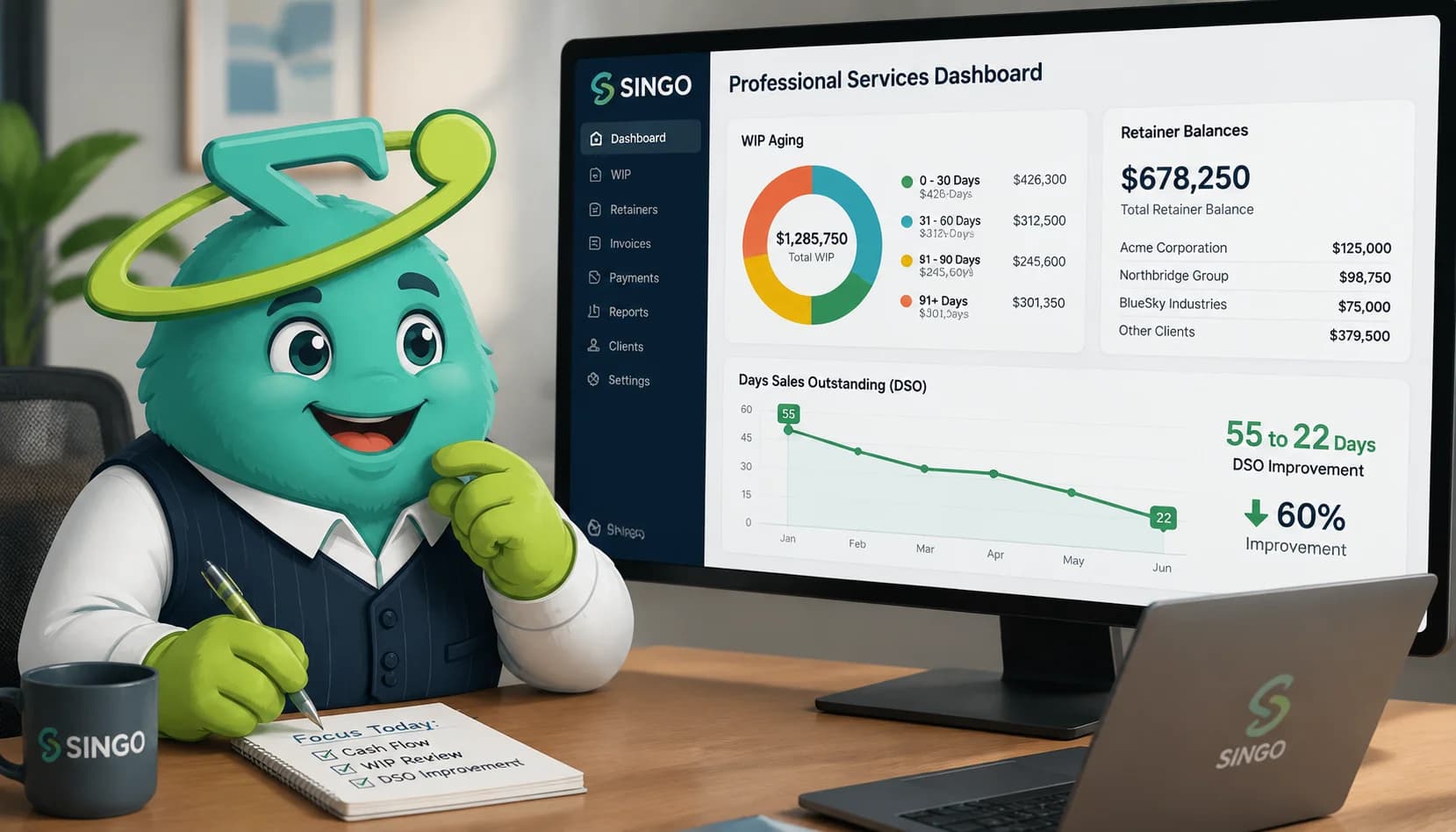
Professional services firms using AR automation typically cut DSO from a 55-day industry benchmark to 22 days, lift collection rate from 82 to 96 percent, and reduce unbilled WIP from 18 to 4 percent within 90 days of deployment. The before-and-after metrics that matter are five: DSO drops from 55 to 22 days, unbilled WIP from 18 to 4 percent, collection rate from 82 to 96 percent, realization rate up 4 to 7 points, and time-from-timesheet-approval-to-invoice from 14 days to under 24 hours. None of those numbers requires headcount changes or PSA replacement. They require closing the seven handoffs between approved time and collected cash. The methodology for the headline DSO metric is detailed in [how to calculate DSO](/blog/how-to-calculate-dso).
Working capital impact is where the conversation lands with managing partners. A 33-day DSO reduction on a $20M firm frees roughly $1.8M of working capital. That is cash that was sitting in client AR and is now in the operating account, available to fund partner draws, hiring, or technology investment. Stack that on top of the $890K median annual WIP recovery and the combined first-year cash impact at a 50-timekeeper firm crosses $2.5M before counting the realization-rate lift.
Time-to-value follows a predictable curve. Thirty days to the first clean invoice cycle through the new workflow. Sixty days to stable retainer replenishment and WIP aging cadence. Ninety days to the full benchmark numbers, assuming partner adoption of the approval queue. The non-financial benefits compound from there: partner-level visibility into WIP and realization, fee earner trust that approved time gets billed, and audit-ready compliance documentation that finance does not have to manufacture at year-end.
33 days
DSO reduction for PS firms using AR automation (55 to 22 days)
SINGOA professional services customer benchmarking, 2025
18% to 4%
Unbilled WIP rate compression at PS firms with AR automation
ALA and AICPA Billing Survey, 2024
82% to 96%
Collection rate improvement at PS firms with AR automation
AICPA and CIMA Finance Benchmarking Report, 2023
4 to 7 points
Realization rate lift from cycle compression (14 days to 24 hours)
BigTime State of Professional Services Report, 2024
$890K
Median annual unbilled WIP recovery at a 50-timekeeper PS firm
SINGOA professional services customer benchmarking, 2025
$1.8M
Working capital freed by a 33-day DSO reduction on $20M revenue
Dun and Bradstreet Professional Services Payment Data, 2024
- 33-day DSO reduction from 55 to 22 days frees $1.8M in working capital for a $20M PS firm, cash that was earned but trapped in client AR
- Timesheet-to-invoice cycle compresses from 14 days to under 24 hours, lifting realization rate 4 to 7 points across the engagement portfolio
- Unbilled WIP rate drops from 18 to 4 percent, recovering a median $890K annually at a 50-timekeeper firm with zero headcount change
- Retainer replenishment automation eliminates the 1-in-5 lapse rate, giving finance a 5 to 7 day buffer to resolve any disputes before fee earners stop logging time
- Partner-level WIP and realization visibility turns the annual realization conversation from anecdote into a data-backed dataset on which clients, projects, or fee earners drive the largest write-downs