
The legal billing stack: why mid-market firms hit a ceiling at 82% realization
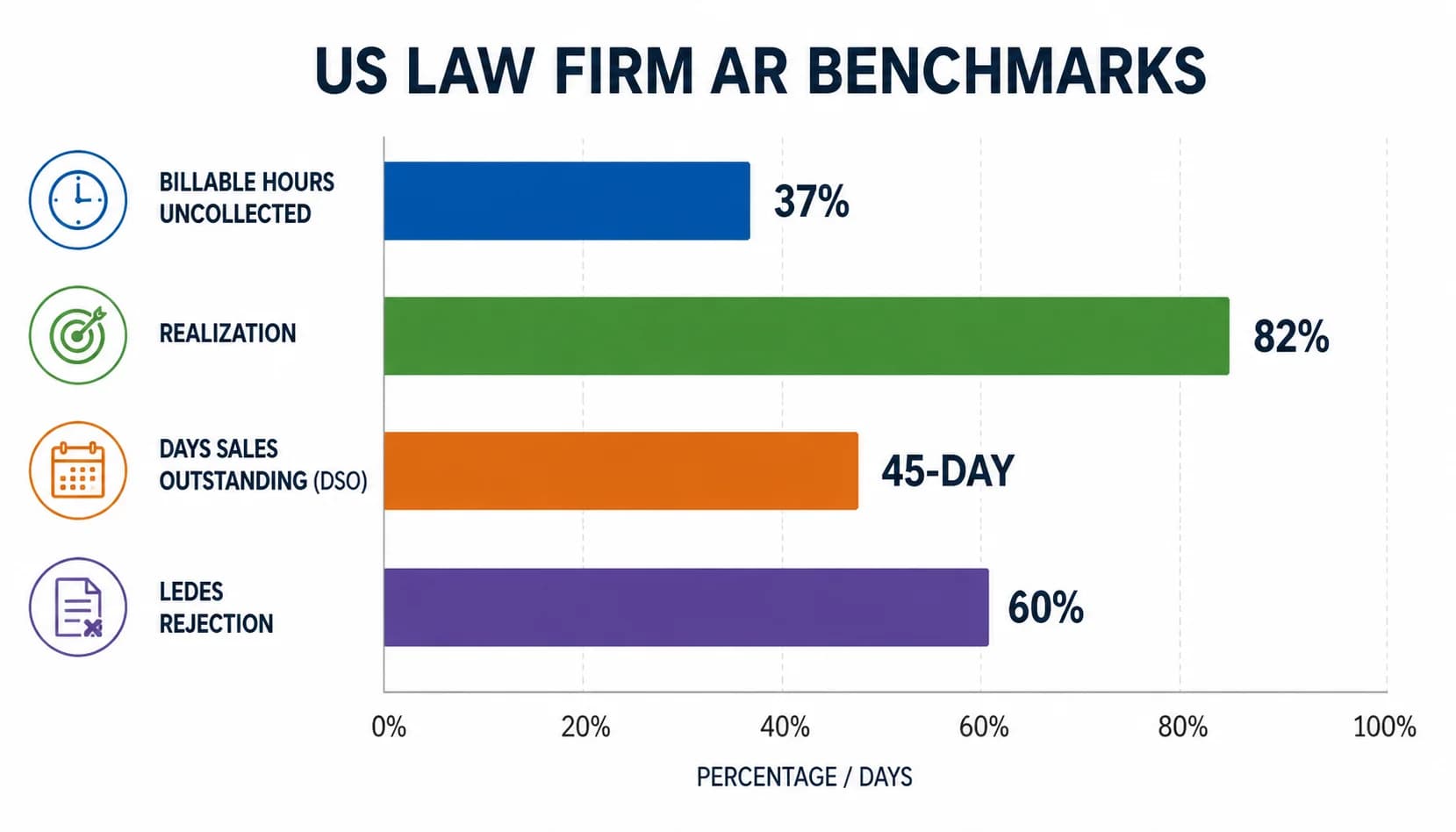
Thirty-seven percent of billable hours never reach a client invoice, according to the Thomson Reuters 2024 State of the Legal Market. For a 40-attorney firm billing $25M a year, that is roughly $9M of senior-associate and partner time written off before a single statement gets cut. Sixty percent of LEDES invoices that do get cut reject on first submission to the corporate portal, per Wolters Kluwer ELM. The work was done. The clock ran. The revenue evaporated.
Mid-market firms feel this as a stuck realization rate hovering in the low 80s, WIP aging past 45 days, and a trust reconciliation that swallows two to four days of a billing administrator's month. Managing partners ask why a firm with strong matter outcomes still struggles to clear collections inside 60 days. The honest answer is that the billing stack, the practice-management system, the QuickBooks ledger, and the spreadsheet trust reconciliation, was never designed to handle LEDES 1998B, IOLTA three-way matches, and partner-level realization analytics on the same screen.
This guide is built for firm administrators and managing partners at 15-to-150-attorney firms evaluating whether a purpose-built legal billing platform will move the needle. It binds the three pillars, LEDES e-billing, IOLTA trust accounting, and realization-rate math, into one decision framework. The target outcome is concrete: lift realization from 82% to 94%, cut DSO from 45 to 24 days, drop LEDES first-pass rejection from 60% to under 5%, all while keeping IOLTA reconciliation bar-audit clean. Read [SINGOA for law firms](/industries/legal) for the product cut of the same framework.
37%
Billable hours uncollected at the average US firm
Thomson Reuters 2024 State of the Legal Market
82%
Average realization rate (firms without billing automation)
ILTA / BigHand 2024 Law Firm Benchmarking
45-55 days
Legal industry DSO baseline
Clio Legal Trends Report 2024
60%
LEDES e-bills rejected on first submission
Wolters Kluwer ELM Solutions 2024
18 hrs
Administrator time per week on billing, collections, and trust reconciliation
AASP Legal Management Survey 2024
Common Pain Points
- 37% of billable hours go uncollected and never reach a client invoice, equivalent to $9M of senior-associate and partner time written off at a $25M-revenue firm before statements get cut
- 60% of LEDES invoices reject on first submission to Tymetrix 360 or Legal Tracker because portal-specific AFA guidelines are checked only at export, not at time entry
- Trust reconciliation eats 2 to 4 days of administrator time per month at firms running IOLTA in a spreadsheet rather than a three-way reconciliation engine
- WIP aging past 45 days before partners release pre-bills, compounding collection lag and dragging realization into the low 80s
- Generic AR platforms treat customers, not matters, breaking down at 50 attorneys when one client routinely has eight matters with separate rate cards, AFA guidelines, and trust sub-ledgers
- Trust accounting violations (commingling, late retainer transfers, unmatched receipts) carry license-loss tail risk under ABA Model Rule 1.15, not just $40K of annual error exposure
Industry Terminology Guide
See your realization-rate ROI
Plug in your worked time and current realization to see what 82% to 94% means in collected revenue and partner-level distribution.
The three pillars of modern legal billing
Firm administrators evaluating vendors should organize the conversation around three pillars: LEDES 1998B e-billing with UTBMS coding, IOLTA three-way trust reconciliation, and realization-rate analytics. Each pillar maps to a specific operational and compliance risk, and each has a concrete vendor-evaluation rubric.
The legal billing stack: why mid-market firms hit a ceiling at 82% realization
Legal billing software is purpose-built AR and billing automation that combines matter-based time capture, LEDES 1998B e-billing with UTBMS coding, IOLTA three-way trust reconciliation, and partner-level realization analytics in one system.
The benchmarks tell a brutal story. Thomson Reuters reports 37% of billable hours go uncollected at the average US firm. The ILTA and BigHand 2024 benchmarking study pegs realization at 82% for firms without billing automation, and the Clio Legal Trends Report shows WIP aging 45 days before partners release pre-bills. Wolters Kluwer ELM data shows 60% of LEDES invoices reject on first submission. None of these numbers describes a collections problem. They describe a billing-stack problem.
Generic AR tools were built for issuing one invoice per customer per month against a single ledger. Law firms operate matters, not customers. One client routinely has eight matters running, each with its own rate card, AFA guidelines, retainer balance, and trust sub-ledger. The billing event is not the invoice send, it is the pre-bill release after partner write-down review. None of that fits a typical AR platform schema, which is why most firms layer Clio or PracticePanther on top of QuickBooks and reconcile trust in a spreadsheet.
That stack works at 15 attorneys. It breaks at 50. Three pressures converge at the mid-market threshold: corporate clients begin demanding LEDES 1998B output to Tymetrix 360 or Legal Tracker, state bar examiners start scrutinising three-way IOLTA reconciliation more aggressively, and partner compensation models tie distributions to realization rates the firm cannot reliably measure. Solving any one in isolation does not move the dial. Platforms like [SINGOA for law firms](/industries/legal) exist because the three problems share a single root: matter-aware data that flows from time entry to billed invoice to received payment to trust transaction without manual hand-offs.
This guide is built for firm administrators, billing leads, and managing partners at 15-to-150-attorney firms in the $5M to $80M revenue band. It assumes you already know what WIP, pre-bills, and trust ledgers are. What follows is the framework to decide if dedicated billing automation will earn its keep. The short version: the ceiling at 82% realization is not a people problem. It is what the stack permits. Here is how to raise it.
LEDES 1998B and UTBMS: the e-billing rules corporate clients enforce
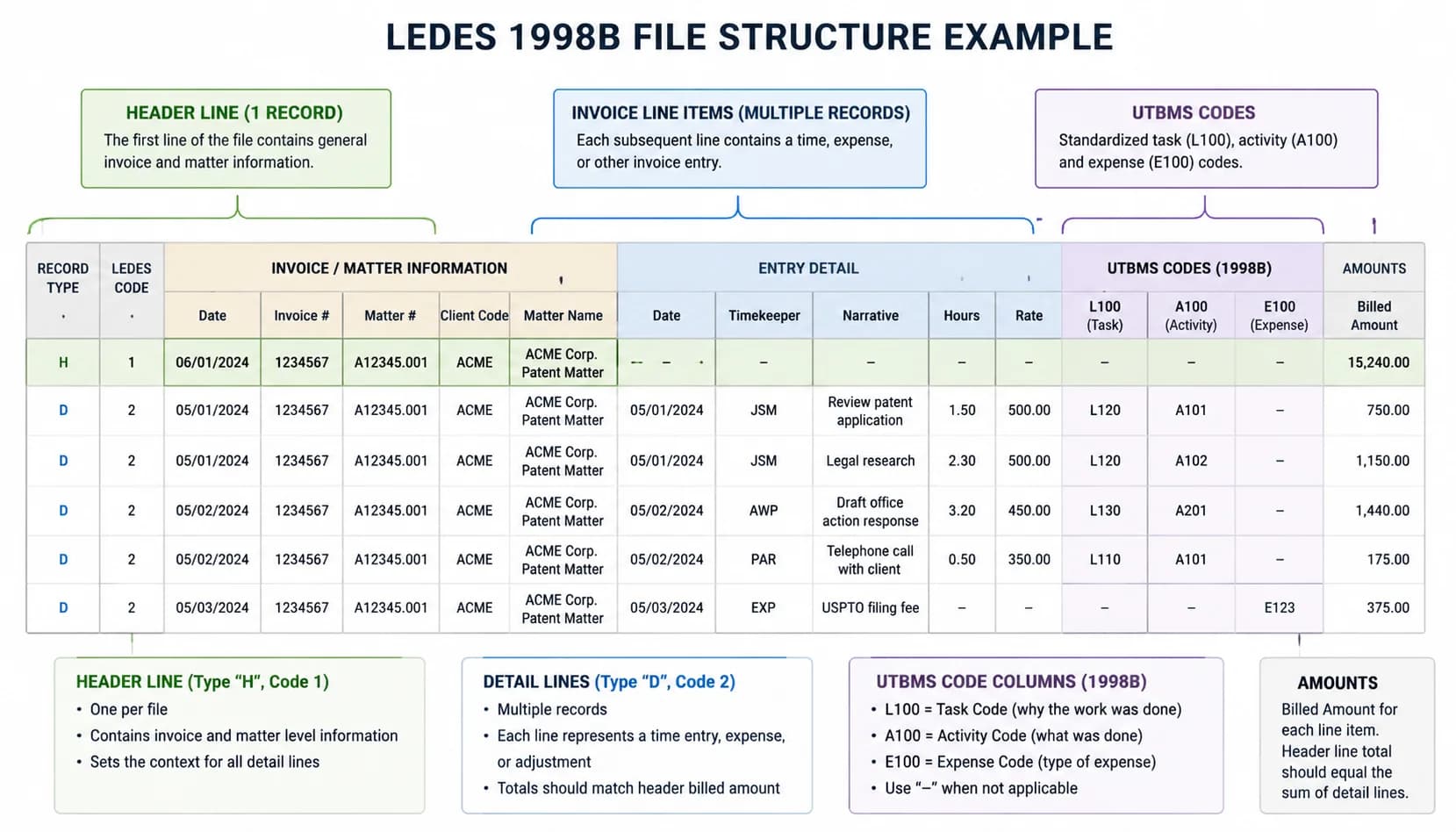
LEDES 1998B is an ASCII pipe-delimited 24-field invoice format required by corporate legal departments for electronic billing through portals such as Tymetrix 360 and Legal Tracker, with UTBMS task, activity, and expense codes required on every line item.
The mechanics matter because the failure mode is binary. A LEDES 1998B file is one header row followed by line items, 24 fields per record, separated by pipes. The header carries client matter ID, invoice number, billing period, and tax data. Each line item carries a UTBMS task code (L100 case assessment, L200 pre-trial pleadings, L300 discovery, L400 trial preparation, and so on), an A-series activity code (A101 plan and prepare, A104 review and analyze), and where relevant an E-series expense code. Miss a code or use a deprecated one and the whole file bounces.
AFA guideline enforcement sits on top of LEDES validation. Each corporate client publishes its own outside-counsel guidelines: no block billing over 0.5 hours, no associate rate above $625, no more than four timekeepers on a single matter without pre-approval, no travel time at full rate. The guidelines are enforced by the portal, not the receiving in-house counsel. A single line item with three tasks bundled together, or a timekeeper rate that exceeds the cap, returns the invoice with a guideline-violation flag. The work has to be re-coded, re-sent, and re-aged.
This is why 60% of first submissions reject. The validation problem is not effort, it is timing. Manual LEDES review happens after the pre-bill is finalised, often the same day it ships, with no time to fix anything. Purpose-built billing tools shift validation left: every time entry is checked against the client's guideline pack as it is recorded, every pre-bill is dry-run through a portal-specific validator before partner release, and the LEDES file is generated and self-tested before it leaves the building. First-pass rejection drops from 60% to under 5%, per Wolters Kluwer ELM data and SINGOA's own legal customer cohort.
The downstream impact is bigger than the rework. Every rejection adds 7 to 14 days to collection. On a $25M billed-revenue firm, cutting average LEDES turnaround by 10 days releases roughly $685K of working capital. The corporate client also notices: in-house counsel report that repeat offenders end up in panel-review conversations the firm did not want to have.
Run LEDES, IOLTA, and realization on one platform
Mid-market firms using SINGOA cut LEDES rejection from 60% to under 5% and shave 21 days off DSO while keeping trust accounting bar-audit clean.
IOLTA trust accounting: the license-loss risk most billing tools ignore
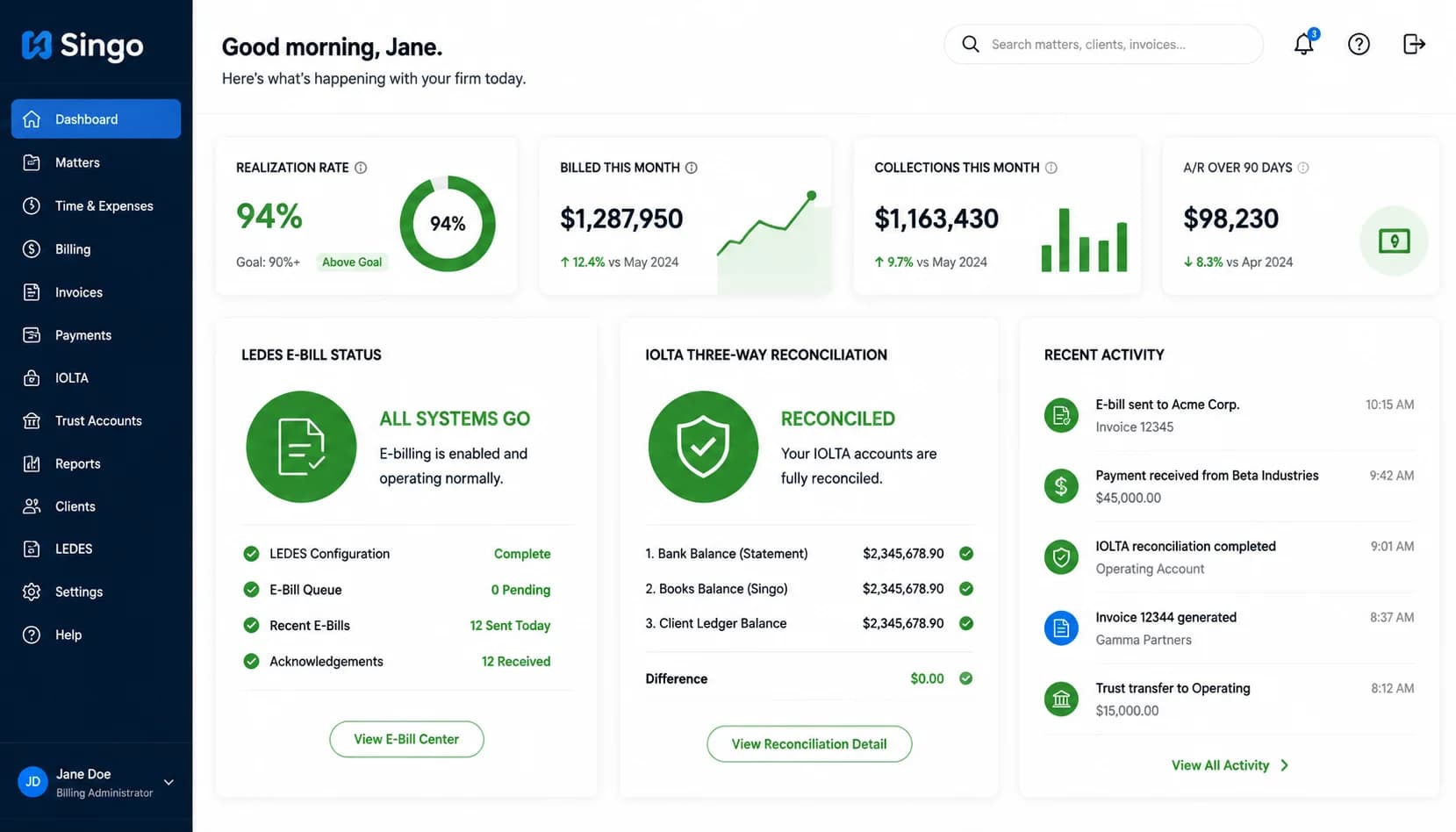
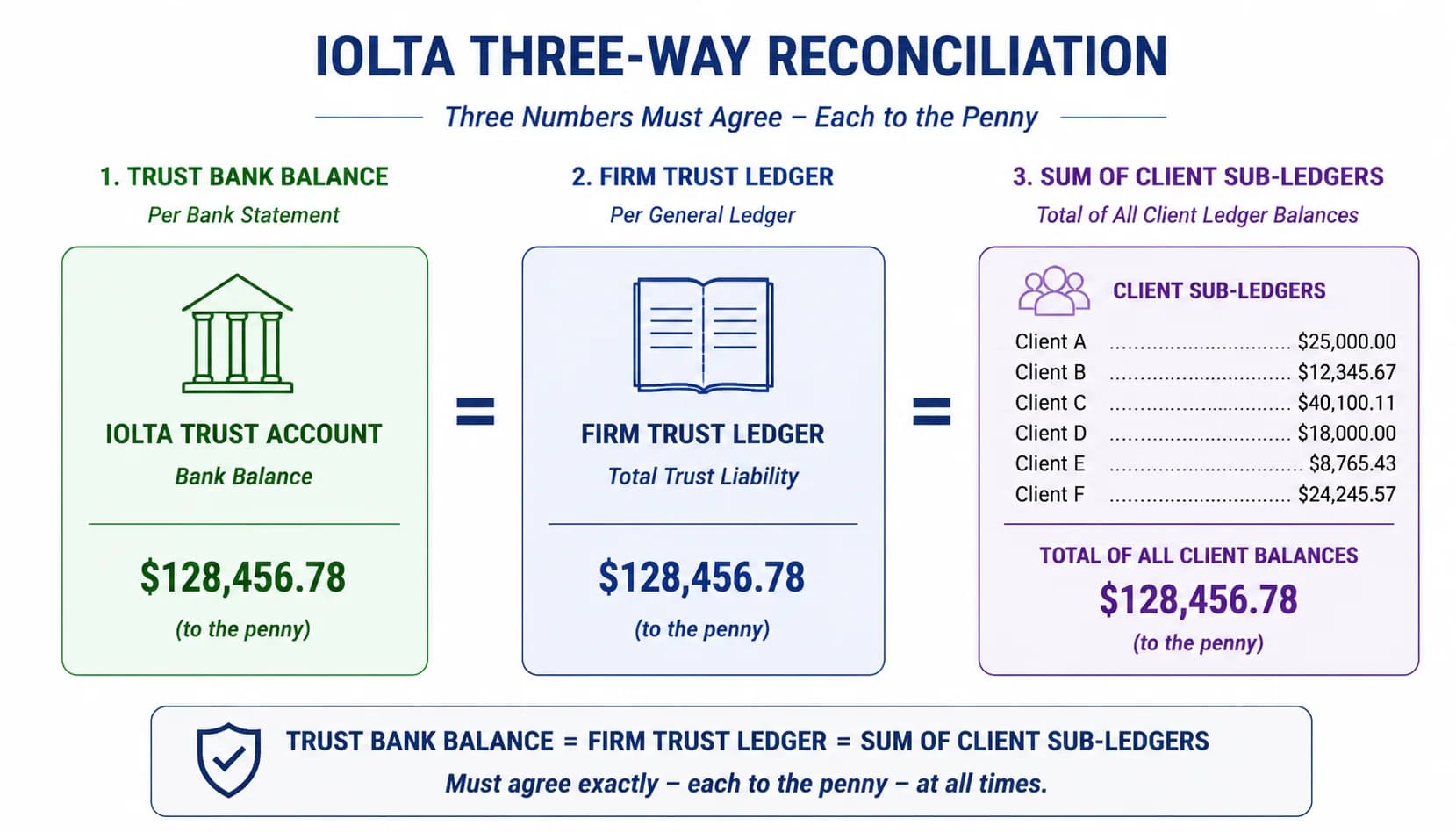
IOLTA requires monthly three-way reconciliation between the trust bank statement, the firm's trust ledger, and the sum of individual client sub-ledgers, governed by ABA Model Rule 1.15 and each state bar's specific rules.
Three-way reconciliation is straightforward in theory. The trust bank balance on the last day of the month must equal the firm's internal trust ledger balance, which must equal the sum of every client's individual trust sub-ledger, all to the penny. A worked example: $480,000 in the IOLTA bank account, $480,000 in the trust general ledger, and 47 client sub-ledgers that sum to $480,000. Any variance, even $0.27 from a misposted receipt, must be investigated and resolved that same reconciliation cycle.
The ABA reports roughly $40K of annual trust-error exposure per firm, but the real number is the license-loss tail risk. Common violations that trigger state-bar audits include commingling firm operating cash with trust funds, paying firm operating expenses out of a trust account by mistake, transferring earned fees from trust to operating before the invoice clears, and carrying unmatched receipts that cannot be tied to a specific client sub-ledger. Each one looks innocent on a Tuesday afternoon and disastrous in a bar disciplinary deposition.
Commingling is failure mode one. It usually happens when a retainer hits the wrong DDA. Late retainer transfers are failure mode two, where earned fees sit in trust past month-end because the pre-bill release lagged. Unmatched receipts are failure mode three, where a wire arrives with no matter reference and someone parks it in trust to be safe. All three are downstream of a billing stack that does not segregate matters at the receipt-matching layer. Read our [compliance and security posture](/compliance) for how SINGOA structures matter-aware controls end to end.
Automation safeguards have to be native, not bolt-on. Matter-segregated sub-ledgers must be created automatically when a matter opens. Transfer approval workflow must require a partner sign-off before any trust-to-operating movement, with the invoice number, amount, and timestamp logged. The audit trail must survive a 7-year retention requirement and reproduce on demand for the bar examiner. Daily, not monthly, three-way reconciliation flips a problem-search from week-long to hours. That is the difference between a remediated misposting and a disciplinary referral.
Realization rate math: how 82% becomes 94% (and what it is worth)
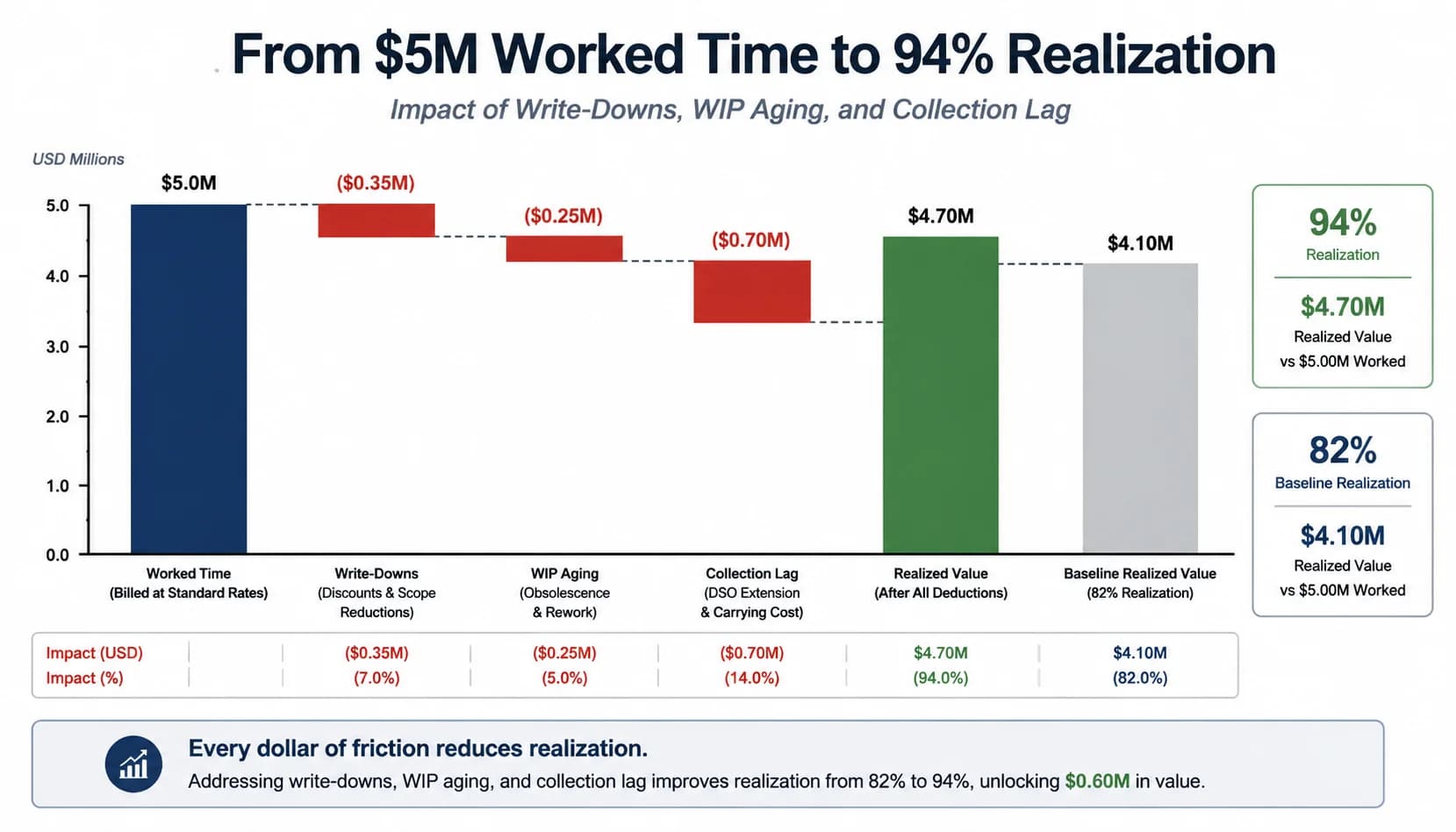
Realization rate is the percentage of worked time that converts to billed and collected revenue. Lifting realization from 82% to 94% on $5M of worked time adds roughly $600,000 of collected revenue per year without adding a single billable hour.
Realization is two metrics stacked on top of each other. Billing realization measures worked-to-billed: of $5M of recorded WIP, how much survives partner write-down and shows up on a final invoice. Collection realization measures billed-to-collected: of what got invoiced, how much arrives in the operating account inside 90 days. The Clio Legal Trends Report 2024 tracks both at the industry level. Most firms talk about realization as one number and miss the fact that the leak is usually in the second stage.
Run the arithmetic on $5M of worked time at $400 average blended rate. At 82% realization, the firm collects $4.10M. At 94%, the firm collects $4.70M. The $600K delta is pure margin because the labour cost was already paid. The same lift on $25M of worked time is $3M. None of that requires a new hire, a new matter, or a new client. It requires closing the leaks that turn worked hours into write-offs or aged AR. For the full math behind the second-stage metric, see our [DSO calculation primer](/blog/how-to-calculate-dso).
The top five realization leaks at mid-market firms are predictable. Partner write-downs (worked hours that get knocked off the pre-bill because the partner judges them unbillable). WIP aging (time entries that sit longer than 30 days before billing). Pre-bill drift (pre-bills that get released and re-edited multiple times before going out). LEDES e-bill rejection (covered above). And collection lag (invoices that age past 60 days because nobody is on a structured follow-up cadence).
Closing the leaks is a measurement problem before it is a process problem. Most firms report a single firmwide realization rate at year-end. Partner-level monthly scorecards change behaviour faster than any process redesign. When a partner sees their own write-down percentage trending 4 points higher than the firm average for three months running, the next pre-bill review goes differently. That is the lever the analytics layer pulls.
Vendor evaluation: the seven criteria that actually matter
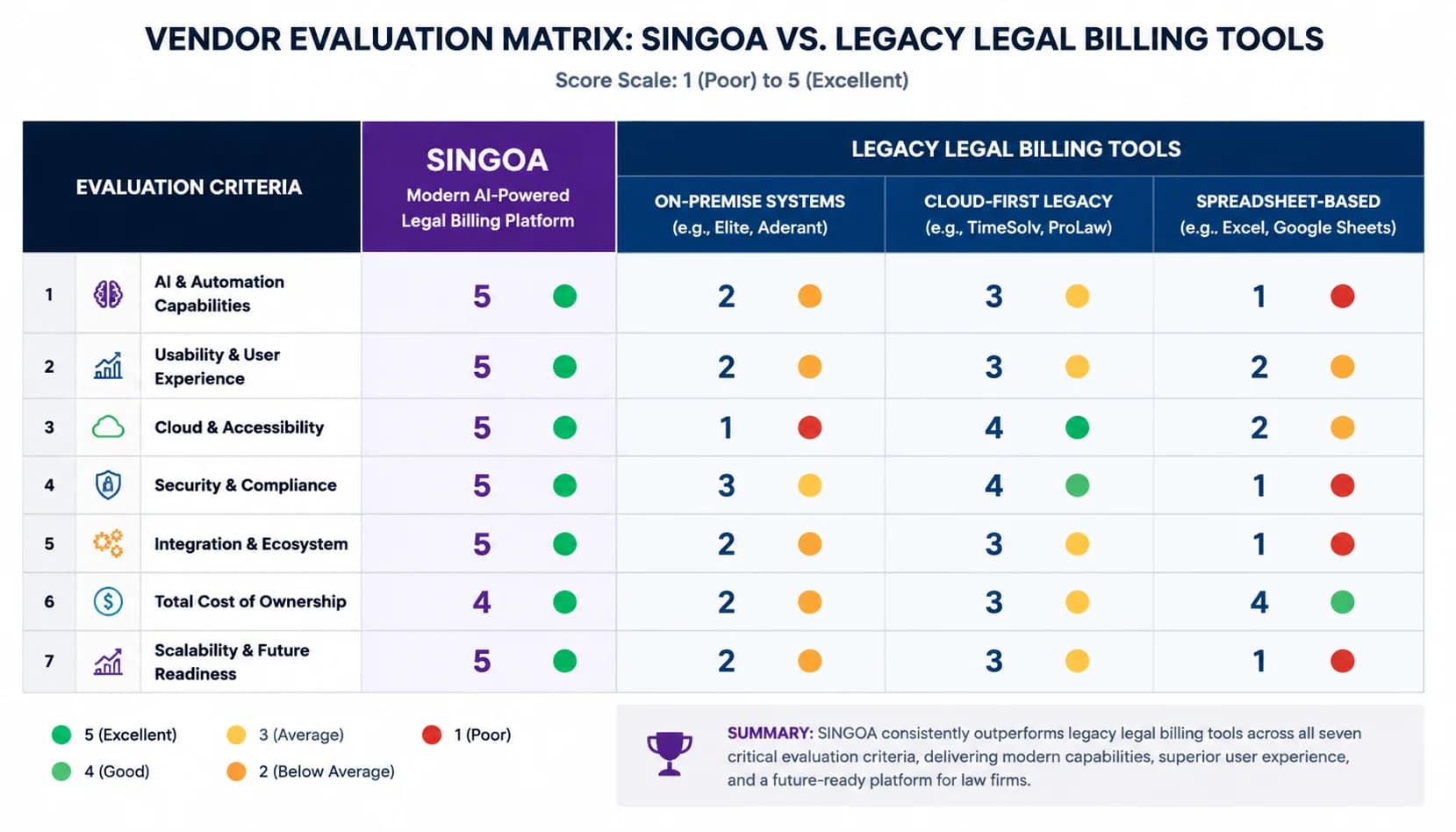
Mid-market law firms should evaluate legal billing software on seven criteria: LEDES 1998B and XML 2.0 support, native IOLTA three-way reconciliation, bidirectional practice-management integration, AI payment matching at 99% accuracy or better, partner-level realization analytics, AFA guideline pre-flight validation, and a sub-60-day implementation model.
Criterion one is LEDES coverage. The platform must generate clean LEDES 1998B output today and LEDES XML 2.0 for the corporate clients that have moved to it. It must ship with portal-specific guideline packs for Tymetrix 360, Legal Tracker, BillingPoint, and Collaborati, refreshed as the portals change validation rules (which they do quarterly). Demo this by asking for a redacted file from last quarter, not a sales-deck mockup. Criterion two is IOLTA. Trust accounting must be a first-class object, with matter-segregated sub-ledgers, a three-way reconciliation engine that runs daily, and a transfer-approval workflow that locks down trust-to-operating movement.
Criterion three is integration depth. Bidirectional sync with the firm's practice-management system (Clio, PracticePanther, Rocket Matter, MyCase, LEAP, Smokeball, Centerbase) and accounting ledger (QuickBooks Online, Xero, Sage Intacct) is non-negotiable. One-way exports break IOLTA reconciliation within 90 days. Look for [50+ integrations including Clio, PracticePanther, and QuickBooks](/integrations) with documented sync objects (matter, time entry, invoice, payment, trust transaction, write-down) and a stated system-of-record per object.
Criterion four is AI payment matching. Matter-based receipts are a hard auto-matching problem because one wire often funds three invoices across two matters. Solutions like SINGOA's AI Payment Matching hit 99.2% auto-match accuracy on legal cohort data, which is the floor a mid-market firm should accept. Criterion five is realization analytics at partner, matter, and client granularity, not just firm-wide rollups, with the ability to break out billing realization and collection realization separately.
Criterion six is AFA guideline pre-flight. The validator must check every time entry against the client's specific outside-counsel guidelines as it is recorded, not only at LEDES export. Criterion seven is the implementation model. A 60-day rollout with a dedicated CSM, dual-run IOLTA period, and pilot-first practice group is the realistic ceiling for a 50-attorney firm. Anything longer compounds the cost of capital you are trying to release. Anything faster usually means the vendor is skipping IOLTA dual-run, which is the line you do not cross. Score every shortlisted vendor against all seven before signing.
Implementation: 60-day rollout without breaking trust accounting
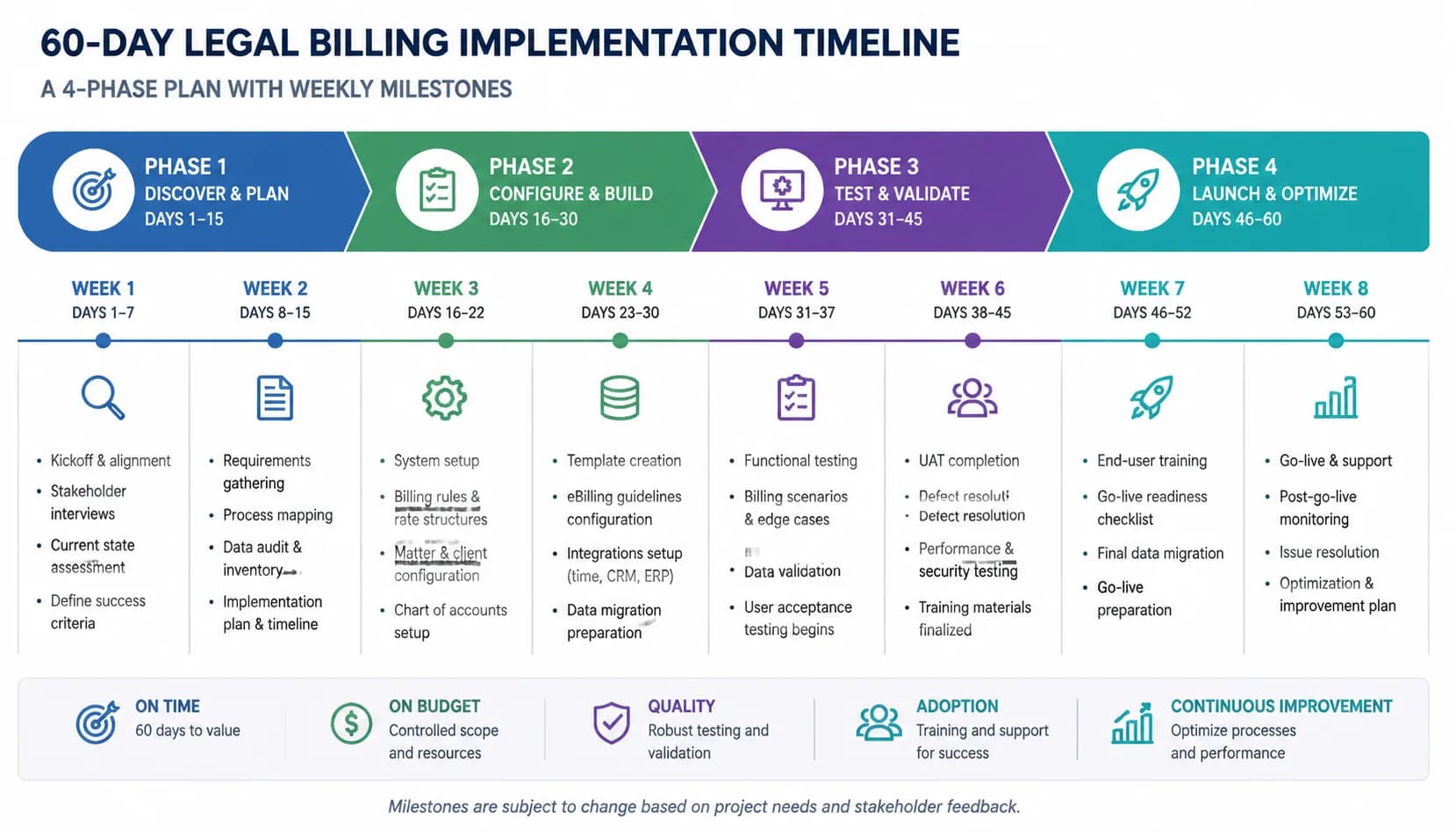
A typical mid-market law firm implements legal billing automation in 45 to 60 days across four phases. The IOLTA dual-run during phases 2 and 3 is the safety net that protects the firm's bar standing.
Phase 1 (weeks 1-2) is discovery. The implementation team maps the firm's matter taxonomy, billing rules per client, AFA guideline pack per corporate client, and historical realization baseline. Every active matter is audited for trust balance accuracy. Every retainer agreement is cross-referenced against the engagement letter. This phase usually exposes 50 to 200 housekeeping items the firm has been carrying for years, which is uncomfortable but useful. Better to clean before cutover than after.
Phase 2 (weeks 3-4) handles trust onboarding and integration sync. The IOLTA bank feed connects. Matter sub-ledgers are populated from the legacy system. The practice-management bidirectional sync turns on. Critically, the new platform runs in shadow mode against the existing bookkeeping ledger, so every three-way reconciliation can be compared side by side. For broader context on this approach, see our take on [scaling AR ops without adding headcount](/blog/scale-ar-operations-without-adding-headcount).
Phase 3 (weeks 5-6) is the practice-group pilot. One group (often litigation, since it generates the heaviest LEDES volume) runs both its time entry and its invoicing on the new platform while the rest of the firm stays on legacy. The pilot validates LEDES output against live corporate portals, exercises pre-bill workflow with real partners, and stress-tests the realization scorecard against historical data. The dual-run trust reconciliation continues throughout.
Phase 4 (weeks 7-8) is firmwide cutover and partner enablement. The remaining practice groups migrate over a single billing cycle. Partner training focuses on the realization scorecard, the pre-bill review queue, and the AFA pre-flight signals. The legacy system is kept in read-only mode for 90 days for historical lookups. The trust reconciliation goes live as the system of record. Done right, the firm closes its first month on the new platform with three-way IOLTA variance at zero and partners actually reading their scorecards.
Practice-management, accounting, and e-billing portal integrations
Legal billing software must integrate bidirectionally with the firm's practice-management system, accounting ledger, and corporate e-billing portals so matter, time entry, invoice, payment, and trust transactions stay reconciled across systems. One-way exports inevitably break IOLTA reconciliation inside the first quarter.
Clio
Bidirectional sync covering matter, contact, time entry, invoice, payment, and trust transaction objects with Clio Manage.
PracticePanther
Native connector for matter, time, billing, and trust ledger objects with bidirectional invoice-status writeback.
Rocket Matter
Two-way sync for matters, time entries, expenses, invoices, payments, and trust transactions with conflict resolution.
MyCase
Bidirectional integration spanning matter management, time tracking, invoicing, and client trust ledger.
LEAP and Smokeball
Connectors for matter-aware time capture, document-linked billing, and trust transaction sync.
Centerbase
Bidirectional sync with Centerbase practice management covering matter, billing, and trust ledger objects.
QuickBooks Online, Xero, Sage Intacct
General ledger connectors that book operating receipts to revenue and trust deposits to liability with daily mirror posting.
Tymetrix 360, Legal Tracker, BillingPoint, Collaborati
E-billing portal connectors that authenticate, submit LEDES files, poll status, capture rejection reasons, and re-submit in one workflow.
Compliance: IOLTA, ABA Model Rules, LEDES standards, and AFA guidelines
Legal billing platforms must satisfy four overlapping regulatory and contractual frameworks. Each maps to a specific control surface inside the product.
IOLTA three-way reconciliation under ABA Model Rule 1.15 and state bar rules
Monthly (ideally daily) match of trust bank balance, firm trust ledger, and sum of client sub-ledgers to the penny, with a 7-year audit trail and partner approval on every trust-to-operating transfer.
ABA Model Rules 1.5, 1.15, and 7.1 (fees, trust accounts, communications)
Reasonable-fee discipline (1.5), trust-account safekeeping (1.15), and truthful communications (7.1) governed across engagement letter, pre-bill, and client-facing reminder content.
LEDES 1998B and LEDES XML 2.0 file standards plus UTBMS coding
Pipe-delimited 24-field invoice generation with UTBMS L-series task, A-series activity, and E-series expense codes validated per portal-specific rules and refreshed quarterly.
AFA (Alternative Fee Arrangement) outside-counsel guidelines per corporate client
Per-client rate caps, block-billing thresholds, timekeeper limits, and travel-time rules enforced before LEDES submission, not only at portal validation.
ROI: what mid-market firms actually capture in year one
Mid-market law firms typically capture four measurable returns in the first 12 months of deploying purpose-built billing automation: 12 points of realization gain (82% to 94%), 21 days off DSO (45 to 24), 18 hours per week of administrator time reclaimed, and LEDES first-pass rejection dropping from 60% to under 5%. ROI payback typically lands inside 3 to 5 months.
On a 40-attorney firm billing $25M of work annually, a 12-point realization lift releases roughly $3M of collected revenue against work already performed. A 21-day DSO reduction on $25M of billed revenue releases roughly $1.4M of working capital that previously sat in receivables. The 18 hours per week of administrator time, sourced from AASP's 2024 legal management survey, translates to roughly 0.5 FTE redeployed from reconciliation and rework to higher-value finance work. The ILTA and BigHand 2024 benchmarking data supports these numbers across the mid-market cohort.
The LEDES rejection drop is the metric corporate clients notice first. Going from 60% first-pass rejection to under 5% removes the rework cycle, accelerates collection by 7 to 14 days per affected invoice, and quietly improves the firm's panel-review standing with in-house counsel. The compounding effect over a year is meaningful: a firm processing 400 LEDES invoices per quarter sees roughly 220 rejection cycles eliminated, each of which previously consumed 30 to 90 minutes of billing-team time.
Payback is short because the gains stack. The realization lift starts in month 2 (first full billing cycle on the new platform), the DSO compression accelerates through month 4 as the smart-collections cadence matures, and the administrator-time reclaim shows up in week 6 once the dual-run IOLTA ends. Most mid-market firms cross break-even at month 4 against the all-in platform plus implementation cost. See our [transparent per-invoice pricing](/pricing) for the inputs to your own model. The harder question is what the firm does with $3M of recovered margin: invest in a new practice group, raise partner distributions, or both.
The 82% realization ceiling, the 45-day collection cycle, and the 60% LEDES rejection rate are not separate problems. They are three symptoms of a billing stack that was never designed to handle matter-aware data, three-way trust reconciliation, and portal-specific e-billing validation on the same screen. Mid-market firms that solve the three together capture roughly $600K of collected revenue per $5M of worked time, release $1.4M of working capital per $25M of billings, and reclaim 18 hours per week of administrator effort. The firms that move first capture the margin first. The next billing cycle is the right cycle to start.
82% to 94%
Realization rate (manual baseline to automated peer)
ILTA / BigHand 2024 + SINGOA legal benchmarks
45 to 24 days
DSO (manual to automated)
Clio Legal Trends Report 2024 + SINGOA legal cohort
18 hrs
Administrator time per week (reclaimed)
AASP Legal Management Survey 2024
60% to under 5%
LEDES first-pass rejection (manual to automated)
Wolters Kluwer ELM 2024 + SINGOA legal cohort
$600K
Collected revenue lift on $5M of worked time
SINGOA legal ROI model (82% to 94% realization)
$1.4M
Working capital released on $25M billed revenue (45 to 24 day DSO)
SINGOA legal ROI model
- Lift realization from 82% to 94% on $5M of worked time, adding roughly $600K of collected revenue with no new billable hours
- Cut DSO from 45 to 24 days, releasing roughly $1.4M of working capital on $25M of billed revenue
- Reclaim 18 hours per week of administrator time previously spent on billing, collections, and trust reconciliation
- Drop LEDES first-pass rejection from 60% to under 5%, removing rework cycles and improving panel-review standing with in-house counsel
- Run daily three-way IOLTA reconciliation with matter-segregated sub-ledgers and partner-approved trust transfers, keeping the firm bar-audit clean
- Score every shortlisted vendor on the same seven criteria before signing: LEDES 1998B+XML 2.0, native IOLTA, bidirectional PM sync, AI payment matching, realization analytics, AFA pre-flight, sub-60-day rollout
- Cross break-even at month 4 against the all-in platform plus implementation cost on a 3-to-5-month payback